Friday, February 24, 2023

The Continental Op (with illustrations by John K. Snyder III)

There have been countless reprints of stories starring Dashiell Hammett’s iconic and groundbreaking hardboiled private detective, The Continental Op. However, the recent collection of the first five-stories in the series from Clover Press is something special due to the addition of illustrations from John K. Snyder III that supplement Hammett’s prose.

Snyder is an accomplished comic book artist who recently resurrected and reimagined Lawrence Block’s Eight Million Ways to Die as a graphic novel to critical and fan acclaim. Snyder’s beautiful, full-page illustrations make Hammett’s prose come alive in this slim collection. To be clear, this Continental Op compilation is not a graphic novel or comic book, but rather a collection of five stories with Snyder illustrations sprinkled throughout.

The five stories were originally published in Black Mask Magazine throughout 1923, but they remain fresh and violent stories of mystery and suspense a century later. The Thin Man and The Maltese Falcon are the works that come to mind when the public hears Hammett’s name. But for my money, the nameless detective from the San Francisco office of the Continental Detective Agency was his best hero and starred in his strongest works.

“Arson Plus”

The first Continental Op story was originally written under the pseudonym of Peter Collinson, and it involves the investigation of a rural fire that flattened a house down to ash. The homeowner was consumed in the blaze while his servants evacuated safely.

It’s a pretty straightforward mystery story with the Op and his partner interviewing suspects who may or may not know anything about the blaze that killed the homeowner until a solution becomes apparent. As the first Continental Op story, it’s clear that Hammett was still trying to find the character’s voice. It’s more of an interesting historical artifact than essential hardboiled reading.

“Crooked Souls”

The adult daughter of a lumber company CEO has been kidnapped and the Continental Detective Agency is hired to find the girl and supplement the efforts of the police. A $50,000 ransom demand provides the Op a chance to lure the bad guys from the shadows, but the client is too bullheaded to pay.

Now, this is a story! We have action and violence with a twist. Don’t sleep on this one. Hammett finds his Continental Op footing here.

“Slippery Fingers”

A wealthy man is stabbed in the throat, and his son wants the Continental Detective Agency to handle the case as the police have failed thus far. The Op figures that the motive was financial and puts some forensic accounting types on the task of going through the dead man’s books.

Another straightforward mystery yarn with a clever solution involving a mysterious set of fingerprints. This one is completely worth reading, despite the lack of gunplay action.

“It”

Sometimes you’ll see this story collected under the title of “The Black Hat That Wasn’t There.” The case involves $100,000 in Liberty Bonds missing from a locked safe of the Golden Gate Trust Company. Meanwhile, there’s a partner in the trust company with access to the bonds who has disappeared. Should be easy: find the partner, find the bonds, right?

The Op follows leads that winds him up in an awesome cat and mouse game within a dark room - two men, one gun. All of this leads to a satisfying and tidy conclusion. Another winner for Hammett.

“Bodies Piled Up”

After a hotel detective is fired for drunkenness, the Continental Op is assigned to fill in for the hotel dick for three days as a temp. On the last day of the assignment, the Op responds to a room housing three murdered hotel guests. All three men had wallets full of cash, so what could the motive be?

The Op and his men run down logical leads until a solution presents itself. Another decent mystery, but not much action - I was still coming off the high from the previous story.

——————-

Overall, this is a superb collection of stories to get you started in the world of the The Continental Op. If you’re also into hardboiled art by one of America’s finest illustrators, you’ll do well to choose this volume with the Snyder paintings over all the others. Recommended.

Wednesday, February 22, 2023

Tarzan #02 - Return of Tarzan

I really enjoyed the Tarzan debut, Tarzan of the Apes, authored by Edgar Rice Burroughs. It was first published in 1912 in The All-Story and then later published as a novel in 1914. The book ended in what I would consider a cliff-hanger with a lot of loose ends requiring a resolution. The series second installment, The Return of Tarzan, does just that. It was first published in New Story Magazine from June through December of 1913. Later, it was published as a hardcover in 1915.

In this installment, Tarzan has an impromptu meeting with a French leader named Count Raoul. This leader assigns Tarzan the role of secret agent, working in Algeria to out two Russian criminals. This portion of the novel really surprised me, as the narrative explodes into a Nick Carter-esque adventure as Tarzan tangles with the criminals. After the skirmish, and the assignment, Tarzan joins a ship headed to Cape Town and creates a friendship with Hazel Strong, a friend of Tarzan's love interest, Jane Porter. Unfortunately, the two Russians joined the ship's passage and throw Tarzan overboard. He washes up on the same coastline he called home in the series debut. Through a wild sequence of events, Tarzan becomes the new chief of the Waziri, a fictional African tribe.

Coincidentally, Jane and her fiance, William Clayton (Tarzan's cousin) are also in route to the west coast of Africa. Ironically, their ship sinks and Clayton and Jane join a lifeboat with one of the Russian criminals. It's this part of Burrough's story that is absolute agony to behold. These characters are left to die without food and water. The extreme circumstances lead to a coin toss to determine which living person will be eaten by the others to survive. This is written with an emotional touch and also places William Clayton into a respectable light as protector and caregiver for Jane (albeit short lived).

Eventually, Jane and William wash up on the coastline shared by Tarzan, and the loose ends are all neatly tied up. William and Jane's proposed marriage ends (no spoilers on how) and Tarzan and Jane are reunited. More importantly, Jane also learns that Tarzan is a Greystoke and the sacrifice he made to keep that fact a secret from her.

The Return of Tarzan also introduces a mainstay of the series, the Lost City of Opar. Tarzan is taken prisoner there and first meets the villain La. It is here that Tarzan discovers a wealth of gold, fortunes that he will eventually return to again and again. There is a brief backstory on Opar's history, but Philip Jose Farmer fleshes this out in his own Tarzan stories and two non-Tarzan novels, Hadon of Ancient Opar (1974) and Flight to Opar (1976).

As an adventure novel, ERB offers so much for the reader in this one book. Shipwrecks, castaways, espionage, desert chases, seemingly endless fights, treasure hunts, survival horror, jungle adventure, and heaps of action. This is really a perfect novel by a fantastic author. As good as Tarzan of the Apes was, this sequel might be just as good. A must-read vintage novel! 

Buy a copy of this book HERE.

Monday, February 20, 2023

Matthew Scudder #05 - Eight Million Ways to Die

Lawrence Block's fifth Matthew Scudder novel, Eight Million Ways to Die (1982), features the alcoholic detective contending with a compelling murder mystery. A young prostitute named Kim Danniken hires Scudder to convince her pimp, an African-American named Chance, to allow her to leave the fold. Kim is tired of hooking, and despite Chance's historically friendly actions and demeanor, she is hesitant about revealing her plans to switch professions. Once Scudder meets Chance, he realizes that her fears weren't valid. Chance is happy to allow her to leave. However, shortly after Scudder explains to Kim that she is free to resign, the young woman is found butchered in a hotel room. 

The plot development builds to Scudder truly caring for Kim and feeling remorse for being involved in Chance and Kim's severance. While not responsible, Scudder still feels as though he owes the dead client a hard day's work to determine who killed her. He works with the police, who are hesitant to receive his tips, and he interviews other prostitutes that Chance had employed. While Chance seems to be the most likely suspect, his alibi is rock solid. Who killed Kim?

What makes Eight Million Ways to Die resonate is that deep down in the city's grime, crime and decay, this novel centralizes Scudder's alcohol dependence. Frequently Scudder attends AA meetings, and challenges himself repeatedly to extend his sobriety into consecutive days. At one point, Scudder hits an eight-day streak. But, his dependence is just too strong. Included in Scudder's struggles is the series stomping grounds like churches, bars, coffee shops, and diners to keep the mood. There are also the obligatory conversations and thoughts about his ex-wife and kids. Some prior characters also re-appear in the novel, furthering some longevity between Scudder and his love interest. 

The book's title contains some weight, mostly emerging from consistent news reports and newspaper articles about various killings throughout New York City involving different methods of death. Scudder reflects that every minute of every day all of us are able to be killed eight million ways. We are all skirting the thin edge between existence and nonexistence each second, which is a true dark sentiment. 

If you ever had the misfortune of seeing the 1986 film 8 Million Ways to Die, starring Jeff Bridges, Andy Garcia, and Rosanna Arquette, I have to sternly remind you that this is not how Lawrence Block's novel should be represented. The film's creators lacked any real interest in what makes this series the very pinnacle of crime-fiction. Arguably, they had no idea what they were doing when it comes to film making, much less how to properly portray Matthew Scudder. Despite the talented cast, the film is just abysmal. 

Eight Million Ways to Die continued Lawrence Block's hot streak and makes for the very best of the series thus far. In fact, this might be one of the best novels I've ever read. Additionally, hearing the audio version of the book with the author's narration was a real pleasure. Highest of recommendations, Eight Million Ways to Die is an absolute mandatory read. 

Buy a copy of this book HERE.

Saturday, February 18, 2023

Conan - Red Nails

Robert E. Howard's last sole contribution to his Conan the Cimmerian character was the novella “Red Nails”. It was published posthumously in Weird Tales over the course of July, August/September, and October 1936, mere weeks from Howard's suicide in June. The story was reprinted in The Sword of Conan (Gnome Press, 1952), Conan the Warrior (Lancer, 1967), and numerous times through Del Rey. “Red Nails” was adapted to comics in Savage Tales issues #2-3, which was reprinted in Conan Saga #9

Conan, in his late 30s, finds female pirate Valeria of the Red Brotherhood in a rural stretch of forest. She had killed a Stygian officer and then fled the city. Conan attempts to join her, urging that they should head to the coast. During the verbal debate on which direction to explore, the duo fight a large reptile monster that resembles a dragon. In the distance, they see a large walled city and head there.

Reaching the city, called Xuchotl, the two agree that this walled place seems desolate, a cavernous void of abandonment and neglect. Inside, the enormous building resembles a large apartment building with hallways and corridors leading in different directions. The entire city exists as a combination of shopping mall and housing, completely enclosed in this gloomy remote structure. 

Eventually, the duo discover a tribe living in the complex called the Tecuhltli, complete with a king and queen that explains the city's unique history. Xuchotl was ruled by two brothers, but one stole the other's wife and then the population split based on loyalties to each brother. The Tecuhltli tribe live in one part of the building, the army and people of Xotalanc exist in another part. Needless to say, the two have been feuding for ages and nails are driven into a pillar to represent the number of slain Xotalanc people, thus the story's title “Red Nails”. 

At novella length, Howard leaves himself plenty of wiggle room to incorporate numerous fights, betrayals, deaths, and action. As Conan and Valeria quickly learn, no one in this mysterious city is particularly noble. I think the narrative's switch from Conan and Olmec's alliance to inevitable confrontation (he wants Valeria) was a smooth transition that allowed some character development, albeit brief. The plot is a little crowded considering nearly the entire story takes place in one structure between warring factions, but the atmosphere and descriptive attention to surroundings enhances the story's depth. Overall, this is an entertaining blood-soaked adventure tale that sits in the higher echelon of Howard's Conan stories. 

Note – S.M. Stirling's Blood of the Serpent (Titan, 2022) full-length novel is a prequel to “Red Nails” and features an original story that details Conan and Valeria's first meeting and the events that Howard described in the opening paragraphs of this story (the death of the Stygian officer). “Red Nails” is also included in that book's ending to preserve a sense of continuity. 

Friday, February 17, 2023

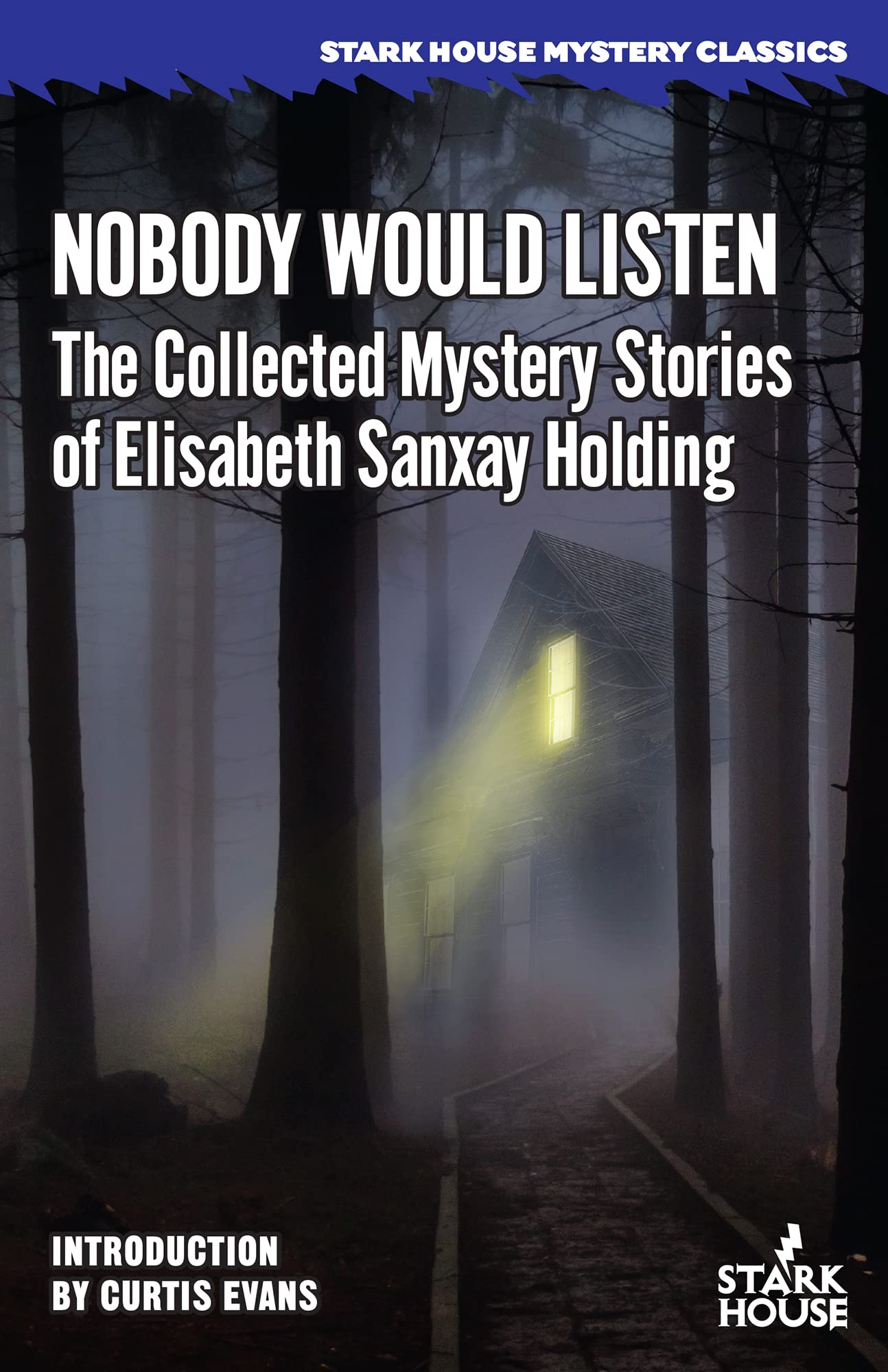
Nobody Would Listen - The Collected Mystery Stories of Elisabeth Sanxay Holding

Elisabeth Sanxay Holding (1889-1955) authored 25 novels between 1920 and 1953. In addition, she wrote over 200 short stories for magazines and digests like Ellery Queen, Alfred Hitchcock, The Saint Detective, and Nero Wolfe. Mostly, she concentrated her efforts on mystery and crime-fiction, however, she also contributed to the science-fiction genre as well. Stark House Press has been releasing many of Holding's novels, novellas, and short stories. The publisher's newest Holding release, Nobody Would Listen: The Collected Mystery Stories of Elisabeth Sanxay Holding, is a mammoth volume collecting 19 stories and novellas as well as an introductory article by Curtis Evans. At over 400 pages in length, there is a little something for everyone. Here are a few of my favorites:

The Strange Children

The Magazine of Mystery and Science-Fiction included this Holding story in its August, 1955 issue. As a fan of “evil kids” fiction and films, I honed in on the ominous story title. This 11 page story features a young woman named Marjorie receiving a call from a distressed mother. The woman explains to Marjorie that she was referred to her by a mutual acquaintance and that she desperately needs a babysitter for her two sleeping children within hours. The woman and her husband have a prior engagement and their sitter and housekeeper are both unavailable. Being late in the evening, Marjorie explains that she shouldn't babysit children that don't know her. What if they wake up and find their parents gone and a stranger in the house? The woman assures Marjorie that the children sleep through the night and won't wake up. Marjorie takes the deal and the family's chauffeur picks her up and drives her to a secluded house in the forest. 

The mother shows Marjorie the house layout and advises her that the children sleep in the bedroom down the hall. There are no other people in the house (this is important). The parents leave and so Marjorie sits in this strange house that is as silent as a tomb. Until she hears a child's laughter down the dark hallway. Looking through the door's keyhole, she finds the children awake in their beds playing with a man in a gray suit. Who is this creepy guy and how did he get in the house? This story is told in a suspenseful way and is just eerily delightful. It's a mix of paranormal, suspense, and mystery and Holding utilizes just enough restraint to keep the reader glued to the pages. Excellent. 

Nobody Would Listen

This is a 20 page story that was first published in Mystery Magazine in August, 1935. Like the above story, this one features an isolated house in the forest, a rainy atmosphere, and a new visitor. 50-year old Mrs. Morrissey has just accepted a new job as a live-in cook and housekeeper for two older women, Mrs. Raleigh and Mrs. Torrance. However, once Mrs. Morrissey settles in, she discovers that the two women have an immense hatred for one another. A nearby neighbor scoffs at Mrs. Morrissey's warning that she fears the two will murder one another. The story is aptly titled with Mrs. Morrissey's repeated warnings fall on deaf ears. Will Mrs. Raleigh and Mrs. Torrance eventually hurt or kill one another, or is this a familiar, old-time rivalry that is nothing more than harmless bickering between two lifelong companions? Holding builds so much suspense and impending doom that it seemingly explodes in the unforgettable finale. Think of “Nobody Would Listen” as a dark character study with a unique atmosphere. Recommended.

Friday the Nineteenth

The Magazine of Fantasy and Science-Fiction included this story in its Summer, 1950 issue. To properly review the story in 2023, I'm citing a popular 1993 film called Groundhog Day. It starred Bill Murray and Andie MacDowell and was written by Danny Rubin, who claimed the concept came to him when he read Anne Rice's 1985 romantic horror novel, The Vampire Lestat, and began thinking about eternal life. In the film, weatherman Phil Connors finds himself reliving February 2nd repeatedly, in a time-loop, in a small tiny Western Pennsylvania town. Oddly, Holding had a similar concept as her plot for "Friday the Nineteenth" – 40 years before Rubin's screenplay. 

Boyce is an average white-collar suburbanite living a mundane life with his boring wife and kids. He begins to fascinate about a relationship with his friend's wife, a plain-Jane looking woman named Molly. On Friday the 19th, Boyce arranges for a meeting with Molly in a downtown bar. There, the two discuss their attraction to each other and the restraints both of them practice when the couples meet at social gatherings. Boyce and Molly make a plan to meet in a more intimate setting the next day, on Saturday the 20th. However, Boyce awakens on Saturday to learn it is Friday all over again. When he meets Molly at the bar, he discovers that both of them realize they are living in a time-loop, constantly reliving Friday the 19th. How do they escape?

Groundhog Day, and other time-loop films like Palm Springs and Edge of Tomorrow, have always fascinated me. I was shocked to find a time-loop story that seemingly matched Groundhog Day, but I would imagine there were even more of these stories prior to Holding's. Regardless, her story injects a Gil Brewer/Orrie Hitt flavor as Boyce becomes the unsatisfied husband and father. I really enjoyed the chemistry between Boyce and his wife and how it changes over time. It was rewarding and entertaining simply examining Boyce's complaints at the start of the story. Everyday events like mowing the grass and taking out the trash become valuable experiences that Boyce wishes to have back when he realizes seeing Molly each day isn't exactly a thrilling experience. 

Other highlights include the private-eye story “Farewell, Big Sister” and three stories starring Captain Martin Consadine, Commissioner of Police on the Caribbean island of Puerto Azul, “People Do Fall Downstairs”, “The Most Audacious Crime”, and “The Daring Doctor”. 

Holding's writing is top-notch and gradually leans from mystery, suspense, thriller, and shades of atmospheric terror. She has a unique writing style where her protagonists think to themselves, but Holding places these thoughts into the form of dialogue with quotation marks. I've seen this method a few times in other early 20th century writers, but it's uncommon to me. If you can accept that, then there is nothing to dislike about any of these stories. The Stark House Press staff has performed a marvelous job of singling out some of her best stories. Recommended! 

Buy a copy of this book HERE.

Wednesday, February 15, 2023

The Maltese Falcon

Samuel Dashiell Hammett (1894-1961) was a military veteran, detective, screenwriter, author, and president of the Civil Rights Congress. He began writing short stories for the pulps in the early 1920s, contributing to publications like 10 Story Book, Black Mask, Saucy Stories, and True Detective Mysteries. Perhaps one of his most popular creations is the Continental Op, a hardboiled detective that appeared in over 35 stories. However, the hero pales in comparison to the massive appeal of Sam Spade. The San Francisco detective first appeared in The Maltese Falcon, a five-part serial that ran from September, 1929 through January, 1930 in Black Mask. The character would later appear in four more short stories and became a Hollywood icon when Humphrey Bogart portrayed Spade in The Maltese Falcon, a 1941 film adaptation. 

Sam Spade shares an office with his partner Miles Archer. The two receive a visitor calling herself Miss Wonderley. This potential new client wants the duo to follow a man named Floyd, who she speculates has convinced her sister to run off with him. When she produces cash, the two agree to the case and Archer is the first to do the checking up. Unfortunately, Spade is notified that same night that Archer has been shot to death. Spade later learns that this Floyd fellow has been killed as well. 

Anyone that reads my reviews knows that one of my biggest pet peeves in literature is starting a novel with a lot of “what the Hell is going on” type of stuff. The Maltese Falcon is one of those books. The first chapters, or arguably the entire first half, purposefully makes very little sense. Wonderley is really a woman named Brigid O' Shaughnessy, who was hired by a man named Gutman in Constantinople to locate a precious statue of a falcon said to have been passed down through the years from the 16th century. This Brigid woman hired another guy named Cairo to help her get the falcon, but then fled to San Francisco with Floyd hoping to make an even more lucrative sell to a higher bidder than Gutman. Forget all of the sister stuff. 

Cairo is now chasing Brigid, while she's being chased by Gutman and the police think Spade is in on the kill of Archer and maybe Floyd because he was sleeping with Archer's wife Iva. It's a tangled plot with a lot of characters and moving parts. Sadly, nothing really ever happens beyond an excessive amount of dialogue, speculation, and finger wagging. At one point, every major character enters the room and they get down to the discussion of who killed who and motives and all of the typical stuff you find in the armchair sleuth business. 

Sure, Spade is a cool character, doesn't say much, and breaks the mold of the Sherlock Golden Age Detective by unconventional means. He doesn't work well with the law, obviously has some anti-hero characteristics (he's sleeping with his partner's wife for God's sake), and becomes an evasive fall guy chasing red herrings galore. He should be easy to cheer, considering he's the least baddest of the bad guys. But, all of these characteristics still left a dull edge. Spade isn't supposed to be a likable guy, but he should damn well be an entertaining one. 

Hammett's storytelling style didn't resonate with me. There isn’t much insight into what any of these characters are thinking. Instead, it reads like a play with the entire novel presented through the dialogue. It is void of any emotional depth.

The idea that this book is cherished by the mystery community seems odd to me. Is it really a mystery novel that needs an adventure, or an adventure novel trapped in the confines of a whodunit? I wanted Sam Spade to grab a suitcase and head to Europe or Asia chasing this Holy Grail-like relic of Spanish lore. The whole idea of chasing the treasure is just begging for a wild globe-trot. But, these things never happen and the mystery doesn't escape a handful of rooms.

Granted, I'm probably saturated in modern detectives or more hard-hitting tough guys from the mid to late 20th century, so finding Sam Spade late in the game didn't do me (or him) any favors. It's like watching Top Gun: Maverick (2022) and then attempting to appreciate The Dawn Patrol (1938). It is probably more my fault than Hammett's, but I still can't justify the hype of Sam Spade or The Maltese Falcon. Overall, this was a snooze fest for me. 

Buy a copy of this book HERE.

Monday, February 13, 2023

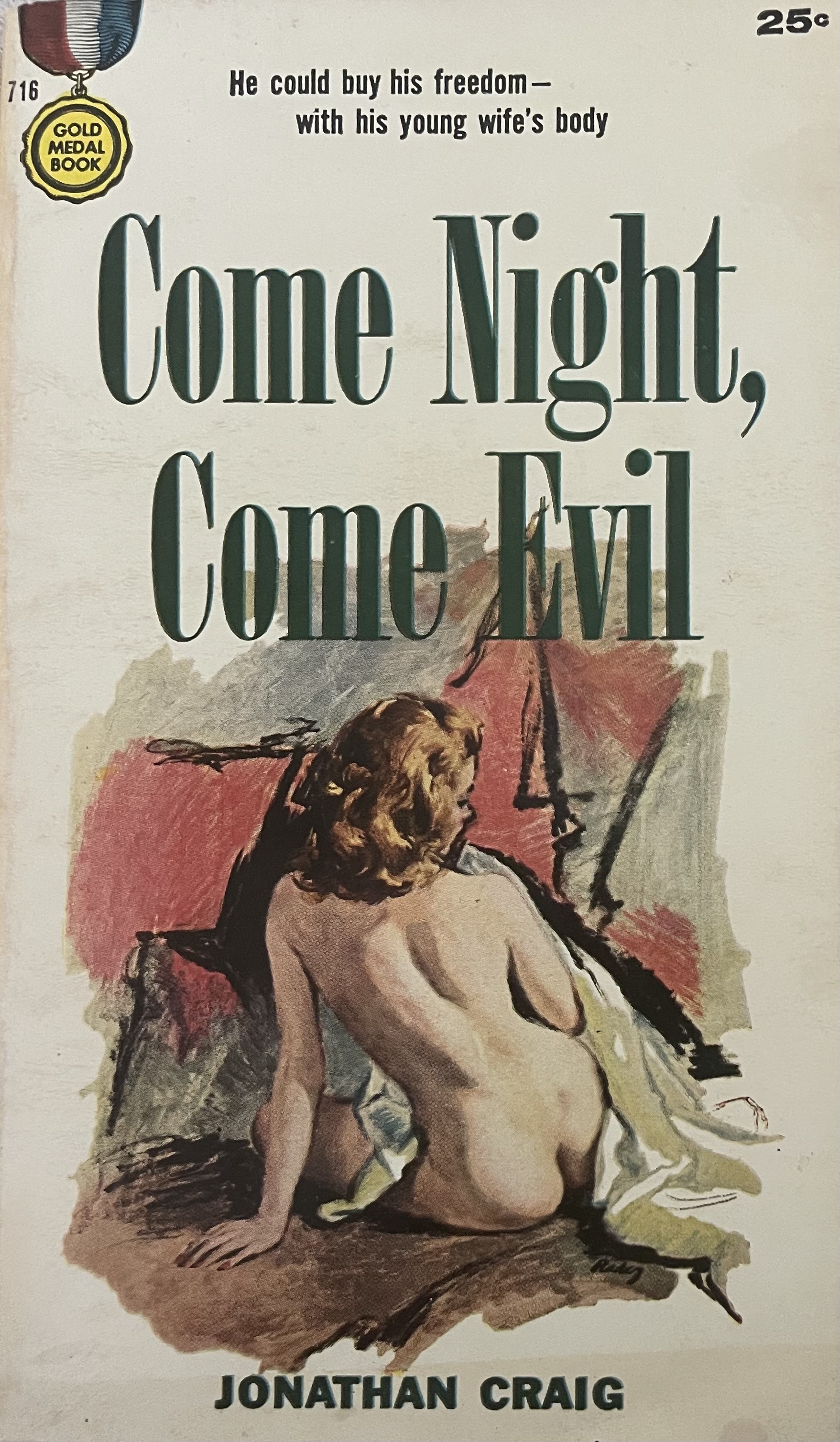
Come Night, Come Evil

Jonathan Craig (Real Name: Frank E. Smith, 1919-1984) was a Florida resident who socialized with Harry Whittington and Gil Brewer as he was writing over 100 novels and 300 short stories during the paperback era. Come Night, Come Evil was a stand-alone crime noir novel from 1957 published by Fawcett Gold Medal.

The novel opens with Jeff Colby being released from prison into the hands of his loyal wife, Laurie. They have every intention of building a life together and putting Jeff’s legal problems behind them. Unfortunately, Jeff has been assigned a fat, slimy parole officer named Carl Munger, who corners the couple in the prison parking lot during the discharge and immediately begins making Jeff’s life miserable.

Munger is a loathsome bully who extorts a kickback from Jeff’s parolee job wages. Jeff is forced to comply with no backtalk because of Munger’s unilateral authority to revoke Jeff’s parole and send him back to prison to finish his sentence.

Why was Jeff in prison at all? Best to let the novel tell that story as it’s a pretty compelling flashback. Suffice to say, it was a bum rap, and Jeff would like to exonerate himself now that he’s out on the streets. And the only way he can stay out is to appease Munger and his inappropriate demands. Finding the people who set Jeff up and understanding their motivation is the central mystery of the paperback.

The problem is that there are a few other mysteries muddying up the plot in this 128-page paperback. The writing is solid, and some of the characters are written extremely well. Despite that, Come Night, Come Evil is a pretty mediocre affair. If you’re looking for top-shelf Jonathan Craig, proceed directly to So Young, So Wicked. Unless you’re trying to read them all, this one can be easily bypassed.