Saturday, March 4, 2023

Conan - The Hand of Nergal

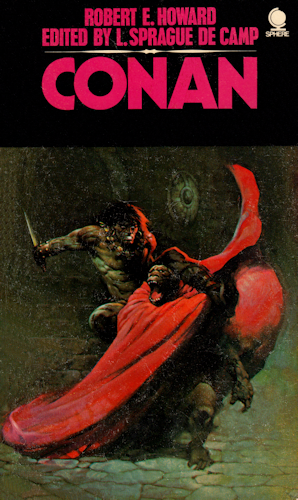
The Conan paperback published by Lancer in 1967 is a treasure trove of excellent short stories starring Robert E. Howard's brawny hero Conan the Cimmerian. Along with Howard shorts like “Rogues in the House”, “Tower of the Elephant”, and “The God in the Bowl”, the book also features stories outlined or half-completed by Howard and finished by L. Sprague de Camp and Lin Carter. One of the second to last stories in Conan is “The Hand of Nergal”. It was originally a fragmented story authored by Howard  in the 1930s. Lin Carter completed the story and titled it. Along with appearances in Conan, “The Hand of Nergal” was also featured in The Conan Chronicles (1989) and Beyond the Gates of Dream (1969). 

What I really enjoy about Conan stories and novels is that the environment and time period is variable. Conan could be a thief, soldier, gladiator, or royalty. In this story, Conan is a mercenary warrior fighting in Turan's civil war. Serving Turan, Conan is thrust into a planned battle to defeat rebellious forces led by a guy named Khan. In the heat of the fight, an army of large, demonic bats swoops down to the battlefield and begin to attack the Turan forces. 

Among the chaos of death and destruction, Conan locks into a fierce battle with one of the bats. Magically, the bat nearly places Conan into a cold-induced coma, but a strange amulet that the hero picked up days before seems to repel the creature. Later, Conan meets a bloody and battered female and they are ushered to the city of Yaralet to assist with killing the rebel leader Khan. 

Through a sorcerer, Conan learns that Khan controls these bat creatures using a precious stone known as Hand of Nergal. Conan and others eventually find Khan's throne room, deep in the bowels of a cave system hidden under the city, and a final battle ensues. There's a touch of cosmic horror and a lot of magic as Conan's forces eventually break Khan's curse and free Turan (I think). 

I really enjoyed this story and found Carter's stroke of science-fiction and fantasy a great blend with the more “on the nose” carnage that Howard's Conan typically creates. The Carter and Howard chemistry worked well, in my opinion, on the Kull stories, and I got that same sense of adventure, dark sorcery, and utter doom here. The balance of brawn and pure strength contending with magic is a recurring theme in Conan literature, and this story is a showcase of that strong storytelling. 

Many Robert E. Howard readers and fans aren't thrilled with the pastiche authors like Carter and de Sprague, but I'm definitely enjoying my voyage through all of these old paperback collections. It is pure escapism and I'm loving it because of stories like “The Hand of Nergal”.

Friday, March 3, 2023

Catspaw Ordeal

Edward S. Aarons struck gold in 1955 with the first of his successful espionage series starring CIA operative Sam Durell. This is considered the second, more prosperous half of Aarons' writing career. The first half consists of roughly 20 crime-fiction and mystery novels authored under his own name and the pseudonym of Edward Ronns. We've slowly consumed Aarons' crime-fiction work here at Paperback Warrior, and continue that trend with a look at the author's 1950 paperback Catspaw Ordeal, published under the name Edward Ronns. It was published by Fawcett Gold Medal at least twice, once in 1950 as #133 and again in 1958 as #766, both with different cover art. It was also published by Phantom in 1954 and Gaywood Press in 1952, both of these with variations of the 1950 Fawcett cover by William Downes.

Danny Archer is a 29-year old former Navy veteran that has settled down in Southwich, Connecticut on the Long Island Sound. Archer is married to a woman named Roz and the two have reached a complacent part of marriage, void of excitement or interest. Archer is not only tied to Roz via marriage, but he also works for her father, a guy named Stanley, who runs a local factory. All of this normal suburbia boredom is shattered when Archer's old flame shows up.

Secretly, Archer has never really gotten over Della Chambers. When she arrives in town, Roz immediately senses that Archer can't resist Della's magnetic pull. When Roz leaves town for a few days, Archer finds himself in a murder investigation. In his own home, Archer finds a dead guy huddled over his office desk. Della is somehow involved, but also a man named Burke Wiley, Archer's old shipmate that supposedly died when their ship was sunk in WW2. Archer believes either Wiley or Della killed the man, but then things become even more complicated when Wiley explains a counterfeiting plot that could make them all super wealthy. 

Obviously, there is a lot going on in this relatively short 170-page paperback. Archer's marriage complications are front and center, but the moving parts begin to tear away part of the protagonist's own sanity. He begins to question his past, and the how his work at the factory is somehow tied into Roz and this seemingly dead-man-from-the-grave, Wiley. But, the core of Aarons' complex plot is a murder mystery. The cops have targeted Archer as the prime suspect, but he can't quite explain where these other characters tie into his personal ordeals at home. It makes for a fascinating, whirlwind of possibilities as Archer walks a balance beam of right and wrong. 

Like most of Aarons' crime-fiction, he uses the same locale and atmosphere. His novels are typically quiet, rural lakeside or oceanfront cottages and houses draped in a thick fog that is symbolic of the criminality slowly descending on the main character or their close friends and family. These locations are nearly always the American Northeast, which makes sense considering Aarons' grew up in Pennsylvania and lived in Connecticut (also the home of Fawcett Gold Medal). While Catspaw Ordeal isn't the best that Aarons' early crime-fiction has to offer (try 1953's The Net for a must-read), it is more than serviceable and a pure pleasure to read. Recommended. Get Edward S. Aarons books HERE.

Wednesday, March 1, 2023

Murgunstrumm

Strange Tales #7 was published in January, 1933 and included stories by Clark Ashton Smith, Henry Whitehead, and Robert E. Howard. One of the issue's highlights is a short novel called Murgunstrumm, authored by Hugh B. Cave (1910-2004). This vampiric horror tale was reprinted by Carcosa Press in Cave's first hardcover collection, Murgunstrumm and Others, in 1977. Thanks to Pulp Fiction Bookstore, the novella is now available as an affordable stand-alone ebook.

In flashback, readers learn that young lovers Paul and Ruth were wrongfully admitted into an insane asylum. The basis for their involuntary confinement to the asylum is hysteria based on their experiences in and around a roadside inn called The Gray Toad. As the novelette begins, Paul is executing his elaborate plan to escape the asylum and return to the inn to destroy the hideous creature he encountered there. He desperately wants to free Ruth and prove to the doctors that they aren't insane.

On the outside, Paul gains help from his friend's driver, a savvy guy named Jeremy. Together, the two head to the inn to learn more about the creatures in an effort to destroy them. Murgunstrumm happens to be the inn's caretaker, a hunched decrepit servant that may feed on human flesh! Inside the inn, the duo comes face to face with the vampire creatures in both human, wolf, and bat form. However, the biggest surprise is when they discover Ruth inside. How did she escape the asylum?!?

Cave absolutely nails the atmosphere of a Universal monster flick. Considering this was published a year after the studio's famed Dracula film, the vibe was probably an easy one to conjure. The author's descriptions of the title character and the creatures that inhabit the inn were traditionally chilling. I also found the amount of gunfire in the story to be a little above average for this sort of horror storytelling. I think the contrast between the guns and the simple crosses made from bed sheets was striking – holy relics with more impact than bullets. Additionally, as an early 20th century horror offering, the town, creatures, and characters were reminiscent of H.P. Lovecraft, but that's probably a common comparison. 

If you enjoy vampire literature, chances are, you probably have read Murgunstrumm already. If not, then you are in for a real treat. Hugh B. Cave is a great storyteller and this is the perfect showcase of his talent. It is also a good reminder for me to track down more of his work. 

Note - I'm sure our readers are growing tired of the constant Stephen King comparisons, but I'd be remiss if I didn't mention that King's own vampire novel, Salem's Lot, featured the Marsten House as home to the vampire. In Cave's tale, the vampires live in the town of Marssen. Coincidence? Probably, but King was a pulp fan. 

Buy a copy of this story HERE

Monday, February 27, 2023

Ellery Queen #16 - Calamity Town

Manfred Bennington Lee and his cousin Emanuel Benjamin Lepofsky used the professional names of Frederic Dannay and Daniel Nathan to write crime-fiction. But, the two joined these professional names into the household pseudonym and character, Ellery Queen. The character is the author of the books in which he appears. It is easy to jump into an Ellery Queen story or novel simply because the history and backstory completely dissolved. You can easily enjoy this male bachelor writing fiction while solving crimes as stand-alone books. 

What's interesting about Calamity Town, roughly the 16th installment, is that it modernizes the series. You're asking, how this is possible considering the book arrived in 1942? But, think about that time period. The US had turned the corner on the Great Depression, a financially barren 10-year era that occurred during Ellery Queen's early beginnings in 1929. Additionally, the series, and this book in particular, mention the rumblings of WWII. Calamity Town also diversifies the locale, moving this sleuth from the well-trampled urban environments of New York and Hollywood to the rural American Northeast, a small fictional town of Wrightsville in an unnamed state in New England. There are also some psychological elements that come to fruition, leading to a rather chilling end. 

Calamity Town opens with Ellery Queen (using the name Ellery Smith) moving his belongings into a medium-sized Victorian house in Wrightsville. The quiet, out-of-nowhere setting will be the perfect place for Queen to accomplish his writings. Upon his first visit to the house, the real estate agent explains that the home is owned by the Haight family, with deep ties to the Wrightsville National Bank. The agent is thankful for Queen due to the house's long vacancy. It is a sort of “spook house” due to a prior resident dropping dead in the living room. Additionally, the house was built for the Haight's daughter Nora and her new husband Jim. However, a cloud of gloom enveloped the house when Jim up and left shortly after the wedding. Nora returned to her family's residence.

Unfortunately, Queen's first few weeks in the new house are interrupted when Jim Haight returns to town and wants to continue his marriage to Nora. Queen agrees to move out of the house so the newlyweds can return to the home. During a New Year's Eve party, Jim and Nora host Queen, the Haight family, and the town's prominent businessmen. But, death is in the air as someone attempts to murder Nora with arsenic poisoning.

When Queen and Nora's sister Pat team-up to investigate the attempted murder, they discover numerous indications that Jim was the planned murderer. He owned a toxicology book, and had written ominous letters dated in the future, suggesting that his wife was poisoned. Witnesses say Jim confessed that he wanted to murder his wife for money and he is a gambling alcoholic in debt. Everything points to Jim, but Queen believes the young man is innocent. Despite Jim's refusal to admit his innocence, Queen rushes to his aid as Calamity Town's second half morphs into a courtroom drama. 

This novel is the typical Golden Age of Detective offering, complete with a cast of characters at a dinner party, a poisoning, and numerous red herrings. But, the novel has plenty of open air – a chance to breathe – with Queen and Pat combing the town for clues. It isn't a locked room puzzle, but instead resembles an early work of crime-noir. The New England small town is reminiscent of Our Town, a tranquil place occupied by wholesome characters. The authors complete the novel with numerous twists that surprised me. It was a compelling read that introduced new elements to the formula, and for that reason, I highly recommend it.

Note – Calamity Town is the first of four novels that are set in Wrightsville. The others are The Murderer is a Fox (1945), Ten Days' Wonder (1948), Double Double (1950), and The Last Woman in his Life (1970).

Buy the book HERE.

Saturday, February 25, 2023

Conan - Shadows in the Moonlight

Robert E. Howard's “Iron Shadows in the Moon”, starring Conan the Cimmerian, was published in Weird Tales in April, 1934. The story was renamed to “Shadows in the Moonlight, and appeared in the Gnome Press volume Conan the Barbarian in 1954. It was later edited by L. Sprague de Camp for inclusion in Swords & Sorcery, a 1963 collection published by Pyramid that featured authors like Fritz Leiber, H.P. Lovecraft, and Clark Ashton Smith. The story can be found in the Lancer 1968 paperback Conan the Freebooter and future collections by Gollancz and Del Rey. It was later adapted into comic format in Savage Sword of Conan #4 and Conan the Cimmerian #22-25

“Shadows in the Moonlight” reads as if it is a hybrid of atmospheric horror and action-adventure. With Howard's association with Lovecraft, E. Hoffman Price and Clark Ashton Smith, his darker passion was stirred to author hair-raising tales like “Pigeons from Hell” (Stephen King named it one of the finest horror stories of the 20th century). But, beyond Conan battling evil sorcerers, snake behemoths, and the undead, how does “Shadows in the Moonlight” incorporate a less “on the nose” horror element? 

By placing Conan, and a damsel in distress, Olivia, on a deserted island, Howard branches this story off into new directions. First and foremost, this deserted island that Conan and Olivia sail to is deathly quiet, an atmosphere that the always colorful Howard is able to describe in an eerie fashion. When exploration begins, out of both boredom and hunger, the two find a crumbling, ancient ruin. Inside, they discover lifelike black statues that are placed in a half-circle. Finding no other shelter, the two decide to spend the night at the ruins (terrifying!) and Olivia has a nightmare that these statues come to life. I found this entire section of Howard's story to be chilling in its total abandonment of this archaic art. 

But, the horror element is temporarily swept aside as Conan and Olivia see a pirate ship on the shore. Hoping to gain passage, Conan fights the pirate captain and wins. But, these pirates are a bad lot (even for pirates) and they soon overtake Conan while Olivia runs into hiding. With Conan beaten and unconscious, the pirates take him to the ruins. But, there's a surprise with the statues, and I'm not going to ruin it for you here. 

“Shadows in the Moonlight” is set during the buccaneer era of Conan's life. In the story, Conan reveals to Olivia that he was in a a brigade called Free Companions, raiding the borders of Koth, Turan, and Zamora for a prince in Eastern Koth. Apparently, all of the Free Companions were killed except for Conan. By the story's end, Conan has become a pirate captain, complete with his own crew and ship. In the grand Conan mythos, this sets up his life under the alias Amra and his pirate empire in the Vilayet Sea. Details of this period make up the narrative of Leonard Carpenter's 1994 novel Scourge of the Bloody Coast

Sitting aside all the horror and pirate talk, “Shadows in the Moonlight” is a barbaric tale with plenty of sword fights and heroic saves set in an exotic location. As a men's action-adventure novel, there's nothing to dislike here. Robert E. Howard was in top form when he wrote the story and it's entertainment value has yet to dwindle. Highly recommended!

Friday, February 24, 2023

The Continental Op (with illustrations by John K. Snyder III)

There have been countless reprints of stories starring Dashiell Hammett’s iconic and groundbreaking hardboiled private detective, The Continental Op. However, the recent collection of the first five-stories in the series from Clover Press is something special due to the addition of illustrations from John K. Snyder III that supplement Hammett’s prose.

Snyder is an accomplished comic book artist who recently resurrected and reimagined Lawrence Block’s Eight Million Ways to Die as a graphic novel to critical and fan acclaim. Snyder’s beautiful, full-page illustrations make Hammett’s prose come alive in this slim collection. To be clear, this Continental Op compilation is not a graphic novel or comic book, but rather a collection of five stories with Snyder illustrations sprinkled throughout.

The five stories were originally published in Black Mask Magazine throughout 1923, but they remain fresh and violent stories of mystery and suspense a century later. The Thin Man and The Maltese Falcon are the works that come to mind when the public hears Hammett’s name. But for my money, the nameless detective from the San Francisco office of the Continental Detective Agency was his best hero and starred in his strongest works.

“Arson Plus”

The first Continental Op story was originally written under the pseudonym of Peter Collinson, and it involves the investigation of a rural fire that flattened a house down to ash. The homeowner was consumed in the blaze while his servants evacuated safely.

It’s a pretty straightforward mystery story with the Op and his partner interviewing suspects who may or may not know anything about the blaze that killed the homeowner until a solution becomes apparent. As the first Continental Op story, it’s clear that Hammett was still trying to find the character’s voice. It’s more of an interesting historical artifact than essential hardboiled reading.

“Crooked Souls”

The adult daughter of a lumber company CEO has been kidnapped and the Continental Detective Agency is hired to find the girl and supplement the efforts of the police. A $50,000 ransom demand provides the Op a chance to lure the bad guys from the shadows, but the client is too bullheaded to pay.

Now, this is a story! We have action and violence with a twist. Don’t sleep on this one. Hammett finds his Continental Op footing here.

“Slippery Fingers”

A wealthy man is stabbed in the throat, and his son wants the Continental Detective Agency to handle the case as the police have failed thus far. The Op figures that the motive was financial and puts some forensic accounting types on the task of going through the dead man’s books.

Another straightforward mystery yarn with a clever solution involving a mysterious set of fingerprints. This one is completely worth reading, despite the lack of gunplay action.

“It”

Sometimes you’ll see this story collected under the title of “The Black Hat That Wasn’t There.” The case involves $100,000 in Liberty Bonds missing from a locked safe of the Golden Gate Trust Company. Meanwhile, there’s a partner in the trust company with access to the bonds who has disappeared. Should be easy: find the partner, find the bonds, right?

The Op follows leads that winds him up in an awesome cat and mouse game within a dark room - two men, one gun. All of this leads to a satisfying and tidy conclusion. Another winner for Hammett.

“Bodies Piled Up”

After a hotel detective is fired for drunkenness, the Continental Op is assigned to fill in for the hotel dick for three days as a temp. On the last day of the assignment, the Op responds to a room housing three murdered hotel guests. All three men had wallets full of cash, so what could the motive be?

The Op and his men run down logical leads until a solution presents itself. Another decent mystery, but not much action - I was still coming off the high from the previous story.

——————-

Overall, this is a superb collection of stories to get you started in the world of the The Continental Op. If you’re also into hardboiled art by one of America’s finest illustrators, you’ll do well to choose this volume with the Snyder paintings over all the others. Recommended.

Wednesday, February 22, 2023

Tarzan #02 - Return of Tarzan

I really enjoyed the Tarzan debut, Tarzan of the Apes, authored by Edgar Rice Burroughs. It was first published in 1912 in The All-Story and then later published as a novel in 1914. The book ended in what I would consider a cliff-hanger with a lot of loose ends requiring a resolution. The series second installment, The Return of Tarzan, does just that. It was first published in New Story Magazine from June through December of 1913. Later, it was published as a hardcover in 1915.

In this installment, Tarzan has an impromptu meeting with a French leader named Count Raoul. This leader assigns Tarzan the role of secret agent, working in Algeria to out two Russian criminals. This portion of the novel really surprised me, as the narrative explodes into a Nick Carter-esque adventure as Tarzan tangles with the criminals. After the skirmish, and the assignment, Tarzan joins a ship headed to Cape Town and creates a friendship with Hazel Strong, a friend of Tarzan's love interest, Jane Porter. Unfortunately, the two Russians joined the ship's passage and throw Tarzan overboard. He washes up on the same coastline he called home in the series debut. Through a wild sequence of events, Tarzan becomes the new chief of the Waziri, a fictional African tribe.

Coincidentally, Jane and her fiance, William Clayton (Tarzan's cousin) are also in route to the west coast of Africa. Ironically, their ship sinks and Clayton and Jane join a lifeboat with one of the Russian criminals. It's this part of Burrough's story that is absolute agony to behold. These characters are left to die without food and water. The extreme circumstances lead to a coin toss to determine which living person will be eaten by the others to survive. This is written with an emotional touch and also places William Clayton into a respectable light as protector and caregiver for Jane (albeit short lived).

Eventually, Jane and William wash up on the coastline shared by Tarzan, and the loose ends are all neatly tied up. William and Jane's proposed marriage ends (no spoilers on how) and Tarzan and Jane are reunited. More importantly, Jane also learns that Tarzan is a Greystoke and the sacrifice he made to keep that fact a secret from her.

The Return of Tarzan also introduces a mainstay of the series, the Lost City of Opar. Tarzan is taken prisoner there and first meets the villain La. It is here that Tarzan discovers a wealth of gold, fortunes that he will eventually return to again and again. There is a brief backstory on Opar's history, but Philip Jose Farmer fleshes this out in his own Tarzan stories and two non-Tarzan novels, Hadon of Ancient Opar (1974) and Flight to Opar (1976).

As an adventure novel, ERB offers so much for the reader in this one book. Shipwrecks, castaways, espionage, desert chases, seemingly endless fights, treasure hunts, survival horror, jungle adventure, and heaps of action. This is really a perfect novel by a fantastic author. As good as Tarzan of the Apes was, this sequel might be just as good. A must-read vintage novel! 

Buy a copy of this book HERE.