Saturday, March 25, 2023

Conan - The Blood-Stained God

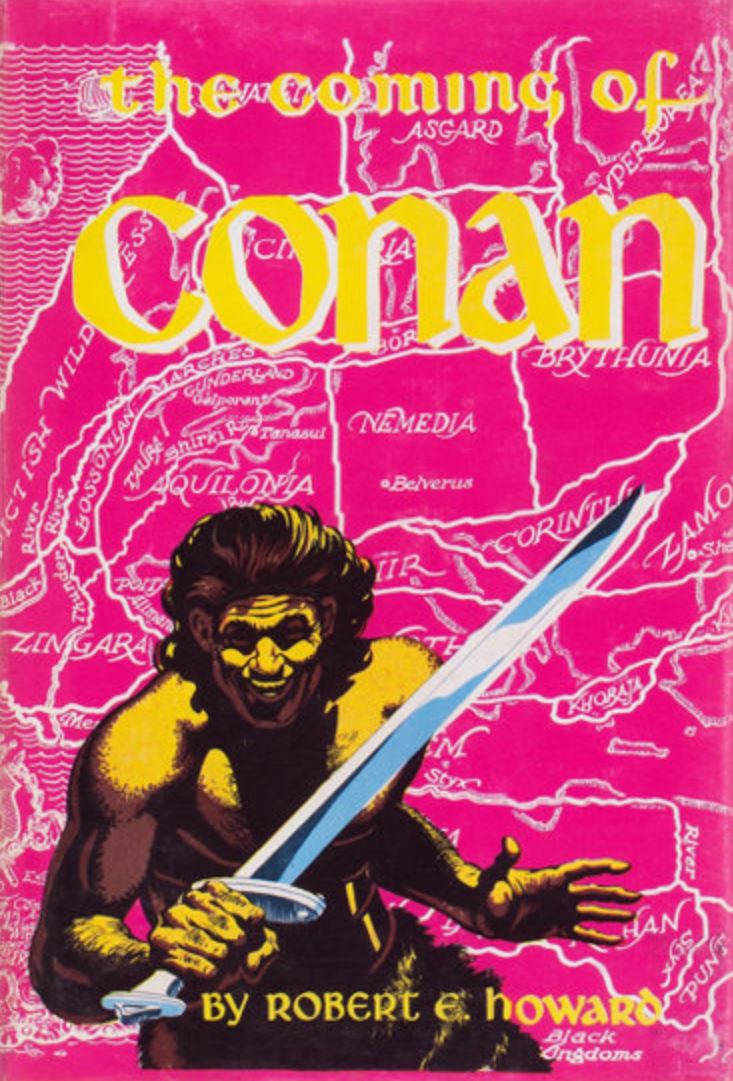
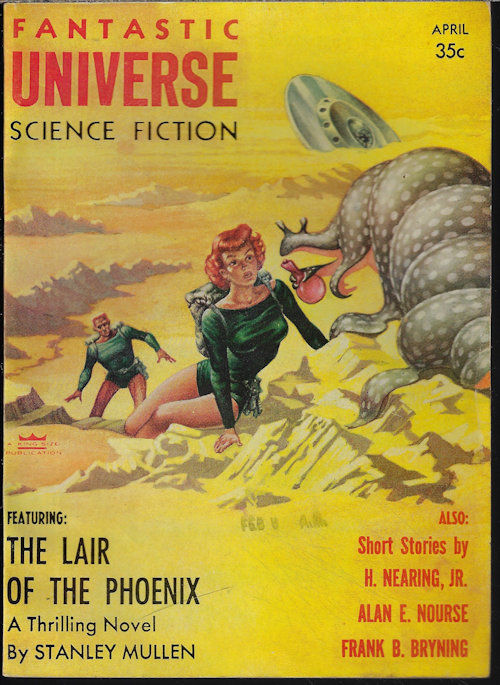
Robert E. Howard created a fictional character named Kirby O' Donnell in the 1930s. O' Donnell was a treasure hunter from the U.S. that disguised himself as a Kurdish merchant. There were two published stories starring the character, “Swords of Shahrazar” (Top-Notch, October 1934) and “The Treasures of Tartary” (Thrilling Adventures, January 1935). The third story, “The Curse of the Bloodstained God”, was not published during Howard's lifetime. Instead, it was discovered in Howard's unpublished manuscripts. It was revised by L. Sprague de Camp and replaced O' Donnell with Conan. It was re-titled “The Blood-Stained God” and was first published in Tales of Conan (Gnome Press, 1955). The story was also featured in Fantastic Universe (April 1956). Additionally, it was reprinted in the paperback Conan of Cimmeria (Lancer, 1969). Howard's original O'Donnell version was published in Swords of Shahrazar (Orbit, 1976). As clarification, my review is de Camp's Conan version of the story.

After serving for approximately two years as a soldier in Turan, Conan sets off solo in search of a fabled treasure in the Kezankian Mountains. Before the rugged action begins, Conan is in the city and sees a man being tortured by a group of men. After a scuffle that knocks Conan unconscious, he awakens to meet an Iranistani named Sassan. This man reveals to Conan that he is in search of the treasure and that a former prince and his companion were the torturers (this was rather confusing). Sassan and Conan decide to team together to search for the treasure.

In the mountains, Conan and Sassan are attacked by the prince and his companion, who are then attacked by a small army of Kezankians that are protecting the treasure from invaders. This fight ends up with everyone dead except Conan, Sassan, and the prince. The three find the temple and Sassan is killed by a booby trap. In an obligatory fashion, the prince attempts to kill Conan and is shocked when the real guardian of the treasure reveals itself. 

I feel like these treasure-hunting Conan stories all end in the same fashion - the hero never gains the gold. The protective baddie always prevents wealth and prosperity, forcing Conan to live his wild and restless lifestyle. What saves “The Blood-Stained God” is the action sequences that escort Conan and Sassan through the dangerous mountain pass. The oncoming army and two key criminals (not Conan and Sassan!) let the arrows fly, increasing the need to find the treasure by destroying each other. I also enjoyed Conan's easy problem-solving to avoid a similar fate that killed Sassan. The treasure’s protector was a lot of fun, but predictable. Recommended, but there are better Conan stories out there.

Friday, March 24, 2023

Modesty Blaise - Pieces of Modesty

Pieces of Modesty is a collection of six Modesty Blaise short stories by Peter O’Donnell written in the 1960s and compiled into one paperback volume published in 1972. The book remains available today as a paperback reprint and ebook.

For the uninitiated, Modesty Blaise is a former Baltic organized crime boss who retired and now works as a British spy along with her hyper-competent sidekick, Willie Garvin. The series began as a comic strip and evolved into a popular series of novels. Pieces of Modesty is the first of two short story collections written by O’Donnell.

“A Better Day to Die”

Modesty and Willie are traveling through a Latin American Banana Republic, so Modesty can say goodbye to an old member of her criminal network who is now dying at the ancient age of 60. A mishap with their car leaves Modesty bumming a ride in a school bus with a missionary preacher and his students. On the ride, Modesty has to endure the pacifist reverend’s diatribe against the violence Modesty has deployed throughout her life.

The excitement heats up with the bus is forced off the road by guerrillas who take the passengers hostage. Will the preacher change his stance when Modesty does her thing to save their collective hides? This story is pure awesomeness and made me wish straight-up action-adventure short stories were more of a phenomena outside the pulps.

“The Giggle-Wrecker”

The British government wants a wannabe defector scientist out of East Berlin and working in London for the Good Guys. However, bringing a valuable human asset from the other side of the Iron Curtain is no easy feat. The solution? Modesty Blaise and Willie Garvin.

This reminds me of a heist story where a team of professionals needs to smuggle contraband out of a secured area and everything goes to holy hell in the process. Tack on a very clever twist ending and we have some very fun reading, indeed.

“I Had a Date with Lady Janet”

This story is noteworthy in the Modesty Blaise universe because it’s the only one narrated in the first person by Modesty’s badass, Cockney sidekick, Willie Garvin,. When not running missions with “The Princess,” Willie runs a pub 25 miles from London called The Treadmill.

In the story, Willie is involved in a casual dating situation with a one-legged gentry gal named Lady Janet. One night before a date with Janet, Willie learns that Modesty has been kidnapped by an old nemesis looking to exact revenge. Will Willie break his date with Lady Janet to rescue Modesty? You betcha.

This is another great story, and having Willie as a narrator was a lot of fun. It really was his adventure - like a Sherlock story featuring an adventure of Watson. Don’t skip this one. Savor it.

“A Perfect Night to Break Your Neck”

Modesty and Willie are enjoying catching up with some old friends over dinner in France. As they're leaving the restaurant, the group is attacked by knife-wielding thugs. Why on earth would someone mount an attack so ham-handed and lacking finesse? The mystery deepens as the attacks keep coming in different venues.

I had trouble connecting with this story or even understanding the stakes and character motivations. You may have better luck. Alternatively, it can safely be skipped altogether.

“Salamander Four”

Modesty Blaise is working a side-hustle as a model for a sculptor in Finland, because, well, of course she is. And during the weeks of modeling for the artist, a lovemaking relationship ensues. One night during the sexual afterglow, a severely-wounded man comes to the house after having been pursued by gunmen through the night. Modesty and her sculptor provide the man sanctuary in the house.

The adventure thrusts Modesty into the world of industrial espionage and gentlemen thieves. Bonus points for some cool knife work from Willie Garvin. This story is another winner.

“The Soo Girl Charity”

The final story of the collection has an oddly comical set-up. A wealthy industrialist jerk pinches Modesty’s ass on the street, and she decides that he owes her $5,000 for the pleasure. She and Willie plan a complicated operation to collect the money through a safecracking burglary heist.

During the burglary itself, the duo stumbles upon indicators that the target is into something way more sinister than pinching bottoms, and the story unfolds from there. This is a great heist story with a clever plan for revenge and a handful of surprises along the way. Whatever you do, don’t skip this one.

Paperback Warrior Assessment

Pieces of Modesty is one of the finest single-author, recurring-character, short story collections I’ve ever read. There just aren’t enough short story collections from the action-adventure paperback era, so savor this one. Highest recommendation. 

Buy a copy of this book HERE.

Wednesday, March 22, 2023

The Elric Saga #01 - Elric of Melnibone

Like a lot of the critically praised books we review here at Paperback Warrior, Elric of Melnibone can lead anyone down their own rabbit hole researching the novel, series, and grand mythos associated with the character. Elric first appeared in Michael Moorcock's novella “The Dreaming City”, published in Science Fantasy in June, 1961. More Elric stories and novellas were published through the early to mid-1960s in Science Fantasy

Moorcock's desired reading order for fans to fully grasp the Elric Saga begins with the first full-length novel to feature the character, Elric Of Melnibone. It was published in the UK in 1972 by Hutchinson. It was published by Lancer the same year under the title The Dreaming City. The most collectible, and arguably desirable, publications of the novel is DAW's 1976 paperback version, Elric of Melnibone, with incredible cover art by Michael Whelan. This review is based on the version that is included in Gallery/Saga Press's The Elric Saga Vol. 1, a 2022 hardcover omnibus that collects the series first three full-length paperbacks and a foreword by Neil Gaiman. This omnibus is also presented as an audio book narrated by the incredible voice of Samuel Roukin. 

At 180ish pages, Elric of Melnibone sets the table for new readers as an origin novel that kicks off the fantasy series properly. Elric is the emperor of the island kingdom of Melnibone, also called Dragon Isle. Elric is the 428th emperor to sit on the ruby throne, but he's a plagued leader. Described as a thin sickly albino, Elric must rely on special potions and magic to stay alive. In essence, he is sort of like a vampire relying on blood to exist. His rival to the throne is his cousin Yyrkoon, a mastermind that is consistently plotting methods to ascend to power. Complicating this familial power struggle is Cymoril, Elric's love interest and sister of Yyrkoon (which means Elric is really in love with his cousin?). 

Melnibone was once the world's dominating superpower, but centuries have eroded the kingdom's prosperity and left them merely a shell of their former glory. However, Melnibone still maintains a flourishing trading business that is sought after by rival kingdoms. In the book's opening chapters, Elric and Yyrkoon are on a war barge fighting one of these rivals when Yyrkoon capitalizes on Elric's weakened state and throws him into the deep sea. 

I won't ruin the whole surprise, but Elric doesn't die. Instead, he lives to avenge this murder attempt by exiling Yyrkoon from Melnibone. But, Yyrkoon captures Cymoril and escapes into the Young Kingdoms far away. As Elric desperately tries to locate Cymoril, he must fight Yyrkoon. It is this search for Elric's love that makes up the bulk of the book's narrative. Elric is forced to find a magical sword called Stormbringer that “possesses” it's wielder. The sword craves killing and feeds its wielder in the same ways as Elric's magic potions. To kill Yyrkoon, Elric needs Stormbringer, but must also face the fact that the sword will be his new master. 

Michael Moorcock is absolutely brilliant with this heroic tale featuring the beloved Elric. In the big picture, Elric is an incarnation of the Eternal Champion, a warrior that is created by the gods and reborn repeatedly. Moorcock's other series titles like Hawkmoon, Erekos, and Corum feature incarnations of the Eternal Champion, just in different universes that make up Moorcock's robust multiverse. However, readers don't need to read these other titles to appreciate this novel. This is an origin tale that gets the reader acquainted with Elric and his mission ahead. It has jealousy, action, nautical adventure, sword-and-sorcery, fantasy, and world building sprinkled into a rather simple plot. It is good versus evil, but tells a broader story of the responsibilities of power. There are numerous underlying themes that reflect political strife and upheaval, a common theme for Moorcock.

Elric of Melnibone is a mandatory read if you have even the smallest desire to read a fantasy novel. It is an easy book to dive into and its characters and frenzied pace are captivating. Highest possible recommendation. 

Buy a copy of this book HERE.
Monday, March 20, 2023

Captain Clive's Dreamworld

To date, Jon Bassoff has authored nine novels of dark crime-fiction and nightmarish horror. I read his debut novel, Corrosion, originally published in 2013, and really enjoyed it. The author has popped up on several “best of the year” lists over the last decade, including his novel Captain Clive's Dreamworld. It was published in 2020 by Eraserhead Press and received an audio book treatment by Blackstone Publishing. The book gained high praise on Amazon's reviews, which caught my eye while shopping for the next horror title to read. 

Deputy Sam Hardy works in a low-life, scum-ridden town plagued by violence and poverty. When a dead prostitute is found with her throat cut, Sam becomes a suspect in her murder. In an odd chain of events, Sam is instructed to move out of town to a place called Angels and Hope. The Sheriff sets Sam up to be the lone lawman of this sleepy desert town. Angels and Hope's claim to fame is a giant amusement park built by a zany entrepreneur named Captain Clive. But, the town is wonky and made up of two-faced citizens that seem to be hiding secrets. These characters evolve from the warm welcoming committee to malevolent tormentors over the course of the book.

Captain Clive's Dreamworld is a weird book, but that isn't necessarily a bad thing. It's presented in a dreamlike way that ultimately conveys the book's title. At times it's like the quirky Twilight Zone episode “Stopover in a Quiet Town”, with the protagonist discovering that his small town is just a reproduction. Other times, Bassoff's writing is dark erotica, complete with disturbingly graphic sex scenes that mostly involve rape or incest. In that regard, it isn't a far cry from the likes of Jack Ketchum or Bryan Smith, two authors I mostly stay away from. Perhaps the best comparison is that of Bentley Little – a little of this and a little of that to make an outlandish horror story memorable. 

Bassoff is a terrific writer that can get the most out of his characters through heartache, emotional angst, homicidal thoughts, and guilt. This gauntlet of emotions lies before the reader to enjoy or combat, which makes the reading  a rip-roar, gut-wrenching event. The reader feels something – good, bad, squeamish - which is what every author desires. There was also a great story here worth telling. It's a cyclical narrative with a plot development that offered some horrifying surprises. 

If  perverted horror is really your thing, then you'll love Captain Clive's Dreamworld. Honestly, I was just lukewarm on some of the provocative stuff, but the story as a whole was good enough for me to...thrust onward I suppose. 

Buy a copy of this book HERE.

Saturday, March 18, 2023

Conan - The Frost-Giant's Daughter

“The Frost-Giant's Daughter” was written by Robert E. Howard in the early 1930s. The story, featuring Conan the Cimmerian, was originally rejected by Weird Tales, so Howard changed the character to Amra of Akbitana and called the story “The Gods of the North”. It was accepted and published by The Fantasy Fan #7 in March, 1934. As a Conan story, its original, more popular form, “The Frost-Giant's Daughter”, was published in The Coming of Conan (Gnome Press, 1953) and Conan of Cimmeria (Lancer, 1969). At just 10 paperback pages, it ranks in the top echelon of Conan literature. 

The titular hero has returned to his homeland in Cimmeria, but grows a hunger for battle. He decides to participate in a raid into Vanaheim with his old barbaric friends the Aesirs. As the story begins, Conan is the last remaining combatant of the Aesirs and an enemy named Heimdul is the sole member left of Vanaheim's fighting forces. They both lock into battle and Conan kills Heimdul, but collapses from exhaustion on the hard frozen ground. 

Conan awakens to feminine laughter and then sees a beautiful ivory-skinned woman in front of him. She's naked and barefoot, yet dancing on the snow. Lusting for this cold-weather maiden, Conan trails the woman for miles through the frozen wastelands. Growing tired, he suddenly realizes that the woman has led him to her two brothers, savage frost giants. They want to cut Conan's heart out for some sort of ritual sacrifice. Forced into battle, Conan kills both giants and then the woman vanishes in a blue flame after asking her father, a god named Ymir, for help. Conan collapses yet again, but this time awakens to find another band of Aesir comrades by his side. 

Conan explains that his encounter with the strange woman and the Aesir don't believe him. They also fail to locate any tracks made by the woman. One Aesir warrior confesses that he does believe what Conan is saying is true and explains that this woman is Atali, the daughter of the god Ymir. The Aesir still refuses to believe Conan's account, but are surprised to see that the warrior is holding a piece of the woman's clothing in his hand. 

“The Frost-Giant's Daughter” has a special kind of frosty ambiance. Howard's descriptions of the battlefield, cold weather, the beautiful woman, and the frost giants themselves was just so vivid. The opening dialogue between Conan and Heimdul seemed epic, despite the fact that the reader never experienced the actual battle. For such a short story, the whole narrative felt this way due to the storytelling and pace. Conan's realization that the dream was reality was a fitting ending and proved to his comrades that his sanity, along with his fighting spirit, was still fully intact. Howard absolutely nailed this Conan story and I'm surprised it wasn't picked up by one of the publishers of that era in its original form.

Friday, March 17, 2023

The Bride Wore Black

Up until 1940, Cornell Woolrich was mostly writing shorter works about the rich and privileged, like Times Square (1929) and Children of the Ritz (1927). After 1932's Manhattan Love Song, eight years passed before another Woorich novel was published. This hiatus set the table for a re-structure of Woolrich's subject matter and a new direction for his literature. 

In 1940, The Bride Wore Black (aka Beware the Lady) was published, the first novel-length suspense thriller from Woorich. The novel kickstarted a crime-fiction career that flourished for twenty years, producing over 15 masterworks of suspense and landing Woolrich in the upper echelons of crime-fiction authors and pioneers. 

The Bride Wore Black is presented in five separate parts, each titled as the last name of a potential victim. In between, the author includes a small portion of insight from the eyes of the murderer, an unnamed woman Hellbent on revenge. Then, another short narrative featuring insight on the victim, and then a paragraph serving as the postmortem. In this presentation, each part is set as its own short-story or novella. These parts eventually connect to make a spectacular whole, but the pure pleasure lies in the construction. 

The first victim is a man named Bliss, lured to the top of a building for an engagement party. It is here that he meets the beauty, a mysterious woman rejecting men while searching for someone special. Bliss, unfortunately, falls for the trap and takes a deadly tumble. His friend, a man named Corey, remembers the woman's eyes moments before Bliss's death. This tidbit will be of some use later in the book.

This same set-up is used as various men meet their demise after gaining some contact with this dark female avenger. The murders are clever, a cross between diabolic (shot with an arrow, suffocated) to quiet death (poisoning). All of these are written with a sense of white-knuckled dread. After Bliss, readers realize that they will be reading the last moments of life for all of these poor unfortunate men. 

Perhaps the most compelling and shocking is Moran. On his last day, his wife is lured out of town with a telegram informing her of her mother's sudden sickness. This was a way to isolate Moran, but there's a catch. He is left caring for his young son. When a woman arrives at the house, promising she is the teacher, Moran's son immediately rejects the visitor, explaining that she isn't his who she claims to be. Prone to fibbing, his warning falls on deaf ears and Moran is led into a macabre, murderous game of hide and seek. 

The Bride Wore Black is a masterpiece that essentially helped define the suspense-thriller market. The novel's use of certainty – a predetermined sentencing for each character – is oddly a paradox of suspense. Readers realize the outcome before death arrives. There is a void of uncertainty, but the build-up to death and murder creates an emotional stirring that's hard to suppress. Woolrich purposefully cranks the wrench, tightening the intensity until the last gasp. If Hitchcock was the master of visual suspense, then Woolrich was certainly his equal with literature. The Bride Wore Black is a must-read. 

Buy a copy of this book HERE.

Wednesday, March 15, 2023

Homicide Handicap

Florida resident Bob McKnight authored 11 short novels published as Ace Doubles between 1957 and 1963. He also wrote a bunch of non-fiction books on horse race handicapping and didn’t forge into fiction until the ripe old age of 51. Homicide Handicap was his last Ace novel from 1963.

Sox Bradley is a thoroughbred racehorse trainer and our narrator in this 100-page conventional mystery. His wealthy ex-wife, Carla, owns a bunch of racehorses, and Sox still works for her despite the marriage being long over. When Carla’s dead body is found stashed away at her Florida mansion, the cops naturally question Sox for the murder.

Yes, this is another one of those paperbacks where the falsely-accused protagonist needs to solve a murder to save his own hide, and it’s a pretty enjoyable iteration of this trope. Sox is a decent main character despite a lack of charisma, and the setting in the world of thoroughbred horse training was an interesting glimpse behind the curtain of a sports subculture. I learned a thing or two along the way that will make me a hit at cocktail parties when the topic of horse racing arises.

There’s a sweet girl interested in Sox and a handful of likely suspects with motive and opportunity. There’s not much action other than a couple of peripheral murders that narrows the field of suspects. You’ll see the solution coming from a furlong away, but it will only serve to make you feel smart in the final chapter when your suspicions are confirmed.

To be clear, Homicide Handicap isn’t a mystery masterpiece, but it was an enjoyable diversion about as good as a typical long-story from Alfred Hitchcock’s Mystery Magazine. The novel has never been reprinted, but many Ace Double collectors probably have a copy that’s been sitting on their shelves for decades. The other side of the paperback is The Dead and the Deadly by Louis Trimble. It’s a good pairing as both authors knew how to execute a formulaic mystery.