Monday, August 7, 2023

Now I Lay Me Down to Sleep

Frank Lambirth (1928-2007) earned his M.A. at the University of Kentucky, then began a career as a high school teacher while also lecturing at UC Davis. Lambirth directed numerous melodramas performed by students and faculty, and in the mid-1980s, he formed the successful Puget Sound Writers Guild, a nonprofit that offered guidance, teaching and feedback for creative writers. While publishing at least two novels under his own name, Lambirth created various pseudonyms, developed drafts and novels using those names, and then would sell the pseudonym. He considered it saleable property. 

While teaching, he once taught a course in the supernatural. He would spend hours with his students sitting in supposedly haunted places conducting field studies. Perhaps his keen interest in the supernatural propelled his writing career. The only two novels I've located with Lambirth's name is Behind the Door (1988) and Now I Lay Me Down to Sleep (1989), both of which are horror. Owning both books, I decided to try Lambirth's writing with the latter novel, originally published as a paperback by Popular Library with cover-art by Mark and Stephanie Gerber.

In the book's opening pages, readers are introduced to protagonist Linc Wilhite. Through a hazy presentation, Wilhite's backstory is saturated with various memories of a love lost, a regretful childhood, an estrangement from his father, and a murky hospital stay. The author only fills in these blank spaces in the narrative's second-half, with one major detail coming near the book's finale. At 231 pages, it's a long road to get there. But, the narrative's central story is Wilhite's experiences in a new job serving as a caretaker in a rural area known as Stone Warrior Island.

Wilhite accepts a job as a lone caretaker for two vacation houses off the coast of the Pacific Northwest. The island is submerged in creepy folklore about Satanism, murder, and a spectral bird, all of which are insanely broadcast by the island's former caretaker, a deranged man who warns Wilhite that Satan lives on the island. Brushing off these ramblings, Wilhite takes the job and is flown to the destination to prepare the houses for the owners' upcoming vacations and a family of renters from New York.

During a few days of isolation, Wilhite – and the reader – explores the houses, the surrounding forest, and the various locks and keys required to enter certain areas. The conclusion is that this place is truly in the middle of nowhere. But, Wilhite receives the New York family of visitors soon and the customary meet and greet ensues. The father is a stressed businessman hounded by his wife, two daughters, and a son. After a warm welcome, things turn sour when Wilhite is invited to join the family for dinner. This altercation, which I won't spoil here, leads Wilhite to question the family's intentions. 

Lambirth's ultra-creepy factor settles in at the halfway point. Through the windows, Wilhite notices that the family is camped in the den, completely stationary, watching hours upon hours of television - on their vacation to the great outdoors. After two solid days of television, Wilhite sneaks a closer look and is horrified at his discovery. Something murderous is stalking Stone Warrior Island.

Do you recall all of those great slasher films of the late 70s and early 80s? For example, when Laurie Strode ventures across the street near the end of John Carpenter's original Halloween? The house is quiet and foreboding, then she hears a creaking as if someone is moving upstairs. You and I both know that Myers is upstairs in the dark. This book works at that atmospheric level. Wilhite, who is basically the only voice the reader hears for most of the book, is left in isolation with a presence that exists off the page. The signs are all there – items shifted around, doors unlocked, footsteps in the house, mysterious fires – but it's all a mystery on who or what it is. Additionally, when a young girl appears, the book reminded me of that great 1970s horror film Let's Scare Jessica to Death. But, it isn't all great.

As good as Lambirth is with creating spooky, unnerving atmospheric horror, he isn't a fabulous storyteller. He shines with descriptive details, describing each scene with vibrant colors and calculating each footfall to the timing of the character's heartbeat. The author is mesmerizing when it comes to painting a room. Yet, dialogue and the character's recollections of the past were nothing short of awful. Thankfully, most of the book is just the reader in the headspace of Wilhite. But, when other characters interact, the writing is amateurish and wonky. It's really a mismatch of sheer greatness and pompous excess. 

The verdict? Now I Lay Me Down to Sleep was a fun reading experience. It was haunting, cerebral, descriptive, atmospheric, and most importantly, it stayed with me long after the last page was read. Despite the clunky writing, the novel served its purpose quite well. It just isn't an absolute gem. I'm not dismissing Lambirth and plan on reading his other horror novel soon.

Buy a copy of this book HERE

Friday, August 4, 2023

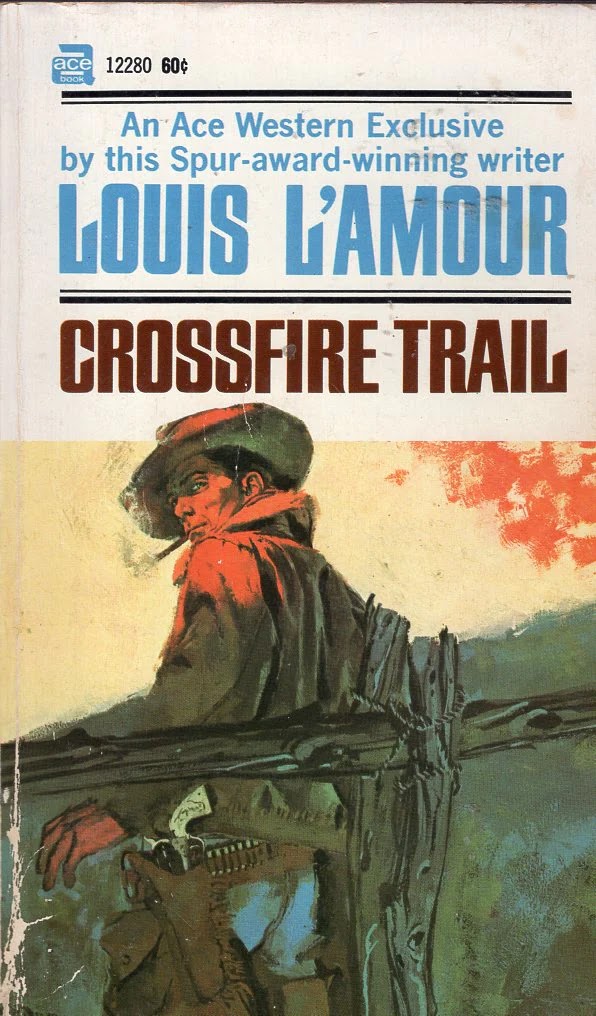
Crossfire Trail

When I browse “best of” lists associated with the literary work of Louis L'Amour, a few books seem to always make the list – Hondo, Flint, The Sacket Brand, The Haunted Mesa, and Last of the Breed. Aside from those, every third or fourth list seems to incorporate his 1954 western novel Crossfire Trail (Ace). This could be due to the 12.5 million viewers that tuned into the 2001 made-for-cable television movie of the same name that featured Tom Selleck. I've always heard good things about the book, so I decided to finally give it a read.

The book begins with protagonist Rafe Caradec (last name Covington in the film), a soldier-of-fortune,gambler, journeyman, aboard a ship bound for San Francisco. His friend Charles Rodney has just been beaten nearly to death by the notorious ship captain. In his dying breath, Rodney reminds readers, and Caradec, that he paid a businessman named Barkow the money owed for his Wyoming ranch. Rodney has paperwork that he has left for Caradec to deliver to his widow, Ann. Then, Rodney dies, and Caradec and some fellow shipmates escape the vessel and head to Wyoming to deliver the news.

When Caradec arrives in the small Wyoming town of Painted Rock, he discovers that Ann has been fed a lie by a group of businessmen who all have a reason to own Rodney's ranch. First, they advise her that the ranch wasn't paid for. Second, they have explained to her that her husband was killed by a Sioux war party a year earlier. When Caradec attempts to explain the truth to Ann, she refuses to listen to his “lies”. 

The plot propels as Caradec, in a quest to uphold his promise to Rodney, must fight the businessmen responsible for the corruption and lies. There's Barkow, now Ann's fiance, along with another vile villain named Dan Shute and the obligatory hired gunmen that murder anyone disputing Painted Rock's form of justice. 

Crossfire Trail is an expanded version of a short-story called "The Trail to Crazy Man", originally published in the July, 1948 issue of West (under a pseudonym of Jim Mayo). There's plenty of action, fisticuffs, fast-draws, and a love interest that anchors the narrative firmly in the “traditional old-west formula”. While it was predictable with the familiar L'Amour trope of “gunman protects widow and ranch”, the writing was superb as always. There's nothing to dislike about Crossfire Trail and I thoroughly enjoyed the banter between Caradec and his friends. As an added bonus, there is a side-story of Caradec rescuing a young Sioux woman, a plot point that serves dividends later. 

If you love traditional western storytelling, chances are you've probably already read Crossfire Trail. If not, I recommend it as your next cowboy yarn. 

Buy a copy of this book HERE.

Wednesday, August 2, 2023

Fog Hides the Fury

Paul Hugo Little (1915-1987) authored novels in genres like historical-fiction, romance, erotica, gothics, and crime-fiction. Supposedly, Little authored over 700 novels in his career, averaging a novel every week and a half beginning in 1963. He used numerous pseudonyms like Marie de Jourlet and Leigh Franklin James. My first experience with Little is his gothic novel Fog Hides the Fury. It was published by Magnum in 1967 under the pseudonym Paula Minton. 

Arlene Dade inherits her family fortune when her father dies in an automobile wreck. The fortune stems from a shipping business created by her great grandfather. Since she was a young girl, Arlene has been living with her Aunt Clara, a sickly woman plagued by asthma attacks. After graduating college, Arlene begins an honorary career of attending her company's legislative and leadership meetings to determine the future of the company.

After having her purse snatched at a local restaurant, a young man springs into action and runs after the thief to retrieve the purse. Arlene marries the man, and later discovers that his family had partnered with her family in the shipping business until things went sour to create an amicable split. Could this whole purse-snatching skit just be a sham so that the man can get Arelene to fall in love with him? Is he secretly hoping to marry into her fortune to gain a free ride on easy street?

Unfortunately, the plot is revealed just like it sounds. There is no shocking twist here, as Aunt Clara even predicts the book's ending. At 218 pages of large font (Easy Eye edition), Little simply goes through the motions of writing a narrative about Arlene's life. Her childhood, high school, college, marriage, and discovery of her husband's deceit is all wrung out of this boring, plodding narrative.

Magnum lists “gothic” on the book's spine, but the novel doesn't really have much in common with a gothic aside from a large house (in San Francisco for God's sake) and some thick fog. It's missing the mysterious painting, rumors of ghosts on the upper floors, the family curse, and a penchant for the dark and spooky. Granted, there's a shoreline, a family secret, some bumps in the night, and two deaths, but nothing that stands out as atmospherically “goth”. 

If you are wanting a predictable romance novel, then by all means track this one down. If you want entertainment, look elsewhere. The book is average at best.

Buy a copy of this book HERE

Monday, July 31, 2023

The Bridges at Toko-Ri

James A. Michener (1907-1997) was a bestselling author who never knew the identity of his biological parents, or when and where he was born. He attended Swarthmore College and University of Northern Colorado, earning degrees in English, Education, and History. He was employed as a teacher, served in the U.S. Navy during WW2, worked as a campaign manager for U.S. Senator Joseph S. Clark, and as an editor for Macmillan Publishers.

Michener's first novel was Tales of the South Pacific (1947), a book based on the author's own experiences in the war. It won the Pulitzer Prize for fiction in 1948 and was adapted into the hit Broadway musical South Pacific. His writing career flourished, eventually selling around 75 million copies with popular historical sagas like Hawaii (1959), Centennial (1974), and Caravans (1963). 15 of the author's books or short stories were adapted to the screen.

My first experience with Michener is The Bridges at Toko-Ri, a 1953 novella that was adapted to film by Paramount Pictures one year later. The film was directed by Mark Robson and starred William Holden, Grace Kelly, and Mickey Rooney. My copy of the book is a 1976 Corgi paperback, a sixth printing that shows prior publications by Bantam in 1962 and Secker & Warburg in 1953.

At 106 pages, Michener's novel explodes with tension, drama, and action as American pilots aboard the USS Savo (named after the real USS Savo Island) plan and execute bombing routes during the Korean War. The book's main character is Brubaker, a frustrated Naval Reserve officer and Naval Aviator who is an attorney back home. He isn't happy about his participation in the Korean War, but understands his talents and the contributions he can make to the war effort. In the book's opening pages, Brubaker's carrier-based jet is downed into the ocean, forcing a fellow aviator named Forney to assist in a rescue.

Both Brubaker and Forney have deep conversations with Admiral Tarrant regarding their missions, brotherhood aboard the ship, and the fact that their assignment – bombing bridges in a heavily fortified position – is a delicate, highly dangerous run that may cost them their lives. Michener injects three endearing side-stories concerning Brubaker's shore leave with his wife and kids, Forney's discovery that the love of his life is marrying someone else, and Tarrant's own struggles with the loss of his son during battle in WW2. 

The book's climactic bombing run was like something out of Star Wars or Top Gun: Maverick. The pilots must fly at low altitude through a slim valley protected by cannons and guns, destroy the targets, and then escape before the Korean fighter jets can intercept them. While the mission is mostly a success, the ending was quite surprising and left me with tears in my eyes. Michener's narrative is such a moving patriotic look at the horrors of war and the unnecessary eternal struggle that humans wage against each other. 

The Bridges at Toko-Ri was simply fantastic and the pages breezed by. It's rare to find military-fiction that is set during the Korean War, so the locale and discovery of facts and data regarding the campaign was really enjoyable. Michener is an excellent writer and I'm stoked to learn more about the man and his 40-book bibliography. According to Wikipedia, State House Press published James A. Michener: A Bibliography in 1996, compiled by David A. Groseclose. I'd like to read more about him and discover some of the real highlights of his literary work. 

Buy a copy of this book HERE.

Friday, July 28, 2023

The Tracks

The small fictional Texas town of McGregor Falls is a railroad stop for a large company called SWR. When an SWR employee is found eviscerated in an empty boxcar, Sheriff Cotton Briggs is called out to investigate. The coroner, and eyewitnesses, present convincing arguments that the man's death may have resulted from some sort of animal attack. The most indisputable evidence is that two high school boys were on the scene during the attack. One of the kids, Travis, escaped the animal, but found himself scratched by the strange beast. 

Author Lyn Kelly swaps the narrative into different perspectives through the course of 350ish pages, ranging from the main characters like Travis and Briggs to various law-enforcement, parents, and other high school students. The plot's development, saturated with horror, violence, and mystery, incorporates the present day events with those in the past. In a gripping backstory, a group of disenchanted Vietnam War veterans form a unique train hobo club called the United Riders of America (URA). But, as details emerge, this club may have ties to the present day “animal” carnage plaguing McGregor Falls.

The Tracks is an excellent creature-feature that welds together genre tropes of crime-fiction and horror. In the forefront is the metamorphosis that Travis undergoes, from shy adolescent to Teen Wolf sports star. His relationship with two girls was a pleasant distraction, but the crime-noir aspect of the story was the most compelling. Briggs' connection to the beast was a pleasant surprise, and the details submerged in the 1970s URA group was just so rewarding as a key piece to the overall story. Aside from the book's final two pages, which wraps up decades of character history, I'm really hoping the author takes a hard look at writing a sequel. In the meantime, The Tracks is a highly recommended horror and crime-fiction thriller. 

Buy a copy of this book HERE.

Wednesday, July 26, 2023

The Town That Saw No Evil

Harry Kantor (1924-1991) was the managing editor of men’s action-adventure magazines including Real Men and Battle Cry, and he periodically contributed to the magazines using pseudonyms (“Frankenstein: Raging Sex Monster” by Lorna Dunne). He also wrote a paperback for Major Books called The Town That Saw No Evil in 1977.

Our narrator is Sam Bledsoe, and he’s a troubleshooter for a good and honorable U.S. Senator (remember those?) who sits on the Senate Judiciary Committee, the fellows who confirm Supreme Court nominees. Bledsoe is a tragic drunk who barely earns his keep, but the time has come to justify his paycheck.

The U.S. President has just nominated Dennis Mendoza, the Dean of Harvard Law School, to the high court. The problem? The FBI background check says that Mendoza has a rap sheet from his young adulthood in Arizona - nasty stuff like rape and attempted murder. But after age 21, Mendoza seems to have had a complete reversal of character. What’s the story?

The Senator dispatches Bledsoe to Guthrie, Arizona to get some answers. Right away, the isolated town of Guthrie is filled with delicious mysteries. Airplanes and helicopters aren’t permitted near it. Roads in and out are pretty much non-existent, so you need to drive across the Mojave Desert to get there. What could this town be hiding?

Upon arriving in Guthrie, Bledsoe’s investigation reveals a background regarding the Supreme Court nominee that doesn’t reconcile at all with his current public persona. There’s definitely a conspiracy afoot to prevent Bledsoe from even making a phone call back to Washington for guidance.

The 176 pages keep turning throughout the because the reader wants to know exactly what this town is all about. The key questions reminded me of the satisfying contemporary Wayward Pines series by Blake Crouch, but Kantor’s solution is very different but no less inventive and satisfying. Kantor definitely draws from the western fiction tradition in this “stranger rides into town” tale. Halfway through the paperback, the reader understands the town’s Big Secret, and it becomes Bledsoe’s fight for his life. I would have preferred more white-knuckle action, but the test of wills among the antagonists was plenty compelling.

Major Books was an obscure paperback publisher that consistently punched above its weight throughout its 200 releases. They took chances on unknown authors with creative ideas. And while the business flopped, the creative output was consistently solid. The Town That Saw No Evil is an interesting little novel that never received a fair shake with readers and deserved better distribution. It really is a fun-reading gem and an easy recommendation. Buy a copy of this book HERE

Monday, July 24, 2023

John Adam - Samurai

British author Christopher Wood (1935-2015) is best known for his erotic novel and film series titled Confessions. James Bond fans may recall that Wood authored two film novelizations in the series, The Spy Who Loved Me (with Richard Maibaum) and Moonraker. Wood has always had a penchant to incorporate Asian settings into his novels, like Seven Nights in Japan and Taiwan. My first experience with the author is the first of two historical men's action-adventure paperbacks starring John Adam.

John Adam – Samurai (1971) is set in the year 1600 and stars John Adam, a 20-year old guy running from the law in Plymouth, England. Like a lot of these international, historical-adventure novels, Adam ends up on a ship under the flag of the East India Company. After stops in India and Java, Adam and his shipmates are overtaken by pirates and is sunk just off the coast of Japan. Adam is the only survivor.

After a few chapters that serve as an introduction to this era of Japan, Adam befriends a Samurai warrior named Kushoni. Adam learns that his ship, which was carrying muskets, was attacked by pirates that were hired by Kushoni's master. These muskets were going to be used to defend Kushoni's people from an aggressively barbaric neighboring clan. But, the pirates double-crossed Kushoni's people and now what's left of the muskets are now in the hands of the evil neighbors. You following all of this? It's really simple – Kushoni and Adam are good guys and represent good people. Everyone else can go to Hell.

The rest of the book plays out with Kushoni showing Adam a thing or two about swords. Adam also screws a lot of Japanese bath servants in graphic sex scenes while simultaneously falling in love, sort of, with a Japanese woman named Somi. But, there's a ton of action as Kushoni beheads, pierces, spears, disembowels, and savagely guts endless hordes of bad guys. There are also some torture sequences that were a little hard to...um...digest. 

Overall, this book was just bonkers, but not in a bad way. I would probably never read it again, but would consider reading the book's sequel, John Adam in Eden. It's just that Wood is such a quirky writer with some of the oddest descriptions considering this really should be a sweeping, historical novel with a little class. Instead, you have things like “quieter than a church fart” and endless religious orgies. It was just so bizarre, but like a good car wreck, I couldn't wrestle my eyes off the pages. Your mileage may vary, but this isn't a terrible way to waste a half-day. 

Buy a copy of this book HERE.