Sunday, July 27, 2025

Holy Judd

A one time editor of Collier's magazine, Henry La Cossitt (1899-1962) also served as a deck hand on a ship and worked as a radio commentator and newspaper correspondent. As a magazine writer, his first published story was “Silent Eyes” in the September 1927 issue of Everybody's. He became a staple in The Saturday Evening Post, Collier's, and Adventure. My first experience with the writer is his prison-break story “Holy Judd”, which was published in the May 1st issue of Adventure in 1933.

La Cossitt's story's features a protagonist named Jim Judd. He is a former District Attorney that is now serving a five year stint in prison. As the story begins, Judd is now in his third year of the sentence and is considered a model prisoner. His record shows he is a trusted inmate that has a bit more freedom than others. He can leave the prison on short errands for the warden and the people in town know him well. When columnists and prison crusaders stop by the facility for inspection and interviews, the prison board typically places Judd front and center as the proverbial model citizen of the clank. 

A special place in the prison is reserved for bad behavior. It's a little knoll in the middle of the prison grounds that is connected by a twenty-five foot tunnel leading to a small concrete box with eight heavy iron doors. This type of penalty box hosts prisoners that have journeyed off the rails and need a break from the population. It consists of insufferable heat, a claustrophobic atmosphere, and one meal a day served with a small cup of water. It's the last place any prisoner wants to remain confined. Yet one day, Judd punches a gardener for no reason. It was as if he wanted to be sent to the box that day. 

As I alluded to earlier, La Cossitt's story is of the prison-break variety. But, what's remarkable about the plot is that Judd is nearing prison release with a clean record and the aptitude to continue on in some variety as a “reformed” man. Why would he purposely risk all of that to condemn himself to such Hellish conditions complete with an attempted escape blemish on his record? 

Thankfully, La Cossitt's story contains an interesting backstory on how Judd found himself in prison - a bogus bribery charge and set-up from his former law partner. Now, his former partner is close to becoming elected Governor and Judd wants to stop it. There's an elaborate set-up to free himself from the prison, capture a fellow inmate, and a quick home invasion angle. 

La Cossitt has a fantastic knack of building character backstories while still maintaining a brisk pace to keep it purposely plot-driven. “Holy Judd” is an enjoyable read. To my knowledge the story has never been reprinted, but you can read it below courtesy of Archive.org.

Saturday, July 26, 2025

Paperback Warrior Primer - Norman Daniels

Norman Daniels (Norman Arthur Danberg, 1905-1995) was a prolific author that experienced tremendous success in the pulp market before creating a second career writing numerous paperback originals, novelizations, and television tie-ins in a variety of genres. He used a multitude of pseudonyms and even collaborated with his wife Dorothy, a sensational paperback writer that specialized in gothic-romance titles. I presented the author's life and literary work on a podcast episode HERE, but wanted to provide a text on this workaholic writer that has seemingly vanished from the reader radar.

Here's a Paperback Warrior Primer on Norman Daniels. 

Norman Arthur Danberg was born in 1905 in Connecticut. He attended both Columbia and Northwestern University. Daniels' first published story was "The Death House Murder", which appeared in Detective-Dragnet magazine in 1932. That same year he saw his stories in magazines like The Shadow Detective Monthly, All-Detective Magazine and Gangster Stories. The December 1933 issue of Thrilling Detective featured a story called “Cold Steel”. This was an important moment for Daniels because it secured a relationship with the pulp powerhouse Standard, which was owned by Ned Pines. They produced a ton of titles in the 30s and 40s and competed with the equally productive publisher Street & Smith. 

Daniels was asked by Standard to pen stories starring their pulp hero The Phantom Detective. From my research it shows that he wrote over 30 installments of the series. After a little bit of a downward curve in pulp sales, the publisher began to think of new ways to gain readers. The idea was to create new heroes. Norman Daniels came up with the idea of The Black Bat character and placed him in Black Book Detective magazine in July 1939. I have a review for the first Black Bat story HERE.

Daniels not only created The Black Bat, he also had a hand in writing, and if not outright creating, a slew of other titles like Dan Fowler G-Man, The Crimson Mask, The Eagle, The Candid Camera Kid, Captain Danger, The Masked Rider, Range Riders as well as also writing for the rival Street and Smith publisher with their pulps like The Avenger, Crime Busters, Doc Savage, The Feds and the popular The Shadow Magazine

The author's Masked Detective character debuted in Masked Detective in 1940. It ran for 12 total issues with a 13th story appearing in Thrilling Mystery. Daniels wrote the first few issues of the series before handing the project off to the other work-horse authors of that era like Sam Merwin Jr. and W.T. Ballard. I reviewed the first appearance of the character HERE.

The author proved to be extremely busy in the 1940s writing shorts for the likes of Romantic Range, Army-Navy Flying Stories, Popular Detective, G-Men Detective, Sky Fighters, Clues Detective Stories, Crack Detective Stories, Thrilling Detective, and Exciting Navy Stories.

The birth of the paperback in the 1950s would be a welcome mat for Daniels to increase his productivity. Using a variety of pseudonyms, Daniels went to work on creating a number of full-length novels that appeared in paperback format. While he was writing for this new format, he continued to write shorts for the magazines and pulps like Western Romance and Mystery Detective. But his paperback output really flourished at this time.
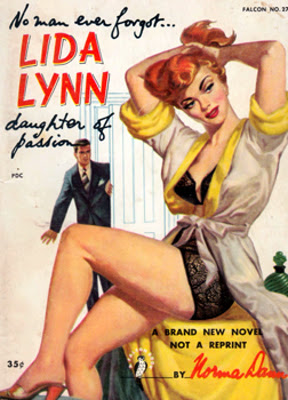
Under the pseudonym of Mark Reed he wrote sleazy books for publishers like Falcon and Rainbow. Books like Street of Dark Desires, The Nude Stranger, Sins of the Flesh, House of 1000 Desires. As David Wade, Daniels wrote at least six books - Come Night, Come Desire, Raise the Devil, She Walks by Night, Bedroom with a View, Only Human and Walk the Evil Street (review HERE). Under the name Norma Dunn he wrote Lida Lynn, Shack Girl, The Twist and Another Man in your Life. Under his real name of Norman Daniels, he produced novels like Mistress on a Deathbed, Sweet Savage and Bedroom in Hell.

While writing a lot of 1950s paperbacks, Daniels also wrote television scripts. According to IMDB, Daniels penned scripts for shows like Alfred Hitchcock Presents, Sugarfoot, Colt. 45, Zane Grey Theater, Ford Theater and General Electric Theater among others. In the 1960s, Daniels incorporated television novelizations and tie-ins into his repertoire with books based on shows like Arrest and Trial, Sam Benedict, The Smith Family, Chase, The Detectives, Ben Casey, Dr. Kildare, The Avengers, etc.

Also in the 1960s, Daniels created an eight-book spy series called The Man from A.P.E. starring a secret agent named John Keith. That series ran from 1964-1971. I read and reviewed the debut HERE. Daniels also wrote a two book series of spy novels starring a CIA agent named Bruce Baron. These were The Baron of Hong Kong from 1967 and Baron's Mission to Peking from 1968. He also wrote a stand-alone spy novel called Spy Hunt in 1960 (reviewed HERE). 

He wrote for a number of other publishers in the 1960s including several WW2 novels like Moments of Glory, Battalion, and Strike Force (aka Killer Tank, reviewed HERE). 

Daniels also wrote another short series starring a California police chief named Kelly Carvel. These books were The Rape of a Town in 1970 followed by One Angry Man in 1971 and concluding with License to Kill in 1972. I reviewed the series debut HERE.

Daniels also submerged himself into the marketable medical thriller and hospital trend. He authored titles like The Surgeon, Savage Heart, Jennifer James RN, Stanton Bishop MD and The Tarnished Scalpel.

In the 1970s, Norman Daniels began delving into the gothics genre. Daniels wrote many of them under the name Angela Gray. Some title names were The Ashes of Falconwyk, Ravenswood Hall, Watcher in the Dark and The Warlock's Daughter. He also wrote them under the name Suzanne Somers. These had titles like Mists of Mourning, Until Death, The House on Thunder Hill and House of Eve. He also used the name Cynthia Kavanaugh to pen gothic romances like The Deception and Bride of Lenore. He also wrote at least one under the name Geraldine Thayer, a novel titled The Dark Rider.  Daniels even wrote some gothic-romance novels under his wife's name to leverage her market value and name.

Norman Daniels was very prolific because he knew the paperback trends and pop-culture. He wrote what was popular at the time and hinged much of his success on what was selling at the cinema. If spy films were popular then he wrote espionage thrillers. Once the gothic market took off he was quick to jump into that concept. When WW2 and high-adventure became a trend, Daniels was quick to place his efforts in that niche. 

Norman Daniels died in Camarillo California in 1995. Much of his literary work, journals, notes and manuscripts were donated to Bowling Green University where they remain available for anyone wishing to browse the author's work. His wife Dorothy, who sold over 10 million copies and wrote over 150 novels, passed away in 2001.

Friday, July 25, 2025

Bulldog #01 - Ten Fathoms Deep

I've recently re-discovered the literary work of Arthur Catherall. He's quickly becoming my destination for instant gratification. His books, marketed for young adults, have adventure ingredients that aren't a far cry from a Fawcett Gold Medal or Ace paperback from the mid 20th century. Catherall authored a number of stand-alone adventures and mysteries, but he created a number of successful series titles as well. I covered one of these titles, the Fighting Four, and enjoyed the tense atmosphere and brisk pace of the WW2 high-adventures. Looking to repeat my enjoyable reading experience I opened up the series debut of Catherall's Bulldog series. 

In Ten Fathoms Deep, readers are introduced to 17-year old Jack Frodsham. After finishing school, Jack arrives in Singapore to meet with his father, Captain Frodsham. The Captain has enjoyed a successful salvaging and freighting career with his tugboat, Bulldog. Based out of the Lion City of Singapore, Frodsham has made his living in the warm rolling waters of the South China Seas. Now, his dreams of Jack joining the family business have become a reality. 

In the first chapter, Jack's father meets with a man who was purportedly dead. The man, “Husky” Hudson, explains to the Frodshams that he was a mate on the freight ship Tenasserim under the command of Captain Miller. However, the ship was mysteriously attacked and sunk. Hudson was ruled dead by drowning, but he managed to escape the attack. He advises the Frodshams that a criminal enterprise that owned the ship sunk it for insurance money. Captain Miller, who died in the attack, was left posthumously scrutinized under a false public statement that the Tenasserium perished due to the Captain's poor navigation of the the reef. Hudson wants to bring honor to Captain Miller's widow and has a plan in place.

Shortly after meeting with Hudson, Jack's father is nearly killed in a stabbing. Now hospitalized, he asks that Jack meet with Hudson to go over the plan and to take control of the Tugboat for all future jobs. His mate will be Hudson and they are joined with a small group of Malays led by Ahmat. Together, the crew will man the Tugboat to a secret place where Hudson knows that the Tenasserium is lying intact in just ten fathoms of water. If they can successfully retrieve the vessel they can prove that it wasn't the Captain's negligence or a reef miscalculation that led to the sinking. But, as the salvage operation commences, the crew are plagued by two rival tugboats and a crew of cutthroat criminals doing the bidding of a mysterious mastermind. 

Ten Fathoms Deep is an amazing book. First, forget the young-adult stigma that may be associated with Catherall and this series. The book reads like a nautical adventure penned by someone like A.S. Fleischman. In fact, the nautical fiction written by the likes of John Blackburn, Conrad Dawn, Arthur D. Howden Smith, and James Gribben certainly would welcome the Tugboat crew. While there isn't any romance, which is par for the course for a good nautical romp, there's plenty of tense adventure and intrigue that saturate the book under Catherall's excellent prose. 

The book, right at 200 pages, is brimming over with a frantic pace as the Tugboat races against the clock to salvage their target before they are obliterated by rival ships. There's a panic-stricken moment of horror when the Tugboat is nearly bombed and Jack must penetrate a pitch black ocean bottom without a guide. There's shipwrecks, island adventure, sunken treasure, some shady characters, fisticuffs, an aerial romp, and some gun-play. But what really sets this book apart is the amount of contractual intrigue. What I mean by that is that Jack and Hudson must navigate some of the details of the Tenasserium's original logs, their competition with a rival salvage gang, and the swerve of an existing job to take on the Tenasserium retrieval. There's also numerous hotheaded propositions made that force Jack into some really tight spots.

With the level of adventure and exciting locale, Ten Fathoms Deep gets my highest recommendation. This is a must-read and you can get your copy HERE.

Additionally, there were at least eleven of the series installments published between 1954 through 1968. The books were published by J.M. Dent & Sons Ltd. in England and Criterion Books in the U.S.

Wednesday, July 23, 2025

The Day the Machines Stopped

Christopher Anvil was the pen name of Harry Christopher Crosby, Jr. (1925 – 2009). Born in Norwich, Connecticut, he served as a U.S. military pilot before launching a career as a prolific science-fiction writer under the Anvil pseudonym. The Day the Machines Stopped from 1964 was his first novel.

The novel begins with two laboratory workers, Brian and Carl, fighting over the same girl in an office love triangle. A newscast on the radio in the background is discussing an ambitious cryogenics project happening in Afghanistan conducted by Soviet scientists. A defector among the scientists is warning the media that these experiments could cause a worldwide failure of all electrical products.

And then poof! The lights go out at the lab. Brian and Carl are dispatched by their boss to see how far the outage stretches and return with a full report of that the men find. In 1964, losing access to your transistor radio was like an internet outage today.

Once outside, Brian and Carl see the extent of the outage. As the book’s cover betrays, everything is out of order — cars, clocks, flashlights, phones — all dead. The laws of nature surely have changed. Human hysteria and lawlessness follow.

The author spends a lot of time (too much, in fact) rationalizing the science behind this science fiction. There are explanations of electron gas that carries a current and hydrometer testing. Most of this can be easily glazed over, so the reader can get to the evolving anarchy.

The journey through a post-apocalyptic wasteland has been done a million times in survivalist literature - although this is a fairly early entry in the genre. You have your wandering nomads and warlords turning to analog weapons to gather power. Pretty standard stuff - all very readable.

The Day the Machines Stopped is a decent entry in the post-apocalyptic genre. It’s been done better elsewhere but this short and entertaining paperback is probably worth your time if you have it in your library. Just don’t spend a fortune chasing it down. Get it affordable HERE. 

Monday, July 21, 2025

Conversations - The Book Graveyard

Eric collaborates with Nick from The Book Graveyard channel to review the 1971 gothic paperback The Shadow Guest. They also explore the gothic paperback scene of the 1960s–80s, focusing on its mix of supernatural and mystery elements. The discussion is available as a podcast you can stream below and as a video on The Book Graveyard channel HERE. I encourage you to watch the video version to see book covers and our physical interaction discussing this great novel. 

Listen to "Conversations - The Book Graveyard" on Spreaker.

Saturday, July 19, 2025

Paperback Warrior Primer - George Harmon Coxe

New York native George Harmon Coxe (1901-1984) was a journalist, prolific pulp writer, and novelist. He served as the president of the Mystery Writers of America and he won the Grand Master Award. Unfortunately, his name and literary work have drifted into the passages of time and remains largely forgotten. I chronicled his life on a podcast feature HERE. But, I wanted to provide a Paperback Warrior Primer for those of you wanting a text profile. So, let's take a look at George Harmon Coxe.

Coxe (pronounced like “cokes”) was born in New York in 1901. He graduated high school at Elmire Free Academy. He attended Purdue for one year following his graduation and shifted his curriculum from engineering to literature. He also changed schools to Cornell University. For five years, beginning in 1922, he was a journalist for the Los Angeles Express, the Utica Observer Dispatch, and Santa Monica Outlook among others. 

Coxe was an admirer of pulp fiction. While performing his day job in 1922 - at the age of 21 - Coxe authored two stories for Detective Story Magazine. In the 1930s, Coxe began writing for Street & Smith's Top-Notch before contributing to even more pulps like Clues All Star Detective Stories, Dime Mystery Book Magazine, Detective Fiction Weekly, Street & Smith's Complete Stories, Thrilling Detective, and Argosy. He wrote hundreds of stories from 1922 through 1972. 

In 1934, Coxe creates a newspaper photographer named Jack Flashgun Casey. There had been previous pulp appearances of newspaper reporters that worked as amateur detectives to solve crimes. But not a photographer in the role as an amateur detective. The March 1934 issue of Black Mask featured the first Jack Flashgun Casey story, "Return Engagement". Initially, Black Mask editor Joe Shaw had discouraged Coxe from creating a recurring character, but he later admitted that the character was so well constructed that the series soon became a reader favorite. 

There were 24 Flashgun Casey stories that appeared in Black Mask from 1934-1943. The only exception was a story in Star Weekly in 1962. The Black Mask stories were all collected in Flash Casey, Detective published in 1946 as an Avon paperback. In addition to the short stories, there were five novels starring Flashgun Casey between 1942 through 1964. Those were Silent for the Dead, Murder for Two, Error of Judgment, The Man Who Died Too Soon, and Deadly Image. Three of the Casey novels are available as reprints through Mysterious Press in both digital and physical copies HERE.

Additionally, a Here's Flash Casey film was released in 1938 and was adapted from the series of short stories. A well-respected, much-loved radio show was broadcast for years starring the character. Also, between 1951 through 1952 the series was adapted to a TV show titled Crime Photographer and starred Darren McGavin. 

Another pulp character that Coxe created is Paul Baron, a hard-boiled private detective that was assisted by a scrappy side kick named Buck O' Shea. Baron appeared in four stories in Black Mask in 1936. 

The next pulp character that Coxe created was Dr. Paul Standish. This character appeared in ten stories and one novel from 1942 to 1966. The stories appeared in glossy magazines like Cosmopolitan, Liberty, and the American Book Magazine. Standish is described as a medical examiner that delves into mysterious deaths. He is aided by a police lieutenant and a nurse secretary. In July, 1948, CBS ran a short-lived radio broadcast starring the character.  

The Kent Murdoch series is Coxe's most well-known title. Murdoch appeared in two stories in The American Magazine, but flourished in the full-length novels - both hardcover and paperback. The first Murdoch novel was Murder with Pictures, appearing in 1935. 22 more installments of the series followed through 1965. You can get most of these books, if not all, through Mysterious Press as reprints HERE.

In Paperback Confidential, Brian Ritt describes Kent Murdoch as being a smarter version of the Flashgun Casey series. Murdoch has a formal education, he's sophisticated and well-mannered. He's married to a woman named Joyce and they work as a team solving crimes in Boston's upper crust. In the Encyclopedia of Pulp Heroes, Jess Nevins summarizes the character as a photographer for the Boston Courier-Herald. Because he is more intelligent than the police he can solve the crimes. However, many times he has to clear his own name after being accused of being a participant in the crime. Murdoch's wife Joyce plays a prominent role in the first six books and then disappears for the rest of the series. Murdoch also teams up with a hardboiled private-eye in this series named Jack Fenner. This Fenner sidekick would star in his own novels as well. 

Coxe, while succeeding with amateur detective characters, also had an official detective in Sam Crombie. Crombie appeared in two novels, The Frightened Fiancé and The Impetuous Mistress. Coxe's other official detective was Max Hale. He appeared in Murder for the Asking and The Lady is Afraid. Hale is a wealthy New Yorker who attended the State Police Academy and then just doesn't have any motivation to solve crimes. He is sort of roped into crime-solving by his secretary Sue Marshall. 

Coxe also wrote a number of stand-alone crime-fiction novels that were published by a variety of publishers in both hardcover and paperback. In the 1930s, Cox's writing had become so popular that MGM took notice. They employed Coxe between 1936 until 1938 to write screenplays. However, Coxe preferred writing books and stories. Three of Coxe's stories were adapted into films - Women are Trouble, Murder with Pictures, and Here's Flash Casey.

Coxe was elected to the President of the Mystery Writers of America in 1952 and won the Mystery Writers of America Grand Master Award in 1964. 

In the March 11, 1971 issue of The Island Packet, Eugene Able interviewed Coxe and he had this to say about his literary work and career:

“When you get my age and have written as many book and stories as I have, you have to be careful not to be repetitive. I like to write a book that has a good story with believable characters. If a reader figures out the mystery halfway through the book, I want the story to be good enough and the characters real enough to make them want to finish it. The trickier you get with your ending, the more you sacrifice the story.”

Coxe married Elizabeth Fowler in 1929 and was married to her until his death on January 31, 1984 in Old Lyme, Connecticut. They had two children. 

You can obtain vintage copies of his books HERE.

Friday, July 18, 2025

Fighting Four #02 - The Tunnel Busters

Way back in 2019 I read a novel by British writer Arthur Catherall titled The Strange Intruder. I enjoyed the book immensely and have kept a watchful eye out for the author's work ever since. Unfortunately, despite his accomplishments as a successful young-adult writer, he has gone out of print and out of the public's eye. Thankfully, the power of the internet has produced some scans of a few of his out-of-print books including three of his exciting Fighting Four novels.

Based on the success of W.E. Johns young-adult military heroes, the Biggles, and his subsequent series Gimlet, many authors were hopeful to attract the same consumer base. Like Johns' mid-20th century novels, Catherall established his own team of military heroes, what I refer to as “Team-Commando”, in 1959 titled The Fighting Four. There were five books published between 1959 through 1964 beginning with the series eponymous debut, The Fighting Four. These WW2-fiction novels were published by Children's Press in England using Catherall's pseudonym of A.R. Channel. 

Typically I like to start any series with the debut. Unfortunately, the series starter isn't available to me so I settled for an introduction to the Fighting Four by way of the second installment, The Tunnel Busters, originally published in 1960. 

This 188-page book begins with a fitting introduction to the team members. Sam Foster is the radio communications specialist. China Brown (questionable name) manages the teams firearms and logistics. Curly Bates is the explosives expert. The group is led by all-around fighting man Sergeant Ted Harris. Based on their success in the first book's adventure, which featured a Norwegian locale, the four have been assigned an explosive new mission. 

Hitler has routed supplies for his troops by way of railroad through an underground tunnel from rural France into Italy. Due to the rugged mountaintops, the interior design of the tunnel, and the anti-aircraft defense, British intelligence wants the team to parachute in and detonate explosives within the tunnel. Paramount to the mission's success is working with the rebel French in an isolated village controlled by the Germans.

The Tunnel Busters was a nonstop action sequence permeating with tension. The book's pace kicks off with Sam's spiraling descent away from the team due to a barrage of German gunfire. Miles away, Sam befriends a young shepherd boy and his dog that prove crucial to the mission. From the onset there's a gunfight with Germans, a tense standoff in a nearby village, a rescue attempt, the aforementioned tunnel busting business, and a wild hostage situation that elevated the book's finale into an emotional roller coaster as German leaders are set to execute members of the team. 

Don't be afraid of the “young-adult” aura of this series and its reputation. Despite violent details from the author, it is clear that enemy forces are dying. Granted the team will typically just knock out their opponents or “riddle them with gunfire”, but Catherall's storytelling has a darker overtone at times with talk of torture, firing squads, and threats of mass slaughter. Comparisons are often made to Johns' Gimlet series, which is expected. However, from research online, it suggests that The Fighting Four are more “adult” in nature compared to the Gimlet or Biggles series. 

Despite lukewarm reviews, my sample-size experience with The Fighting Four was exceptional. I thoroughly enjoyed this high-adventure military yarn and would definitely recommend it to men's action-adventure fans of any age. I'll be reading more of these books. You can get them HERE.