Tuesday, March 17, 2020

Max Thursday #03 - Uneasy Street

Popular crime-fiction author Wade Miller was actually a collaborative pseudonym utilized by two writers – Bob Wade (1920-2012) and Bill Miller (1920-1961). While the two mostly concentrated their efforts on stand-alone titles, they did launch a successful six-book series in 1947 starring private-eye Max Thursday who works cases in and around San Diego, California. The series debut, Guilty Bystander, was adapted to film in 1950 and switched the location from San Diego to New York City. I've always enjoyed the Wade Miller brand, so I'm sampling this series with the third installment, Uneasy Street, published by Signet in 1948.

It's December 23rd and our private-eye protagonist wants a quick job before the Christmas break. Instead, an older client named Syliva Wister engages Thursday to transport a music box for her. However, after being told where to deliver the goods, Wister is murdered and Thursday immediately becomes the prime suspect. Teaming with series ally Lieutenant Clapp, Thursday hopes to clear his name while also determining what's so special about the music box. Who wants it? What secrets does it contain?

As much as I hoped to enjoy this novel, I found it incredibly dull. The authors incorporate dozens of characters and involve them with a handful of crimes. By page 80, I was dumbfounded by PI fiction's two important elements – the client and the mission. These should be easily defined but in this case it's a moving target. The plot becomes a confusing chain-reaction of bribery for nude photos, a stolen painting, international smuggling and murder. It was so dense I couldn't tell the murdered from the murderer. I think the authors were flying by the seat of their pants – winging it all the way.

If you are a Wade Miller completest, maybe this is worth owning. It’s also available as a cheap ebook. However, be prepared: Uneasy Street wasn't an easy read.

Buy a copy of this book HERE

Monday, March 16, 2020

Paperback Warrior Podcast - Episode 35

It’s time for Paperback Warrior Podcast Episode 35. In this episode, we discuss the meaning of noir fiction as a jumping off point for a career retrospective on Bruno Fischer. We discuss the weird menace subgenre of pulp fiction, and Eric reviews “Crime Commadoes by Peter Cave. We are on all podcast platforms or you can stream below. Download directly HERE

Listen to "Episode 35: Bruno Fischer" on Spreaker.

Sunday, March 15, 2020

Few Die Well

“After the success of I Killed StalinSterling Noel (1903-1984) settled into a niche of writing international espionage and crime-noir fiction with a distinct emphasis on atomic energy and its protection from various Communist regimes. Few Die Well, published in 1953 by Dell, continues that same trend.

The book introduces Jeff English, an American spy who's employed by a defense contractor named Bureau X, the same agency Noel utilized in his I Killed Stalin narrative. English's leash is long when it comes to not only defending US intellectual property, but seeking and destroying Communist cells throughout the world. In one unfortunate mix-up in Teheran, English, posing as a Frenchman, kills two Soviet agents and is placed on a hit list by the Russians. The assassin is a man named Constantine Bardor, a determined Russian who never forgives or forgets.

English's most recent assignment is to assume the identity of a U.S. Army Captain named Randall McCarey and infiltrate an atomic laboratory in New Jersey. His mission is to kill a scientist who is collaborating with the Russians and spilling state secrets. To do this, he must contend with a number of Russian informants who have been implanted among the facility's 900 residential laborers. Noel's harrowing narrative has English essentially living with the enemy while locating the leaks and attempting to make the facility more impenetrable in the future. Once Bardor appears to settle the old score, English and a few allies are caught between the proverbial rock and a hard place. It's a fun position for the readers, but a rough ride for the good guys.

Few Die Well is an absolute treasure. Without giving away too many spoilers, Noel's slower character development regarding a love interest is effective. It's this element that adds a personal touch to what is otherwise a violently cold, calculated mission to fight Russian agents and Communist sympathizers. It's certainly a period piece, explicitly reflecting the heightened Cold War era in a methodical, action-oriented way. Noel knows his audience, loves this style of writing and delivers another top-notch spy entry.

Note – In one humorous parody of Noel's newfound success, he describes English reading a “rip-snorting and impossible spy-chiller called I Killed Stalin by somebody by the name of Sterling Noel.” It's enjoyable to see authors have fun with their fans.

Buy a copy of this book HERE

Dirty Harry #02 - Death on the Docks

After the third Dirty Harry film, The Enforcer, star actor Clint Eastwood announced he would no longer contribute to the film franchise. The studio, Warner Brothers, decided that fans of these flicks would still be willing to shell out cash for more of the character's adventures. Under their publishing brand of Men of Action (S-Com, C.A.T.S.), the studio licensed 12 paperbacks starring Dirty Harry himself, Lieutenant Harry Callahan. The house name was Dane Hartman, but in reality the books were authored by Richard S. Meyers (1953- ) and Leslie Alan Horvitz (1948- ). Strategic marketing created striking, illustrated book covers to lure men's action-adventure readers like myself. I happened upon the series second installment, Death on the Docks, published in 1981.

A San Francisco labor union called Local 242 of the Brotherhood of Longshoremen has found itself in a political upheaval. The union is led by a vile criminal named Braxton. A candidate to the union's presidency, Tuber, hopes to wrest control from Braxton, but those attempts are quickly flushed in the novel's opening pages. In a violent crescendo, Braxton has hitmen kill Tuber and his family. Problem solved...until Callahan is called in to lead the murder investigation.

In what becomes a familiar pattern, Callahan is handed various clues in haphazard fashion from shallow characters that have a one or two chapter lifespan. The author doesn't attempt to create a mystery or develop a story in which Callahan, and readers, slowly solve the crime. Instead, the chapters just feature Callahan being directed to various locales – bar, dock, store, house - and shooting a criminal. When the action is exported to a small Caribbean island, where Braxton has fled, the climax comes in baby steps that fail to deliver an explosive, plausible or satisfying conclusion.

In short, Death on the Docks is like one of those dives located south of the Mason-Dixon Line that swears they have real New York pizza. After a few bites you realize it's just a soggy, messy imitation. No validity. It's just not authentic. On sample size, these novels aren't of the same quality as the film franchise. They won't "make your day"...only ruin it.

Buy a copy of this book HERE

Saturday, March 14, 2020

Day of the Gun

After enjoying a trio of crime-fiction novels by Clifton Adams (1919-1971), my first look at the author’s prolific western sagas was the 1969 novel Tragg's Choice, winner of a coveted Spur award. Appreciating his unorthodox approach to traditional western storytelling, I was excited to test another of his genre works, 1962's Day of the Gun.

Sam Engels is an elderly, widowed man and a former Field Marshal in and around the boomtowns of the Oklahoma Territory. I could immediately sense that Engels had a few hills he chose to die on, but miraculously survived all of those battles. Through brief backstories it's conveyed that his wounds and age, combined with the approach of the 20th Century, has led Engels to the twilight of his career. Now unemployed, Engels has arrived in the small town of Guthrie, Oklahoma in hopes of obtaining a U.S. Marshal job.

After departing the stagecoach, Engels has a brief, violent encounter with three young cattlemen after they push the “old-timer” into the dust. Afterwards, Engels meets the local Marshal and learns that his application was denied due to age. Later that night, the dejected Engels is once again attacked by the three cattlemen. After three broken ribs and a vast array of bruises and cuts, Engels is left in the dirt to die. He awakens to find a woman named Kit tending to his wounds in a makeshift doctor's office. After talking with the young woman, he learns that Kit is actually an orphan that he saved years ago.

Kit explains to Engels that a deranged killer named Elsey has victimized her for a number of years by murdering her husband and anyone else who attempts to befriend her. Fearing that Elsey will now target Engels, she urges him to heal up and leave town. But in an odd twist of fate, the man who won the U.S. Marshal job asks Engels if he can ride as a posse-man (the lowest tier of 1800s law enforcement) to capture Elsey. Engels must then decide to either swallow his pride and accept the lowly servitude or simply leave town and pursue his next career choice as a cattleman.

Once again, Clifton Adams approaches the western genre with an abstract method of storytelling. In the same way that Tragg's Choice was so compelling, Adams creates an aging, experienced character who has reached the end of his career. It's a familiar formula, the elderly striving to stay relevant in an age dominated by youth and change, but Adams is able to incorporate outside elements to distance himself from just an average retelling. The narrative focuses on a number of conflicts, primarily Engels contending with a younger, more resilient partner while tracking a killer. Engels' mysterious past is purposefully left unexplored, allowing readers to come to their own conclusions on his murky history. These are just small nuances that help create a unique reading experience even for seasoned western fans.

Like Claire Huffaker and Lewis B. Patten, Clifton Adams isn't a mainstream name within western fiction. While fans flock to talents like Louis L'Amour, Zane Grey, Luke Short and Max Brand, it is perhaps this second tier of talent makes up some of the genre's best literary works. Day of the Gun is another excellent western tale from an author that mastered the genre. At some point I would like to sample his Amos Flagg series, but with so many excellent stand-alone titles, it may take some time to properly evaluate that series.

Purchase your copy of Day of the Gun HERE.

Web of the City

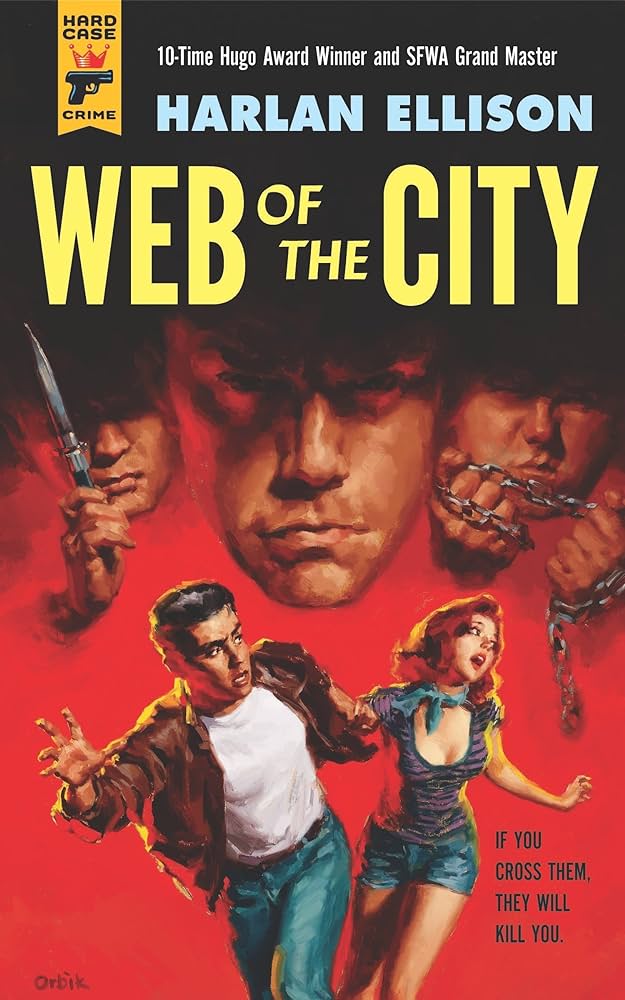
Harlan Ellison (1934-2018) is mostly known for his work as a science-fiction author and essayist. While going through U.S. Army basic training in 1957, Ellison wrote his first published novel called Web of the City that was initially released under the title of Rumble in 1958 when juvenile delinquent novels were a hot property. Hard Case Crime reprinted the novel in 2013 while also adding three of Ellison’s street-gang short stories to the volume.


Web of the City is a novel about a fictional New York street gang called The Cougars. Ellison claimed that he researched the book by going undercover in a Brooklyn street gang called The Barons using a fake name, and he served as “war counselor” for ten weeks before leaving. For the record, I think that story is somewhere between wildly exaggerated and complete bullshit. Nevertheless, he wrote a memoir about his supposed street gang internship called “Memos from Purgatory,” a 1961 release before fact-checking of outlandish claims was a thing.

In the novel, 17 year-old Rusty Santora declares that he wants to leave his position as president of The Cougars, but his former street gang members have other ideas. In order to prevent his desertion, gang members stomp Rusty down, and convince him that he’s good as dead if he doesn’t fall in line. Meanwhile, tensions are mounting between The Cougars and their arch-enemies, The Cherokees (the Brooklyn variety, not the Native Americans). As you may have guessed, a rumble is inevitable.

The juvenile delinquent genre tropes come at the reader fast and furious in this thin novel. You have the high school shop teacher with the heart of gold encouraging Rusty to leave the street life behind and pursue a career as an industrial designer. Rusty’s sister is following in his footsteps as an up-and-comer in The Cougars Girls Auxiliary (“The Cougie Cats”), and he’s terrified that she might never see adulthood. Some of the tropes are quaint - much of the drama takes place in soda shops and the gangbangers use switchblades and broken bottles when violence explodes at the teen dances.

Eventually, an actual plot emerges when gang activity hits close to home for Rusty. His sense of grief and street honor compel him to seek revenge, and Ellison treats the reader to a compelling vendetta storyline that keeps the tension mounting until the final climax. It’s nothing you haven’t read before, but this iteration is extremely well-crafted.

The fight scenes - and there are many - are vividly drawn and offset the corniness of the story. It’s a fun read if you’re looking for a throwback to a simpler time when guys were guys and dolls were dolls. I’m sure it was written as a serious sociological peek behind the curtain of an grim urban subculture devoid of hope. These days, it’s just a bit overwrought and a mostly entertaining time capsule. Buy a copy of the book HERE

Friday, March 13, 2020

Wasteworld #04 - My Way

With 1984's My Way, the four-book Wasteworld series comes to an abrupt end. Authored by a combination of Laurence James and Angus Wells, this post-apocalyptic series centered on U.S. military veteran Matthew Chance and his perilous endeavors to reach his ex-wife and kids in Utah. Beginning in New Orleans, each book showcases Chance's road to survival through warlords, mutants and dictators in the same manner that popular doomsday series titles The SurvivalistDoomsday Warrior and The Last Ranger also did.

In the Wasteworld third installment, Angels, Chance had seemingly met his match with a vicious gang of Hell's Angels bikers. Thankfully, a female Apache warrior named Kathi saved the day in the book's grandiose finale. My Way is a seamless continuation as Kathi and Chance head north into Nevada. After a couple of quick run 'n gun battles, Kathi's part of the narrative concludes and Chance arrives in Las Vegas to begin another adventure.

After meeting a nice mechanic and his hospitable family, Chance learns that Vegas is now controlled by two brothers, Al and Tony Clementi. Like a 1950s crime-noir paperback, the two brothers control the city's gambling venues and drinking halls. When they target the mechanic's young daughter, Chance is thrust into a war with a doomsday crime syndicate. After killing Al, Tony's faction declares war on Chance. While that narrative comes to fruition, a side-story develops with three bounty hunters from Texas hunting Chance through the Vegas rubble.

Despite the book's exciting premise, My Way fails to deliver a pleasant reading experience. Far too often the authors digress from the narrative to explain a minor character's history or to inform readers of an outlaw's infamous history. For example, there's a whole segment on Billy the Kid. While the action was enthralling, I felt it was misplaced and untimely. When key scenes required gunplay, the reader was served dialogue. But when a descriptive scene analysis is required, the characters just shoot it all to Hell.

While publisher Granada probably had a limited circulation (UK and New Zealand only), the sales numbers just didn't produce a commercially-successful series. Unfortunately, My Way wasn’t written as a series finale, so invested readers aren't provided a proper conclusion to Matthew Chance's epic struggle. This novel's poor execution ensured that interest in a proper ending likely dwindled among readers. Looking at the series as a whole, the first and fourth books were lukewarm while the second and third installments were very enjoyable. Having read the Wasteworld saga once, I'm not terribly interested in ever reading it again. It might be worth the time and effort to track down the series, but there are certainly far better books to pursue.

Buy a copy of this book HERE