Monday, June 19, 2023

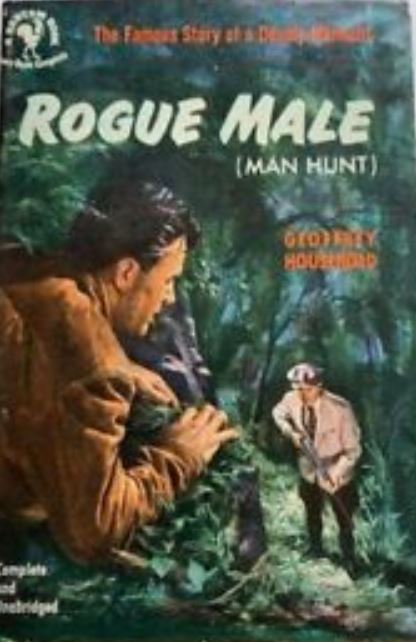
Rogue Male

According to Wikipedia, Geoffrey Household (1900-1988) was born in England, earned a B.A. in English Literature, worked as an assistant confidential secretary in Bucharest, sold bananas in Spain, and wrote children's encyclopedias and children's radio pays for CBS. During WWII, Household served in British Intelligence internationally. Household began to write in the 1920s and saw his first novel published in 1936. Overall, he authored 28 total novels, and seven short story collections. But, his most admired and critically acclaimed book is 1939's Rogue Male. The novel was adapted into the film Man Hunt in 1941 and as Rogue Male in 1976. I stumbled onto the novel after reading a number of interviews conducted with David Morrell, an author that cited Rogue Male as a primary influence on his bestseller First Blood

The book's protagonist is a British citizen, unnamed, that loves firearms and hunting. In the opening pages, the character is placing his rifle optics on a dictator, presumably Hitler or Stalin, for sport. But, he is immediately caught by the dictator's military and taken inside to be tortured. At some point, the torture escalates and a military man vomits. From the description, one of the character's eyes becomes lacerated and burned. After the torture, they throw the character over a cliff, making it look like an accident. 

Fortunately (unfortunately for me), the character survives and heads back to England where he finds himself hunted by the dictator's secret police. The character manages to kill one at a train station, then journeys into seclusion in the forest. Here he burrows into a hideaway, but is soon found by his pursuer.  The character is then faced with dying from lack of water and food or somehow killing his enemy.

There's no bones about it. Rogue Male did nothing for me. The narrative is brittle, with a British dryness that seemed absolutely lifeless and one-dimensional. I enjoy British espionage and high-adventure novels, but Rogue Male isn't what I would consider spy-fiction despite the characteristics. In reality, the author spends a painful amount of time dragging his character through the forest examining hedges and trees. The payoff finale was void of any excitement (although it was shocking), leaving me numb with boredom and wishing I had the hours back.

Rogue Male sucks. Bottom line. 

Try your luck with it HERE.

Friday, June 16, 2023

Spy Hunt

Paperback Warrior features a fairly robust section for author Norman Daniels (real name Norman Danberg, 1905-1995), including a podcast feature on his life and literary work. While I enjoy a variety of his crime-noir paperbacks, I feel like he was best served as a spy-fiction writer, or at the very least, international conflicts concerning the military. His best work is probably the eight-book espionage series Man from A.P.E.starring American secret-agent John Keith. That series debut, Overkill, was published by Pyramid in 1964. But, as a template for that series, Daniels authored a stand-alone secret-agent novel called Spy Hunt. It was published in 1960 by Pyramid and now exists as an ebook by Fiction Hunter Press.

In Spy Hunt, readers are introduced to Jeff Stuart, a CIA operative working directly for Colonel Piper. In the book's riveting opener, Stuart walks into his office and discovers a man pointing a gun at him. The next chapter explains how Stuart ended up in this situation. With very little rest, Stuart was ordered to fly round-trip from Washington D.C. to Hong Kong to retrieve a document from an unnamed man. Tired from jet lag and little sleep, Stuart walks into his office, sees the man with the gun, and is ordered to give the document up. 

Stuart complies with the man's orders, surrenders the document, and then on the brink of exhaustion, hunts his enemy down to retrieve the document. He then takes his enemy back to his office to torture him for information. At the point of pulling the trigger to execute the man, Colonel Piper's people arrive and inform Stuart that this was just a training exercise. Piper wanted to be sure that Stuart could operate in a stressful/no sleep situation. Also, if he could pull the trigger. Stuart proved capable. 

Stuart's next assignment is legit. An American scientist has been captured by the Russians and the American government wants to shut him up. To avoid the scientist singing American secrets, the CIA wants Stuart to pose as a Cuban in Moscow undercover as a weapons buyer for Castro. He is to kill the scientist at the first opportunity, then escape the country with no American assistance or aid. Stuart understands that the mission will probably be suicide (complete with those deadly poison capsules on his body), but he's sworn to the agency.

The author's variables in the story make the narrative come alive with mystery, excitement, and a sense of urgency. Stuart's nemesis is a female Russian agent hoping to seduce and kill him. On the flip side, the Russians invite the scientist's wife to Moscow for a cordial face to face visit. Stuart uses her as an inside track to the prison where the scientist is being held. These two women, both on opposite ends of the spectrum, create sexual tension and deadly encounters as Stuart treads water to kill his target and escape Russia alive. 

Spy Hunt was absolutely terrific, but I do feel that Daniels' second-half narrative was way too long. Despite the book's length of a mere 150 pages, the second-half is a road trip survival adventure as Stuart drives through the countryside receiving aid from begrudged laborers. The finale was fantastic, but it was cumbersome for 35-40 pages. Regardless, Daniels voices Stuart's third-person narrative, and the story for that matter, like a solid Matt Helm installment by Donald Hamilton. Or, as I alluded to earlier, a building block for his Man of A.P.E. series. If you love a good globe-trotting Cold War affair, then Spy Hunt is highly recommended.

Buy a copy of this book HERE

Wednesday, June 14, 2023

North and South

In 1982, paperback author John Jakes (1932-2023) struck literary gold with his 800+ page Pre-Civil War epic, North and South. The bestseller furthered the author’s career as one of the most popular American authors of historical fiction while spawning two sequels and a hit 1985 miniseries adaptation.

The novel opens in 1686 with the story of how a young ironworker named Joseph Moffat finds himself fleeing Scotland for what is now Pennsylvania under the name Joseph Hazard to avoid a murder charge. Jakes’ storytelling sucks you right in with violence and adventure. We also meet a young aristocrat from France named Charles Main (formerly Charles de Main) who is an early settler in the American colony of Carolina making his money in the pelt and slave trade.

These dual prologues provide the reader with a brief explanation of how the Hazard family and Main family find themselves in the North and South respectively. The novel’s linear action really begins in 1842 when George Hazard on Pennsylvania and Orry Main of South Carolina find themselves in the same cadet class at West Point Academy. This is 19 years before the U.S. Civil War kicked off.

By this point, the Hazard family has a successful iron company, and the Main family own a rice plantation with over 150 slaves. Despite the cultural divide, the two lads become fast friends. George is full of humor and knows how to charm the ladies. Orry is more serious and reserved with his only focus being a success as a soldier. Upon graduation, they are deployed to the same infantry unit just as the Mexican-American war is heating up over the annexation of Texas.

Throughout the novel, the moral quandary of slavery is always humming in the background. The Northern characters find the practice repellant, and the Southern characters find a myriad of ways to rationalize enslaving blacks. This percolates up in heated debates throughout the novel that eventually divide the young nation and spark a civil war.

The author was also influenced by plantation novels like Mandingo/Falconhurst series in depicting the savagery of slavery and the stigma of mixed-race romances. In these scenes, there are some shocking images of torturous violence and others of forbidden love. The sex in North and South is all off-page.

The Civil War is not the centerpiece of this epic novel. The War Between the States is the focus of the 1984 sequel, Love and War. Instead, this first book in the trilogy focuses on the North vs. South Cold War — the culture war, if you will, — driven by disagreements regarding slavery. The two families and their respective journeys taking them up to this great divide during a fascinating time in America’s evolution as a nation are the vehicles for Jakes to examine this time in history.

I enjoyed North and South quite a bit, but the book is long. And it felt long. Unlike big books like Lonesome Dove and Pillars of the Earth where the pages fly by and you don’t want it to end, North and South felt like trying to devour a ten-season Netflix series. It’s a lot to carry but never hard to follow. Nevertheless, there are way too many storylines and characters. The fact that there are two more 800-page behemoths in the trilogy makes my head ache.

If you can gather up the energy for a historical epic novel, North and South is a fine choice. It’s a giant meal, but fully-digestible if you’re in the right headspace. I want to know what happens to these characters in the war and thereafter, so I’ll definitely read the sequels. But I need some 180-page pulpy paperbacks to cleanse my palette first. 

Buy a copy of this book HERE.

Tuesday, June 13, 2023

Rex Brandon #01 - Death Warriors

In 1951 and 1952, British author Denis Hughes (1917-2008) wrote 12 novels under the pseudonym of Marco Garon starring international adventurer Rex Brandon. These were among the 50 titles Hughes wrote using a variety of pen names over the five year period between 1949 and 1954. Bold Venture Press is reprinting the series, starting with the first installment, Death Warriors, from 1951.

Rex Brandon is a geologist and big game hunter by trade, but a swashbuckling adventurer at heart. Death Warriors finds Rex summoned to the heart of savage Africa by a French colonialist in the fictional African nation of Mandibarza. Brandon’s mission is to locate an explorer who went missing in the jungle while he was searching for irikum, a rare mineral valued for its potential to produce atomic energy.

Using the guise of a big game hunt with a goal of shooting gorillas (which, I guess, was a thing in 1951?), Rex and his small expeditionary team set off into the jungle to locate the missing explorer and the irikum. The reader also learns that another search party with the identical mission previously became lost and never returned from the wilds. The previous mission included a beautiful woman named Coralie, and you’d correctly surmise that she will be the damsel in distress requiring saving at some point.

In the jungle, it quickly becomes clear that there are others in the woods - beyond the man-eating lions - who wish to thwart the expedition. Members of the party start disappearing, and supplies are scarce. There’s not a ton of action in the novel’s first half, but the Blair Witch Project vibe of the thick and menacing woods is certainly unsettling. Things go from bad to worse for Rex and his companions when the war-painted, jungle savages (of the “ooga-booga” variety) make their inevitable appearance halfway through the adventure.

If the novel’s first half is mostly setup (although not uninteresting), the second half moves quickly from one pulpy action set-piece to another. Rex and his sidekicks are forced to tangle with every flavor of African jungle menace you can imagine, and it’s a cartoonish blast building up to a conclusion that leaves Rex alive to experience the next 11 adventures in the series. 

Fans of Tarzan and Doc Savage will feel right at home with Rex Brandon. Based on this short novel, it seems that pulp-fiction from Great Britain in 1951 has a lot in common with American pulp-fiction from the 1930s. While Americans were turning a page to the gritty realism of 1950s noir, British readers were still enjoying square-jawed heroes rescuing women from the jaws of killer crocodiles in the darkest realms of Africa. Whichever your preference, we should all be grateful that there are outfits like Bold Venture Press keeping these works of pulp literature alive in the 21st Century. 

Buy a copy of the book HERE

Monday, June 12, 2023

Winter Marines, The (aka Winter's Coming, Winter's Gone)

Allen Glick served two tours of duty in the U.S. Marine Corps during America's involvement in the Vietnam War. He survived the 1968 TET Offensive and the siege of Khe Sahn. After the war, he became a master carpenter, and a high school English teacher. During this time, Glick was also a writer, penning four original novels. Based on his Vietnam War experience, he authored the fictional novel Winter's Coming, Winter's Gone. The book was originally published in 1984 as a hardcover by Eakin Press, but thankfully was reprinted as The Winter Marines, a mass market paperback by Bantam in 1987. It is now available in ebook format. 

At nearly 350-pages, The Winter Marines, is divided into two time periods featuring protagonist David Schrader. The first-half thrusts the nineteen-year old Schrader into the steamy, war-torn jungles of Vietnam in 1966. The book's second-half focuses on Schrader's post-war civilian life in Austin, Texas in 1979. Separating the two halves is a 20-page layover with Schrader in Florida in 1972. 

In Vietnam, Glick's experiences are conveyed to the reader through the fictional, battle-weary eyes of young David Schrader. Through the grueling patrols, intense firefights, bombings, and death, the narrative explores Schrader's resolve in battle and his camaraderie with his fellow soldiers. The author focuses on Vietnam's history, with a South Vietnamese family man named Li relaying his family's role in Vietnam's military campaigns, including the violent French involvement, to Schrader and his brothers-in-arms. There is some racial tension in the book's opening half which explores the Latino, African-American, and Caucasian bitterness, both a disturbing plot point and a reminder of just how far from home and far apart the Americans were despite the togetherness during the battle.

Post-war, Schrader's job as a bartender in Texas is a stark contrast to commanding soldiers and coordinating airstrikes using multi-million dollar equipment. Like a lot of Vietnam veterans, Schrader is suffering with PTSD. Exhausted from nightmares and a lack of sleep, Schrader's life is a cycle of lethargic, pointless activities that challenge his ability to simply rise and exist each day. Thankfully, he has a love interest and a close friendship with one of his war buddies. This second-half of Glick's narrative explores the fringes of drug abuse, alcoholism, and criminality, but shines a spotlight on the unfair condemnation heaped on Schrader and his fellow soldiers back home. Sadly, it's an accurate, historic look at a dark place in American history. 

If you are a military-fiction or non-fiction scholar, The Winter Marines is an obligatory read. There are plenty of autobiographies and accounts of the Vietnam War from many different perspectives. But, from the little I've read, Allen Glick's is one of the most realistic and alarming. While sometimes a tough read, it can also be an encouraging one. Highly recommended. 

Buy a copy of this book HERE.

Friday, June 9, 2023

Sheba

Jack Higgins (real name Harry Patterson, 1929-2022) was just getting his feet wet as an author when Seven Pillars to Hell was published. It was printed in 1963 by Abelard-Schuman under Patterson's pseudonym Hugh Marlowe. Mostly, the book went unnoticed and remained out of print for decades. Long after Jack Higgins became a household name, the author made revisions to his earlier works and saw them reprinted. Such is the case with Seven Pillars to Hell, which was revised into the 1995 novel Sheba, published by Berkley. I chose to read and review this version.

The book begins in Germany in 1939 with a select group of advisers meeting with Hitler on his plans to invade Poland. To avoid British interference, the men devise a method to blow up the Suez Canal. But, the problem arises with the immense distances required to fuel and attack the strategic location. When a colleague proposes that he has discovered the location of the legendary Temple of Sheba, buried in the ruthless Empty Quarter desert, the Germans create Operation Sheba to utilize this lost ancient structure as a supply depot for aircraft. 

A few months later, Higgins introduces Sheba's star hero, Gavin Kane, an Indiana Jones type of adventurer that is an archaeologist and nautical smuggler. After one of his illegal sea-run trades, Kane meets a woman who offers to pay him to locate her husband. Coincidentally, her husband is the professor that originally discovered the Temple of Sheba. Chances are that the man was killed, but Kane is a businessman and accepts the job. 

Sheba is saturated with fast-paced action sequences, most of which culminate in the hot desert sands as Kane, his associates, and his employer are on the run from Nazis. Like King Solomon's Mines, for example, the book's second half is mostly presented as a treasure hunt in the temple's underground passageways and secret tunnels. But, a brutal survival element is introduced that places characters forging for freedom through the harsh elements. 

Higgins is one of the best adventure writers of all-time, so his imagination and storytelling is superb as the book kicks into the third and final act. In some ways, a lot of his novels have a similar theme with WW2 historical vines weaving in and out of iron-fisted, strong-armed heroic fantasy (swords traded for machine guns). Once again, Higgins knocked my socks off with one of the better books I've read by him. This one was really something special and I'm glad it now exists in multiple formats for lifetimes to come. Highly recommended! 

Buy a copy of this book HERE.

Wednesday, June 7, 2023

How to Sell a Haunted House

In How to Sell a Haunted House, main character Louise resumes her strenuous relationship with her brother Mark after their elderly parents die in a car wreck. The reunion takes place in their parents' home in Charleston, South Carolina, where both of them spend time and energy dredging up their tumultuous childhood memories while warring and speculating over the proposed inheritance. But, the element that makes Grady Hendrix's haunted house book scary is a puppet. An evil, murderous, terrifying, and memorable little puppet.

After discovering repressed memories, Louise must come to grips with the fact that her parents were super weirdos and supernaturally gifted (cursed?). While her parents were loving and mostly appeared normal, behind closed doors there were a lot of bizarre things happening with porcelain dolls and clown puppets, the objects that 90% of children are deathly afraid of. Through a fast-paced narrative that incorporates some disturbing bloodletting and sadistic puppet mania, Hendrix hits his stride and thrills to the end.  

Hendrix isn't a stranger to hysterically funny horror. His novels like Horrorstor, My Best Friend's Exorcism, and The Final Girl Support Group are bestsellers due to the unique blend of satirical comedy and clever fanboy horror. How to Sell a Haunted House employs all of Hendrix's horror tropes, but still has a very personal, intimate story to share. 

If you want a not-so-traditional haunted dwelling tale, then this is an open house invitation you can't decline. Recommended!

Buy a copy of this book HERE.