Wednesday, July 12, 2023

Killer Blizzard

Before pursuing a career in journalism and public relations, Dan Jorgensen studied creative writing at Colorado State University, where he wrote his first book, Killer Blizzard. The novel was published by Major Books in 1976 and lives today as a Kindle Unlimited selection.

The paperback opens with a violent prison break with a pair of inmates escaping into the wintery night. It’s a good evening for an escape because police and emergency services are otherwise occupied while buckling down for the arrival of a blizzard — a Killer Blizzard, in fact!

We also meet a lovely young couple named Rollie and Jean, who live in a farmhouse. Rollie is a highway patrolman, and Jean’s job is being pregnant. As luck would have it, shortly after Rollie leaves for his Killer Blizzard patrol, the half-frozen, escaped inmates stumble into the farmhouse demanding refuge from pregnant Jean.

Meanwhile, Patrolman Rollie is dealing with a series of blizzard-related emergencies on the roads while his wife is forcibly hosting the two hoods. The paperback nicely balances the weather-disaster genre with a criminals-on-the-run noir as the chapters toggle back and forth quite well.

The author was clearly influenced by Fawcett Gold Medal paperback original novels of the 1950s and 1960s. His writing is straightforward and uncomplicated with no-frills linear plotting. There’s just enough character development to understand everyone’s motivations, but it never slows down the action.

The novel builds to an exciting climax that is quite satisfying to read, and it went in directions I wasn’t necessarily expecting. All-in-all, this was a pretty good read. Don’t spend a fortune acquiring it, but if you are seeking a vintage paperback to enjoy with your Kindle Unlimited subscription, you’re sure to enjoy Killer Blizzard

Buy a copy of this book HERE.

Monday, July 10, 2023

The Dark Hour

In the beginning of K.J. Young's The Dark Hour, set in the 1970s, a young guy named Mark is attempting to secure a brand new job. He finds himself interviewing for a home health aide position at a deteriorating mansion in the bad section of town. The job seems simple enough, pays well, and mostly consists of assisting the primary caregiver, a young woman named Lisa, take are of two elderly siblings named Roy and Alma. She'll clip the toenails and trim the ear hair, he can just do the easy stuff.

Like a terrifying prophetic warning, Lisa advises Mark that she feels that something isn't quite right about Roy and Alma. She claims there are weird photographs on the mansion's unused upper floors. Seconding the sentiment is a hippy sketchy neighbor that warns Mark to stay away. But, Mark slowly becomes entranced by Roy and Alma's past lives as magicians, and quickly becomes infatuated with the idea of wealth. Roy and Alma have a tremendous amount of money, own a pricey sports car, and seem to take a liking to Mark as if he is a family member.

Mark notices that Roy and Alma belong to a weird society that seems incapable of aging. When Lisa flings herself off the top of the mansion, the narrative escalates to introduce Mark's girlfriend Michelle, and her new role as Roy and Alma's friend and health aide. Is she leapfrogging Mark to capture a possible inheritance?

The Dark Hour is an average thriller that uses old-school gothic horror tropes to propel the narrative. The central mystery is easy to figure out, and Mark and Michelle's involuntary participation in their “eternal youth” is an overused literary plot that dates back centuries. But, Young's writing is enthralling enough and has a unique twist that makes the chief protagonist unlikable until the end. This concept challenges the reader's allegiance to the character and makes for an interesting presentation. Overall, if you like this sort of modern goth (like Darcy Coates), then The Dark Hour should be a pleasant experience. 

Buy a copy of this book HERE.

Friday, July 7, 2023

Black Eye

According to publisher Bold Venture Press, Tony Masero was born in London, attended art school, and trained as a graphic designer. He eventually began illustrating book covers for the major publishing houses and agencies. Masero has created artwork for Dr. Who, Edge the Loner, Indiana Jones, and countless fanzines and paperbacks. Along with illustrating, Masero also writes men's action-adventure, crime-fiction, and western novels. My first experience with his literary work is Black Eye, published by Bold Venture Press in 2020.

In first-person perspective, Phil Black explains to the reader that he does favors for people. He served in WW2's Pacific Theater, and now hangs around San Francisco reading the paper, smoking, and gazing out the window. He has an old Marine buddy that camps out at the local bar, a guy nicknamed Gunny, that can quickly get the word from the street, the city's gossip, and the ins and outs of localized crime. So, it's no surprise when a beautiful woman named Linda crosses Black's path. 

Linda's husband served with Black in the war. Now, he's gone missing, she's filed a missing persons report with the police, and she wants Black to look into it. Semper-Fi and all of that. Black agrees to the opportunity and begins his search by scouring the man's boxing history, specifically finding his corner-man. With Gunny's help, Black weaves in and out of clues and amateur gumshoe tropes to learn that the man's disappearance connects to a heist made during the war.

On Iwo Jima, some of Black's unit were involved in heisting some treasures through an undercover operation. Later, the Chinese became involved, mostly with a Syndicate attempting to recover a sacred tablet. The book's first half is a violent, pulpy romp as Black attempts to locate the tablet and its owner while combating the nefarious individuals out to stop him. Surprisingly, the book's second half is sort of a different story that places the hero and Gunny in Argentina working with the FBI. This second half is more of a prison breakout as an espionage-styled adventure. 

Masero pays homage to plenty of mid-20th century crime-noir and men's action-adventure, but mostly his entertaining story is like something exploding right out of the pages of Black Mask. By placing the story in the late 1940s/early 1950s, his emphasis on style and pulpy characteristics really stands out. The violence wasn't over-the-top, but still offered enough brutality to keep the pages flying by. 

In some ways Masero's writing style, complete with the genre tropes we all love, reminds me of author Will Murray (Doc Savage). While not necessarily original, it still compliments the genre and offers fans exactly what they want – story and style. Black Eye has it all in spades and I highly recommend it. 

Buy a copy of this book HERE.

Thursday, July 6, 2023

Pulp Champagne - The Short Fiction of Lorenz Heller

Lorenz Heller (1910-1965) was an awesome crime-fiction author under a variety of different pseudonyms who was largely forgotten until Stark House Press began reprinting his novels under his actual name. The publisher has released a 13-story compilation of Heller’s short stories spanning from 1947 to 1955 from the pulps and digests.

The compilation has a smart introduction by pulp scholar Bill Kelly, who explains that Heller’s gimmick, if it can be called that, is deep and thorough characterizations nestled into the salacious, pulpy plots. His characters are well-drawn and three-dimensional rather than archetypes or stereotypes that exist solely to push a plot forward. I’ve made this point in my previous reviews of Heller’s novels, and I wanted to see if this literary trick could be sustained in the four stories I sampled from the collection.

“I’ll See You Dead”

This story originally appeared in Detective Tales from May 1947. The narrator is Al Crane, a newly-promoted police detective who is also a family man with a reputation for honesty. One night at a bar, Crane receives a tip that a local torch singer had recently been tossed in the river to die by goons working for a local mobster. As a cop with a sense of duty, Crane is compelled to act.

It’s a pretty good short story with a specific “solution” typical of a lot of pre-Manhunt 1940s crime stories still bound to the conventions of mystery fiction. Heller’s writing is solid as his narrator adopts the hardboiled voice we’ve seen elsewhere from Robert Leslie Bellem and Carroll John Daly.

This was a good story, but I want to see what Heller could do after 1950 when hardboiled crime-fiction got great.

“Forger’s Fate”

This one was from Dime Detective’s April 1951 issue, and it’s organized as a verbatim transcript of a statement provided to the District Attorney’s Office by a Florida man named Wesley Smith. He’s a salesman peddling a check-writing machine designed to thwart forgers. As part of his sales pitch, Smith practices a trick called “muscle forgery” to show how easy it is to copy another’s handwriting perfectly.

After showing off his talent in a bar, Smith is strong-armed into a situation where he is pressured to use his forgery skills to cover up a murder. This is a great story largely because Smith is such a foppish blowhard of a character. Don’t skip this one. It’s a really fun read and a surprisingly violent action story.

“Don’t Ever Forget!”

March 1953’s Detective Story Magazine brings us this gem. Our narrator is recently-retired Police Chief McMahon, who is grabbing a meal and some coffee with his replacement in their dumpy Florida backwater town. A reporter approaches McMahon wanting to do a story on the former chief, who declines the offer.

Later, McMahon learns that the reporter asking around about him isn’t a reporter at all. What’s his agenda? McMahon’s badge-less investigation is solid and the ending is satisfying in this neatly-packaged short story.

“Living Bait”

This one originally appeared in the May 1955 issue of Justice! (a decent Manhunt knockoff). It takes place on a Florida chartered fishing boat with a couple catching tarpons, a local fish. The guy is a wealthy blowhard and his girl is a real dish. The boat captain is telling the story, and his first mate is a colorful, lively character.

A fight erupts and one of the characters falls overboard - presumably dead in the choppy sea. Was it murder or is something else going on? This story was a complete delight and showcased Heller’s superior characterizations.

Paperback Warrior Assessment:

As expected, Pulp Champagne is a terrific collection by an author worth remembering. I will say that if you are looking for very hardboiled crime short stories, any of the Manhunt anthologies from Stark House are superior volumes. Fortunately, we live in a world where you can own them all, so you probably should. 

Buy a copy of this book HERE.

Wednesday, July 5, 2023

Duke Rhoades #01 - Finding Anne Farley (aka Ring My Love With Diamonds)

I was thumbing through some old hardcovers and stumbled on Best Detective Stories of the Year – 1978. It was edited by Edward D. Hoch and published by E.P. Dutton. The first author I flipped to was John D. MacDonald. The entry is called “Finding Anne Farley”, a novelette that first appeared in 1977 as a serial in the Chicago Sun-Times and other newspapers via the publication's Field Newspaper Syndicate. 

There are a number of interesting aspects to “Finding Anne Farley”. First, and foremost, is that this was the debut of MacDonald's short-lived insurance-investigator Duke Rhoades. The character's first name is derived from his described physical appearance as being similar to actor John Wayne. The character appeared in two additional stories, “Friend of the Family” (1978) and “Eyewitness” (1979). Second, “Finding Anne Farley” was a unique five-week concept that allowed readers to mail responses on how the story will end. The lucky winners received a monetary prize payout. Lastly, the syndicated run of the story allowed newspapers to run the story under an alternate title of “Ring My Love With Diamonds”. 

As readers are introduced to Rhoades, he has just accepted his most recent job of retrieving stolen diamonds. The owner of an Atlanta jewelry store filed an insurance claim that 32 pieces of jewelry were stolen from his store. The thief, and possible accomplices, reproduced and systematically replaced these stolen diamonds with fakes. After a lengthy criminal investigation, and repeated calls and letters, the store was paid out for the missing diamonds. The conclusion is that an employee named Anne Farley was behind the theft. She took the money and ran, seemingly disappearing into parts unknown. If Rhoades can get a lead on her whereabouts, he may be able to locate the diamonds and put the insurance company back to even.

This five-week serial amounts to about 30 hardcover pages, a suitable length for MacDonald's “search and rescue” narrative to propel through the peaks and valleys of the investigation. Rhoades is a likable hero, complete with the gumshoe characteristics and tender-heart that makes for an honest and capable protagonist. The ending was a little stereotypical of a cozy whodunit, but getting there was fun. You can read this story for free HERE.

My source for this review was Steve Scott's excellent blog The Trap of Solid Gold. He has a detailed, and more analytical look at this story and character HERE. I also snagged the accompanying artwork there as well. 

Monday, July 3, 2023

Death Ends the Scene

“Death Ends the Scene” is a 1948 Dan Turner Hollywood Detective mystery novella originally from Hollywood Detective Magazine that is available today as part of the compilation, Homicide Hunch from The Pulp Fiction Book Store.

The setup for this one is really cool. A letter is delivered to Private Eye Dan Turner containing $500 cash and some very specific instructions. The client is about to kill himself, and he wants Turner to come to the suicide scene, take the gun and stash it - creating the misimpression that the death was a murder. This will allow the client’s widow to enjoy a double-indemnity clause in the insurance policy, whereas a suicide would pay out nothing.

The scheming suicider is a famous director who had fallen out of favor with the industry and hit the skids. On his way to the bottom, the director married a gold-digging bitch who stands to benefit from his double-indemnity scam. Can Turner get to him before he offs himself? Is there money to be made here without getting sideways with an insurance company?

Turner immediately learns that this unusual client is in serious debt to a gambling racketeer named Benny the Greaseball (subtle touch, Mr. Bellem). The mystery unfolds delightfully from there with plenty of hardboiled patter and outstanding fight scenes.

These Dan Turner stories are cheap and plentiful — they are also a ton of fun to read. “Death Ends the Scene” is no exception. This novella is such a compelling joy. It’s literary candy, but you won’t regret the couple hours you spend devouring this story. 

Buy your illustrated copy of the book, which includes this story, HERE.

Friday, June 30, 2023

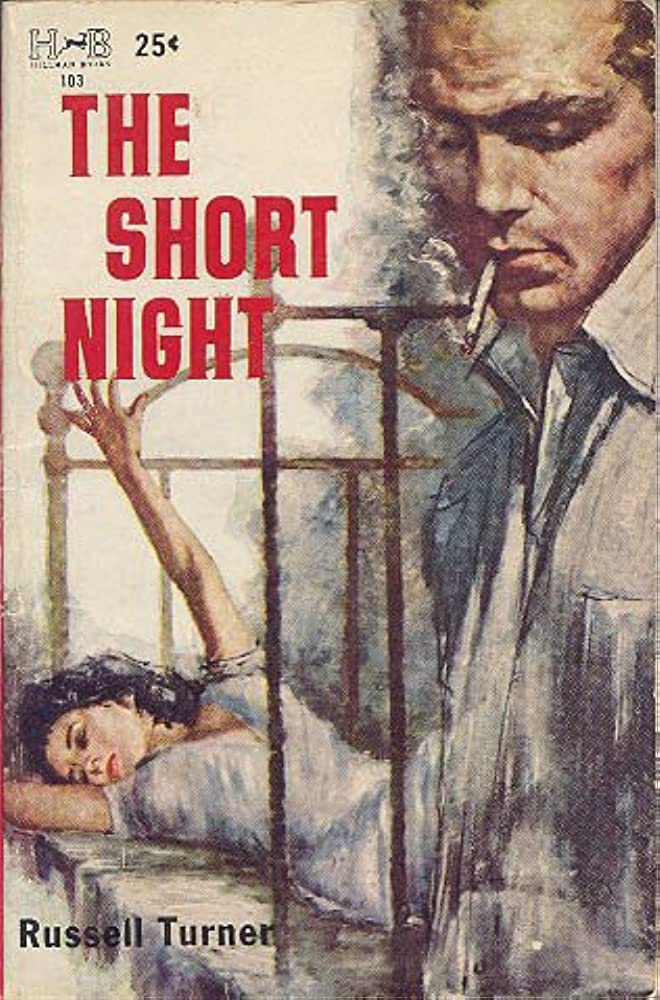
The Short Night

Leonard S. Zinberg (1911-1968) was best known for his work under the pseudonym Ed Lacy, but he also employed other pen names, including Russell Turner for a 1957 noir paperback called The Short Night. The novel has been reprinted by Cutting Edge Books for modern audiences.

Our narrator is a former first-baseman and current baseball scout for the Brooklyn Dodgers based in Vero Beach, Florida named Lester “Red” Dolsan. As the novel opens, he’s just arrived in Manhattan two years after the suicide of his wife. Dolsan is good with money and has a pad in NYC that he hardly ever uses because he’s always on the road - mostly in Puerto Rico recruiting promising Latino shortstops.

Before email and voicemail, people wrote letters on paper or used phone answering services to take messages — also on paper. Going through the messages and letters awaiting him in New York, Dolsan learns that a woman he knew briefly from his past named Peggy was trying desperately to reach him. The flashback of their meet-cute is pretty great, so I won’t spoil it here.

When Dolsan tries to find Peggy, she has largely disappeared. Some amateur gumshoe work starts to fill in the blanks about why she was looking for him months ago. His need to locate Peggy is serious, and the more he searches, the deeper he finds himself enmeshed in the mystery of her disappearance.

Lacy (he’ll always be Ed Lacy to me) is an awesome writer, and his dialogue is among the best of that era. Dolsan is a tough, hardboiled knight-errant with a heart of gold. You’ll really enjoy spending time with this character. In fact, all the characters are vividly-drawn and endlessly-interesting. I’m baffled why this mini-masterpiece was published by a back-bench paperback house using one of the author’s disposable pseudonyms. This book is really something special.

The novel’s central mystery (“What happened to Peggy?”) has a delightfully-clever solution that I couldn’t see coming. Dolsan’s reaction to the dilemma once he solves the mystery also made for some fine reading. Do your best to avoid plot details, and you’ll be delighted throughout this wonderful treat of a paperback. Highest recommendation.