Friday, September 1, 2023

Tarzan #03 - Beasts of Tarzan

Just one year after the series' second installment, The Return of Tarzan, author Edgar Rice Burroughs saw his third Tarzan installment, The Beasts of Tarzan, serialized in All-Story Cavalier in 1914. The story was published in book format (with additional text) by A.C. McClurg in 1916, and has since been published in numerous formats and re-imagined on countless media platforms. 

Like the publishing history, the events in this novel take place about a year after The Return of Tarzan. In the early portion of the novel, readers learn that Tarzan has built an estate home in Uziri, Africa and spends part of his time at another estate in London. Tarzan and Jane also have an infant son named Jack, who was first introduced in the Burroughs novel The Eternal Savage (serialized as The Eternal Lover), which isn't a necessary read to enjoy this Tarzan installment. Jack plays a prominent role in The Beasts of Tarzan, but more as a concept than an actual character. 

The book's narrative revolves around two of Tarzan's fiercest enemies, Russian men named Nikolas Rokoff and Alexis Paulvitch. The duo first appeared in The Return of Tarzan, where they were caught and jailed for numerous criminal offenses, including attempts to kill Countess Olga de Coude, Lord Greystroke and his wife. In The Beasts of Tarzan, the two men escape prison (off page), a fact that Paris policeman Paul D'Arnot conveys to Tarzan in an apartment building. These two men manage to trap and kidnap Tarzan, Jane, and a baby (a surprise twist on the Jack kidnapping). Separately, the three are imprisoned on a ship called the Kincaid.

Later, Rokoff transports Tarzan to the isolated Jungle Island where he takes his clothes from him and ultimately leaves him there to die. He tells Tarzan that he will take Jane to be his lover and that Jack will be raised by a tribe of cannibals (harsh!). Thankfully, Tarzan is at home in this sort of savage wilderness. He quickly dispatches a king ape and befriends another ape called Akut. Tarzan also befriends a giant cat (panther?) called Sheeta and a Wagambi warrior named Mugambi. Together, these heroes lead a band of apes against Rokoff, Paulvitch, and their hired henchman. The propulsive plot features these heroes chasing the villains through the jungle and various tribes of savages. 

I can't reveal too much in this review, but The Beasts of Tarzan was better than The Return of Tarzan in my opinion. Burroughs' injects so much primitive violence and brutality into his writing, from Sheeta disemboweling enemies to Tarzan's fatal strikes of vengeance. As one would expect, the jungle tribes are filled with nefarious characters ranging from mercenaries to flesh-eating cannibals. I wish the book was slightly shorter, but the events at the end of the book concerning Paulvitch are important elements that set the table for the fourth series installment, The Son of Tarzan. As unnecessary as they may seem, the author had a grand design at work here. 

The Tarzan series is quickly becoming one of my favorites, and I'm anxious to read more of what horror, violence, and awe-inspiring adventures await this jungle family. In the meantime, Tarzan of the Apes, The Return of Tarzan, and this novel, The Beasts of Tarzan, are darn-near perfect. If you haven't read these books, you are in for one heck of a ride. Highest recommendation.

Buy a copy of this book HERE.

Wednesday, August 30, 2023

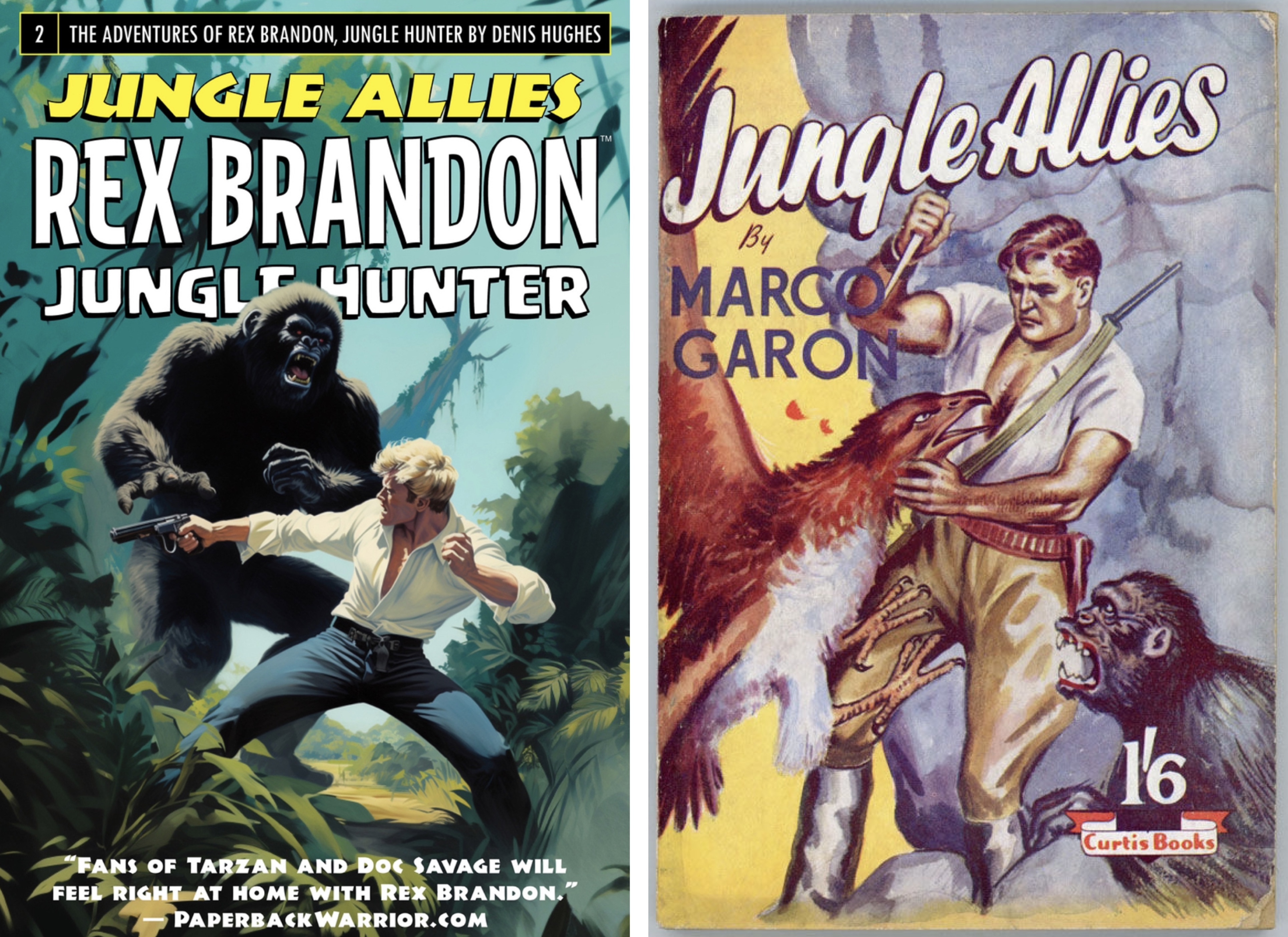
Rex Brandon #02 - Jungle Allies

The second installment of the jungle adventurer Rex Brandon series by Denis Hughes (1917-2008) has been reprinted by Bold Venture Press. It’s called Jungle Allies and it was originally published in 1951 under the pseudonym Marco Garon.

Rex Brandon is a world-famous geologist and big-game hunter who runs expeditions into the deepest part of Africa’s great Congo basin. In this adventure, the Belgians have engaged him to survey the jungle for mineral resources. He began his journey with 19 African “bearers” carrying Rex’s shit through the jungle, but he’s now down to a mere 15 due to accidents and whatnot with more carnage to follow.

One night while setting up camp along the fetid banks of a muddy river, Brandon happens upon a stumbling and exhausted white man along the river’s crocodile-infested shore. Brandon assists him back to camp and learns that he is an American named Jeff Lambert who was part of an archaeological expedition.

Lambert explains that his entire crew of academic archeologists was killed, and a female journalist named Naomi was captured by a fierce lost race of deep-jungle Africans. Fun Fact: The ferocious tribe holding the white chick is guarded by trained killer gorillas. With a challenge like that and a caucasian chick in-peril, it doesn’t take much convincing to send Rex on a rescue mission.

Along the way, they encounter a rogue elephant, a Pygmy tribe, hungry crocodiles, an attack-hippo, spear-chucking hostiles and a gang of pissed-off gorillas. There’s a lot of fun action spread throughout this economical 115-page novel. The series order is also irrelevant. You can safely start with this installment, if so inclined.

Jungle Allies is an exciting and fun African adventure book. However, you’ll need to set aside all of your modern sensibilities and remind yourself that this novel was written in 1951 when the idea of a “white savior” among savage Africans didn’t raise eyebrows. But if you enjoy an inventive and fun Indiana Jones-ish pulpy adventure, you’re sure to have a good time here. Recommended. 

Buy a copy of this book HERE.

Monday, August 28, 2023

Paul Chavasse #02 - The Year of the Tiger

Using the name Martin Fallon, Jack Higgins (real name Henry Patterson), authored a six-book series of espionage novels starring British spy Paul Chavasse. I've read and enjoyed the first, third, and fourth installments of the series – The Testament of Caspar Schultz (1962), The Keys of Hell (1965), and Midnight Never Comes (1966). The backstory on the second series novel is interesting.

Year of the Tiger was originally published in 1963 by Abeland Shulman as a hardcover in the U.K using the Martin Fallon pseudonym. Soon after publication, the book simply left the market and was never reprinted as a paperback like the other series installments (which all capitalized on Higgins' enormous household popularity). Like his other novels, Higgins and his agent decided these early books needed a freshening up. Higgins added additional details to Year of the Tiger (see below) and the book was published in paperback by Berkley in 1996 using the same title and the Higgins name. Simultaneously, it was also published in hardcover by Michael Joseph in the U.K.

What's really cool about Year of the Tiger's re-imagining is that Paul Chavasse is presented in the modern day. The book opens in London in 1995 and has Chavasse experiencing a nightmare from a previous adventure. When he awakens, readers are brought up to speed on Chavasse's life and career since 1969's A Fine Night for Dying, the series last installment. Readers learn that Chavasse has spent forty years in the British Secret Intelligence, twenty as a field operative, another twenty as Bureau Chief. Now, Chavasse is on the cusp of becoming the Prime Minister.

In a surprise meeting, Chavasse is approached by a Tibetan man who is inquiring about one of Chavasse's prior assignments – assistance to the CIA of getting the Dali Lama into India in 1959. This mini-adventure is presented as a flashback section condensed to about 17 pages. My assumption is that Higgins' original novel began here, void of the entire 1995 events. There's a brief present day London thing, and then the book takes readers to the bulk of the narrative, featuring Chavasse on a 1962 mission into Chinese-controlled Tibet to free a scientist. These Cold War thrillers from the likes of Higgins and his contemporaries seemed to consistently feature missions to free or kill scientists. As I alluded to earlier, the whole 1962 adventure, prefaced by the short 1959 stint, was probably the bulk of the 1963 hardcover. 

While Chavasse doesn't have the passion or flair of James Bond, or the clever satire of Matt Helm, I still really enjoy the character's down-to-business approach. Some readers of the series complain that Chavasse never completes the assignment efficiently. I'd like to think we are just reading about the assignments that didn't work out so well. The other 200+ adventures were probably tedious and dull. 

In this novel, Chavasse is captured, brutally tortured, and placed before a firing squad. In the middle, he makes a romantic connection, weeds out the traitor, contends with a brilliant villain, and befriends the scientist he's sworn to retrieve. The book's closing section wraps up the story quite nicely with a far-reaching present-day side-story that blends all of the narrative's pieces together. The end result makes this my favorite Chavasse novel to date and an easy re-read. Recommended! 

Buy a copy of this book HERE.

Saturday, August 26, 2023

Coffin #01 - Death Wish

Budd Lewis (1948-2014) began his entertainment career by directing television commercials between 1970 to 1974. Beginning in 1974, Lewis wrote for Warren Publishing, contributing his dark imagination to stories in Creepy, Eerie, and Vampirella. Lewis also co-created The Rook. Later, he would write for Hollywood, including Terminator and Dark Angel, as well as animated shows like The Smurfs and The Real Ghostbusters. The focus here at Paperback Warrior is on his western hero Coffin, which first appeared in Eerie in 1974. The popularity of the hero resulted in multiple appearances in the comic magazine. The vivid, violent artwork of these stories was created by Spanish artist Jose Ortiz (1932-2013; Rogue Trooper, Judge Dredd).

If you enjoy the vicious nature of the Piccadilly Cowboys of the 1970s, including their savage titles like Edge, Adam Steele, and Apache, then Coffin is a darn-near must-read title from that same era. The character's first appearance proves to be a true origin tale called “Death Wish”, which features 12 gruesome pages of western storytelling with an obvious horror overtone (obligatory for Eerie). 

In this story, readers are introduced to Coffin, an unnamed protagonist traveling by stagecoach through the Arizona desert in 1889. In flashbacks, Coffin is a smiling polished sales representative for Sharps Rifles, with his contract being the U.S. Army. Abruptly, the stagecoach is attacked by what appears to be Native American warriors on horseback. The drivers are both killed and the coach tips over, spilling Coffin onto the hot sand. Grabbing his belongings, including a rifle, Coffin scurries to safety. From the nearby rocks and foliage, Coffin sees the other travelers, all women, savagely murdered by the warriors.

Coffin, an average guy thrust into a nightmarish scenario, mistakenly takes the path of vengeance. He tracks through the desert and finds a tribe of Native Americans. From several yards away, Coffin shoots the men with his rifle. Before disposing of the whole tribe, Coffin is ambushed by a trio of braves and is brutally beaten. But, beyond the physical abuse, Coffin is cursed by the tribe. His curse is that he can never die. He can experience horrific pain – being shot, burned, skinned, and tortured beyond recognition - but he can never die. The tribe placed this curse on him because...get this...Coffin killed the wrong tribe to avenge the death of the stagecoach travelers! Further, on the last pages of the story, readers learn the real identify of the men who attacked the coach. This surprise ending was brilliant. Coffin totally screwed up, but that's what makes the story so entertaining. He wasn't born a hero, he isn't a hero. Instead, he's an average guy who just made a mistake and it cost him dearly.

The Coffin character would re-appear in Eerie issues #67 (Aug 1975), #68 (Sep 1975), #70 (Nov 1975), #130 (Mar 1982), and #137 (Dec 1982). The concept is that Coffin will rally behind the Native American cause at a point in history when the various tribes are warring with the military and also being brutalized into accepting shitty government deals. He also becomes a lone-avenger fighting insane religious cults and other nefarious predators. The Eerie reprints are available by Dark Horse and feature the Coffin stories.

Friday, August 25, 2023

House of Storm

Mignon G. Eberhart (1899-1996) authored mystery novels from the 1920s to the 1980s, earning her the praise as America's version of Agatha Christie. In fact, she was one of the leading female crime-fiction authors of her time (and one of the highest-paid) with a total of 59 novels, eight of which were adapted to film. She was awarded the Mystery Writers of America's Grand Master Award and also earned the Agatha Award. Eberhart also served as president of the Mystery Writers of America. 

My first experience with her is the 1949 novel House of Storm, which was originally published by Curtis. My version is the 1964 Popular Library paperback. The book exists in various formats and remains in print today.

The novel takes place over a 24-hour period of time on the fictional Beadon Island in the Caribbean. Like something out of a mid-20th century gothic-romance novel, the beautiful and vulnerable protagonist, Nonie, has recently experienced the loss of her father. With no other recourse, she moves to Beadon Island for a vacation. Eberhart sets the table by providing sheets of rain and prevailing wind as a hurricane descends on the island. This sort of chaos symbolically parallels Nonie's upcoming marriage to an older gentleman named Roy. This culmination of storm and mismatched marriage is the complimentary greeting for a murderer.

With a full house of various characters, a murder takes place when a wealthy woman is found dead. There's red herrings galore, ranging from Nonie's fiance Roy to her one true love of the story, an ambitious man named Jim. Each suspect is interviewed by both the island coroner and police, so the narrative unfolds in a typical armchair detective format – a house full of people with varying degrees of motive. The secluded house hosting a murderer makes for a great atmosphere that Eberhart feeds on. With thick tension, the clues are slowly unveiled to readers. Guessing the killer's identity before the police is ultimately the real thrill, as always. 

If you are a fan of the Agatha Christie novels like And Then There Were None, then this is certainly your cup of tea. For me, I found the narrative required a great deal of attention and patience and the prose was a little uneven. But, there's no denying Eberhart's storytelling strengths of character development and atmosphere. I'll be reading more of the author's work. 

Buy a copy of this book HERE.

Thursday, August 24, 2023

Do You Know Me?

In the Stark House Press reprint of One is a Lonely Number, my review stated, “This is a book that could never have been published in today’s climate as the societal norms have shifted too greatly.” That novel was exceptional, perfected by author Bruce Elliott's abstract writing style. Pulp fans may recall Elliott contributing to The Shadow paperbacks when the two-per-month schedule began to bog down author Walter Gibson. Elliott was an unusual writer that displayed his deep character studies by concentrating on Lamont Cranston more than the pulp hero identity that Cranston portrayed. 

I decided to try another literary work from Bruce Elliott, so I thumbed through some online pulp magazines and found a novella titled “Do You Know Me?”. It was published in the rather tame Thrilling Detective publication, specifically the February 1953 issue. This story follows an entertaining but average Shell Scott story (“Murder's Strip Tease”) by Richard S. Prather. That's not criticizing Prather's work, but I say that just as a stark comparison to what Elliott contributes to this issue. In Prather's contribution, a client wants to pay Scott to get a blackmailer off of his back. In Elliott's story, a deranged psychopath is preying on New York City by slicing off faces to destroy “masks”. Needless to say, Elliott was pushing the envelope, especially when you examine the full scope of what he's offering to his readers in this 24-page story.

The story is set in New York City over the course of a crisp autumn day. The author introduces “the man nobody knew” as a resident of a West Forty-Seventh Street apartment just east of Broadway. The room in which the man awakens has door frames and windows stuffed with newspapers. The radiator weazes its first harsh clanking of the season and the stove's greasy burners permeates the air with a rank smell. Beside the bed, written in lipstick, an ominous message is scrawled: Since you can't catch me, and since I don't want to kill again, I'm going to kill myself. 

The unknown man, who I'll simply refer to as “the killer”, is described as experiencing torturous thoughts as his days and nights are filled with agony. Elliott states “the plastic shell that surrounded him was slowly dissolving." This isn't the only time that the author describes this killer as if he is a mannequin, some sort of killer that awakens from a stiff catatonia once the plastic dissolves. He even goes as far as saying the killer's movement was like “a deep sea diver inside his suit”. This covering – metaphorically – is detailed as a gelatinous mass that surrounds bone and tissue. Like some macabre Hemingway fault, this character is stricken with some sort of physical ailment that contributes to his psychological trauma. The killer is terrifying, made more so by the six-inch razor-sharp blade he keeps in his jacket pocket. 

The killer emerges into the night and approaches a prostitute. He asks her repeatedly, “do you know me, do you recognize me, and where do you know me from?” The prostitute doesn't know him, and fakes interest to lure the killer upstairs. In hopes of turning a trick for money, she quickly realizes that the killer was very serious with his questioning. When he discovers she doesn't know him, he kills her. In his mind, he asks himself why he can't cut and rip off the “mask” while the victims are still breathing. This is really savage stuff for Thrilling Detective, but Elliott ups the ante. 

A wealthy advertising agent named Thomas is introduced. Thomas lives in the suburbs of Mount Vernon and travels to the city each day for work. Three days a week he attends therapy sessions because Thomas doesn't want to be a man. He despises his wife and is ashamed of his young son because the child's existence proves that Thomas is in fact a biological man. After leaving his therapy session on Park Avenue, Thomas decides that this night he is going to forget women and throw away his whole miserable life. Elliott describes Thomas' agenda: “Tonight he wanted a man and he didn't care if it was dangerous, and he didn't care if rough trade sometimes turned on you and beat you up, and sometimes even killed you. He wanted a real man.” Needless to say, this is provocative stuff for a mainstream pulp in 1953.

Through the course of Elliott's compelling, awe-inspiring story, more characters are introduced, each with their own backstory. What the author is presenting is a cross-examination of the diversity of New York City. A young waitress is introduced, along with her boyfriend, a city police officer, a doctor, and two Russian-born immigrants. All of these characters entwine in a disturbing series of events that mirrors an active-shooter situation today. In this story, the killer begins randomly murdering people in nightmarish fashion in the middle of Times Square. 

Elliott's provides some riveting stuff involving sexuality, social unrest, and mental illness. Circling back to the opening statements of this review, Elliott's One is a Lonely Number could have never been published in today's market. However, this author's short-story certainly could have been published today, but seems unfitting and way ahead of its time for 1953. It’s a reversal. I question how “Do You Know Me?” could have possibly been published in that conservative era. It is art imitating life, as if Elliott himself is asking the question of his readers and publisher. Even when you look at the more violent publishing turn with 1947's mature I, the Jury, written by Mickey Spillane, the mainstream literary world wasn't exploring sexuality and mental trauma in such an obvious way. Elliott's writing is just so abstract and impressive here. The message is subjective and in the eye of the beholder. I strongly encourage you to read the story for free online (linked below), or track down the expensive back-issue. 

Wednesday, August 23, 2023

Gang Rumble

By 1955, author Edward S. Aarons had mostly switched his writing expertise to espionage thrillers starring his secret-agent star Sam Durell. Before that, the author had crafted really good crime-fiction that often had the pseudonym Edward Ronns attached to it. In 1958, three years after finding literary success with his Assignment series, Aarons returned to the world of crime-fiction to author a potboiler called Gang Rumble. It was published by Avon and now exists as a Black Gat reprint by Stark House Press.

The narrative takes place over the course of one hot summer night in Philadelphia. Young Johnny Broom is a reckless, defiant hood that leads a small-time lot of losers called the Lancers. Broom's gang is set to rumble with a rival faction called the Violets in a section of abandoned row-houses deemed The Jungle. But, Broom's scheduled rumble is just a distraction for the cops. This hoodlum has a much larger agenda taking place.

With the cops dedicating their labor to the widely circulated rumble, Broom and two other guys are going to rob a local warehouse for a mid-level crime-boss. It's an audition for Broom to move up a few rungs on the criminal ladder. But, the book's most enduring element is that Broom's older brother Pete – a real nice good guy – works in the warehouse and has been coaching Broom to turn a corner and right his life on the straight and narrow. Will Broom kill Pete in the holdup?

This is a really unusual novel for Aarons and I've read enough of his crime-fiction to recognize some striking patterns here. Typically, Aarons doesn't write many crime-noir novels set in urban locations. His usual locale is the New England shoreline towns or the occasional lakeside cottages that permeate crime-noir paperbacks. Further, his crime novels are mostly void of any sexual depravity or heinous violence. 

In Gang Rumble, a male character is mentioned as pleasing himself, which leads to an affair with a housemaid. There is also an attempted rape scene, which is a little more detailed than what Aarons normally presents to readers. One of the characters recalls killing fish by emptying the tank and watching them slowly perish. These are all very unusual aspects to Aarons writing. It reads more like something Ovid Demaris would write – perverted criminals engaging in ultra-violent ways. Or, at the very least a Jim Thompson-styled romp. 

Whether Aarons was influenced by other writers (or assisted?), Gang Rumble is an enjoyable action-packed novel with plenty of intensity, riveting suspense, and an unpredictable formula. It has all of the popular crime-fiction tropes – kidnap, hostage, heist, police procedural – including unruly youngsters doing dastardly things. There's some social preaching here and there, mostly a repetitive pulpit soapbox on mankind's spiral into lawless savagery, which is eerily prophetic as the years roll on. While the author's literary estate is mostly locked tight, I'm glad this one slipped through and was able to be reprinted by Black Gat/Stark House Press. Highly recommended! 

Buy a copy of this book HERE.