Saturday, February 4, 2023

Conan - A Witch Shall Be Born

“A Witch Shall Be Born” was published in the December, 1934 issue of Weird Tales. This Conan story, authored by Robert E. Howard, was written on a tight, fast-paced schedule that prior summer. It was published again in Avon Fantasy Reader #10 in 1949,  and was later grammatically edited by L. Sprague de Camp for Conan the Barbarian (Gnome Press) in 1954 and Conan the Freebooter (Lancer) in 1968. While not a terrific Conan story, it does feature one of the most iconic scenes in the character's long history.

Khauran's Queen Taramis becomes awake inside her chamber and finds an image of her twin-sister Salome. This is seemingly impossible because Salome died as a baby. However, Salome advises Taramis that she is indeed alive and well because she was cursed at birth with a crescent shaped birthmark on her chest. In a brief backstory, it is explained that Taramis and Salome both come from a lineage of witches. When Salome was born, she was placed in the desert to die a cruel death by the elements. But, a magician named Khitai found the baby and nursed her back to health while teaching her the fine art of sorcery. 

As a way to destroy her rival sister, Salome teams with a mercenary named Constantius to allow his military to infiltrate Khauran. Conan, who just happens to be the Captain of Taramis' Royal Guard, catches on to the plot. He fights against the infiltration, but is overcome by too many blades. In one of the most iconic, visually descriptive scenes in the Conan mythos, the titular hero is crucified on a large wooden X. This scene was used in the Conan the Barbarian film as a remnant of Oliver Stone's original screenplay based on this story. After Conan's removal, Salome throws Taramis in the dungeon and carries on ruling Khauran for seven months as the fake Queen. 

Conan is pulled from the clutches of a cruel death by a brutal raider named Olgerd Vladislav. Among Vladislav's vast army of raiders, Conan rises to power and eventually usurps Vladislav as the group's new leader. In a bid for revenge against his original tormentors, Conan leads his men back to Khauran to face Constantius, Salome and a dungeon monstrosity. 

Overall, the build-up and momentum to have Conan rescue Taramis and fight the monster is quickly dismissed at the story's end. Unfortunately, Conan is replaced by a different hero, lending a dose of disappointment to what is an average story at best. While this is surely a Conan story, it doesn't feature the hero in a majority of the narrative. In fact, a good portion of the story is simply a letter explaining Khauran's downfall under Salome's rule. 

If you are a Conan enthusiast, then the story is essential to a future work by de Camp. In “The Flame Knife”, Olgerd Vladislav returns for revenge against Conan as a follow-up to the events in this story. “The Flame Knife” is featured in 1968's Conan the Wanderer (Lancer) and became its own novel, Conan: The Flame Knife, in 1981.

Friday, February 3, 2023

The Far Cry

Fredric Brown (1906-1972) authored crime-fiction, fantasy, and science-fiction from 1938 through 1965. He won an Edgar award for his first novel, The Fabulous Clipjoint (1947), and his novel Screaming Mimi was adapted into a 1958 film. Anthony Boucher of The New York Times Book Review described Brown as the successor to Cornell Woolrich. Interesting enough, Brown is also credited as writing one the shortest short stories of all-time, a unique work with only two sentences: “The last man on Earth sat alone in a room. There was a knock at the door.” We've covered his two novels Madball (1953) and The Wench is Dead (1955) and decided to try another, The Far Cry. It was originally published by E.P. Dutton in 1951 and then in paperback by Bantam (#1133) in 1952. It now exists in audio and digital by Bruin Books. 

Family man and real estate agent George Weaver went a little crazy a few months ago. Recently released from the hospital, Weaver is advised by his doctors to take it easy. He has orders to temporarily disengage from his business to allow himself time to settle back into his normal lifestyle. To do this, Weaver leaves his home in Kansas City and heads to a small New Mexico town called Taos. It's here that he finds a vacation home, a dreary, rural house where he can rest, paint a little, and drink. Weaver gets a great deal on the place because a woman was attacked in the house and stabbed several yards away. The real estate agent can't seem to find a buyer due to the home's nefarious history. So, Weaver agrees to spend the summer there for free in exchange for fixing up the place. 

Through a journalist friend, Weaver learns about the woman's murder eight years ago and is offered a little side hustle. Weaver can take photos of the area and his friend can write up a sensational article about the murder for a tabloid. However, Weaver begins to become invested in the mystery. The police could not locate anything regarding the woman's past – where did she come from? Equally puzzling was that the police weren't able to learn much about the house's owner and supposed murderer. Where did he come from? Where did he escape to? Weaver submerges himself into the case and finds himself emotionally connected to the crime in troubling ways. 

In reading The Far Cry, I notice that Stephen King possibly borrowed the idea from this novel to create his classic horror bestseller The Shining. There are a number of striking similarities between the two works, notably an alcoholic protagonist writing while taking care of a rural empty dwelling that has a murderous history. If one were to get extremely specific, both books feature a boy who sees the victim and both of these works feature a similar ending. It might be a stretch, but at the very least they are certainly similar. Additionally, King has cited Fredric Brown as an influence.

Brown uses the old crime-noir formula of introducing an amateur sleuth into the investigation. He carefully intertwines this small town murder with a unique character study of Weaver, the dejected suburbanite faced with complacency in a lousy marriage. There are a number of motivations for Weaver to find the answers to the murder, but its murkiness becomes nearly trance-like for the main character. Weaver's alcoholism, mental instability, anonymity in town, and sheer boredom of unemployment all weigh in on the narrative's strong plot building and slow unraveling of every juicy detail of the murder. The mystery is a hypnotic one for Weaver, pushing him into some dark places.

If you enjoy suspenseful, edgy murder mysteries presented in a unique and clever way, then look no farther than The Far Cry. Highly recommended.

Wednesday, February 1, 2023

Object of Lust

Like a lot of working authors of the paperback original era, Charles Runyon (1928-2015) supplemented his income as a mystery and science-fiction writer by authoring titillating sleaze novels using a pseudonym. Black Gat Books, an imprint of Stark House Press, has unearthed a 1962 title Runyon wrote under the pen name Mark West for a contemporary reprint.

Marian, age 35, is a bored and lonely housewife and mom who is initially receptive to the flirtatious advances of 22 year-old Lewis Leland. Things escalate into hot-and-heavy make-out sessions for the pair in the woodsy confines of the lake resort town where Lewis works teaches high school girls how to water-ski.

After Lewis saves Marian from drowning in the lake, they get together on-the-sly for some thank-you-sex, the encounter ends abruptly when they are almost caught together in the woods by some local kids. Marian develops cold feet and loses the fire in her belly for young Lewis. The problem? Lewis doesn’t want this forbidden romance to end and goes into a full stalker mode.

Unlike most novels about creepy stalkers, this one is partially told from the creep’s perspective. This is a trick that Runyon also employed in his groundbreaking serial killer novel from 1965, The Prettiest Girl I Ever Killed. Runyon does a particularly good job of getting the reader into Lewis’ infatuated head, and the writing is particularly solid.

Unfortunately, the paperback isn’t a crime-suspense novel throughout. Instead, the plot swims in the histrionics of the daisy-chain of affairs and infidelities among the summer lovers in Marian’s orbit. It’s pretty standard fare for a 1960s sleaze paperback and nothing you haven’t read before if you’re familiar with the genre.

To be clear, the scenes with Lewis becoming increasingly unhinged were pure gold. For my money, I’d have preferred more creepy stalker stuff and way less relationship drama filler. Is this book worth your while? Runyon was definitely a unique talent, but this isn’t his best work. It’s not much better than a mediocre Orrie Hitt book covered in some light suspense shrink wrap.

Buy a copy of the book HERE.

Monday, January 30, 2023

The Postman Always Rings Twice

Paperback Warrior attempts to dive into the dusty, neglected shelves of used book stores and flea markets to bring attention to books that went unnoticed during their publication or author's life. Mostly, that is well received and remains the mainframe of our content and fan base. However, sometimes we hit the books that are absolute classics, mainstream literary works that have received a large consumer response and accolades. While these popular novels are well-worn topics in review circles, they remain “new” to us. There are hundreds upon hundreds of novels that we haven't read that are all mainstream classics. Like, The Postman Always Rings Twice, arguably the catalyst for noir-fiction.

Author James Cain (1892-1977) burst on the writing scene in 1930 with Our Government, a collection of satirical stereotypes of governments. This was a microscopic debut compared to his wildly popular 1934 work of crime-fiction, The Postman Always Rings Twice. The novel became an instant hit, made Cain a notable author, and spawned seven film adaptations. One could consult any number of crime-fiction references and follow any rabbit hole to learn more about this novel and author, but here's my take on this influential classic:

The novel begins when drifting menace, and first-person narrator, Frank Chambers is kicked off of a train in rural southern California. He stumbles upon a diner, orders a bunch of food, and tells the dive's owner, a Greek named Nick, that his friend is coming to meet him for lunch and to pick up the bill. This is a lie, of course, but Nick sees something in Frank that he likes and offers him a job working on cars on the same lot at the restaurant. Frank takes the job after glancing at Nick's wife Cora, a cook and waitress at the restaurant.

One thing leads to another and Frank successfully seduces Cora. In secret, the two engage in a sexual relationship, and plan on running away after killing Nick. It all seems to go as planned until a black cat throws a crinkle into the dubious plot. After the first murder attempt is foiled, the duo plan another, more elaborate plot involving a car accident and liquor. This one leads to interaction with rival, yet friendly attorneys that pit Cora and Frank against one another.

Cain's novel is simplistic, literary ecstasy. The entanglement of these two characters, the miserable wife Cora, no longer complacent with her unhappy marriage, and small-timer Frank, destined to remain on the wrong side of the tracks, slowly unravels in a frenzy of jealousy, rage, and sex. Each of the three characters, innocent 'ole Nick included, are dynamic characters that remain a fixture in the reader's mind long after the last morbid pages are read.

In many ways, The Postman Always Rings Twice surely influenced the paperback original novelists that thrived off of the femme fatale sub-genre of crime-noir – Gil Brewer and Orrie Hitt. I'm not sure if a lot of the vintage paperback crime-noir novels populating my shelves and this blog even exist without Cain's masterpiece. Worthy of a legacy? Yes indeed. Highest possible recommendation.

Buy a copy of this book HERE.

Saturday, January 28, 2023

Conan - The Scarlet Citadel

The January, 1933 issue of Weird Tales featured the Robert E. Howard story “The Scarlet Citadel”. It was later included in the King Conan (1953) and Conan the Usurper (1967) collections. The story was published more recently in The Conan Chronicles Vol. 2 (2001) and Conan of Cimmeria Vol. 1 (2003).

“The Scarlet Citadel” features Howard's famed Conan the Cimmerian in a much later period of his life. Readers discover that Conan is now an older, wiser warrior that has taken the crown of Aquilonia. King Conan receives a message from the king of Ophir claiming that the emperor of the nearby region Koth is threatening his kingdom. Ophir needs Aquilonia's assistance, so King Conan generously leads an army of 5,000 knights to fight Koth's invasion. 

Upon arrival, Conan discovers that it was a trap. Both Ophir and Koth's leaders were working together to ensnare the hero. Their secret weapon is Tsotha-Lanti, an evil sorcerer that captures Conan and places him in a deep, multi-chambered dungeon in a high tower. It is here that Conan experiences horrifying creatures that have been created or altered by the “mad scientist” Tsotha-Lanti. His biggest rival is a giant, slithering serpent that seems to guard the dungeon's cavernous hallways. 

In an attempt to escape, Conan frees a powerful wizard named Pelias. In a short backstory, Pelias explains to Conan that he was a rival of Tsotha-Lanti before being captured and imprisoned for ten years by the mad sorcerer. As the story continues, there's a prison escape, Conan riding a flying dragon (?), and an epic showdown as Conan and Pelias extract their revenge.

This story is on par with “The Tower of the Elephant” and “Rogues in the House” in terms of pure storytelling excellence. The escapism, extraordinary sense of adventure, and suspenseful dungeon horror are key elements that catapult the story into the higher echelons of Howard's literary showcase. His attention to detail grips the reader with an ominous overtone that promises nothing short of death and bloody destruction. Howard's lengthy paragraph describing Tsotha's castle overlooking the city, its lone road with steep, daunting hills on each side, makes for an impregnable tomb. This description makes Conan's dazzling, unorthodox escape more powerful and entertaining. 

As a fan of Conan's younger years – thieving, wandering, soldiering – I neglect to read many of his royalty adventures. As King Conan, “The Scarlet Citadel” is about as good as it gets. This older and wiser hero was just a real pleasure to read and understand. As an aside, this story was adapted by Roy Thomas and Frank Brunner in Savage Sword of Conan #30 (1977) and in King Conan: The Scarlet Citadel (2011). I highly recommend reading the original story and then the comic adaptations if you need more visuals. Howard's imagery is enough, in my humble opinion. Highly recommdended!

Friday, January 27, 2023

The Happy Man

Eric C. Higgs is a Southern California writer who has only published three novels in his career, including The Happy Man, a 1985 Paperjacks release with an unlikely cult following. The short novel has recently found new life as a reprint from Valancourt Books. 

Our narrator is Charles Ripley, a typical suburbanite in Chula Vista, California - right near San Diego, three-miles from the Mexican border. He works for a defense contractor and lives a dull suburban life with his wife. Things change when new neighbors move in next door. Their names are Ruskin and Sybil Marsh, and Charles takes the time to invite them over for a drink in their first night in the neighborhood. The couples hit it off, and a transformative friendship is formed. 

The first chapter (a flash-forward in the novel’s greater timeline) spoils the trajectory of the book, and the paperback would have been better if the reader could have read about Charles’ evolution more organically. Instead, you’re told right off the bat that things get rather violent for the people in Charles’ immediate orbit. 

Despite this foreshadowing misstep, The Happy Man is a really well-written novel. The story of Charles and his conflicted relationship with his new neighbors made for compulsive reading. It was particularly fascinating to see how the new neighbors altered the behavior of the entire subdivision based solely on the force of their influence. Things get decidedly wild as the book heats up - both sexually and violently. Swingers parties. Secret societies. Drug use. Mysterious murders. And things way darker. 

It’s not a perfect book. The big revelation about the neighbors wasn’t all that surprising and the sudden shift to a culty horror novel was a bit clumsy and abrupt. Despite all that, I found myself enjoying The Happy Man immensely. Recommended. 

Buy a copy of this book HERE.

Thursday, January 26, 2023

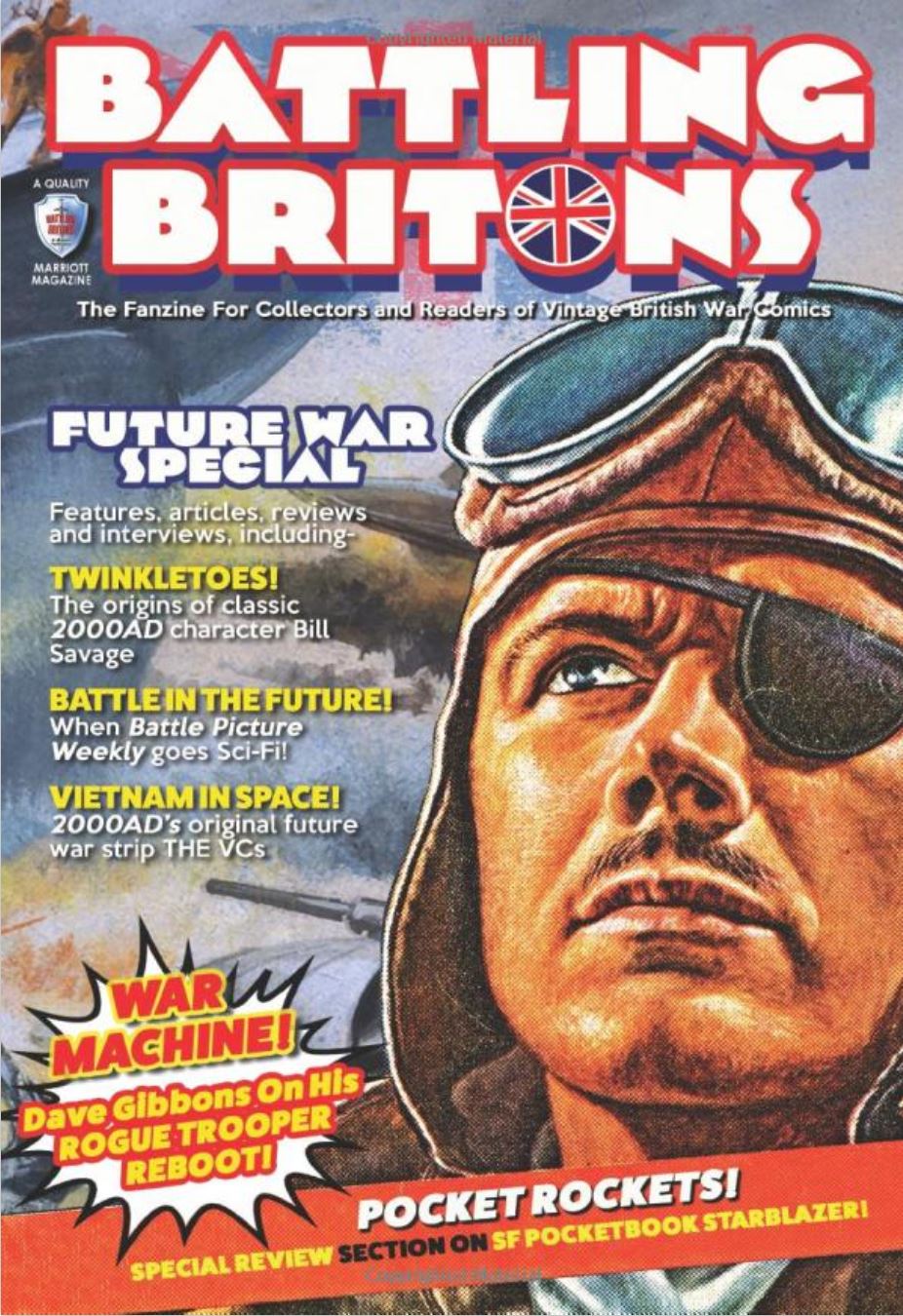
Battling Britons #04 - Future War Special

Paperback Warrior generally offers two types of reviews. The first, and most common, is the experienced examination of a novel or a story based on a prior history with the author, book, or series title. For example, we can talk for miles about Mack Bolan, Matthew Scudder, or Quarry because we have a fondness for the character, authors, and series and have read a great deal on the subject. The second type of review is what I refer to as the discovery review. This is our writings and musings of a book, author, or genre that we don't have as much experience with. Our discovery is more of an emotional thing – how it affects us directly and the interest it creates in pursuing the author, future books, or related series titles. 

This review is pure discovery, prompted by our genuine love for the fanzines and articles compiled, edited, and written by Justin Marriott and his colleagues. Marriott is a literary scholar of paperbacks, comics, magazines, and pulps, all of the stuff we live and breathe here at PW. Normally, we try to refrain from discovery reviews, but even more so, we generally don't review books about books. It seems silly to review reviews, right? But, Marriott's newest endeavor, his second run of a series of books called Battling Britons, prompted me to learn more about British war comics. Honestly, I had never heard the term until I read about Marriott's series launch a year ago. 

I ordered a copy of the newest issue of Battling Britons, number four, published in November, 2022. The theme for this issue is "Future War Special", covering a variety of war and science-fiction titles, comics, strips, and graphic novels. The only experience I've had with any British comics, sadly, is 2000AD character Judge Dredd. That's probably par for the course for snooty Americans like myself who solely dabble in the US branded comic companies like Marvel, DC, Dark Horse, Image, and Boom. In my defense, I only read books related to one title, X-Men. So, I'm a snoot among snoots I suppose. 

My first impression is that Battling Britons is a 160 page book with a kick-ass glossy cover and design created by Paperback Warrior reader and fan Bill Cunningham. This guy does fantastic work with everything he touches (like the MAM Quarterly books) and this is no different. I would also speculate that Battling Britons might be Marriott's most professional fanzine, a well-structured book that maximizes each page size with an abundance of book covers, columns, articles, and a whopping amount of information on the subject. Granted, the interior pages are black and white, but the content and scope of the material more than make up for that small nuisance. 

Here's the thing. I have no Earthly idea what some of these columns are referring to considering I know zilch about British comics. But damned if my interest isn't peaked, and my education a little better after reading through the book. Titles like Commando, Starblazer, Rogue Trooper/War Machine, and 2000AD look absolutely amazing and I found myself questioning my existence for 46 years around the sun without having this stuff in my life. Where have I been? 

This series title offers eight regular columns and 14 features that are related to the "Future War" theme. 

Highlights:

“A Brief History of Time (Travel in British Comics)”, is four pages about comics and story arcs featuring time travel in world war settings. Starlord 1977's strip “Timequake”, for example, features a bleak alternative future where the Germans prevailed in WW2. Another variation of that comes in the form of “The Sentinels”, featured in Misty 1977. 

There are two articles with James Bacon discussing the reboot of Rogue Trooper, which was informative to me because I never knew about the first version. Now I know, and knowing is half the battle, right? 

“Savage by Name, Savage by Nature” is six awesome pages featuring a look at Bill Savage, a character that appeared in the early issues of 2000AD. The character and premise sounds cool as Hell. A vigilante -esque guy, Savage, is fighting a force called the Volgan who have invaded England. Double-barreled shotguns and grimaced faces make this one look like a must have.

“Pocket Rockets” concerns the anthology comic book series Starblazer, which ran 281 issues from 1979 through 1991. The article is written by Alan Holloway and reviews 18 stories appearing in the series in the 1980s. These stories range from classic science-fiction, fantasy, sword and sorcery, and even space crime-noir. These write-ups and the issue cover art makes me want to retire and just read Starblazer all day. 

Battling Britons was an unfamiliar, new journey for me, but one I'm glad I took. This was a resourceful, intelligent book about books designed in an easy to follow format. The amount of information collected on these British publications including titles, characters, history, writers, and industry was staggering. Justin Marriott continues to produce the best fanzines on the planet and Battling Britons continues his greatness. Recommended. 

Buy a copy of this book HERE.