Friday, February 17, 2023

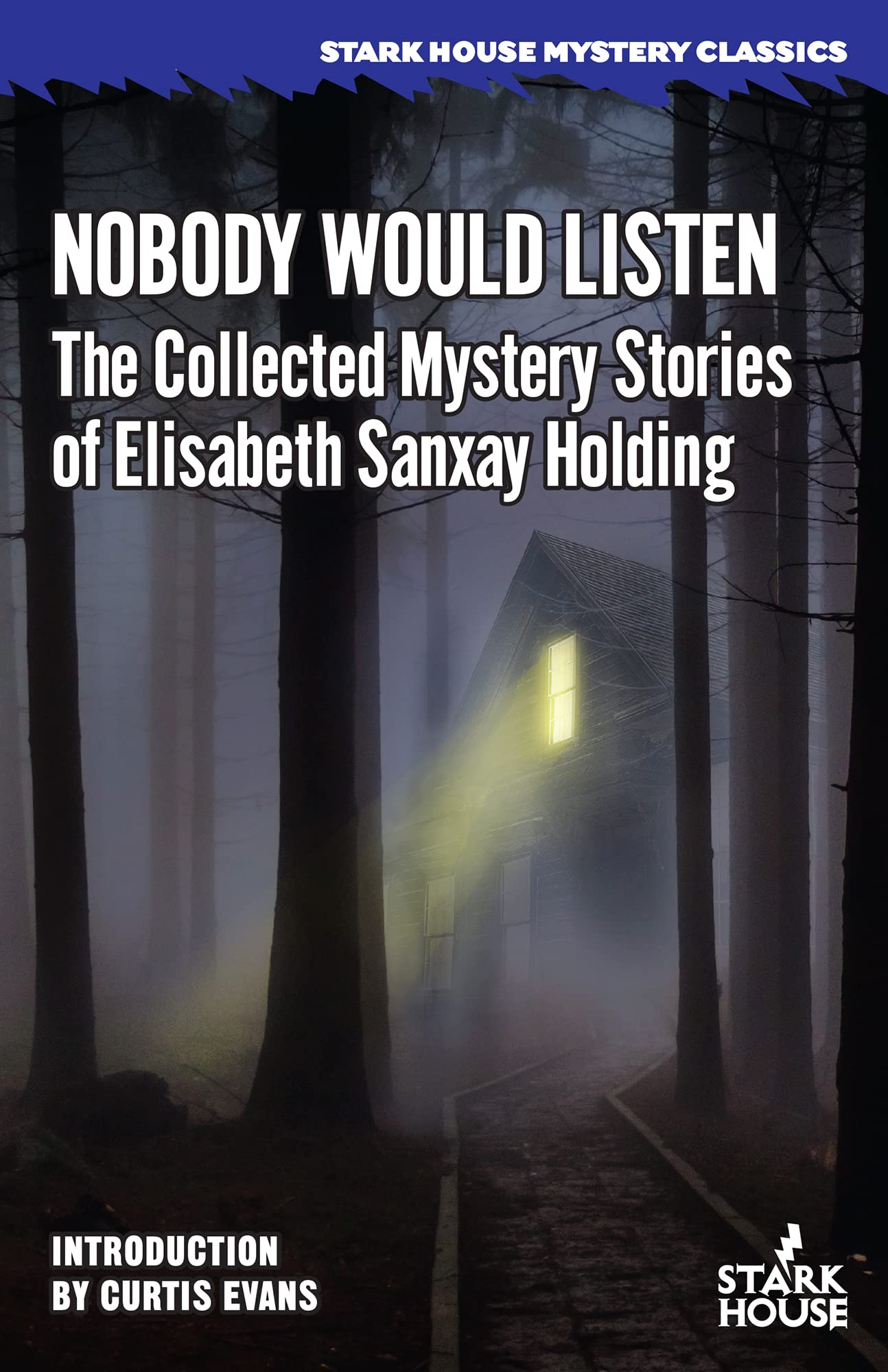
Nobody Would Listen - The Collected Mystery Stories of Elisabeth Sanxay Holding

Elisabeth Sanxay Holding (1889-1955) authored 25 novels between 1920 and 1953. In addition, she wrote over 200 short stories for magazines and digests like Ellery Queen, Alfred Hitchcock, The Saint Detective, and Nero Wolfe. Mostly, she concentrated her efforts on mystery and crime-fiction, however, she also contributed to the science-fiction genre as well. Stark House Press has been releasing many of Holding's novels, novellas, and short stories. The publisher's newest Holding release, Nobody Would Listen: The Collected Mystery Stories of Elisabeth Sanxay Holding, is a mammoth volume collecting 19 stories and novellas as well as an introductory article by Curtis Evans. At over 400 pages in length, there is a little something for everyone. Here are a few of my favorites:

The Strange Children

The Magazine of Mystery and Science-Fiction included this Holding story in its August, 1955 issue. As a fan of “evil kids” fiction and films, I honed in on the ominous story title. This 11 page story features a young woman named Marjorie receiving a call from a distressed mother. The woman explains to Marjorie that she was referred to her by a mutual acquaintance and that she desperately needs a babysitter for her two sleeping children within hours. The woman and her husband have a prior engagement and their sitter and housekeeper are both unavailable. Being late in the evening, Marjorie explains that she shouldn't babysit children that don't know her. What if they wake up and find their parents gone and a stranger in the house? The woman assures Marjorie that the children sleep through the night and won't wake up. Marjorie takes the deal and the family's chauffeur picks her up and drives her to a secluded house in the forest. 

The mother shows Marjorie the house layout and advises her that the children sleep in the bedroom down the hall. There are no other people in the house (this is important). The parents leave and so Marjorie sits in this strange house that is as silent as a tomb. Until she hears a child's laughter down the dark hallway. Looking through the door's keyhole, she finds the children awake in their beds playing with a man in a gray suit. Who is this creepy guy and how did he get in the house? This story is told in a suspenseful way and is just eerily delightful. It's a mix of paranormal, suspense, and mystery and Holding utilizes just enough restraint to keep the reader glued to the pages. Excellent. 

Nobody Would Listen

This is a 20 page story that was first published in Mystery Magazine in August, 1935. Like the above story, this one features an isolated house in the forest, a rainy atmosphere, and a new visitor. 50-year old Mrs. Morrissey has just accepted a new job as a live-in cook and housekeeper for two older women, Mrs. Raleigh and Mrs. Torrance. However, once Mrs. Morrissey settles in, she discovers that the two women have an immense hatred for one another. A nearby neighbor scoffs at Mrs. Morrissey's warning that she fears the two will murder one another. The story is aptly titled with Mrs. Morrissey's repeated warnings fall on deaf ears. Will Mrs. Raleigh and Mrs. Torrance eventually hurt or kill one another, or is this a familiar, old-time rivalry that is nothing more than harmless bickering between two lifelong companions? Holding builds so much suspense and impending doom that it seemingly explodes in the unforgettable finale. Think of “Nobody Would Listen” as a dark character study with a unique atmosphere. Recommended.

Friday the Nineteenth

The Magazine of Fantasy and Science-Fiction included this story in its Summer, 1950 issue. To properly review the story in 2023, I'm citing a popular 1993 film called Groundhog Day. It starred Bill Murray and Andie MacDowell and was written by Danny Rubin, who claimed the concept came to him when he read Anne Rice's 1985 romantic horror novel, The Vampire Lestat, and began thinking about eternal life. In the film, weatherman Phil Connors finds himself reliving February 2nd repeatedly, in a time-loop, in a small tiny Western Pennsylvania town. Oddly, Holding had a similar concept as her plot for "Friday the Nineteenth" – 40 years before Rubin's screenplay. 

Boyce is an average white-collar suburbanite living a mundane life with his boring wife and kids. He begins to fascinate about a relationship with his friend's wife, a plain-Jane looking woman named Molly. On Friday the 19th, Boyce arranges for a meeting with Molly in a downtown bar. There, the two discuss their attraction to each other and the restraints both of them practice when the couples meet at social gatherings. Boyce and Molly make a plan to meet in a more intimate setting the next day, on Saturday the 20th. However, Boyce awakens on Saturday to learn it is Friday all over again. When he meets Molly at the bar, he discovers that both of them realize they are living in a time-loop, constantly reliving Friday the 19th. How do they escape?

Groundhog Day, and other time-loop films like Palm Springs and Edge of Tomorrow, have always fascinated me. I was shocked to find a time-loop story that seemingly matched Groundhog Day, but I would imagine there were even more of these stories prior to Holding's. Regardless, her story injects a Gil Brewer/Orrie Hitt flavor as Boyce becomes the unsatisfied husband and father. I really enjoyed the chemistry between Boyce and his wife and how it changes over time. It was rewarding and entertaining simply examining Boyce's complaints at the start of the story. Everyday events like mowing the grass and taking out the trash become valuable experiences that Boyce wishes to have back when he realizes seeing Molly each day isn't exactly a thrilling experience. 

Other highlights include the private-eye story “Farewell, Big Sister” and three stories starring Captain Martin Consadine, Commissioner of Police on the Caribbean island of Puerto Azul, “People Do Fall Downstairs”, “The Most Audacious Crime”, and “The Daring Doctor”. 

Holding's writing is top-notch and gradually leans from mystery, suspense, thriller, and shades of atmospheric terror. She has a unique writing style where her protagonists think to themselves, but Holding places these thoughts into the form of dialogue with quotation marks. I've seen this method a few times in other early 20th century writers, but it's uncommon to me. If you can accept that, then there is nothing to dislike about any of these stories. The Stark House Press staff has performed a marvelous job of singling out some of her best stories. Recommended! 

Buy a copy of this book HERE.

Wednesday, February 15, 2023

The Maltese Falcon

Samuel Dashiell Hammett (1894-1961) was a military veteran, detective, screenwriter, author, and president of the Civil Rights Congress. He began writing short stories for the pulps in the early 1920s, contributing to publications like 10 Story Book, Black Mask, Saucy Stories, and True Detective Mysteries. Perhaps one of his most popular creations is the Continental Op, a hardboiled detective that appeared in over 35 stories. However, the hero pales in comparison to the massive appeal of Sam Spade. The San Francisco detective first appeared in The Maltese Falcon, a five-part serial that ran from September, 1929 through January, 1930 in Black Mask. The character would later appear in four more short stories and became a Hollywood icon when Humphrey Bogart portrayed Spade in The Maltese Falcon, a 1941 film adaptation. 

Sam Spade shares an office with his partner Miles Archer. The two receive a visitor calling herself Miss Wonderley. This potential new client wants the duo to follow a man named Floyd, who she speculates has convinced her sister to run off with him. When she produces cash, the two agree to the case and Archer is the first to do the checking up. Unfortunately, Spade is notified that same night that Archer has been shot to death. Spade later learns that this Floyd fellow has been killed as well. 

Anyone that reads my reviews knows that one of my biggest pet peeves in literature is starting a novel with a lot of “what the Hell is going on” type of stuff. The Maltese Falcon is one of those books. The first chapters, or arguably the entire first half, purposefully makes very little sense. Wonderley is really a woman named Brigid O' Shaughnessy, who was hired by a man named Gutman in Constantinople to locate a precious statue of a falcon said to have been passed down through the years from the 16th century. This Brigid woman hired another guy named Cairo to help her get the falcon, but then fled to San Francisco with Floyd hoping to make an even more lucrative sell to a higher bidder than Gutman. Forget all of the sister stuff. 

Cairo is now chasing Brigid, while she's being chased by Gutman and the police think Spade is in on the kill of Archer and maybe Floyd because he was sleeping with Archer's wife Iva. It's a tangled plot with a lot of characters and moving parts. Sadly, nothing really ever happens beyond an excessive amount of dialogue, speculation, and finger wagging. At one point, every major character enters the room and they get down to the discussion of who killed who and motives and all of the typical stuff you find in the armchair sleuth business. 

Sure, Spade is a cool character, doesn't say much, and breaks the mold of the Sherlock Golden Age Detective by unconventional means. He doesn't work well with the law, obviously has some anti-hero characteristics (he's sleeping with his partner's wife for God's sake), and becomes an evasive fall guy chasing red herrings galore. He should be easy to cheer, considering he's the least baddest of the bad guys. But, all of these characteristics still left a dull edge. Spade isn't supposed to be a likable guy, but he should damn well be an entertaining one. 

Hammett's storytelling style didn't resonate with me. There isn’t much insight into what any of these characters are thinking. Instead, it reads like a play with the entire novel presented through the dialogue. It is void of any emotional depth.

The idea that this book is cherished by the mystery community seems odd to me. Is it really a mystery novel that needs an adventure, or an adventure novel trapped in the confines of a whodunit? I wanted Sam Spade to grab a suitcase and head to Europe or Asia chasing this Holy Grail-like relic of Spanish lore. The whole idea of chasing the treasure is just begging for a wild globe-trot. But, these things never happen and the mystery doesn't escape a handful of rooms.

Granted, I'm probably saturated in modern detectives or more hard-hitting tough guys from the mid to late 20th century, so finding Sam Spade late in the game didn't do me (or him) any favors. It's like watching Top Gun: Maverick (2022) and then attempting to appreciate The Dawn Patrol (1938). It is probably more my fault than Hammett's, but I still can't justify the hype of Sam Spade or The Maltese Falcon. Overall, this was a snooze fest for me. 

Buy a copy of this book HERE.

Monday, February 13, 2023

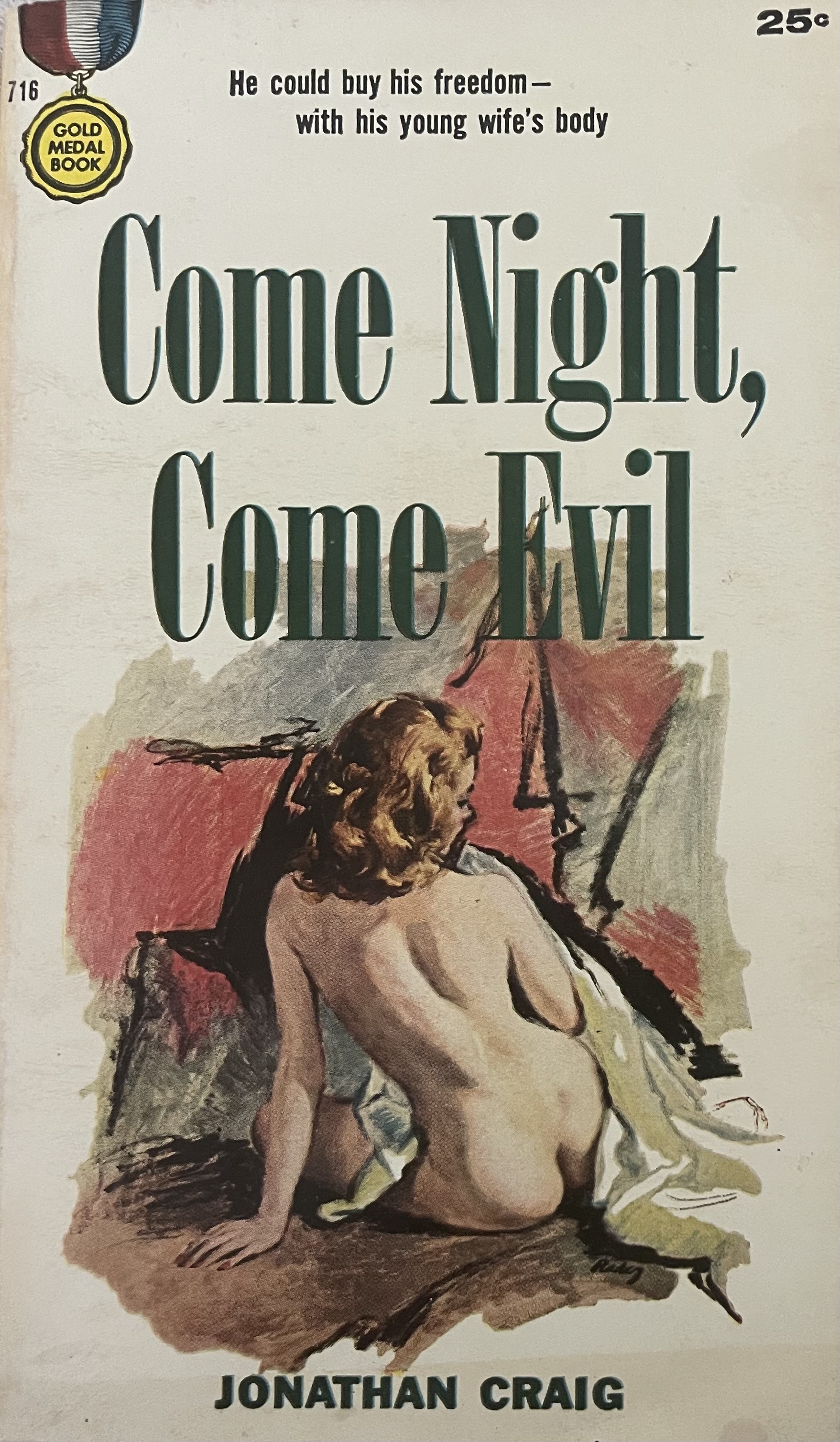
Come Night, Come Evil

Jonathan Craig (Real Name: Frank E. Smith, 1919-1984) was a Florida resident who socialized with Harry Whittington and Gil Brewer as he was writing over 100 novels and 300 short stories during the paperback era. Come Night, Come Evil was a stand-alone crime noir novel from 1957 published by Fawcett Gold Medal.

The novel opens with Jeff Colby being released from prison into the hands of his loyal wife, Laurie. They have every intention of building a life together and putting Jeff’s legal problems behind them. Unfortunately, Jeff has been assigned a fat, slimy parole officer named Carl Munger, who corners the couple in the prison parking lot during the discharge and immediately begins making Jeff’s life miserable.

Munger is a loathsome bully who extorts a kickback from Jeff’s parolee job wages. Jeff is forced to comply with no backtalk because of Munger’s unilateral authority to revoke Jeff’s parole and send him back to prison to finish his sentence.

Why was Jeff in prison at all? Best to let the novel tell that story as it’s a pretty compelling flashback. Suffice to say, it was a bum rap, and Jeff would like to exonerate himself now that he’s out on the streets. And the only way he can stay out is to appease Munger and his inappropriate demands. Finding the people who set Jeff up and understanding their motivation is the central mystery of the paperback.

The problem is that there are a few other mysteries muddying up the plot in this 128-page paperback. The writing is solid, and some of the characters are written extremely well. Despite that, Come Night, Come Evil is a pretty mediocre affair. If you’re looking for top-shelf Jonathan Craig, proceed directly to So Young, So Wicked. Unless you’re trying to read them all, this one can be easily bypassed. 

Saturday, February 11, 2023

Conan - Hawks over Shem

If you look online for the definition for “convoluted”, it should just provide a link to Robert E. Howard and L. Sprague de Camp's “Hawks over Shem” short story. In my quest to absorb as much Conan literature as humanly possible, I read half of this particular short story and found myself so confused that I re-read the first half again, which led to even more confusion. What in the Hell is going on here?

Perhaps the problem with this jumbled, fragmented, mess of a story is that it was originally a manuscript that Howard wrote about ancient Egypt called “Hawks over Egypt”. This version of the story was written by Howard in the 1930s and was first published in The Road of Azrael, a 1979 collection by Grant and later Bantam. It later appeared in Sword Woman and other Historical Adventures in 2011 by Del Rey. 

By 1955, L. Sprague de Camp had re-written “Hawks over Egypt” into a Conan the Cimmerian story with a new title of “Hawks over Shem”. It first appeared in Fantastic Universe's October 1955 issue. It was also included in the Gnome Press collection Tales of Conan the same year. The 1968 Lancer paperback Conan the Freebooter contains the story and its comic adaptation is featured in The Savage Sword of Conan #36

It's a fool's errand for me to try and review the story properly considering I received it in a dense fog of endless characters and alliances. Here's my best attempt: Conan and a stranger name Farouz are attacked by four Kushites. After Conan and Farouz kill the assailants, they scamper to a bar (where no alcohol is served) where a discussion happens that serves as plot development. A guy named Othbaal is contending for leadership of Asgalun. He's the cousin of King Akhirom, a lunatic. Othbaal is fighting a commander named Mazdak and a Kushite general, Imbalayo. It's a triangle of politics, backstabbing, and a lot of alliances.

This was just a nightmare to read and I couldn't gather which character was representing which country and who the enemy was. Thankfully, Conan's elementary role was to kill Othbaal and form a friendship with a mistress named Rufia. Together they attempt to leave the city among the factions of Anakim solders, Asgalun citizens, Imbalayo's power-heave, the Hyrkanians, a witch, a bonesucking creature, the crazy King Akhirom, and a Kushite captain. There's some connection to Conan's pirate days, but by the story's end, both Conan and Rufia flee north and this story thankfully ends. 

At 50ish pages, there's a backstabbing and an alliance formed over some minor backstory on nearly every page. I haven't read “Hawks over Egypt”, but I can imagine it must be better and more restrained than this over-indulgent nonsense. Out of the Conan stories I've recently read, this was the worst of the bunch. Avoid this headache.

Friday, February 10, 2023

Deathlands #07 - Dectra Chain

Let's talk about Deathlands. So far, the series has been solid except for the mediocre fourth installment, Crater Lake. I can chalk that up to, “everyone has a bad night”, even paperback warrior Laurence James. But, James rebounded in a big way with the series' turning point, Homeward Bound, and subsequent post-apocalyptic western Pony Soldiers. I was really looking forward to this seventh novel to see where we go from here in terms of location and quality. Dectra Train was published by Gold Eagle in 1988 and remains available as a Graphic Audio Book wherever quality 80s over-the-top, post-apocalyptic literature is offered. 

After the stint in the American southwest, Ryan and the gang enter the redoubt and make the leap. Their jarred landing puts them in another redoubt that appears as if it was just utilized by someone or something. I would imagine this little plot sprinkle will re-surface in a future installment. It's like a Quantum Leap episode where Sam discovers another leaper. 

Inside the redoubt, the group's newest member, the Apache shaman Man Whose Eyes Sees No More, receives his simpler name of Donfil More, inspired by his favorite rock duo, The Everly Brothers. The group emerges from the redoubt and find a barrage of water and a mutant. After contending with the obstacles, the heroes make a raft and battle a great white shark. It turns out that the group have arrived at a seaside area of what once was the state of Maine. The author perhaps adds in a bit of his literary influences by having the group discover a road sign that lists Jerusalem's Lot (the Stephen King fictional town; Salem's Lot) and Miskatonic University (H.P. Lovecraft lore). Total freakout coolness moment. 

On with the show, Ryan leads his band of travelers to a coastal village called Claggartville. The town works in the whaling industry and have a variety of ships and crews, the largest being the Salvation captained by a hideous, sadistic woman named Pyra Quadde. The narrative leads to Ryan and Donfil placed in shackles aboard the Salvation performing hard labor. It's a typical prison-break styled story as the heroic duo attempt to survive their harsh environment while planning an escape. Meanwhile, the rest of the gang are planning to set sail to find Ryan in their hijacked boat. 

Dectra Chain is a total blast. It's like a combination of Lovecraft and Moby Dick in the smooth, velvety afterglow of a destructive mushroom cloud. I like the fact that each of the heroes had a small part to play, including Doc's unwavering voice of wisdom, which isn't completely lost in the violence and gunfire. Some could argue that this is just another nautical adventure with all of the familiar tropes, and there is some truth to that, but having these memorable Deathlands characters fighting it out on the high seas was really clever. I loved the plot development, the bad guys (and girls), the locale, and the journey through Maine in autumn. Overall, another solid installment in what is slowly becoming one of my favorite series titles of all-time.

Buy a copy of this book HERE.

Wednesday, February 8, 2023

The Last Place God Made

Jack Higgins' (Harry Patterson) The Last Place God Made was originally published in 1971 as a hardcover by Collins. It was published in paperback by Fawcett Crest and remains available today in physical, digital, and audio editions. 

The opening pages introduce Neil Mallory, a young British brush pilot with exceptional skills. He's flying mail routes over and along the Negro River in Brazil. He loses power, runs low on fuel, and with the help of a veteran RAF pilot, is guided to a semi-safe landing. Mallory walks away from the wreckage and meets the guy who helped save his life, Sam Hannah. The two have some drinks together and Mallory learns that Hannah is a well-known guy in these exotic areas, a heavy boozer and women-chaser that loves a good time on someone else’s dollar.

The night before returning to the more friendly, less treacherous metropolis of London, Mallory is seduced by a woman who leads him into an alley and steals his wallet and passport. Mallory, facing unemployment and a perilous financial outlook, accepts a job with Hannah flying packages. But, is there more to this than meets the eye?

Higgins places these two characters at odds with each other while they perform a dangerous mission of assisting nuns on a missionary expedition to care for a tribe of indigenous people. A beautiful model and actress named Joanna learns that her sister, one of the nuns, has been taken captive by the Huna tribe. Joanna has a romantic involvement with both Hannah and Mallory, adding even more tension and abrasion between the pilots. They both agree to assist Joanna in locating her sister, despite the ominous threats the jungle brings. 

In some ways I felt that The Last Place God Made was reminiscent of another bush pilot Higgins novel, 1968's East of Desolation. The two books share pilots as protagonists, and both are set in exotic, “high adventure” locales. East of Desolation is more of a murder mystery while The Last Place God Made is an action-adventure novel. My mild disappointment with this book is that the first 150 pages was a slow burn explaining the region, history, and characters. The build-up of Hannah and Mallory's rivalry was enjoyable, but nothing really happens until the last 60-70 pages. The book's closing chapters is some of the best Higgins action-adventure scenes I've read. The finale places both Hannah and Mallory with heavy firepower in a crumbling old church as hundreds of spear-wielding natives attack. This was well worth the wait. 

The Last Place God Made is a calculated build-up featuring historic details of Brazil, fearless characters, gunplay, treachery, jealousy, crime-fiction, and the high-adventure genre tropes one would expect from the author. It may also be the most violent Higgins novel I've experienced in terms of savage violence and torture. This is not for the squeamish. If you can handle the blood 'n guts, this is another great Higgins offering.

Buy a copy of the book HERE.

Monday, February 6, 2023

Dark Shadows #01 - Dark Shadows

Paperback Library published 33 Dark Shadows novels from 1966 through 1972. These gothic paperbacks were based on the American soap opera that ran on ABC television from 1966 until 1971. The paperbacks were authored by popular gothic author William Edward Daniel Ross under his pseudonym Marilyn Ross. Thankfully, these novels make up a stand-alone series that can be read independently of the television show. They re-create the show, evident with this first paperback, the eponymous Dark Shadows, capturing most of what occurs in the Dark Shadows debut episode. But, the paperback series changes some of the characters and even adds new ones that aren't featured on the television version. Thus, it creates its own universe and continuity. If you want to avoid sappy daytime television reruns, then this paperback series is exactly what you need. Plus, it is completely affordable as audio books on CD or on your favorite streaming service like Hoopla or Audible. 

In Ross's series debut, young Victoria Winters arrives in the fictional Maine seaside village of Collinsport. Readers learn that she was orphaned as a baby and she never learned who her parents were. Money was mysteriously supplied to her throughout her upbringing in the form of a mailed check. Now, she is ready for her next job as a governess to a young boy at Collins House, an enormous mansion that houses over 40 rooms. 

Meeting the family, she discovers that Elizabeth Collins Stoddard hasn't left the house in nearly 20 years. Her brother, Roger Collins, is a single guy that possesses a rather dull outlook on life in between his routine cocktails. There's also Carolyn, a rambunctious, spunky young adult that finds relief from the boredom at a local bar. But, the most interesting character is that of Ernest Collins, a symphony violinist that experienced the death of two loves. The first was his wife Elaine, who supposedly died in a car accident. The second was a lover that threw herself from Widow's Hill, a place far above the rocky shore where women apparently jump to their deaths. 

Throughout the narrative, Victoria is tormented by an unseen stalker that plays tricks on her. At night she can hear heavy breathing and footsteps outside of her room. She finds a creepy mask hanging from her ceiling and is attacked in the dark cellar. The scariest moment for Victoria is when her car suddenly loses control and crashes. Of course, Elizabeth and others refuse to believe that anyone is stalking Victoria. But, the mystery points to Ernest as a possible suspect.

Unfortunately, this debut Dark Shadows paperback is a dull, uninspiring read. Ross utilizes long, drawn out dialogue to pad the book's length, leaving readers lulled into a bored mood with the pointless conversations. The attempts to scare or harm Victoria are few and far between, leaving very little activities to keep readers enthralled. Further, the atmosphere is described as sunny and warm, which left me disconnected from the television visuals of the old seaside mansion draped in fog. If I didn't read the title or the “Victoria Winters” name, I never could have guessed this was a Dark Shadows book. In addition, both Elizabeth, Ernest, and his lovers are not included in the television show.

Perhaps the series will improve with more of a supernatural element. Barnabas Collins, despite appearing on the cover of at least one printing of this specific paperback, doesn't appear in the series until the fifth installment. In the meantime, steer well clear of this dud.