Tuesday, June 27, 2023

Night Time Is Murder Time

The November, 1945 issue of New Detective Magazine featured short stories by David Crewe, Cyril Plunkett, Rex Whitechurch, and Ken Lewis among others. The story that I immediately flipped to was the lead novelette story, “Night Time is Murder Time”, a “man on the run” tale penned by legendary crime-fiction author Bruno Fischer.

Ray was medically discharged from the military after harrowing combat in WW2. After his recovery, he returns to his small hometown and moves in with his father. One night, Ray receives a call from a guy warning him that a female friend is in danger. Ray drives his father's car onto a rural route and gets halfway to his destination when the fuses in the car blow, pitching him and the vehicle into darkness. When he strikes a match, Ray discovers a dead body in the backseat.

Behaving in the most irrational method, Ray fails to warn the police (or his father who happens to be a judge). Like most of these mid-20th century crime-noir stories, Ray disposes of the body and car. He then makes a run for it to clear his name and find the real killer that set him up as the fall guy. The story weaves in and out of Ray's quest for justice while foiling the police. There's a few suspects thrown in to keep the reader guessing, and a nice touching side-story with Ray confiding in his father.

Bruno Fischer isn't capable of writing a bad story, and while this is certainly an overused plot-device, the author still packs a punch with a straight-laced whodunit. For a brisk 20-minute read, “Night Time is Murder Time” is recommended.


Monday, June 26, 2023

Beneath Cruel Waters

Horror and crime-fiction author Jon Bassoff continues to impress me with his literary work. As a modern writer, he is certainly in the top echelons for innovative, moving storytelling that captures the dark and dreary landscape of rural America. His books produce a poverty-ridden moodiness that reminds me of Joe R. Lansdale or Elmore Leonard, but with the hazy overtones of bleak horror. His newest novel, at the time of this writing, is Beneath Cruel Waters. It was published by Blackstone in 2022 and exists in audio, digital, and physical formats.

The book is presented in rotating timelines that incorporate present day events with those in the past. In the present, Holt Davidson has returned to his small Colorado hometown after discovering his mother took her own life. After rummaging through his mother's belongings, he finds a bizarre photo of a dead man. Why did his mother have this photo? What is the significance?

In the past, the author presents Davidson's childhood, mostly focusing on his mother's life. She is a single mom struggling to make ends meet. After meeting a former felon, she begins a dating routine that escalates into a frightful fatal-attraction scenario. Davidson's uncle arrives and begins to strike up a reunion with the family, catering to Davidson's sister. These past events, as trivial as they may seem, have a large impact on what Davidson is experiencing in present day.

As Davidson journeys into the past, attempting to make sense of his fuzzy memories, he learns a great deal about his tumultuous childhood, his mother's suicide, and horrifying events that forced his sister into a mental hospital. All of these events circumvent the dead man photo, a mysterious love letter, a gun, and an illegal abortionist. How they all tie into each other is the mystery, thrill, and entertainment of Bassoff's riveting novel.

Beneath Cruel Waters was nothing short of amazing. The characters, the plot development, the core mystery, and the presentation was masterfully woven to create the ultimate page-turner. As an intimate glimpse into the lives of small-town America, no one can do it any better than Jon Bassoff. If you love gripping novels that demand to be devoured in one sitting, look no further than Beneath Cruel Waters. Highest recommendation. 

Buy a copy of this book HERE.

Friday, June 23, 2023

Heller #01 - The Oil Rig

Author Frank Roderus (1942-2016) was a newspaper writer and author that penned over 300 novels, most of which were westerns. He earned two prestigious Spur Awards from the Western Writers of America and also earned a Colorado Press Association award for best news story. In 1984, Roderus began writing a crime-fiction series starring Colorado rancher Carl Heller. There were seven installments in the series, all published by Bantam. In a 2013 interview with Tom Rizzo, Roderus explained that writing westerns allowed him tax advantages on his horses. By having Heller ride a motorcycle, Roderus was also able to gain a tax advantage on his own motorcycles. Brilliant idea.

Carl Heller was fortunate enough to inherit several thousand mountain acres in the high-country from his great grandfather. Instead of running a beef operation on steroids, antibiotics, and modern efficiencies, Heller uses the old-fashioned method of allowing the herd to run free, culling them once a year. He's not wealthy, and admits to barely keeping up the tax payments on the enormous property, but he manages an average lifestyle. He's a law-school dropout that is described as a playboy that enjoys riding the mountains on his horse, Kawasaki motorcycle, or race-car styled BMW. He has a lukewarm relationship with a local gal in town, a school teacher named Donna. He's in excellent shape, works out each day, and serves as a paperback version of the modern cowboy. That's the origin tale of Carl Heller.

While riding the rapids with a group of friends, Heller learns that a small group of farmers have been hoodwinked by big city shysters. The proposal by Mineral Consortium is that gold has been discovered in ecological surveys on the farmers' land. If the farmers will agree to allow Mineral Consortium to lease property, they will provide the farmers an excellent 30% royalty for all “metals” retrieved. When Heller becomes involved, he discovers that the contracts excluded minerals. The Mineral Consortium used this loophole to establish oil rigs on these leases to pull millions of gallons of oil royalty free. Their defense to the one-sided contract is that gold does exist on the property, but it's nothing more than the small grains found in seawater. They are happy to provide 30% for this small amount of gold retrieval.

Heller explains that there is a distinct difference between law and justice. To establish the character's validity, Heller confesses to Donna that he tracked down and killed a rapist that escaped a court of law. The reader gets the idea that maybe Heller has performed this sort of vigilantism more than once. Like Lawrence Block's Matthew Scudder, Heller explains that he does favors for people. So, Heller's motivation is peaked when he discusses the dilemma facing the farmers. Additionally, there is an incentive of a monetary percentage payout if the leases produce money for the farmers instead of the Mineral Consortium. 

The book's first half was a real slow burn as Heller discusses legal avenues to explore. Included is a swindle Heller concocts to lead the Mineral Consortium into believing real gold does exist. To perform the trick, Heller establishes an identity of working for a mining company to construct a large mill. The evidence is convincing enough that the company wants to renegotiate the deal with the farmers. All of this consumes the book's first half, which in itself would be an average story. However, the second half makes all of the difference.

In the second half, Roderus fuels the fire with an action-packed, suspenseful narrative with Heller facing the bad guys around an oil rig at night. This was just an incredible page-turner as Heller was forced to rely on his wits to outsmart the armed gunmen. It's a violent smash-up that includes everything I love about 1970s and 1980s men's action-adventure novels. This closing second-half was well worth the price of admission.

Frank Roderus is a unique author that uses traditional western storytelling to plot modern crime-fiction. Often, he writes like a tough guy cowboy, so much that the wording is odd. For example, something like 3AM is pronounced “three ayem”. Heller's moral compass, good-guy characteristics, and the ability to be a strong, reliable protagonist kicks off the series in a promising way. This is the meat and potatoes of Roderus storytelling and The Oil Rig is recommended if you like that sort of thing. I do, so I'll be reading more. 

You can buy a copy of this book HERE.

Thursday, June 22, 2023

The Mark of Satan's Claw

Fred Ottenheimer was a writer and artist employed by various humor cartoons and strips in the mid-20th century. Along with working for Charlton Comics and Magazine Enterprises, Ottenheimer's most notable work was in the pages of Warren Publishing in the 1970s. Often listed as Fred Ott, he wrote for Vampirella, Creepy, and Eerie. My first experience with the writer is his story “The Mark of Satan's Claw”, which was the lead in Creepy's January 1972 issue. The story is beautifully illustrated by Spanish artist Jaime Brocal Remohi. 

In the story's opener, a journalist named Jonathan Howard has just arrived to the foggy village of Llangwell, Scotland. After meeting with a local innkeeper, Howard accepts a room while explaining to readers the reason for his arrival in this sleepy town. Howard is a true-crime writer and wants to delve into the recent string of child murders in Llangwell. The innkeeper warns Howard to stray from the town's business and attempts to convince him that there are no murders.

Howard meets with Llangwell's Chief Constable and learns more about the murdered children. The lawman explains that the murders have been taking place for years under the direction of a local cult of Satan worshipers. He then shows Howard the cult's symbol, which has been burned into his own chest. He explains he escaped the cult and volunteers to take Howard out to the moors to show him where the dead children turn up.

In a memorable panel, the police find a dead boy on the swampy rocks. Howard becomes shocked by the reality of dead children. But, a whisper from the darkness invites Howard back to a rural cottage where a man explains more about the history of the Satanic cult and provides instructions on a secret book that may hold more answers.

The combination of Remohi's gloomy pencils and Ott's dour narrative was enthralling. This is a rare monster story that blends a child serial-killer element with a fantasy outline. I was surprised with the story's twist and found the ending suitable, but not altogether satisfying. “The Mark of Satan's Claw” was just scary enough to be recommended, but the time-frame and artistic style – both in the writing and presentation – is truly the main star. I enjoyed it, and you can read it for free below:

Wednesday, June 21, 2023

One by One

Freida McFadden is a New York Times, USA Today, and Publisher's Weekly bestselling author of psychological suspense thrillers. With curious titles like Want to Know a Secret?, Do You Remember?, Do Not Disturb, and The Housemaid's Secret, it was just a matter of time before one of her novels showed up in my library app. My first McFadden novel is One by One, originally published in 2020. It's not to be confused with Ruth Ware's 2020 book of the same name. There's apparently more than one One by One.

The book is presented mostly in the present tense by main character Claire, but there are intervals written in third-person from someone simply titled “Anonymous” recapping their own childhood. This was a pleasant distraction from the rather one-dimensional locale of lush forest and dense trees. These accounts from Claire and “Anonymous” were destined to collide by the book's end, but the mystery is how the two characters are related and the inevitable word journey.

Claire (teacher) and her husband Noah (physicist) are in the slumber of a failing marriage, so the two decide to embark on a short vacation to a cozy inn nestled in the northern Colorado wilderness. They are accompanied by Claire's best friend Lindsey (can't remember!) and her new boyfriend Warner (surgeon), as well as Noah's best friend Jack (handyman) and his wife Michelle (attorney). It's a diverse group made up of various professions that may or may not play a hand in the book's plot.

Like most outings in the forest, car trouble and lack of cell phone coverage invite murder and mayhem. As Jack attempts to lead the group through the forest, hoping to find the inn, they immediately become lost, cold, and hungry with water diminishing. The first member of the group dies from poisoning, then another from an apparent animal attack. One disappears completely. Three members are left when they locate a small cabin full of supplies. But, the cabin's owner is dead. What in the actual Hell is happening here?

I've watched plenty of VHS horror, and read my fair share of Paperbacks from Hell, so the premise of One by One wasn't that original. Thankfully, McFadden focuses on character development to build her plot and enhance the story. She has a unique way of telling a great story through dialogue and character interaction. It isn't what's on page, but what's hidden from the reader that is so important. McFadden doesn't provide enough clues to really hone in on the murderer, but she kept me guessing until the very end.

If you enjoy the “weeding out the weak” survival novels, or just a “who's the murderer within our ranks” story, then One by One is an easy recommendation. I devoured it in one sitting and not only discovered a great book, but a fantastic author. At the time of this writing, I'm on the waiting list for her newest novel, Ward D, which promises more mystery, murder, and...terrible cell phone service.

Buy a copy of this book HERE.

Monday, June 19, 2023

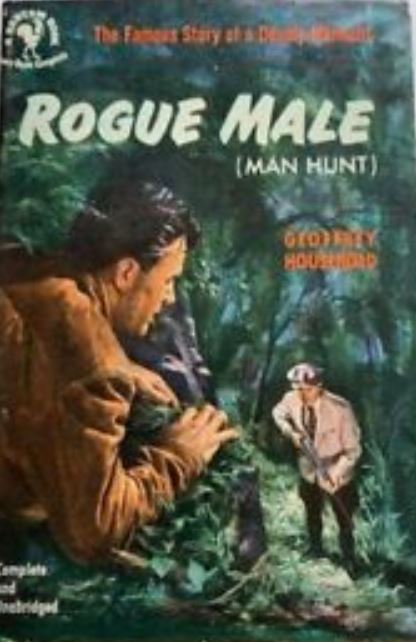
Rogue Male

According to Wikipedia, Geoffrey Household (1900-1988) was born in England, earned a B.A. in English Literature, worked as an assistant confidential secretary in Bucharest, sold bananas in Spain, and wrote children's encyclopedias and children's radio pays for CBS. During WWII, Household served in British Intelligence internationally. Household began to write in the 1920s and saw his first novel published in 1936. Overall, he authored 28 total novels, and seven short story collections. But, his most admired and critically acclaimed book is 1939's Rogue Male. The novel was adapted into the film Man Hunt in 1941 and as Rogue Male in 1976. I stumbled onto the novel after reading a number of interviews conducted with David Morrell, an author that cited Rogue Male as a primary influence on his bestseller First Blood

The book's protagonist is a British citizen, unnamed, that loves firearms and hunting. In the opening pages, the character is placing his rifle optics on a dictator, presumably Hitler or Stalin, for sport. But, he is immediately caught by the dictator's military and taken inside to be tortured. At some point, the torture escalates and a military man vomits. From the description, one of the character's eyes becomes lacerated and burned. After the torture, they throw the character over a cliff, making it look like an accident. 

Fortunately (unfortunately for me), the character survives and heads back to England where he finds himself hunted by the dictator's secret police. The character manages to kill one at a train station, then journeys into seclusion in the forest. Here he burrows into a hideaway, but is soon found by his pursuer.  The character is then faced with dying from lack of water and food or somehow killing his enemy.

There's no bones about it. Rogue Male did nothing for me. The narrative is brittle, with a British dryness that seemed absolutely lifeless and one-dimensional. I enjoy British espionage and high-adventure novels, but Rogue Male isn't what I would consider spy-fiction despite the characteristics. In reality, the author spends a painful amount of time dragging his character through the forest examining hedges and trees. The payoff finale was void of any excitement (although it was shocking), leaving me numb with boredom and wishing I had the hours back.

Rogue Male sucks. Bottom line. 

Try your luck with it HERE.

Friday, June 16, 2023

Spy Hunt

Paperback Warrior features a fairly robust section for author Norman Daniels (real name Norman Danberg, 1905-1995), including a podcast feature on his life and literary work. While I enjoy a variety of his crime-noir paperbacks, I feel like he was best served as a spy-fiction writer, or at the very least, international conflicts concerning the military. His best work is probably the eight-book espionage series Man from A.P.E.starring American secret-agent John Keith. That series debut, Overkill, was published by Pyramid in 1964. But, as a template for that series, Daniels authored a stand-alone secret-agent novel called Spy Hunt. It was published in 1960 by Pyramid and now exists as an ebook by Fiction Hunter Press.

In Spy Hunt, readers are introduced to Jeff Stuart, a CIA operative working directly for Colonel Piper. In the book's riveting opener, Stuart walks into his office and discovers a man pointing a gun at him. The next chapter explains how Stuart ended up in this situation. With very little rest, Stuart was ordered to fly round-trip from Washington D.C. to Hong Kong to retrieve a document from an unnamed man. Tired from jet lag and little sleep, Stuart walks into his office, sees the man with the gun, and is ordered to give the document up. 

Stuart complies with the man's orders, surrenders the document, and then on the brink of exhaustion, hunts his enemy down to retrieve the document. He then takes his enemy back to his office to torture him for information. At the point of pulling the trigger to execute the man, Colonel Piper's people arrive and inform Stuart that this was just a training exercise. Piper wanted to be sure that Stuart could operate in a stressful/no sleep situation. Also, if he could pull the trigger. Stuart proved capable. 

Stuart's next assignment is legit. An American scientist has been captured by the Russians and the American government wants to shut him up. To avoid the scientist singing American secrets, the CIA wants Stuart to pose as a Cuban in Moscow undercover as a weapons buyer for Castro. He is to kill the scientist at the first opportunity, then escape the country with no American assistance or aid. Stuart understands that the mission will probably be suicide (complete with those deadly poison capsules on his body), but he's sworn to the agency.

The author's variables in the story make the narrative come alive with mystery, excitement, and a sense of urgency. Stuart's nemesis is a female Russian agent hoping to seduce and kill him. On the flip side, the Russians invite the scientist's wife to Moscow for a cordial face to face visit. Stuart uses her as an inside track to the prison where the scientist is being held. These two women, both on opposite ends of the spectrum, create sexual tension and deadly encounters as Stuart treads water to kill his target and escape Russia alive. 

Spy Hunt was absolutely terrific, but I do feel that Daniels' second-half narrative was way too long. Despite the book's length of a mere 150 pages, the second-half is a road trip survival adventure as Stuart drives through the countryside receiving aid from begrudged laborers. The finale was fantastic, but it was cumbersome for 35-40 pages. Regardless, Daniels voices Stuart's third-person narrative, and the story for that matter, like a solid Matt Helm installment by Donald Hamilton. Or, as I alluded to earlier, a building block for his Man of A.P.E. series. If you love a good globe-trotting Cold War affair, then Spy Hunt is highly recommended.

Buy a copy of this book HERE