Friday, September 8, 2023

Thunderclap

Jack Sheridan was a novelist of the early 1950s whose work has been rediscovered thanks to new editions from Cutting Edge Books. This includes his 1951 Fawcett Gold Medal paperback original, Thunderclap.

The main character is a nomadic laborer named Britt Callum who can never hold down a job because he inevitably gets in a fight and clobbers the other guy a bit too hard. After a one-punch knockout in an Oklahoma bunkhouse, the human giant is back on the road hitchhiking and looking for a place to land.

He settles in rural Wichita Falls, Texas where he encounters a short ex-boxer named Rigger who appears to be the town’s drunken bully. Early in the novel, there’s a vivid fistfight scene showcasing the author’s capacity to be a damn fine action writer. For his part, Rigger is a powderkeg of hot-tempered, little-man violence and every scene awaits his next eruption.

One thing leads to another, and Big Britt finds himself working for Little Rigger and living at his wheat farm. As soon as Britt arrives at Rigger’s dilapidated acreage, he meets Rigger’s wife, Marcy. And as soon as the author describes her round, firm breasts, you know exactly where this story is headed.

Rigger has a brother named Newt who also lives on the farm. As bad and dangerous as Rigger is, Newt is ten-times more dangerous and conniving. Newt is the first to notice the vibes between Britt and Marcy, and the minefield of Britt’s current existence is underscored.

In 1951, Thunderclap was a commercial success selling over 500,000 copies and multiple printings with two cover variations. The people of Wichita Falls didn’t care for the way their town was portrayed as a redneck shithole populated by dusty bar-fighters, but such is fiction, right?

This is a novel with a great beginning and a gruesome conclusion, but a plodding middle. The “will they, won’t they” dilemma between Britt and Marcy occupied nearly the entirety of the book to the extent that I was left thinking that Harry Whittington or Gil Brewer would have just killed off the bastard Rigger much sooner setting up the novel’s tension.

Thunderclap is also a rather depressing novel, like a blues song or murder ballad set to prose. These are some hard-luck characters scraping by with a meager existence. The upside is that Sheridan is a very good writer, and I never considered walking away from the book because I needed to know what would become of these four tragic characters.

As long as you know what you’re getting (i.e. not a crime noir, more of a rural melodrama), you’ll probably like Thunderclap just fine. The Texas setting is vivid, the characters are well-drawn, and the writing is solid. It’s not a masterpiece by any means, but a compelling timepiece certainly worth your time. 

Buy a copy of this book HERE.

Thursday, September 7, 2023

Somebody's Done For

Philadelphia crime-noir author David Goodis died on January 7, 1967 at age 49 from brain trauma after being beaten in a robbery. That same year, his final novel, Somebody’s Done For, was posthumously published, but failed to make much of a splash at the time. Thank heavens, Stark House Noir Classics have resurrected the novel as a trade paperback and Kindle ebook.

The protagonist is Calvin Jander, and as the novel opens, he is far from land in Delaware Bay treading water to save his own life following the unfortunate sinking of his rowboat during a solo fishing trip. Let me tell you, that first chapter grabs the reader right by the balls and gets your attention. The panic and fear associated with the certainty that the remainder of your life can be counted in minutes is palpable in Goodis’ prose.

The means by which Jander makes it to the beach on the New Jersey side is pretty amazing, so I won’t spoil it here. He is helped ashore by a beautiful woman named Vera who leads him to an abandoned jungle shack and warns him not to ask too many questions if he wants to live. This was undeveloped land back in 1967, so it’s the perfect place for wanted criminals to hide out far from civilization. Vera is laying low with a small but dangerous group who are less than thrilled about the intrusion of Jander in their hideout.

Jander could slip away easily enough, but we learn that he’s an office drone who always dreamt of being a hero. Vera is in a rough spot with these toughs, and Calvin owes her for saving his life. Maybe it’s hero time? Goodis does a nice job contrasting the aspirational heroism and rationality of Jander with the dangerous powderkeg of emotional irrationality displayed by the crew in the hideout.

Goodis slow-plays the explanation of why this group of dysfunctional, bickering psychopaths is hiding in the woods. When he finally explains their back-story, it’s predictably great.

Most of Goodis’ best work comes from his exploration of skid row bums, but this one follows a white collar professional thrust into a seedy underbelly of crime and dysfunction. It’s an oddly-paced novel that ventures into some pretty dark places. Ultimately, Somebody’s Done For is a satisfying novel that underscores the fact that Goodis was a unique talent taken from the world too soon. 

Buy a copy of this book HERE.

Wednesday, September 6, 2023

Steve Bentley #05 - Murder on her Mind

The fifth Steve Bentley novel is Murder on Her Mind, originally published by Dell in 1960. The novel, authored by Howard Hunt using a pseudonym of Robert Dietrich, has been reintroduced to modern audiences in an exciting new version by Cutting Edge Books. It exists in both paperback and digital as well as an inclusion in the massive Steve Bentley omnibus Bentley for Hire.

As a reminder, Bentley is a former U.S. Treasury agent who experienced combat in The Korean War. Now, he works as a successful accountant in Washington, D.C. and spends his free time sailing his boat on the Potomac River. The author positions the Bentley character like an amateur private-eye with plenty of intelligence, street smarts, quick wits, determination, and tenacity. In some ways, Bentley always reminds me of the popular Chester Drum character created by Milton Lesser (better known as Stephen Marlowe). So, it is no surprise that these books normally start with a client walking into Bentley's office needing favors beyond the typical IRS hustle. 

Chula Marques enters Bentley's office wanting an accounting sheet prepared for her father, a Baltimore resident and former revolutionist from an unknown banana country. Bentley is skeptical to become involved with this sort of international diplomat, and his fears are realized when he's handed counterfeit money. Because of Bentley's prior experience rooting out counterfeiters for the U.S. Treasury, he can easily identify saggy president eyes on American currency. 

Bentley dismisses Chula, but her memory stays with him. He visits the local club where she performs, and has a run-in with her drunk and disorderly husband as well as the bandstand leader who may be having an affair with her. Bentley is also approached by a newspaper reporter that represents a sensational publication that focuses on the hottest D.C. scandals. They want the scoop on Chula and her father.

All of this is entertaining enough to read, but the author understands his consumer's needs. One morning, Bentley receives a phone call from Chula that her father is missing. His last known whereabouts is a small shoreline town in Maryland. When Bentley arrives at the beach cottage (a popular staple in crime-noir) he discovers the dead reporter. Someone killed the reporter to put the hush on whatever they feel was blabbed to or by Bentley. So, if the journalist has been whacked, it is only a matter of time before someone tries to hush Bentley. 

Howard Hunt's plot is a little convoluted with some stolen jewels, a gunrunning enterprise, and the ins-and-outs of his relationship with Chula. The most entertaining aspect of the story for me was the abrasion between Bentley and a local criminal kingpin named Renzo. The story-line featuring Bentley squaring off with Renzo's two hitmen was worth the price of admission. Also, uncommon to this series, is a rather foul mood conveyed by Bentley. The imagery of the hero hoisting a rifle and walking down the beach to possibly kill his pursuer was just so vivid and memorable. Hunt was really on his game with this novel. 

If you love intriguing private-eye novels with interesting characters and an intense, calculated story, then by all means Murder on Her Mind should be your next read. While Hunt is often unfairly dismissed by crime-fiction fans, I continue to find his literary work exceptional. The Steve Bentley series is the best representation of the Howard Hunt formula and this is no different. Highly recommended. 

Buy a copy of this book HERE.

Monday, September 4, 2023

The Dark Garden (aka Death in the Fog)

Last month, I reviewed Mignon G. Eberhart's novel House of Storm (1949) and enjoyed it enough to pursue another of her 59 novels. Life is short, and my reading time is limited, so I decided to seek out her best. According to the New York Times, that novel is The Dark Garden. It was originally published in hardcover by Doubleday Doran in 1933. It was later published as a mass market paperback and also was printed as Death in the Fog

Katie Warren resides in a large Victorian mansion as a live-in guest of Mina Petrie, a wealthy dying widow. One evening, in the midst of thick fog, Katie and her companion Paul accidentally strike and kill another house guest named Charlotte with Mina's car. The author's description of the bump as the tires roll over the body resonates with the reader and Katie, who consistently hears and plays back this memory repeatedly in her mind. In shock, Katie and Paul return to Mina's house and call the law.

Inspector Crafft, who is either a descendant from Africa or Asia (the author describes him distastefully as “a wiry little brown man”), arrives later to interview Katie to determine details of the accidental death. In doing so, Crafft begins to assemble a suspect list that suggests Charlotte was murdered. While readers, and Katie, seem to think this was simply an accident, Crafft (the star of the show) suggests otherwise. As the clues begin to mount, pointing to various motives regarding dying Mina's will, another person is found dead. 

This sort of whodunit was very common even by the “early” 20th century. It places the emphasis on an investigation of various house guests in a large cavernous dwelling that typically revolves around an inheritance. What makes or breaks these elementary stories is the writing, and Eberhart possesses extraordinary storytelling talents. Her writing is dependent on atmosphere, character development, and a slow, brooding pace that may or may not please impatient readers. One memorable scene involves Katie and a cat peering into a dark room after hearing footsteps. It's such a simple scene that doesn't culminate into anything crucial to the story, but the description, atmosphere, tension, and surreal terror is orchestrated in a superb way. It's uncanny how well Eberhart could paint a room in stark black yet still deliver colorful characters. 

As an investigative, procedural mystery in a “locked room” type of story, The Dark Garden totally delivers. If you love a slow-burn with an emphasis on character development and tight atmosphere, then this book is an absolute must-read. Eberhart was really something special.

Buy a copy of this book HERE

Saturday, September 2, 2023

Dax the Warrior #01 - Dax the Warrior

There are a hundred or more Conan clones saturating pop-culture, including fiction, comics, movies, and games. These sword-and-sorcery stars were extremely popular in the 1970s and 1980s, pairing with the popularity of Lancer and Ace reprinting many of the Robert E. Howard Conan stories along with new entries by the likes of Lin Carter and L. Sprague de Camp. In addition, the great Conan comics emerged like Conan the Barbarian

Eerie, published by Warren Publishing Company, debuted a Conan-esque hero in the pages of their 39th issue, released in April of 1972. The story, “Dax the Warrior”, featured Esteban Maroto as both the artist and writer, a joint position that Maroto maintained for all of the early installments of the series. Maroto would later rise to prominence within the world of Conan, contributing to comics like Savage Sword of Conan the Barbarian and Savage Tales and creating awesome paperback artwork for Ace including Conan: The Flame Knife, Conan and the Sorcerer, Conan the Mercenary, and Conan: The Treasure of Tranicos. Needless to say, I was excited to recently discover this Dax series created solely by this talented artist.

"Dax the Warrior", later re-titled to "Dax the Damned", was Eerie's second serial after the short-lived Prince Targo. The character appears in Eerie issues #39, 40-41, 43-50, 52, 59, and 120. Oddly enough, ten of these dozen stories were re-written for Eerie issue #59, published in April 1974. While the reasoning isn't completely explained by Warren Publishing, apparently the company felt that these stories written by Maroto needed to be reprinted and re-written to centralize plots and to smooth out some of the hero's strengths. The artwork of these prior Dax stories remained for issue #59, but the stories are all written by Bud Lewis instead. I may be crucified for saying this, but I think Lewis is a superb writer and does a better job with these stories than Maroto. But, there is no criticism from me or anyone else in terms of the art. It is exceptional. Issue #59 also features Dax on the book's cover for the first time, appearing in an awesome painting by Ken Kelly (Conan, Molly Hatchet). If you want to read this character's stories, issue #59 would be the best. It features 10 stories over the course of 100 pages.

So, who or what is Dax exactly? That part of the story is mired in darkness for most of the series, including the character's debut in “Dax the Warrior”. In the opening pages, the swordsman is riding through a battlefield littered with corpses. The narrator states that Dax is returning to his native land now that the battle is over. He is tired and his horse is weary, but he hears a voice in the air coming from a young woman. He is excited to find her and says to himself he had almost forgotten that there were women in the world. 

Increasing the pace, the girl, who is known as Freya in this story, suggests that they both try to escape. Who the girl wants to escape from isn't clear, but suddenly the couple are attacked by a creature riding a large bird (reminding me of the Tarn on Gor) and the girl is taken from Dax. He swears to rescue her, so he pursues the pair into a dark gruesome lair filled with webs and bones. He is met at the passage's opening by a cloaked individual who warns Dax to never enter this place. He demands that Dax live with the memory of Freya and to leave forever. Ignoring the warning, Dax ventures further into the lair to discover its horrible secrets. The last panel is instrumental in setting the tone and ominous nature of these stories. 

As I alluded to earlier, this story was re-written for issue #59, including a splash of color on one panel to illuminate Maroto's excellent artwork. Again, Maroto's art remains intact throughout the story, but Bud Lewis re-writes the narrative. Freya's name is changed to Naiad and the story is re-titled to “Dax the Damned”, which suggests that Dax has somehow been transferred from the battlefield to some form of Hell. Or, it is honing in on the message from the last panel. It's not completely clear based on this story.

If you love 1970s sword-and-sorcery, then Dax should probably be on your radar. You can enjoy this series by purchasing Eerie trade paperback volumes, searching your comic store for back issues, or by reading the issues for free on Internet Archive. I've featured the “Dax the Warrior” story for you below:

Friday, September 1, 2023

Tarzan #03 - Beasts of Tarzan

Just one year after the series' second installment, The Return of Tarzan, author Edgar Rice Burroughs saw his third Tarzan installment, The Beasts of Tarzan, serialized in All-Story Cavalier in 1914. The story was published in book format (with additional text) by A.C. McClurg in 1916, and has since been published in numerous formats and re-imagined on countless media platforms. 

Like the publishing history, the events in this novel take place about a year after The Return of Tarzan. In the early portion of the novel, readers learn that Tarzan has built an estate home in Uziri, Africa and spends part of his time at another estate in London. Tarzan and Jane also have an infant son named Jack, who was first introduced in the Burroughs novel The Eternal Savage (serialized as The Eternal Lover), which isn't a necessary read to enjoy this Tarzan installment. Jack plays a prominent role in The Beasts of Tarzan, but more as a concept than an actual character. 

The book's narrative revolves around two of Tarzan's fiercest enemies, Russian men named Nikolas Rokoff and Alexis Paulvitch. The duo first appeared in The Return of Tarzan, where they were caught and jailed for numerous criminal offenses, including attempts to kill Countess Olga de Coude, Lord Greystroke and his wife. In The Beasts of Tarzan, the two men escape prison (off page), a fact that Paris policeman Paul D'Arnot conveys to Tarzan in an apartment building. These two men manage to trap and kidnap Tarzan, Jane, and a baby (a surprise twist on the Jack kidnapping). Separately, the three are imprisoned on a ship called the Kincaid.

Later, Rokoff transports Tarzan to the isolated Jungle Island where he takes his clothes from him and ultimately leaves him there to die. He tells Tarzan that he will take Jane to be his lover and that Jack will be raised by a tribe of cannibals (harsh!). Thankfully, Tarzan is at home in this sort of savage wilderness. He quickly dispatches a king ape and befriends another ape called Akut. Tarzan also befriends a giant cat (panther?) called Sheeta and a Wagambi warrior named Mugambi. Together, these heroes lead a band of apes against Rokoff, Paulvitch, and their hired henchman. The propulsive plot features these heroes chasing the villains through the jungle and various tribes of savages. 

I can't reveal too much in this review, but The Beasts of Tarzan was better than The Return of Tarzan in my opinion. Burroughs' injects so much primitive violence and brutality into his writing, from Sheeta disemboweling enemies to Tarzan's fatal strikes of vengeance. As one would expect, the jungle tribes are filled with nefarious characters ranging from mercenaries to flesh-eating cannibals. I wish the book was slightly shorter, but the events at the end of the book concerning Paulvitch are important elements that set the table for the fourth series installment, The Son of Tarzan. As unnecessary as they may seem, the author had a grand design at work here. 

The Tarzan series is quickly becoming one of my favorites, and I'm anxious to read more of what horror, violence, and awe-inspiring adventures await this jungle family. In the meantime, Tarzan of the Apes, The Return of Tarzan, and this novel, The Beasts of Tarzan, are darn-near perfect. If you haven't read these books, you are in for one heck of a ride. Highest recommendation.

Buy a copy of this book HERE.

Wednesday, August 30, 2023

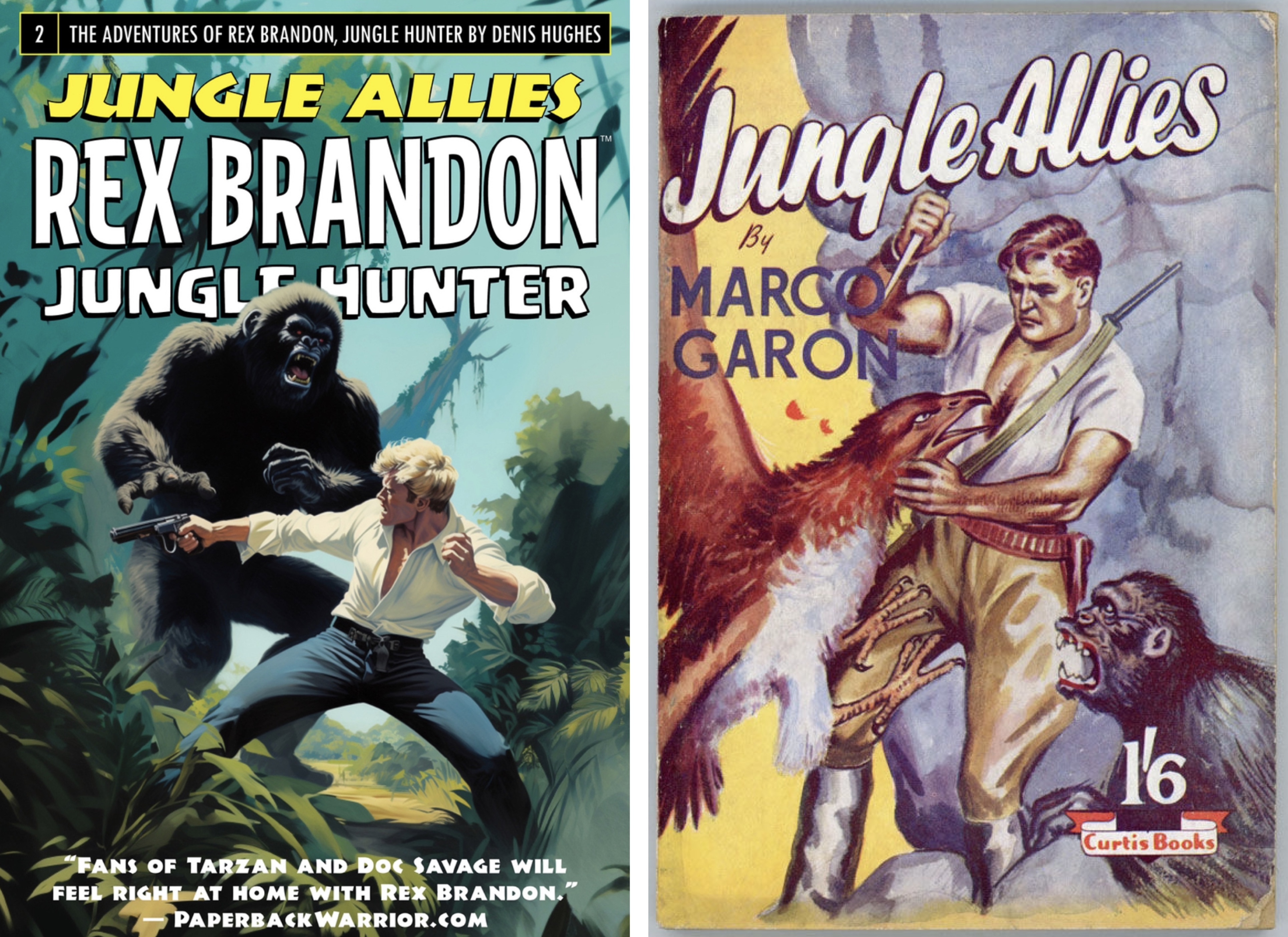
Rex Brandon #02 - Jungle Allies

The second installment of the jungle adventurer Rex Brandon series by Denis Hughes (1917-2008) has been reprinted by Bold Venture Press. It’s called Jungle Allies and it was originally published in 1951 under the pseudonym Marco Garon.

Rex Brandon is a world-famous geologist and big-game hunter who runs expeditions into the deepest part of Africa’s great Congo basin. In this adventure, the Belgians have engaged him to survey the jungle for mineral resources. He began his journey with 19 African “bearers” carrying Rex’s shit through the jungle, but he’s now down to a mere 15 due to accidents and whatnot with more carnage to follow.

One night while setting up camp along the fetid banks of a muddy river, Brandon happens upon a stumbling and exhausted white man along the river’s crocodile-infested shore. Brandon assists him back to camp and learns that he is an American named Jeff Lambert who was part of an archaeological expedition.

Lambert explains that his entire crew of academic archeologists was killed, and a female journalist named Naomi was captured by a fierce lost race of deep-jungle Africans. Fun Fact: The ferocious tribe holding the white chick is guarded by trained killer gorillas. With a challenge like that and a caucasian chick in-peril, it doesn’t take much convincing to send Rex on a rescue mission.

Along the way, they encounter a rogue elephant, a Pygmy tribe, hungry crocodiles, an attack-hippo, spear-chucking hostiles and a gang of pissed-off gorillas. There’s a lot of fun action spread throughout this economical 115-page novel. The series order is also irrelevant. You can safely start with this installment, if so inclined.

Jungle Allies is an exciting and fun African adventure book. However, you’ll need to set aside all of your modern sensibilities and remind yourself that this novel was written in 1951 when the idea of a “white savior” among savage Africans didn’t raise eyebrows. But if you enjoy an inventive and fun Indiana Jones-ish pulpy adventure, you’re sure to have a good time here. Recommended. 

Buy a copy of this book HERE.