Saturday, September 23, 2023

Conan - Conan

Many of Robert E. Howard's Conan the Cimmerian short-stories were out of print for decades, or had steep auction house pricing that prevented casual fans from reading them. Aside from one Ace paperback, and a series of Gnome Press hardcovers, these previously published stories existed in back-issues of Weird Tales

Beginning in the late 1960s, Lancer began publishing affordable paperbacks collecting these original Robert E. Howard published Conan stories. In addition, these collections also included unpublished Conan manuscripts and new material edited or authored by Lin Carter and L. Sprague de Camp. You can journey down any pulp sword-and-sorcery rabbit-hole and read more about the development of these Lancer paperbacks, the discovery of manuscripts by Howard heirs' literary agent Glenn Lord, and both the praise and criticism of Conan pastiche writing, which is included in these Lancer editions. 

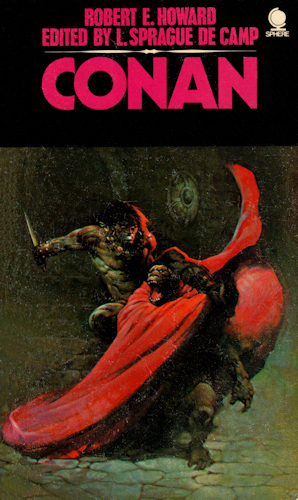
I want to simply highlight the stories including in each paperback, beginning with the very first Lancer edition aptly titled Conan. The collection was first published in 1967 and features a Frank Frazetta cover. The paperback, weighing in at just 221 pages, includes two of Howard's most respected and well-known Conan stories, “The Tower of the Elephant” and “Rogues in the House”, with the latter selection influencing the book's cover art. 

“Introduction” - As I alluded to earlier, the development of the Lancer paperbacks is a much talked about event that populates the sword-and-sorcery community. In this five page introduction, author L. Sprague de Camp introduces readers to Robert E. Howard with a brief biography. He also cites a specific letter that Howard wrote to fellow author Clark Ashton Smith explaining how the Conan character was created. In addition, de Camp analyzes the term “heroic fantasy” and how it came to fruition. 

“Letter from Robert E. Howard to P. Schuyler Miller” - This is four and a half pages showcasing a letter that Howard wrote to the science-fiction writer and educator Miller. In the letter, Howard explains the Hyborian nations and comparisons to medieval Europe, Asia, and Africa. The letter also displays Howard's explanation of Conan as the king of Aquilonia for many years. This letter was originally published in the The Coming of Conan hardcover by Gnome Press in 1953.

“The Hyborian Age, Part 1” - Howard's 14-page essay outlining the entire Hyborian kingdom and the rise and fall of the various cultures that make up the sprawling landscape. This was originally contained in the The Phantagraph in 1936, and subsequently in the volumes The Coming of Conan, King Kull, and Skull-Face and Others.

“The Thing in the Crypt” - Some find fault that this book, which is a celebration of Robert E. Howard's Conan creation, offers a non-Howard work as the first fictional story in the collection. “The Thing in the Crypt” was authored by L. Sprague de Camp and Lin Carter, but the reason it is the first actual story in the collection is because the books, edited by Carter and de Camp, are a road map of Conan's chronological life. This story features Conan as a teenager who just escaped a slave pen after being captured after a raid in Asgard. Later, there is a story that Bjorn Nayberg authored (with assists from Carter and de Camp), “Legions of the Dead”, that predates the events in this story. It is found in Conan the Swordsman. In “The Thing in the Crypt”, Conan finds a cave containing a mummified corpse holding a sword. When he takes the sword, the mummy comes to life and the two battle. This story also influenced a similar scene in the Conan the Barbarian film. “The Thing in the Crypt” first appears in this story collection. 

“The Tower of the Elephant” - This first appeared in the March, 1933 issue of Weird Tales. A young Conan arrives in Arenjun and overhears a conversation about the wealth and riches contained in a tall structure deemed The Tower of the Elephant. Always looking for thieving opportunities, Conan climbs the tower with the help of another thief, Taurus. Conan discovers cosmic horror inside the tower and fights to escape. Howard’s endless imagination just flows onto the page with this wild, action-packed adventure. It quickly pulls you into the story with just a few opening paragraphs. The author's prose is just so smooth and stimulating, providing excellent plot development and pacing.

“The Hall of the Dead” - This was a fragmented Conan the Cimmerian document created by Howard and then re-worked by L. Sprague de Camp. This version was first published in The Magazine of Fantasy and Science-Fiction's February 1967 issue. Like many other stories, the era of “The Hall of the Dead” is set during Conan's thieving years, around 18-20ish. It picks up when Conan enters an abandoned, ancient city called Larsha. In a hot-pursuit is a group of Zamorian soldiers who have been assigned to arrest Conan for theft. As Conan explores this abandoned city, he teams up with another thief as the two fight giant slugs and other baddies that are protecting gold within this abandoned city. There's nothing to really dislike about “The Hall of the Dead”, but loyalist complaints favor Howard's original version, which is shorter and features some differences in Nestor's actions in the story and the disappearance of the giant slug. In essence, I felt the story as a whole, regardless of writer, effectively placed Conan in a gloomy post-apocalyptic setting of an abandoned city, albeit a very short visit, and that was very rewarding. 

“The God in the Bowl” - This Robert E. Howard story wasn't published in the author's lifetime. It was rejected by pulp magazine Weird Tales, and after Howard's death, went undiscovered until 1951. It was then edited by L. Sprague de Camp and first published in Space Science-Fiction's September, 1952 issue. The premise reveals that “thief” Conan accepts a job from Nemedia's Governor's son to break into an antique house to steal a precious diadem. This diadem is being kept in a sarcophagus that was apparently discovered in the dark realm of Stygia. However, there is a monster lurking in the house and and the overnight clerk is found dead. The story has a really unique flavor for a Conan story and nearly borders on detective-fiction. Overall, I can recommend “The God in the Bowl”, but there are plenty of other Conan stories you should be reading before this one.

“Rogues in the House” - This story first appeared in the pulp magazine Weird Tales in January, 1934. That same year, it was also featured in a short story collection, Terror by Night, published by Selwyn and Blount. The premise has Conan being assisted by an aristocrat to escape prison. In a series of wild events, Conan, the aristocrat, and a priest are trapped inside of a large house. The house contains a number of deadly traps used to enslave and kill the priest's political rivals. But, this story also influenced the Conan paperback's front cover with Conan battling Thak, an ape-like creature that prowls the house. This story is one of my all-time favorites by Howard and is filled with political intrigue, action, and savage violence. A must read.

“The Hand of Nergal” - Originally a fragmented story authored by Howard  in the 1930s, Lin Carter completed the manuscript and titled it. Along with appearances in Conan, “The Hand of Nergal” was also featured in The Conan Chronicles and Beyond the Gates of Dream. In the story, Conan is a mercenary serving Turan. In the heat of battle, Conan is battling these crazy giant bats when he nearly falls unconscious. Thankfully, Conan had discovered a strange amulet days before, which helps to repel the bats. Conan meets a female warrior and the two of them journey to the city of Yaralet to battle the sorcerer responsible for conjuring up these crazy bats. I really enjoyed this story and found Carter's stroke of science-fiction and fantasy a great blend with the more “on the nose” carnage that Howard's Conan typically creates. The Carter and Howard blend worked well, in my opinion, on the Kull stories, and you get that same sense of adventure, dark sorcery, and utter doom in this story.

“The City of Skulls” - This paperback collection is the first appearance of this story, which was originally titled “Chains of Shamballah” in the first printing's table of contents. This is one of only two stories in the collection that is authored by both Lin Carter and L. Sprague de Camp, void of any Robert E. Howard writing. In this story, Conan's military unit is massacred, leaving only himself, his friend Juma, and a princess alive. The three are taken captive and forced across mountains, through bitter cold winds, and into a warm jungle called Shamballah, the City of Skulls. It's an epic story with Conan and Juma eventually sold into slavery aboard a ship and the princess being promised to a Toad-God-Thing. The story locations are described so well and thrust these characters – unwillingly – into the heart of madness with high altitudes and low temperatures. Mix in the ruthless rowing expedition as testaments to Conan's internal fortitude to soldier on. That's why we read these harrowing adventure tales. Carter and de Camp can tell a great story and I feel like “The City of Skulls” is a worthy addition to this stellar Conan collection. 

Buy a copy of this book HERE.

Friday, September 22, 2023

The Spy Who Sat and Waited

Robert Wright Campbell (1927–2000) was a television writer who crafted teleplays for many shows in the 1950s and 1960s, including Maverick and Marcus Welby M.D. He later became a novelist and achieved commercial success with his mystery titles such as The Junkyard Dog and In La-La Land We Trust, both from 1986. His first book was a spy novel from 1975 called The Spy Who Sat and Waited, available today from Kindle Unlimited.

Here’s the premise: During World War I, Germany stationed sleeper agents around the world, and as Germany’s surrender became imminent in 1918, the Krauts told their spies to remain undercover awaiting the inevitable rebirth of the Reich. It’s pretty much the premise of the 2013 TV show, The Americans, where Soviet spies walk among us living as normal Americans for decades. In this case, it’s a German spy chilling in Scotland awaiting instructions while living a shadow life.

The novel begins immediately following WWI when a German sleeper spy, who adopts the name named Will Hartz, relocates from Switzerland to Scotland’s Orkney Islands, a useful port in both world wars. The water surrounding the islands was the site of a dramatic series of events in 1919 where the Germans intentionally sunk and abandoned 52 of their own ships rather than have them captured and redistributed to enemy forces at the war’s conclusion.

Upon settling there, Will buys a pub frequented by fishermen and settles in for a quiet life awaiting tasking from Germany. The author perfectly captures the combination of stress, boredom and loneliness that long-term undercover agents experience. This is exacerbated by the ambiguity of the mission in peacetime and the lack of directions from his superiors back in the Fatherland.

It’s a long wait for Wilhelm, but the author keeps things moving for the reader. Wilhelm follows the developments in Germany via the news from afar, including the rise of a Nationalist party comprised of disgruntled war veterans, led by a man named Adolf Hitler.

The reader is also treated to flashbacks from Will’s life to give us a better understanding of how this mild-mannered fellow became a spy embedded in a small Scottish fishing village. It’s a slow burn more about a man forced to live in a small community with a big secret rather than a typical spy yarn of the era. Nevertheless, the paperback was plenty entertaining for a literary novel about a small man with a big secret.

The first half of the paperback is a character-driven novel about a dormant spy, and the second half has some elements of a spy novel coinciding with the rise of Hitler, if that makes sense. Hitler’s ascendance pushes Will in some uncomfortable directions, and the novel’s central tension is his willingness to go along with orders from the Fatherland after assimilating quite nicely into Scottish island culture for 20 years.

I enjoyed this novel, but it was about twice as long as it should have been. It was not action-packed, but it was very well-written. Will’s journey through the early 20th century made for some good reading, but the reader shouldn’t confuse the book with a fast-moving spy thriller. If “recommended with reservations” is a thing, that’s probably where I land. 

Buy a copy of this book HERE.

Wednesday, September 20, 2023

Quest of the Dark Lady

Ben Haas (1926-1977) sold his first story to the pulps when he was 18 years of age. After serving as a Sergeant in the U.S. Army, and working in the steel industry, Haas became a full-time writer in 1961. He used pseudonyms like Thorne Douglas, Richard Meade, John Benteen, and William Kane. I'm familiar with the author's western writing, but wanted to try something a little different from the author. 

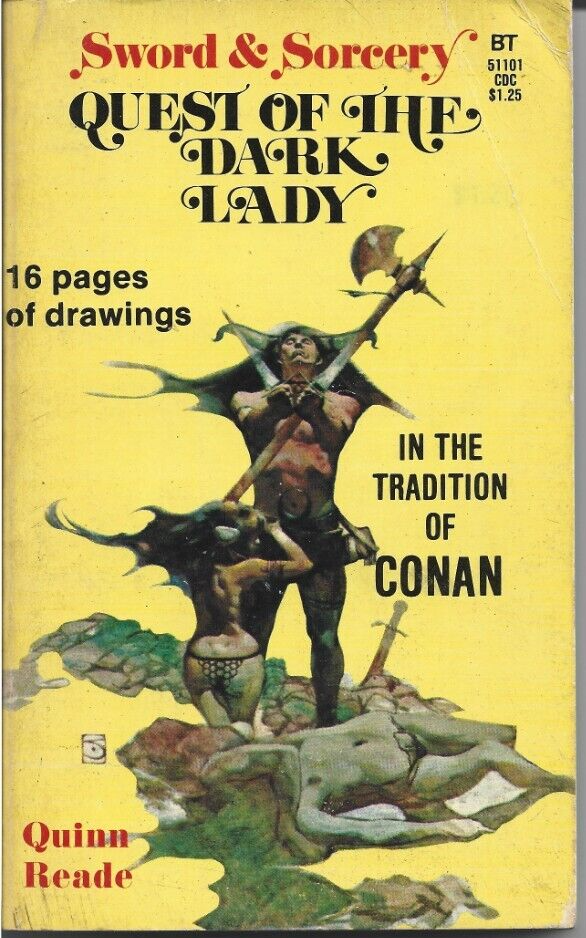
I decided to read another vintage sword-and-sorcery novel, a Haas-penned paperback called Quest of the Dark Lady. It was written under the pseudonym Quinn Reade. The book was first published by Belmont in 1969 using artwork by Jeff Jones. It was printed again by Belmont using a different cover by Jeff Jones. The publisher re-cycled artwork that was first used on the Belmont paperback The Quest of Kadji by Lin Carter. The book was also published in the U.K. by Paramount using that same artwork. 

In the book, readers discover that the Earth was devastated by a nuclear war hundreds (if not thousands) of years ago. What remains is a scarred civilization that resembles the Middle-Ages – men on horseback fight for King and Crown using swords, shields, and magic. The only known human population dwells in a placed called The Iron Lands. It is here that King (sometimes referred to as Emperor) Langax protects the people with a vast military force. Beyond the safety of The Iron Lands lies the Terrible East, a desolate landscape plagued by hideous monsters.

Years ago, Langax made the unfortunate mistake of ousting all of the sorcerers and magicians from The Iron Lands. In doing so, he then became vulnerable to some sort of spell originating in the Terrible East. This spell places Langax in a deep coma. He awakens briefly to advise his staff that the only savior now is an entity (or human) known as the Dark Lady. But, she lies somewhere in the Terrible East. The only person who can find her lies in Langax's dungeon awaiting execution for sabotage. That man is a former high-ranking soldier named Wulf.

There's so much to love about this simple 140-page adventure novel. The mystery surrounding why Wulf lies in a dungeon is slowly fed to the reader in the early pages. Eventually, this backstory is spelled out for the reader, but part of the book's reading pleasure is this core mystery. Surprisingly, Haas also includes a partner for Wulf, a fiery swordswoman who also plays a romantic role. When these two team up with a sorcerer, the three embark on a Hero's Quest to find the Dark Lady and save the kingdom.

This is a wildly entertaining, simple sword-and-sorcery novel that has plenty of action-oriented adventure. The monsters rear their ugly heads, the secret of the Dark Lady is revealed, and Wulf's exposure as an admirable hero are chief components making this an easy recommendation. But, get the second printing if you can locate it. It has interior artwork panels to enhance the great story.

Buy a copy of this book HERE.

Monday, September 18, 2023

Exotic Adventures of Robert Silverberg

Robert Silverberg is one of the most popular science-fiction authors of all time. He has won numerous honors for his literary work, including Hugo and Nebula Awards as well as induction into the prestigious Science-Fiction and Fantasy Hall of Fame. Just as he gained a tremendous foothold on the science-fiction and fantasy genres in the 1950s, the publishing industry began to become stagnant with many magazines, digests, and paperback publishers ceasing production. One of those magazines was a Men's Action-Adventure offering called Exotic Adventures. It lasted only six total issues, but Silverberg contributed over 20 stories to the run using a variety of pseudonyms. 

Esteemed MAM historians Robert Deis and Wyatt Doyle have collected these stories into a mammoth volume aptly titled Exotic Adventures of Robert Silverberg. It is part of the duo's The Men's Adventure Library published by New Texture. The book features an informative introduction regarding both Silverberg and his contributions to MAMs, as well as the publication history on the short-lived Exotic Adventures magazine. 

In this intro, I thoroughly enjoyed the education on Silverberg's paperback sleaze novels. The author penned many genre novels for the sleaze publishers like Beacon, Regency, Midnight Reader, and Nightstand. There's an excellent backstory here on William Hamling, who played a prominent role in Silverberg's early success as a writer, including the sex novels and sexology articles that the author wrote. There is also information on Silverberg joining Scott Meredith's agency. Meredith was the premier literary agent of that era, and Deis and Doyle point out that Meredith sold excerpts from Silverberg's sex books to the MAMs to use for their shorts. This was the same thing that was happening with Lawrence Block during that time as well. 

I really enjoy adventure stories, and this volume is packed with some really good Silverberg stories that feature promiscuous women, admirable heroes, and exotic locations. Most of the themes are sex-oriented, with adventurers pushed to the brink of death by some folly they made with a vivacious woman. Nothing showcases that theme more than “Safari of Death”, a short story originally featured in the magazine's third issue with Silverberg using the pseudonym Leon Kaiser. Like many of these MAM stories, the author is the main character and the presentation is first-person. In this story, Kaiser (a married man) relays an affair he had with a married woman on a safari hunt in the French Cameroons. Before the hunt is through, Kaiser learns more about this woman's character and the extreme nature of her lust. Needless to say, “Safari of Death” ends with a grisly scene.

The best story in this volume is “Trapped by Mau Mau Terror”, a short originally published in issue four using a Silverberg pseudonym of Norman Reynolds. The story is set in Kenya during a time when the Kikuyu tribe was on a violent rise to power under the name Mau Mau. The protagonist explains in the first-person how he came to manage a farm in Nairobi. At 30 years of age, with Korean War experience, this young man finds himself in the arms of a woman on a night of horrifying bloodshed. Inside a farm house, the man and his lover fight off hordes of blood-crazed savages over the course of a very violent evening. This was a high-intensity, large body-count as Silverberg and his heroes methodically clear the house of intruders. In some ways, this reminded me of another MAM story called “Night Visit”, which was published in Adam in October 1976 (author and artist unknown). 

It wouldn't be a true MAM omnibus without at least one killer-crab story. The book gives the readers what they want with “Attacked by Monster Crabs”, featured in the magazine's third issue under the pseudonym Dave Callahan. This is a fun, rather meaningless story about a guy and his lover attacked by pinching monstrosities near Belize. Another highlight of the book is a more serious entry called “I Escaped from the Soviet Slave Camp”, featured in the sixth issue under the name Anna Lukacs. In first-person, Lukacs details the horrific invasion of Hungary by the Soviets and her enslavement as a sex-slave. While certainly not the same overtones, the violence and sadistic savagery of this story was similar to a 1967 book I recently read and reviewed called Tortured for Christ, however the focus was on the Soviet's invasion and atrocities committed in Romania. Silverberg's story is excellent and provided a harsh look at the historic horrors perpetrated by the notorious Soviet empire. 

Exotic Adventures of Robert Silverberg is worth its weight in gold and contains some fantastic stories. While this author will forever be ingrained in science-fiction and fantasy, his other literary work was just as exceptional and memorable. I'm glad that Robert Deis and Wyatt Doyle recognized the need to bring these stories to light. They continue to impress with each and every volume. Highly recommended! 

Buy a copy of this book HERE.

Saturday, September 16, 2023

Paperback Warrior Primer - Claw the Unconquered

In the late 1960s, the publishing industry was abuzz with the reprinting of Robert E. Howard's Conan stories. Most of these had been missing from the commercial markets for decades, others had been collected in expensive hardback collections that fetched nearly auction-house prices. For the first time, the casual consumer could read these stories, including some that were previously unpublished, in affordable paperback editions courtesy of Lancer. With these new editions, authors like Lin Carter and L. Sprague de Camp were able to also contribute their own Conan stories as pastiches of Robert E. Howard's own storytelling style. 

Lancer, and later Ace, contributed to an influx of sword-and-sorcery pop-culture due to their paperback releases of Conan and other Robert E. Howard stories. The genre exploded with television, movies, and countless paperback novels featuring shirtless barbarians imitating Conan. By the 1970s, sword-and-sorcery was everywhere, so it was just a matter of time before the comic book industry seized their share of the market. 

With the success of Conan on the pages of Marvel, DC Comics became busy creating sword-and-sorcery titles that would compete in the hectic heroic-fantasy realm. In 1975, the company launched their creations, eight new titles that featured scantily-clad heroes holding sharp, gleaming swords. These books were Warlord, Beowulf, Dragon Slayer, Tor, Nightmaster, Starfire, Stalker, and today's topic, Claw the Unconquered

With Claw the Unconquered, the creative team made the decision to hone in on John Buscema’s Conan artwork. Who would be the best fit for Claw's artistic design and presentation? None other than Ernie Chan, an artist that spent the prior two years inking John Buscema’s art on Conan the Barbarian. Chan created the covers for the first nine issues, and penciled the interior pages on the first seven before giving the reigns to other artists like Joe Kubert and Keith Giffen.

Gracing the cover of Claw the Unconquered's first issue, titled “The Sword and the Silent Scream”, is a black-haired muscular barbarian carefully straddling a vulnerable young woman. Without the robust Claw logo, one glance would surely register that the book is another Conan issue. But, that was the point – to capture the dedicated readers of Conan the Barbarian and Savage Sword of Conan the Barbarian. Chan perfected this. 

Chan's co-creator of Claw was David Michelinie, who contributed to the creation of some of comics greatest characters in Venom, Carnage, War Machine, and Ant-Man. Michelinie and Chan had worked collectively on other DC books like House of Mystery and House of Secrets. Michelinie's concept was that Claw existed in a place called Pytharia, a land that resembles ancient Earth. Fans of Conan may see some similarities with Pytharia and Robert E. Howard's own landscape found in the Hyborian Age. In essence, it is a sprawling world filled with heroes and villains – noblemen, savages, evil sorcerers, terrifying creatures, and the obligatory beautiful women that need saving. 

At the forefront, like Howard's own stories, is the endless musical chairs played by politicians and their rivals. Conan, against his better judgment, seemingly always found himself embroiled in a political rivalry turned violent. Claw mirrors that same participation, which ultimately sets the table for the character's origin tale in the debut issue.

In the first three pages, readers learn that Claw's real name is Valcan and that he literally wears a red glove over his right fist, indicating early on that something is different about his hand. Claw is strolling through Ichar, the throne city of Pytharia when a thief attempts to rob him. Claw throws the poor soul through a window, then orders meat and wine. His muscles, good looks, and temperament gains an invitation from the attractive waitress to join her upstairs. But, she accidentally dislodges his glove and discovers he has a hairy hand with...claws! Later, it is revealed that the waitress was purposefully trying to verify Claw's identity in an effort to satisfy her master, an innkeeper named Tarmag.

In the streets, Tarmag has his henchmen attack Claw. Fortunately, Claw disposes of them all, but he mistakenly lets Tarmag live (a non-Conan move). The man journeys to Castle Darkmorn (what a name!) and tells (King) Occulas of the Yellow Eye the whereabouts of Claw. His reward? An instant fatal backstabbing by Occulas' guards. But why does Occulas want Claw? 

In a flashback from years ago, Prince Occulas is plotting to take the King's throne and learns from an oracle (named in the third issue as Miftung) that the only thing standing in his way is a man with a bizarre hand. Occulas has a peasant man tortured to learn that someone named Kregar of Kanon Wood has a funny hand. He bribes the King's men to go out and kill Kregar and his family. On page 13, where these events unfold, readers see that Kregar does have a hand that resembles Claw's. While Kregar and his family are all murdered, the men left behind a small infant that had a clawed right hand. Off the page, an angelic hand reaches for the baby and says that “your time is not yet come, for there are tasks awaiting that only you may perform.”

Occulas fatally poisons the King, snatches the crown, and for years thrusts Pytharia into desolate servitude. An older, crueler Occulas is then shown speaking to the oracle about a new threat that arises, a man named Valcan that has a deformity that has earned him the name Claw. Sensing this new threat, the story then circles back to the beginning (present day) as Occulas sends another of his henchmen to kill Claw. With the aid of the beautiful waitress, Claw is deceptively led to the Temple of Kann where a giant beast is awakened with a magical gem. Claw fights the monster, and then leaves the temple as the waitress is left to die. 

What readers gather from the first issue is that the through-story will be Occulas attempting to seek and destroy Claw as the hero journeys from place to place fighting the good fight for the people. The book takes on some other genres, like the traditional western monomyth, science-fiction, and fantasy. Additionally, Claw can't remember his past, so readers will be mysteified as to who the angel was that saved Claw from death as an infant. Through his journeys, he is searching to learn more about his origin and why he is destined to do great things. Magical elements regarding the claw and its purpose begin to shed some light on Claw's destiny. 

Like most of the other sword-and-sorcery books that DC launched, Claw the Unconquered was short-lived. The original run lasted just a total of 12 issues, ending in September 1978. The character made another appearance in 1981 in Warlord issues #48-49. 

Claw continues to exist in comic book continuity. He has randomly appeared in the modern pages of Wonder Woman, Justice League, and Swamp Thing. In a completely different character, there were elements of Claw used for the Primal Force comic also published by DC. The character was re-introduced to Conan fans through a rebirth by Dynamite Entertainment. Claw teamed with Red Sonja in the four-book miniseries Devil's Hands. Additionally, there was a spin-off of that series simply called Claw the Unconquered, which ran a total of six issues and was written by Chuck Dixon. 

While I can't speak on the title after 1978, I highly encourage you to read the full 12-issue run of the original DC comic. If you enjoy 1970s sword-and-sorcery literature, then this is well worth the nostalgic trip through time.

Buy a copy of this book HERE

Friday, September 15, 2023

Chronicles of Counter-Earth #01 - Tarnsman of Gor

There are many different names given to the Gor series of sword and planet adventures. Some refer to it as The Chronicles of Counter-Earth or The Gorean Saga, other monikers exist like The Saga of Tarl Cabot, Gorean Cycle, Gorean Chronicles, and Counter-Earth Saga. Additionally, some readers refer to is as How To Place a Dog Collar on Your Lover in 5 Easy Steps. The series was authored by John Lange Jr under the pseudonym of John Norman. The series ran 37 total installments between 1966 and 2022. The novels have been published by a combination of DAW Books, Ballantine, and Open Road Media. They currently exist in digital and audio versions.

The first thing you need to know about the series is that it is a controversial one. In these books, the author depicts women in an unfavorable light, often showcasing them as material possessions serving as abused collar-bound slaves. These women submit themselves to men by dropping to their knees and placing their arms in a position where it would suggest they are begging. These female slaves are known as kajira. The popular series spawned a subculture lifestyle known as Gorean with its own language. I'm not choosing this platform to either praise or criticize anyone who likes the series or its influence. You do you, and I'll do me. I'm simply sampling the series based on my newfound love for fantasy and science-fiction novels. Nothing more, nothing less.

Before reading the debut, Tarnsman of Gor, I discovered that the early novels in this series are pure sword-and-sorcery  heavily influenced by Edgar Rice Burroughs' Barsoom series (1912-1943). After reading the first few chapters, I discovered it is darn-near a complete ripoff of A Princess of Mars. But, that isn't necessarily a bad thing. 

At the beginning of the book, readers are introduced to a British man named Tarl Cabot, residing in present-day (read that as the 1960s) America. We learn that his mother died when he was young and his father seemingly disappeared. Tarl becomes well-educated at Oxford University and later becomes a professor at a New England college in America. While on a hiking and camping vacation in the rural mountains of New Hampshire, Tarl stumbles on an electronic device that allows him to use his thumbprint to access a document. The device is a makeshift letter from his father dated 1640. Soon, a spaceship appears and beams up Tarl.

Tarl awakens to find that his father is alive and well and a senior leader in a tower city called Ka-Ro-Ba. This city exists on a planet called Gor, which is “hidden” in the same solar system as Earth. The planet is ruled by a mysterious sect of supreme beings known as Priest-Kings and the leaders they have chosen for society are provided insights on the planet's dynamics – like the fact that it is round. The rest of society – those in a lower class – are fed misleading information to keep them on the lower rungs of survival. The lower classes think that Gor is flat. They also don't have access to any modern technology, or have the ability to rise above their intellectual levels. So, most of Gor exists on the same technological level of...say Earth's Bronze Age. Weapons are swords, daggers, shields, spears, etc. But, the most popular vehicles are large winged birds called Tarn, which all of Gor's military seem to ride. 

Without going too far down the rabbit hole here, Gor's various nations tend to war with each other. The winner gets that nation's home stone, which is just a rock with the name of the nation printed on it. Apparently if your nation captures another nation's home stone, then you control that nation. So, the nation of Ar is getting a little too big for their pants, so young Tarl is educated in Gorean culture, including how to fight with the various weapons and how to control and ride the Tarn animals. Why? Because he is going to fly into Ar undercover and steal their home stone. Which makes up the bulk of this series debut. 

Here at Paperback Warrior, we just call them how we see them. I sat down one Saturday for a couple of hours and read this 220-page paperback from cover to cover in one sitting. I was never bored by it. By suspending my disbelief on some of the ridiculous hero saves, I found myself thoroughly entertained. Lange certainly took some liberties with Burroughs' Barsoom series, including the first and last chapters of the book, and I had some hesitation on reading past the first chapter because of it. But, I'm glad I did because this is pure adventure from start to finish.

The book's monomyth story kicks into high-gear when Tarl is “shot down” over the skies of Ar. Landing in the jungle with the King of Ar's spunky daughter Talena, he must contend with giant Spider People, a fight to the death with a master swordsman and survive being crucified on a boat and drawn-and-quartered by flying birds. All of this is carefully navigated as Tarl contends with two brutal villains on a quest to disrupt the power of Ar while questioning his own nation's mission on Gor.

In some ways, this fish-out-of-water tale reminded me of Lin Carter's own Burroughs' rip-off series Zanthodon, albeit a more advanced version in terms of society and landscape. I prefer the Carter series more, but there was nothing about Tarnsman of Gor that was unsatisfactory. In fact, this early indication suggests that Tarl is a hero that disputes the idea of slavery and punishment of women. In one scene he frees a slave girl destined for death, and throughout the narrative he continually promotes equality between himself and Talena. He frees more slaves and has a more respectful view of women than...say...Conan. The most despicable treatment of women I've ever experienced in fiction is William W. Johnstone's Out of the Ashes series, which sets the gold standard in terms of male chauvinism. But, as I've noted, this series apparently retains some quality in the early installments.   

If you enjoy over-the-top, completely senseless science-fiction adventure, then Tarnsman of Gor will deliver a good time. I can't speak for the rest of the series, but this specific book was wildly entertaining. Highly recommended! 

Buy a copy of this book HERE.

Wednesday, September 13, 2023

Change Partners

Celebrated jazz musician Charles Boeckman (1920-2015) authored crime-fiction novels, westerns, and short stories for the pulps and digests in the mid 20th century. Using the pseudonym Alex Carter, Boeckman authored racy sleaze novels for Beacon Books. I read, enjoyed, and reviewed two of these novels, Boy-Lover (1963) and Traded Wives (1964). I thought I would try another one, Change Partners, originally published in 1963.

In 1960, Ernest Evans, known as the famous singer and dancer Chubby Checker, released a cover of Hank Ballard's song “The Twist”. The song, and Checker's dance move, lit up the club floors and had incredible success on radio. But, “The Twist” dance was considered pretty provocative for 1960. 

In Change Partners, Les Kennedy arrives home from his photography studio to find his suburban housewife Vicki doing the Twist dance in his living room. The way her hips and buttocks twist and shake puts Les into an immediate sexual surrender. After the two make love, they agree to head to the local country club to dance the night away. It is here that Les gets drunk and Vicki gyrates with a used car salesman. Spotting his wife's sexy dance moves on the floor with a stranger, Les makes a club spectacle by dragging her to the car and back home. Things aren't looking good for the Kennedys.

Pretty soon, the club incident spills over into marital disharmony when Vicki begins an affair with the used car salesman from the dance. In retaliation – you know where this is going by the title – Les strikes up an affair with the couple's friend and dance instructor Sybil. The married couple's sexual encounters with other people makes up the bulk of the narrative.

Before you start thinking this story seems tepid and dull, let me remind you that this sort of novel isn't a far stretch from what Gil Brewer and Orrie Hitt were doing with their own sexy crime-fiction. Arguably, those authors created crime stories with the real focus being the tumultuous affairs and sexy flirting to propel the plot. Boeckman is just missing the crime element in his books, but to be clear there is a crime committed in Change Partners that provokes some jail time for the main character. But, it isn't anything exceptional. Instead, the author pursues the hot chemistry and sex (never graphic) that the characters experience as their marriage deteriorates. The emotional baggage, insecurities, guilt, and motivation to adultery is what makes the narrative twist and turn to the literary music.

Like Boy-Lover and Traded Wives, Boeckman pens another gem with this portrait of suburban marital Hell. If you enjoy the riches-to-rags fall from grace noir that stems from crime-fiction, then you'll love this book. Recommended.

Buy a copy of this book HERE