Wednesday, October 4, 2023

To the Stars #03 - Starworld

Along with series titles like Stainless Steel Rat and Bill, the Galactic Hero, Harry Harrison wrote a number of science-fiction and fantasy novels during his long and respected career. I've concentrated on reading the author's trilogy To the Stars, Homeworld (1980), Wheelworld (1981), and today's topic, Starworld (1981). 

The story so far is that Earth is completely ruled by the rich that have established a two-class one-world government administered by the United Nations. You have the rich controlling everything, including Earth's far-reaching “territory”, a series of slave planets that serve as manufacturing and service for the lower-class Proles. A whiz engineer named Jan figures out that Earth is hiding human history and is seized by the authorities and sentenced to death on a farming planet. All of this is captured in the first book, Homeworld.

In Wheelworld, Jan orchestrates an uprising on the farming planet to usurp an old woman's rigid authority. Her concept of being complacent and living to serve Earth with harvests of corn is overthrown by Jan's forward-thinking, liberal approach to do things in a more democratic way. Jan later discovers that his short uprising on Earth led a series of events that have forced Earth into a war with the only country not participating in the one-world government, Israel, as well as rebels from all of the slave labor planets. On the last page of Wheelworld, Jan joins the rebellion to take down Earth's power-hungry leaders.

Starworld is a buzzsaw filled with non-stop action as Jan and other patriots form a strategic plan to organize the rebellion into a fighting force. This fertile story-line incorporates a lot of different elements ranging from espionage to military combat. At the root of Harrison's riveting narrative is a dilemma facing Jan – he must learn to trust the man who murdered his sister (events that occurred in Homeworld). Enhancing the plot development is preparation for a spacecraft battle and overtaking a military base in the Mojave Desert. Jan also has a romantic relationship with a woman that plays a key part in the rebel's success.

Once you've read Homeworld and Wheelworld, you get the idea where this novel is heading. It's much more epic than the two prior installments and often places Jan in a minor role for some of the developing plot. While the military campaign and ultimate war seems like a grand spectacle, the novel is still less than 200 pages, so an org chart or notes isn't a requirement. This is lightweight science-fiction for casual genre fans. Recommended! 

Buy a copy of the book HERE.

Monday, October 2, 2023

To the Stars #02 - Wheelworld

Harry Harrison was a popular science-fiction author that created a number of memorable series titles and characters. His most popular works are those involving the Stainless Steel Rat and Bill, the Galactic Hero. While I haven't explored those titles yet, I did enjoy my first foray into the author's To the Stars trilogy, Homeworld, originally published in 1980. Needless to say, I continued my space-travels with the second installment, Wheelworld, published one year later.

This trilogy, which has nothing to do with another of Harrison's works called Deathworld, is fairly easy to understand and enjoy, so those of you loosely reading science-fiction should be tall enough for this ride. In Homeworld, readers learn that in the 23rd century, Earth is ran by a one-world government administered by the United Nations. The rich make up a conglomerate of authority that rules the proles, the other class of humans that simply exist as slaves in manufacturing and service. Earth's rich and powerful controls the outlying planets and moons, creating slave planets that simply manufacture goods to ship to Earth. The people on these planets live a life of labor, void of any knowledge of human history.

Jan (male), the series hero, is a microchip whiz that lives a life of luxury on Earth. He figures out the whole conspiracy that forces the proles into servitude and tries to stop it. By teaming with the Israelis, the only country that isn't part of the one-world government, Jan learns about the hushed human history, the plight of mankind, and the big lie fed to the world by “big brother”. By the end of Homeworld, Jan is captured, his sister is murdered, and he is sentenced to life as a slave on a farming planet. 

As Wheelworld begins, readers learn that four years have passed since Homeworld's final page. Jan is living on the agriculture planet Halvmork. Here's the deal on this planet, because it is an integral part of the story. The planet, which is much smaller than Earth, is off-tilt by a few degrees which creates one massive season every four years. On this planet, there is twilight on one side of the planet and temperatures hovering around 80s degrees for four consecutive years. Jan, and the other harvesters, grow corn during this time. After four years, the weather shifts on that part of the planet to 150 degrees and nonstop sunlight. So, after four years, Jan and the others await ships to arrive to take the corn back to Earth. Then, via mobilized transports (like large tanks), the entire population travels thousands of miles to the other side of the planet to take advantage of the four year period that is twilight and 80 degrees there. Cool, right?

This population of slavers has its own governing body, an old woman who is antiquated in her ways and butts heads with the forward-thinking hero. Jan is in a romantic relationship with the old woman's daughter Alzbetta, and the two want to become married but it is forbidden. This is a splendid side-story that propels the book's central plot. As the book begins, it is harvest time and the four years is coming to an end. The sun is beginning to shine and the forecast is heating up. But, the ships don't arrive, which is a major problem. 

Jan makes the decision to take all of the corn on the motorized trek across the planet. His reasoning is that the ships may arrive on the other side of the planet and the corn will be needed there. But, the old woman refuses to do this so Jan has to strong-arm her family to do the right thing. This creates a physical fight between Jan and a family enforcer, which leads to a riveting trial and execution thing at the book's end. But, the real pleasure of Wheelworld is the “wheeling” across the planet as the team fights through volcanic ash, huge crevices in the Earth, swarms of insects, and the human turmoil and factions that develop on the road trip. 

Honestly, Wheelworld can work perfectly as a stand-alone novel. It is a road trip adventure as Jan and the team work their way from Point A to Point B to avoid natural disasters. In some ways, the book reminded me of Damnation Alley by Roger Zelazny as a futuristic obstacle course pressed for time. In the trilogy, this is really the hinge that gets from the Earth action in Homeworld to the Earth War story in Starworld. But, regardless of your approach, Wheelworld is a fantastic novel and a great reading experience. 

Buy a copy of this book HERE.

Friday, September 29, 2023

Red Sonja #04 - Endithor's Daughter

This fourth installment in Ace's Red Sonja paperback series places the fiery-haired swordswoman in the city of Shadizar, the sister city to Zamora. She's in town searching for work, but struggling for fair payment. Mostly, the jobs consist of guard duty for the various merchants and shippers traveling from Shadizar to neighboring cities. As proficient as Sonja is with a sword, she faces discrimination for being female. The lack of securing a job keeps her planted in this urban city for the entirety of David C. Smith and Richard L. Tierney's novel.

In the book's beginning, a man named Endithor is attempting to sacrifice a virgin by stabbing her with a knife. Guards, and a city leader named Nalor, break into the room and arrest Endithor before the girl is stabbed. Endithor declares that Nalor betrayed him, and that the whole ritual was planned by Nalor in an effort to supernaturally dispose of a political rival named Kus. Endithor is placed on trial the same day, found guilty, and then is tortured to death in the city square as an entertaining public spectacle. Endithor's daughter Areel watched the execution while also planning her revenge on Nalor, thus she gains the book's title.

That's a lot to unpack, but ultimately Nalor felt that Endithor was becoming a fearsome political rival and just set him up to die. So who is this Kus fellow? That's the really cool part of the book. In flashback scenes, readers discover that Kus was an ancient warrior who fell to his knees on a corpse-strewn battlefield. Approaching death, Kus is “kissed” by a beautiful woman. Kus discovers that the woman was a vampire and that she cursed him with the eternal gift of draining victims of their blood to remain alive and ageless. With the gifts of immortality, Kus also has the ability to shape-shift, control minds, and fly around. Kus sleeps in a coffin in a cold basement because he can't be subjected to sunlight. Both Kus and Nalor form a partnership to protect each other's interests – Kus staying alive and preying on the city while also killing off any of Nalor's political rivals and foes. 

Where does Red Sonja fit into all of this? Since she is living in Shadizar at the time of Endithor's execution, she begins to find herself embroiled in the political rivalry. She crosses paths with Areel, learns of Nalor's nefarious ways, and discovers Kus's sorcery and vampiric nature. By teaming up with a local bartender, and a group of mischievous kids, Sonja discovers where Kus is sleeping during the day and then, well, I won't ruin this “fright night” for you. 

Needless to say, Endithor's Daughter is an entertaining combination of sword-and-sorcery and Hammer Horror in a not-so-traditional horror presentation. The book's first-half sets up the characters and political strife occurring in the city. The second-half is the quest to find Kus and dispose of Nalor, which takes some time. The book's last 50 pages were exceptional as the story hit its stride and the inevitable “the blade versus the fangs” finally rose to fruition. But, I stress that the reader needs some patience because the novel is heavy on dialogue, less on action. Prepare accordingly, and then enjoy the Hell out of it. 

Buy a copy of this book HERE.

Wednesday, September 27, 2023

Jim Breen #01 - The Knave of Diamonds

Jack Karney (1911-????) was an employee of the Manhattan District Attorney’s Office who wrote 11 paperback crime novels in his day, including two Ace Doubles. Insurance Investigator Jim Breen was his two-book “series” character first appearing in 1959’s The Knave of Diamonds. The short novel has been reprinted by Wildside Press as a one-dollar ebook or a ten-dollar paperback

Our narrator is Jim Breen, who grew up among the youthful toughs on New York’s Cherry Street. He’s now the in-house investigator for Bender’s Insurance Company, and working the streets of Manhattan is a good deal for everyone because Breen is well-connected on both sides of the law. 

An insured party had $80,000 in jewelry stolen in a home-invasion robbery. Rather than paying out the whole claim, Breen is hitting the streets with the plan of buying back the hot rocks for $30,000 — no questions asked. In order to make the deal happen, Breen needs to find the burglar to negotiate the deal. 

For Breen, that means canvassing hoodlums that he grew up with on the streets. A particular childhood friend comes to mind who may have actually pulled off the heist, but what kind of reception is Breen likely to get when accusing any local hoodlum of a robbery?

Breen faces plenty of resistance along his unusual quest to give $30,000 away to a robber. The fistfight scenes are top-notch, and Breen really gets to kick some ass. Overall, The Knave of Diamonds was a solid, if unremarkable, hardboiled private eye novel that was perfectly-consistent with the genre output in 1959. If you like that type of thing, you’re bound to enjoy this one just fine. 

Buy a copy of this book HERE.

Monday, September 25, 2023

Tarzan #04 - The Son of Tarzan

On page 196 of the 1963 Ballantine paperback of The Son of Tarzan, two characters discuss and recap the major plot points of the novel. Nothing orchestrates the ultimate mess Edgar Rice Burroughs created than the conversation these two characters have. 

In it, a dying villain advises Korak, the son of Tarzan (more on that later), that the girl he is searching for isn't with him. He then explains to Korak that he was hired to steal this girl by another guy, and he is the one that now has the girl. Bluntly, Korak responds that he just left that guy and was sent back here to gain the true wherabouts of the girl. The villain explains the girl was originally captured from a Sheik, who had captured her from a royal French family. The guy that hired him wanted to take the girl to London. After he captured her, the Sheik re-captured her and now she's in his village (soon to be owned by the Sheik's half-brother).

Can you follow this convoluted human-trafficking mess? It is a literary nightmare to follow.

For the record, I absolutely love the first three Tarzan novels, Tarzan of the Apes, The Return of Tarzan, and The Beasts of Tarzan, and you can read my energetic praise of those books here on the blog. I was really excited to jump into this fourth series installment, The Son of Tarzan. The novel was first published in All-Story Weekly as a six-part serial from December 4, 1915 through January 8, 1916. It was then packaged as a full-length novel and published by A.C. McClurg in 1917. 

Let's unpack this. The son of Tarzan is a boy named Jack. He was the infant that was supposedly kidnapped by two villains in the last book (spoiler, he wasn't). Fast-forward ten years from the events of the prior novel, The Beasts of Tarzan, and the Clayton family – John/Jack/Jane -  live in London while also managing a sprawling estate in Africa. Jack manages to run away from home in order to guide a familiar Ape named Akut back to Dover in Africa. Akut is the ape that Tarzan befriended in the last book, who now is being used unfairly as a showpiece for the paying public.

In an extraordinary series of events, Jack and Akut are left stranded in the African jungle. The author sort of recycles Tarzan of the Apes to fit the narrative of this book. The first-half of The Son of Tarzan is a coming-of-age tale as Jack transforms from London schoolboy to fierce and confident king of the jungle, Korak the Killer. Despite the over-utilized “fish out of water” formula, watching Korak become the second-coming of Tarzan was awesome. He's a strong, lethal, and intelligent lad that certainly embodies everything we love about his father. With a title of The Son of Tarzan, I was totally committed to a novel about Korak. However, Burroughs messes it all up.

The entire second-half is nothing short of a disaster. As I alluded to earlier, a young French girl named Meriem is snatched by human-traffickers and given to an evil Sheik. In his village, she's routinely beaten by both the Sheik and an old lady. Thankfully, she's captured from the Sheik, but soon finds that the duo who kidnap her are nearly as awful as the Sheik. I lost track of how many times Meriem is passed back and forth between these two guys, the Sheik, the Sheik's half-brother, Korak, and Tarzan and Jane. Ultimately, the best part of this whole fiasco is the time she spends with both Korak and Akut. Meriem falls in love with Korak (obviously) and becomes familiar with not only surviving in the jungle, but thriving. She is the embodiment of Tarzan's Jane. Easy to connect the dots.

As if Tarzan needed another name (he's already John Clayton, Tarzan, Lord Greystoke), he is referred to as Big Bwana in this book (Jane is My Dear). Burroughs disguises that Bwana is Tarzan until the book's climax,” but it isn't hard to figure it out. 

The narrative spins its wheels with the “pass Meriem back and forth” sequence, but there were some emotional investments made into Meriem's relationship with Bwana and My Dar as well as the aforementioned chemistry with Korak. Beyond that, I really disliked the novel's flow and dependence on the human-trafficking plot. Burroughs spent a great deal of time passing Jane around in the last novel, and it seemed like this was just more of the same. 

Hopefully, the series' fifth installment, Tarzan and the Jewels of Opar, takes more of a fantasy or science-fiction flavoring instead of human plight. But, the synopsis of the book suggests that Jane has been kidnapped again. 

Buy a copy of this book HERE.

Saturday, September 23, 2023

Conan - Conan

Many of Robert E. Howard's Conan the Cimmerian short-stories were out of print for decades, or had steep auction house pricing that prevented casual fans from reading them. Aside from one Ace paperback, and a series of Gnome Press hardcovers, these previously published stories existed in back-issues of Weird Tales

Beginning in the late 1960s, Lancer began publishing affordable paperbacks collecting these original Robert E. Howard published Conan stories. In addition, these collections also included unpublished Conan manuscripts and new material edited or authored by Lin Carter and L. Sprague de Camp. You can journey down any pulp sword-and-sorcery rabbit-hole and read more about the development of these Lancer paperbacks, the discovery of manuscripts by Howard heirs' literary agent Glenn Lord, and both the praise and criticism of Conan pastiche writing, which is included in these Lancer editions. 

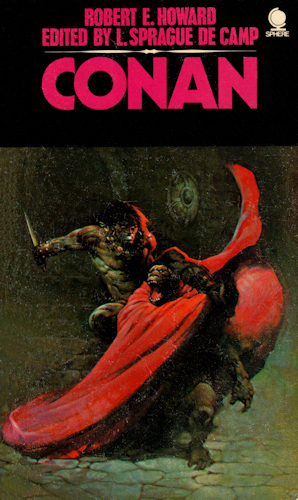
I want to simply highlight the stories including in each paperback, beginning with the very first Lancer edition aptly titled Conan. The collection was first published in 1967 and features a Frank Frazetta cover. The paperback, weighing in at just 221 pages, includes two of Howard's most respected and well-known Conan stories, “The Tower of the Elephant” and “Rogues in the House”, with the latter selection influencing the book's cover art. 

“Introduction” - As I alluded to earlier, the development of the Lancer paperbacks is a much talked about event that populates the sword-and-sorcery community. In this five page introduction, author L. Sprague de Camp introduces readers to Robert E. Howard with a brief biography. He also cites a specific letter that Howard wrote to fellow author Clark Ashton Smith explaining how the Conan character was created. In addition, de Camp analyzes the term “heroic fantasy” and how it came to fruition. 

“Letter from Robert E. Howard to P. Schuyler Miller” - This is four and a half pages showcasing a letter that Howard wrote to the science-fiction writer and educator Miller. In the letter, Howard explains the Hyborian nations and comparisons to medieval Europe, Asia, and Africa. The letter also displays Howard's explanation of Conan as the king of Aquilonia for many years. This letter was originally published in the The Coming of Conan hardcover by Gnome Press in 1953.

“The Hyborian Age, Part 1” - Howard's 14-page essay outlining the entire Hyborian kingdom and the rise and fall of the various cultures that make up the sprawling landscape. This was originally contained in the The Phantagraph in 1936, and subsequently in the volumes The Coming of Conan, King Kull, and Skull-Face and Others.

“The Thing in the Crypt” - Some find fault that this book, which is a celebration of Robert E. Howard's Conan creation, offers a non-Howard work as the first fictional story in the collection. “The Thing in the Crypt” was authored by L. Sprague de Camp and Lin Carter, but the reason it is the first actual story in the collection is because the books, edited by Carter and de Camp, are a road map of Conan's chronological life. This story features Conan as a teenager who just escaped a slave pen after being captured after a raid in Asgard. Later, there is a story that Bjorn Nayberg authored (with assists from Carter and de Camp), “Legions of the Dead”, that predates the events in this story. It is found in Conan the Swordsman. In “The Thing in the Crypt”, Conan finds a cave containing a mummified corpse holding a sword. When he takes the sword, the mummy comes to life and the two battle. This story also influenced a similar scene in the Conan the Barbarian film. “The Thing in the Crypt” first appears in this story collection. 

“The Tower of the Elephant” - This first appeared in the March, 1933 issue of Weird Tales. A young Conan arrives in Arenjun and overhears a conversation about the wealth and riches contained in a tall structure deemed The Tower of the Elephant. Always looking for thieving opportunities, Conan climbs the tower with the help of another thief, Taurus. Conan discovers cosmic horror inside the tower and fights to escape. Howard’s endless imagination just flows onto the page with this wild, action-packed adventure. It quickly pulls you into the story with just a few opening paragraphs. The author's prose is just so smooth and stimulating, providing excellent plot development and pacing.

“The Hall of the Dead” - This was a fragmented Conan the Cimmerian document created by Howard and then re-worked by L. Sprague de Camp. This version was first published in The Magazine of Fantasy and Science-Fiction's February 1967 issue. Like many other stories, the era of “The Hall of the Dead” is set during Conan's thieving years, around 18-20ish. It picks up when Conan enters an abandoned, ancient city called Larsha. In a hot-pursuit is a group of Zamorian soldiers who have been assigned to arrest Conan for theft. As Conan explores this abandoned city, he teams up with another thief as the two fight giant slugs and other baddies that are protecting gold within this abandoned city. There's nothing to really dislike about “The Hall of the Dead”, but loyalist complaints favor Howard's original version, which is shorter and features some differences in Nestor's actions in the story and the disappearance of the giant slug. In essence, I felt the story as a whole, regardless of writer, effectively placed Conan in a gloomy post-apocalyptic setting of an abandoned city, albeit a very short visit, and that was very rewarding. 

“The God in the Bowl” - This Robert E. Howard story wasn't published in the author's lifetime. It was rejected by pulp magazine Weird Tales, and after Howard's death, went undiscovered until 1951. It was then edited by L. Sprague de Camp and first published in Space Science-Fiction's September, 1952 issue. The premise reveals that “thief” Conan accepts a job from Nemedia's Governor's son to break into an antique house to steal a precious diadem. This diadem is being kept in a sarcophagus that was apparently discovered in the dark realm of Stygia. However, there is a monster lurking in the house and and the overnight clerk is found dead. The story has a really unique flavor for a Conan story and nearly borders on detective-fiction. Overall, I can recommend “The God in the Bowl”, but there are plenty of other Conan stories you should be reading before this one.

“Rogues in the House” - This story first appeared in the pulp magazine Weird Tales in January, 1934. That same year, it was also featured in a short story collection, Terror by Night, published by Selwyn and Blount. The premise has Conan being assisted by an aristocrat to escape prison. In a series of wild events, Conan, the aristocrat, and a priest are trapped inside of a large house. The house contains a number of deadly traps used to enslave and kill the priest's political rivals. But, this story also influenced the Conan paperback's front cover with Conan battling Thak, an ape-like creature that prowls the house. This story is one of my all-time favorites by Howard and is filled with political intrigue, action, and savage violence. A must read.

“The Hand of Nergal” - Originally a fragmented story authored by Howard  in the 1930s, Lin Carter completed the manuscript and titled it. Along with appearances in Conan, “The Hand of Nergal” was also featured in The Conan Chronicles and Beyond the Gates of Dream. In the story, Conan is a mercenary serving Turan. In the heat of battle, Conan is battling these crazy giant bats when he nearly falls unconscious. Thankfully, Conan had discovered a strange amulet days before, which helps to repel the bats. Conan meets a female warrior and the two of them journey to the city of Yaralet to battle the sorcerer responsible for conjuring up these crazy bats. I really enjoyed this story and found Carter's stroke of science-fiction and fantasy a great blend with the more “on the nose” carnage that Howard's Conan typically creates. The Carter and Howard blend worked well, in my opinion, on the Kull stories, and you get that same sense of adventure, dark sorcery, and utter doom in this story.

“The City of Skulls” - This paperback collection is the first appearance of this story, which was originally titled “Chains of Shamballah” in the first printing's table of contents. This is one of only two stories in the collection that is authored by both Lin Carter and L. Sprague de Camp, void of any Robert E. Howard writing. In this story, Conan's military unit is massacred, leaving only himself, his friend Juma, and a princess alive. The three are taken captive and forced across mountains, through bitter cold winds, and into a warm jungle called Shamballah, the City of Skulls. It's an epic story with Conan and Juma eventually sold into slavery aboard a ship and the princess being promised to a Toad-God-Thing. The story locations are described so well and thrust these characters – unwillingly – into the heart of madness with high altitudes and low temperatures. Mix in the ruthless rowing expedition as testaments to Conan's internal fortitude to soldier on. That's why we read these harrowing adventure tales. Carter and de Camp can tell a great story and I feel like “The City of Skulls” is a worthy addition to this stellar Conan collection. 

Buy a copy of this book HERE.

Friday, September 22, 2023

The Spy Who Sat and Waited

Robert Wright Campbell (1927–2000) was a television writer who crafted teleplays for many shows in the 1950s and 1960s, including Maverick and Marcus Welby M.D. He later became a novelist and achieved commercial success with his mystery titles such as The Junkyard Dog and In La-La Land We Trust, both from 1986. His first book was a spy novel from 1975 called The Spy Who Sat and Waited, available today from Kindle Unlimited.

Here’s the premise: During World War I, Germany stationed sleeper agents around the world, and as Germany’s surrender became imminent in 1918, the Krauts told their spies to remain undercover awaiting the inevitable rebirth of the Reich. It’s pretty much the premise of the 2013 TV show, The Americans, where Soviet spies walk among us living as normal Americans for decades. In this case, it’s a German spy chilling in Scotland awaiting instructions while living a shadow life.

The novel begins immediately following WWI when a German sleeper spy, who adopts the name named Will Hartz, relocates from Switzerland to Scotland’s Orkney Islands, a useful port in both world wars. The water surrounding the islands was the site of a dramatic series of events in 1919 where the Germans intentionally sunk and abandoned 52 of their own ships rather than have them captured and redistributed to enemy forces at the war’s conclusion.

Upon settling there, Will buys a pub frequented by fishermen and settles in for a quiet life awaiting tasking from Germany. The author perfectly captures the combination of stress, boredom and loneliness that long-term undercover agents experience. This is exacerbated by the ambiguity of the mission in peacetime and the lack of directions from his superiors back in the Fatherland.

It’s a long wait for Wilhelm, but the author keeps things moving for the reader. Wilhelm follows the developments in Germany via the news from afar, including the rise of a Nationalist party comprised of disgruntled war veterans, led by a man named Adolf Hitler.

The reader is also treated to flashbacks from Will’s life to give us a better understanding of how this mild-mannered fellow became a spy embedded in a small Scottish fishing village. It’s a slow burn more about a man forced to live in a small community with a big secret rather than a typical spy yarn of the era. Nevertheless, the paperback was plenty entertaining for a literary novel about a small man with a big secret.

The first half of the paperback is a character-driven novel about a dormant spy, and the second half has some elements of a spy novel coinciding with the rise of Hitler, if that makes sense. Hitler’s ascendance pushes Will in some uncomfortable directions, and the novel’s central tension is his willingness to go along with orders from the Fatherland after assimilating quite nicely into Scottish island culture for 20 years.

I enjoyed this novel, but it was about twice as long as it should have been. It was not action-packed, but it was very well-written. Will’s journey through the early 20th century made for some good reading, but the reader shouldn’t confuse the book with a fast-moving spy thriller. If “recommended with reservations” is a thing, that’s probably where I land. 

Buy a copy of this book HERE.