Friday, December 10, 2021

Steve Midnight #01 - The Dead Ride Free

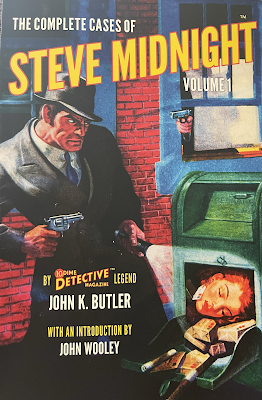
Before breaking into movies and television, pulp author John K. Butler (1908-1964) wrote nine novellas in Dime Detective Magazine starring a mystery-solving cab driver named Steven Middleton Knight, AKA: Steve Midnight. The stories have been collected into two attractive volumes by Altus Press, and I read the series debut, “The Dead Ride Free,” from May 1940.

Our narrator Steve Midnight was a wealthy playboy who lost it all during the Great Depression. He’s working as a cabbie for the Red Owl Cab Company in Los Angeles one cold night when a tall guy wearing a turban wants to be taken to Topanga Canyon. Steve immediately recognizes the fare as an old vaudeville magician named Zohar the Great. It’s been 20 years since Steve saw Zohar sawing a woman in half, and now he’s in the back of Steve’s taxi.

Zohar asks Steve to load a large parcel into the cab. After Steve agrees, he learns that the parcel is a locked coffin weighing about 150 pounds. Zohar explains that the casket houses a mummy from 1300 BC - a prop for his act. Upon arrival at Zohar’s shack, the magician offers to show Steve the mummy. However, upon opening the coffin, the men find the body of a freshly-dead woman with a dagger protruding from her chest.

For reasons best explained in the novella’s narrative, Steve is left to solve this mystery without the help of the police or the shady magician. There are some pretty cool curve balls thrown into the mystery’s plot, and Steve is a fine character to serve as our guide over the course of 50-pages.

Overall, “The Dead Ride Free” is a solid 1940s pulp mystery, but nothing earth-shattering, hardboiled or revelatory. I enjoyed the story and will revisit the collection when I’m in the mood for this particular flavor of comfort food.

Get your copy HERE

Thursday, December 9, 2021

The Sea-Wolf

Jack London (John Griffith Chaney, 1876-1916) is one of those authors that populates every library or indispensable high school reading lists. As a kid, I remember reading his classic White Fang (1906) and promising myself that I would read more of his work. Over 30 years later, I finally decided to read another of the author's classics, The Sea-Wolf. It has been filmed 13 times and was featured as a series for BBC Radio 4 in 1991.

Humphrey Van Weyden is a newspaper columnist living in San Francisco. One afternoon, Hump is pleasantly boating off the California coast when he's rammed by a large schooner called the Ghost. The vessel is captained by Wolf Larsen, an abrasive individual that is described as highly intellectual and materialistic. Hump has the option of sinking, swimming, or hitching a ride on the Ghost. Unfortunately, he climbs aboard and quickly realizes he's in for a Hellish ride.

Hump declares that he wants a u-turn back to the coast so he can return home. Larsen refuses and orders that the ship continue its journey to Japan. Larsen offers to pay Hump to work aboard the ship and orders him to be a cabin boy. Hump resists but eventually his will is broken and he submits to long days of cooking, cleaning, and contending with a seasoned, very violent crew.

London provides some unique perspective through Hump's eyes. The excessive hard work and perseverance strengthen Hump. He realizes that he has been sleeping through life with his cushy desk job and a complacency to perform the most mundane tasks. As the narrative continues, Hump discovers that beneath Larsen's granite veneer, he is a literary scholar and possesses an atypical knowledge for math calculations and navigation. Because of the commonality, Hump and Larsen spend hours discussing books and art.

Eventually the abused crew turns on Larsen and attempts a mutiny. Larsen's tactical experience allows him to fight back against the crew, eventually torturing specific catalysts. Due to the violence and madness, Hump swears to kill Larsen. Things grind to a screeching halt when a woman, Maud Brewster, is rescued from the seas. Her background as a writer immediately connects with Hump. Together, the duo hopes to escape Larsen and his rebellious crew.

I really enjoyed London's novel and found Larsen (whom is the premise of the book's title) a multifaceted nemesis. The story has a couple of offshoots that I felt really solidified the storytelling: Hump's rivalry with a murderous cook, Larsen's vendetta against his brother, Hump's romanticizing with Maude, the arctic survival finale, etc. London's emphasis on Larsen's approach to life, work, and resilience provides so many great passages and quotes, my favorite being:

“Surely there can be little in this world more awful than the spectacle of a strong man in the moment when he is utterly weak and broken.”

I've read that The Sea-Wolf has similarities to Rudyard Kipling's 1897 novel Captains Courageous. London, who was proven to perform plagiarism, wasn't the only writer to use this plot. I would imagine there are a number of nautical novels with heroes that are trapped at sea with a tyrannical captain. But, I would say that Max Brand's (real name Frederick Schiller Faust) 1941 novel Luck of the Spindrift is nearly a carbon copy of The Sea-Wolf in terms of storyline. In Brand's novel, a San Francisco philosopher finds himself trapped on a ship headed to the South Seas. He has an interest in the only female on board and there's a devious captain to brutalize the crew.

If you enjoy more modern nautical adventures by the likes of Clive Cussler, Hammond Innes, Kenneth Bulmer and Patrick O'Brian, I think you owe it to yourself to read early 20th century novels like this one. Without these pioneering efforts, nautical fiction wouldn't have such strong and solid sea legs.

Wednesday, December 8, 2021

Dirk Pitt #03 - Iceberg

Clive Cussler (1931-2020) was a massively-popular novelist who dominated the bestseller lists for the duration of his writing career. His most enduring series character was Dirk Pitt, a troubleshooter for the fictional National Underwater and Marine Agency. My first exposure to the author and the character was his third installment, 1976’s Iceberg.

The book opens with a U.S. Coast Guard mission mapping the locations of icebergs floating in the North Atlantic near Newfoundland. From the air, the Coastie crew spots one impossibly large iceberg - 200 feet high weighing upwards of one-million tons. Closer examination of the iceberg reveals the impossible - an entire ship embedded within the ice but still visible from the sky. The Coast Guard estimates that once the iceberg drifts into the gulf stream, it's sure to melt - likely submerging the ghost ship into the depths of the sea. The iceberg must have dislodged from some northern glacier, but there’s no way to know its origin.

Enter Dirk Pitt. He’s an U.S. Air Force Major on permanent loan to NUMA - the National Underwater and Marine Agency. NUMA dispatches Pitt to a Coast Guard cutter with a mission to get inside the ghost ship and better understand what’s happening. As a character, Pitt is a combination of James Bond and Doc Savage. He’s a funny and likable hero stacked with core competencies. He can fly a helicopter, dive to great depths and bag the babes as needed. His deductive capabilities rival those of the great Sherlock Holmes.

The providence of the ship-in-the-berg is a plot point that I won’t spoil for you here, but it only serves as starting point into a variety of mysteries Pitt is called upon to solve over the 400-pages. He’s a smart cookie and not afraid to kick ass when needed. His relationship with his Admiral boss and the boss’ lovesick personal secretary make for some fine human moments throughout the paperback.

I was expecting Iceberg to be filled with dense plotting and littered with incomprehensible nautical jargon that would cause my eyes to glaze over. I’m pleased to report that Cussler avoids this trap and makes the pages fly by with a basic good guys vs. bad guys plot and a propulsive story. His books are about twice as thick as other men’s adventure paperbacks from the same era, so I was expecting a complex story akin to the work of Tom Clancy. Instead, Iceberg was pulpy as all-heck. The action and villainous motivations were over-the-top like a good Destroyer novel, and the layered twist endings were pedestrian, outrageous and fun. No one should ever accuse Cussler of writing high-brow, smartypants fiction. I hereby stand corrected.

The appeal of Cussler’s novels is now clear. If Iceberg is any indication, the series is a lot more fun than you might expect. The books can apparently be read in any order, and there are plenty of lists online ranking them based on quality. I look forward to diving deeper into this author and his famous series. Recommended. Get it HERE

Tuesday, December 7, 2021

Brother

Ania Ahlborn is a contemporary horror fiction author born in Poland who emigrated to the United States where she earned an English degree from University of New Mexico. She writes disturbing novels from her Greenville, South Carolina home that have earned acclaim from the Horror Writers Association and a huge social media following of rabid fans. My first introduction to her work was her 2015 novel, Brother.

The year is 1980, and it’s time to meet the Morrows, the serial killer family at the center of the novel. Daddy Wayne is a Vietnam vet who handles the killing of female hitchhikers they bring back to their horror house in the woods. Momma’s own childhood trauma undoubtedly set the table for her own adulthood of bloodthirsty psychopathology. Their oldest kid is named Ray. He’s in his 20s now and prefers to be called Rebel. He gets off on tormenting his sensitive younger brother Michael, now 19. Meanwhile, Michael is protective of his sister Misty Dawn. There’s also another sister named Lauralynn, but we don’t even say her name out loud.

The Morrows are poor. Not like the urban poor we have today with smartphones and HD televisions. They are country poor. Appalachia poor. They make ends meet by shoplifting and collecting whatever trinkets they can find on the women they kidnap, torture and kill. The bodies are buried out back of their ancient, dilapidated West Virginia farmhouse sporting faded clapboards and filthy windows. They pretty much keep to themselves except when Rebel and Michael venture into town to stalk possible victims, steal food or chat up girls at the local record store.

Brother’s third-person narrative follows Michael, who, despite being a complicit member of a psychopathic serial killer family, is actually a very sweet boy. Through flashbacks, the reader receives glimpses of this awful family’s origin story, and it’s every bit the nightmare you’d expect. Older sister Lauralynn was the nice, compassionate girl of the bunch who looked after Michael when he was young. You’ll notice that she’s not present during the contemporary scenes, and the story of her departure from the Morrow house is doled out gradually as one of the novel’s central mysteries.

Brother is basically a bloody and gruesome coming of age suspense story about young Michael growing to understand his own dysfunctional upbringing in this messed-up family. There’s a puppy love story to enjoy and lots of abuse of Michael at the hands of his loathsome older brother. Throughout the novel, Ahlborn’s writing is exceptionally good and the pages fly from one atrocity to another. The book is a real bloodbath and incredibly compelling, but I didn’t find it particularly scary. Instead, the paperback presents a gripping suspense story that chooses to focus on the characters instead of the gore. By now you know if this is your kind of thing. If so, Brother is an easy recommendation. 

Get a copy HERE

Monday, December 6, 2021

Let Me Kill You Tenderly

Robert Sidney Bowen (1900-1977) was a World War One aviator who became a pulp writer from the 1930s into the 1950s. In 1946 and 1947, he wrote a series of short works for Popular Detective starring a private investigator named Chet Lacey that have been compiled into an ebook by The Pulp Fiction Book Store. My introduction to the author and character is “Let Me Kill You Tenderly” from June 1946.

As the novella opens, Private Eye Chet Lacey is gearing up for a well-earned Mexico vacation when an ex-girlfriend comes ringing. These days her name is Vivian Ames, and she’s married to a wealthy bank president named Ken. Well, Ken has been kidnapped and the bad guys are demanding a $50,000 ransom from Viv in exchange for her husband’s safe return. No cops or the banker dies. Viv needs Chet’s help.

Simple setup, but things quickly become complex. There’s good reason to believe Ken faked his own kidnapping. But why would he do that? It’s like stealing $50,000 from himself, right? That’s the mystery that Chet needs to solve. Things get crazy, violent and action-packed pretty quickly as Chet navigates his way through a ransom money drop that becomes a gunfire bloodbath.

The bodies pile up, and Chet eventually solves the case in a tidy and logical conclusion. Overall, “Let Me Kill You Tenderly” was a rather generic hardboiled private detective yarn, but completely enjoyable and well-written. We’re lucky there are outfits like The Pulp Fiction Book Store keeping this old stuff alive. Check them out.

Buy a copy of this book HERE

Friday, December 3, 2021

Tip on a Dead Jockey

“Tip on a Dead Jockey” is the 40-page title story of a paperback compilation of Shaw’s short fiction from 1957. The protagonist is Lloyd Barber, an American WW2 pilot who has been bumming around Paris for the past 18 months since his marriage crumbled back home. Barber made some money working as a technical advisor on a Hollywood war movie filmed in Paris, but his savings are now declining.

One day a woman finds Barber and solicits his help. The lady is married to one of Barber’s war buddies - a fellow named Jimmy - who recently packed a bag and disappeared, abandoning his job and bride. Basically, she wants Barber to find her husband. Not being a detective or manhunter, Barber begins to seek out an older fellow named Bert Smith, who he met betting on horses at the track a while ago.   

The story then cuts to an extended flashback taking the reader back to the relationship between Barber and Bert that began at the track betting on the horses. The two guys hit it off and Bert eventually makes the young pilot an offer: Fly a heavy box from Cairo to Cannes and make an easy $25,000. I won’t spoil what’s in the box or how it might tie into Barber’s missing war buddy, but the moral dilemma posed by the mysterious cargo is the centerpiece of the story.

Because “Tip on a Dead Jockey” is literary fiction from the New Yorker and not pulp fiction from Manhunt, the story’s ending isn’t particularly twisty or impactful. It is, however, satisfying and very well written. The original paperback is out-of-print, but the story is included in the 63-story collection of Shaw’s finest work called Short Stories: Five Decades currently available from University of Chicago Press. I read a few more of his stories, and he’s definitely worth checking out if expertly-crafted short fiction is your thing.

Thursday, December 2, 2021

The White South

Many titles by Hammond Innes posses a nautical theme. From seafaring adventures like The Wreck of Mary Deare to oceanic oil rig thrillers like North Star, Innes explored the world searching for a great story. His mid-career novel The White South, published in 1949, takes readers to the frigid waters of the Antarctic. As both a survival tale and nautical quest, the book's synopsis promises an ice shaking boat disaster in giant seas. Go ahead and take my money. I'm sold. 

Like many average males, Duncan Craig is no longer complacent with his suburban existence as a London desk clerk. In the Navy, he traveled the world, commanding a ship in WW2 and his heart is aching for a more meaningful and exciting life. After selling his belongings, Craig has a plan to move to South Africa. But, in a London airport, Craig's life changes dramatically.

After asking a favor, Craig is attempting to join a charter plane to Capetown. The flight is owned by the South Antarctic Whaling Company, but specifically Colonel Bland. After making his plea for one of the five seats on board, Bland willingly allows Craig to join them. On board is Bland's daughter-in-law Judie and an assortment of minor characters. Craig overhears that Judie's father works for Bland as a manager of sorts on a whaling ship. But, a conflict has risen due to Bland promoting his own inexperienced son Erick. Judie and Erick are married, but she hates the man and considers him a lying scoundrel who partnered with the Germans during WW2. The fact that Erick may pass her father in seniority makes her furious.

Eventually, Bland learns of Craig's experience with boats and makes him an offer he can't resist. Craig will command one of the whaling ships in the Antarctic sea. In the midst of the job proposal and hiring,  he learns that Judie's father mysteriously committed suicide by jumping overboard. Judie feels that Erick killed him, but that's a mystery that eventually expands. After inquiring into the details, Craig begins investigating the circumstances surrounding the man's death. Thus, Craig and Judie fall in love.

This is a nautical adventure and Innes spends some time acclimating readers on the whaling industry, which I found surprisingly interesting. Craig's inexperience is the catalyst for this educational journey, but eventually tragedy strikes. In the icy seas, Erick rams his ship into Craig's in a high-stakes deadly version of bumper cars. The two ships sink and the passengers are forced onto the ice. A rescue attempt then traps another ship between two icebergs. 

The book's final 100-pages is a brutal cold weather survival tale as Craig orchestrates an escape attempt while contending with warring factions over supplies, injuries, and the few lifeboats remaining. He's an admirable hero that must overcome extreme adversity among men that don't necessarily respect his fishing inexperience. Thus, there's no surprise that Craig is the unlikely hero that rises to the occasion for the greater good. 

There's a lot for readers to busy themselves with including memorization of who's who among the Norwegian names. Placing the characters and their locations on the ice was sometimes difficult. Because of that, the reading requires some focus and concentration to stay on task. It's not a heavy lift, but still requires minor endurance. If you love Hammond Innes, this is another stellar addition to his bibliography. Get it HERE