Friday, March 17, 2023

The Bride Wore Black

Up until 1940, Cornell Woolrich was mostly writing shorter works about the rich and privileged, like Times Square (1929) and Children of the Ritz (1927). After 1932's Manhattan Love Song, eight years passed before another Woorich novel was published. This hiatus set the table for a re-structure of Woolrich's subject matter and a new direction for his literature. 

In 1940, The Bride Wore Black (aka Beware the Lady) was published, the first novel-length suspense thriller from Woorich. The novel kickstarted a crime-fiction career that flourished for twenty years, producing over 15 masterworks of suspense and landing Woolrich in the upper echelons of crime-fiction authors and pioneers. 

The Bride Wore Black is presented in five separate parts, each titled as the last name of a potential victim. In between, the author includes a small portion of insight from the eyes of the murderer, an unnamed woman Hellbent on revenge. Then, another short narrative featuring insight on the victim, and then a paragraph serving as the postmortem. In this presentation, each part is set as its own short-story or novella. These parts eventually connect to make a spectacular whole, but the pure pleasure lies in the construction. 

The first victim is a man named Bliss, lured to the top of a building for an engagement party. It is here that he meets the beauty, a mysterious woman rejecting men while searching for someone special. Bliss, unfortunately, falls for the trap and takes a deadly tumble. His friend, a man named Corey, remembers the woman's eyes moments before Bliss's death. This tidbit will be of some use later in the book.

This same set-up is used as various men meet their demise after gaining some contact with this dark female avenger. The murders are clever, a cross between diabolic (shot with an arrow, suffocated) to quiet death (poisoning). All of these are written with a sense of white-knuckled dread. After Bliss, readers realize that they will be reading the last moments of life for all of these poor unfortunate men. 

Perhaps the most compelling and shocking is Moran. On his last day, his wife is lured out of town with a telegram informing her of her mother's sudden sickness. This was a way to isolate Moran, but there's a catch. He is left caring for his young son. When a woman arrives at the house, promising she is the teacher, Moran's son immediately rejects the visitor, explaining that she isn't his who she claims to be. Prone to fibbing, his warning falls on deaf ears and Moran is led into a macabre, murderous game of hide and seek. 

The Bride Wore Black is a masterpiece that essentially helped define the suspense-thriller market. The novel's use of certainty – a predetermined sentencing for each character – is oddly a paradox of suspense. Readers realize the outcome before death arrives. There is a void of uncertainty, but the build-up to death and murder creates an emotional stirring that's hard to suppress. Woolrich purposefully cranks the wrench, tightening the intensity until the last gasp. If Hitchcock was the master of visual suspense, then Woolrich was certainly his equal with literature. The Bride Wore Black is a must-read. 

Buy a copy of this book HERE.

Wednesday, March 15, 2023

Homicide Handicap

Florida resident Bob McKnight authored 11 short novels published as Ace Doubles between 1957 and 1963. He also wrote a bunch of non-fiction books on horse race handicapping and didn’t forge into fiction until the ripe old age of 51. Homicide Handicap was his last Ace novel from 1963.

Sox Bradley is a thoroughbred racehorse trainer and our narrator in this 100-page conventional mystery. His wealthy ex-wife, Carla, owns a bunch of racehorses, and Sox still works for her despite the marriage being long over. When Carla’s dead body is found stashed away at her Florida mansion, the cops naturally question Sox for the murder.

Yes, this is another one of those paperbacks where the falsely-accused protagonist needs to solve a murder to save his own hide, and it’s a pretty enjoyable iteration of this trope. Sox is a decent main character despite a lack of charisma, and the setting in the world of thoroughbred horse training was an interesting glimpse behind the curtain of a sports subculture. I learned a thing or two along the way that will make me a hit at cocktail parties when the topic of horse racing arises.

There’s a sweet girl interested in Sox and a handful of likely suspects with motive and opportunity. There’s not much action other than a couple of peripheral murders that narrows the field of suspects. You’ll see the solution coming from a furlong away, but it will only serve to make you feel smart in the final chapter when your suspicions are confirmed.

To be clear, Homicide Handicap isn’t a mystery masterpiece, but it was an enjoyable diversion about as good as a typical long-story from Alfred Hitchcock’s Mystery Magazine. The novel has never been reprinted, but many Ace Double collectors probably have a copy that’s been sitting on their shelves for decades. The other side of the paperback is The Dead and the Deadly by Louis Trimble. It’s a good pairing as both authors knew how to execute a formulaic mystery.

Monday, March 13, 2023

Double Indemnity

James M. Cain hit a homerun with his femme fatale crime-fiction novel The Postman Always Rings Twice. The bestselling novel was adapted to film seven times, converted into an opera, a radio drama and a play. It is considered one of the best novels of the 20th century. So, how would Cain ever top it? Well, he really never did, but he came really close with Double Indemnity. This novel was originally published in Liberty in 1936. The book was later published in 1943 in the collection Three of a Kind, an omnibus containing Double Indemnity as well as two additional works by Cain, Career in C Major and The Embezzler

Like The Postman Always Rings Twice, Double Indemnity is told in the first-person as a sort of “if you are reading this then I'm in the deathhouse” kind of book. The protagonist is Walter Huff, an insurance agent in Beverly Hills. Like Cain's character Frank Chambers, Huff is a strategist who helps plot a murder when he falls for a young seductress named Phyllis. The problem is that Phyllis is married to a wealthy guy named Nirdlinger, one of Huff's clients. After Huff falls for Phyllis, the two collaborate on knocking Nirdlinger off to cash in on an accident policy. 

Like most of the femme fatale novels, which Cain perfected for similar novelists like Gil Brewer and Orrie Hitt, the murder plan develops into treachery, jealousy, lust, greed, and plain 'ole lyin' and cheatin'. The murder hits a major snag when Huff learns that Phyllis may have played him for a fool in hopes to run away with another guy. But, Huff gains some insight through Phyllis's gorgeous stepdaughter, whom he ultimately falls in love with. 

This book is rather short, but packs a punch. The gauntlet that Huff runs from A to Z in hopes to successfully murder for love, then backtrack to kill for vengeance is clever, compelling, and masterfully written. It's a tug-of-war as Huff clamors with the concept of murder, the ultimate sin. There's a deep mystery centralized as the narrative rotates different characters off the playing field. Who is truly innocent is one of the book's most perplexing questions. But, thankfully Cain keeps the characters to a minimum, keeping the plot development tight as the story expands outward into a brisk “man on the run” concept. 

Double Indemnity was adapted to film in 1944 by mystery powerhouse novelist Raymond Chandler and Billy Wilder. It was filmed again in 1973 and staged as a play in 2011. It's a prevalent bookend that butts up nicely with The Postman Always Rings Twice. While inferior to that masterpiece, Double Indemnity is still a mandatory read for any crime-fiction fan worth his salt. Highly recommended! 

Buy a copy of the book HERE.

Saturday, March 11, 2023

Conan - The Road of the Eagles (aka Way of the Swords, Conan Man of Destiny)

The December, 1955 Fantastic Universe issue featured an L. Sprague de Camp Conan story called “Conan, Man of Destiny”. This story was taken from a Robert E. Howard manuscript, originally titled “The Road of the Eagles”, discovered by Glenn Lord, about the Ottoman Empire featuring a hero named Ivan Sablianka. Howard's original version was edited by Lord and published in the Donald Grant collection Road of Azrael as “The Way of the Swords”. de Camp changed the title “Conan, Man of Destiny” to “The Road of the Eagles”. That story – de Camp's version – was later published in Lancer's 1968 collection Conan the Freebooter as by both de Camp and Howard. The comic adaptation appears in The Savage Sword of Conan #38

“The Road of the Eagles” continues where “Shadows in the Moonlight” leaves off. Conan and his pirates, now referred to as the Red Brotherhood, are attacked by Yildiz, the king of Turan and his General Artaban. Meanwhile, a young woman named Roxana escapes the ransacking and destruction of her village by a man named Kurusk Khan. Roxana, and a small army of Hyrkanians, runs into Artaban and he explains to her that he was in debt to Yildiz and basically attacked Conan's pirate crew to just pay off debt. Now, he is sort of rethinking his decision to serve Yildiz and wants to go independent and do his own thing with his army. 

With Artaban's change of heart, Roxana also reveals that the chief rival to Yildiz is Prince Teyaspa, her lover. She tells Artaban that Teyaspa is in a dungeon jail and he agrees to assist her with liberating him. While this is happening, Conan, nearly playing a bit part by this point, is running around with his surviving pirates trying to find and kill Yildiz. Here is where the story becomes very complicated and rather convoluted. Which, seems to be a pattern now with de Camp's reworking of Howard's stories that were never meant to feature Conan or The Hyborian Age. 

My understanding is that the castle where Teyaspa is imprisoned is simultaneously attacked by the Hyrkanians wanting revenge for their village destruction and Conan and his Red Brotherhood that want to find and kill Artaban before they seek Yildiz. Then, you have Artaban and Roxana attempting the prison break for Teyaspa. Honestly, this is like Game of Thrones on drugs that just leads to a Shakespeare-styled tragic ending. But, before the suicides (yes, they happen) the best part of the story reveals itself. Conan vs vampires!

Inside the dark cavernous tunnel system below the castle are ravenous hairy cave creatures called brylukas. They are vampiric in nature and attack Conan and his crew. This portion of the narrative is just brimming over with intense action-adventure as the titular hero attempts to climb through the cave's passageways while fighting off these savage monsters. This is more of what I want from Conan – brawn versus monsters, evil men, and sorcerers. Unfortunately, this exhilarating story within the story of Conan's escape from the creatures comes at the very end and is very short-lived. 

“The Road of the Eagles” is an okay read, but requires patience and pen on paper (or a handy phone notepad) just to keep up with who is chasing whom and for what reason – revenge, power, loot, women, etc. If you can dedicate 45 mins of heavy concentration, then the story totally works. If you are looking for just casual escapism, look elsewhere.

Friday, March 10, 2023

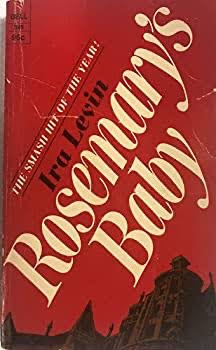
Rosemary's Baby

American author Ira Levin (1929-2007) struck gold in 1967 with his second novel, Rosemary’s Baby, selling four-million copies and counting. The novel’s iconic standing was solidified by the 1968 film adaptation by Roman Polanski (Full Disclosure: I’ve never seen it). The novel remains in-print today in every format imaginable. 

Guy and Rosemary Woodhouse are upgrading their Manhattan apartment to an exclusive, in-demand building called The Bramford. After signing the lease, the couple learns that the building has a dark past. Historic residents were accused of cannibalism, child murder and witchcraft. Decades ago, the building was thought to be cursed.

Despite these warnings, Guy and Rosemary move into Apartment 7B. Rosemary quickly makes a friend who promptly commits suicide. This brings her directly into the orbit of her busybody neighbors who all seem very interested in Rosemary’s fertility. 

Rosemary’s husband Guy is a struggling actor, but something about The Bramford has him acting quite different than normal. One night Rosemary has a vivid dream that her neighbors and Guy were involved in a dark ritual of sorts. When Rosemary awakens, she’s covered in scratches and soon learns that she’s pregnant. 

Levin does a great job of writing Rosemary as a naive ingenue from Nebraska, and she seems to be the only character willfully blind to the subtle manipulation of all the other characters and what may be growing in her womb. The novel is a slow burn to be sure, but the creeping dread that rises in the reader displays some really adept horror writing with a gentle touch. Scary? A little. Unnerving? Bullseye! Recommended? Definitely. 

Buy a copy of this book HERE.

Wednesday, March 8, 2023

Harry Stoner #01 - The Lime Pit

Jonathan Valin was born in Cincinnati, Ohio in 1947. He graduated from University of Chicago, and now works for Fi, a music criticism magazine he helped create. In the middle of his career were 11 mystery novels starring a Cincinnati detective named Harry Stoner. As a fan of 1980s crime-fiction, I decided to begin the series with the very first novel, The Lime Pit, published in 1980 as a hardcover by Dodd Mead.

Throughout the course of The Lime Pit, readers gain tidbits about Harry Stoner's life. The first thing we learn is that he served in the U.S. military as an M.P. during the Vietnam War. He has killed people before, and at one point he worked in Cincinnati's District Attorney's office. Now, Stoner is a private detective making ends meet taking on cases in America's mid-western heartland. As the book begins, Stoner is responding to an inquiry made by a Cincinnati man named Hugo Cratz.

Cratz is an elderly man living in the average community of North Clifton. He advises Stoner that a young woman he befriended, Cindy Ann, has gone missing. After the police dismiss the case, Cratz wants to hire Stoner to find her. The problem is that Cratz can barely rub two nickels together, so Stoner realizes he's probably working the case pro brono. The last place Cindy Ann was seen was with the controversial neighborhood couple. When Stoner interviews the couple, they tell him that Cratz is just hurt that his girl has run off with a biker. But, there isn't enough conviction in their story to fully satisfy Stoner. Combining this with Cratz's account that the weird couple are actually human sex traffickers peddling young women to Cincinnati's upper-crust thrusts Stoner into the investigation.

I read some online reviews about Valin's writing style and tend to agree with all of them. First and foremost, the guy can write his ass off. Second, his dialogue is convincing – this is how real people talk. So much that Valin even analyzes his own work by mentioning characters in other books fail to possess enough validity. He encourages his readers that his work is the real deal. I like that element and it reminded me of the great horror writer Brian Keene and his real-world presentation of average blue-collar people behaving in ways that genuinely seem valid and real. 

The Lime Pit drags readers through some really dark places within sex trafficking, politics, sports, and the lifestyles of the rich and richer. It's gritty, often disturbing, and very violent. Stoner is the capable protagonist guiding the readers through this seedy underworld. He doesn't necessarily break the law in an attempt to punish the lawbreakers, but he skirts the edges in a captivating way. I found comparisons to Loren Estleman's Amos Walker mysteries, with both detectives stalking their way through blue-collar towns to obtain justice. In fact, the first Amos Walker installment, Motor City Blue, has a similar plot to The Lime Pit, and was published the same year.

If you enjoy a great mystery filled with diverse characters, the The Lime Pit is sure to please. I loved this book and I'm anxious to read more Harry Stoner novels. 

Buy a copy of this book HERE.

Monday, March 6, 2023

Two Truths and a Lie

Sarah Pinkster is a contemporary fantasy and science-fiction author currently living in Baltimore. In 2020, Tor Books released her 34-page creepy novella called “Two Truths and a Lie” that won both the Hugo and the Nebula awards for Best Novelette. It’s available for two-bucks as an ebook. 

Marco and Stella were friends back in high school who lost touch over the years. When Marco’s unpopular older brother Denny dies, Stella resurfaces in Marco’s life to attend the funeral and pay her respects. Stella even offers to help Marco clean out Denny’s house. 

Denny was a hoarder, so going through his house with her old friend isn’t a pleasant task. The upside is that the manual labor of filling trash bags with Denny’s detritus gives Stella and Marco a chance to catch up with one another. 

As the two are cleaning and chatting, Stella asks Marco if he remembers a local children’s TV show from their childhood called “The Uncle Bob Show.“ Marco answers that he does recall the show and that his deceased brother had been in the studio audience for at least one episode decades ago. Their shared vague recollection was that the low-budget kid’s program was a sinister turn on "Mr. Rogers’ Neighborhood."

In the heaps of junk in Dennis’ home, they find a VHS tape from "The Uncle Bob Show" and pop it into the VCR. The show’s format is bizarre, and the stories told by Uncle Bob to his youthful audience are unnerving. I’ll let you read the novella yourself to get the gist. This leads to Stella conducting her own investigation into the show’s history from back in the 1980s and things get seriously creepy. 

"Two Truths and a Lie" is a story playing with the vague and largely repressed memories we all have from our childhoods. Pinkster’s writing is solid throughout. The ending didn’t really work for me, but I love the concept enough to recommend the novella without reservations. 

Buy a copy of this book HERE.