Monday, May 1, 2023

The Bleeding House (aka The House)

Hilda Lawrence (1906-1976) was a pseudonym for Hildegarde Kronmiller Lawrence, a mid-20th century author that wrote four novels in the 1940s. Nearly all of the books feature the characters of Mark East, a private investigator in Manhattan, and two New England spinsters, Miss Beulah and Miss Bessy. My only experience with the author is her last published work, Duet of Death. This 1949 offering consists of two short novellas – The Bleeding House (aka The House) and Death has Four Hands (aka Composition for Four Hands). 

Cutting Edge Books has recently published new editions of The House and Composition for Four Hands. Each novella is featured as a paperback and also collected digitally in the omnibus Best Pulp Noir Fiction Volume Nine: Four Hardboiled Novels. I chose to concentrate my efforts on The House

The book is presented in first-person by Isobel, a young woman living in a large, cavernous mansion left to her by her late father. Her dull days are spent under the constant scrutiny of her callous mother. Her only enjoyment in life is spying on her neighbors, a group of middle-aged cousins and friends that indulge in drinking affairs that typically involve rumors of Isobel's father, her mother, and her household. 

Through's Isobel's recollections, readers learn that Isobel's father died under mysterious circumstances. He acquired a terminal illness and spent his dying days with blue-collar men at a nearby labor camp. But, his death was linked to a tragic, fiery car accident on a road between the two dwellings. 

In the book's opening chapters, Isobel begins seeing a mysterious figure in the house. Her father's dog, which she inherited after his death, senses that the stranger may be a family member. Other signs begin to appear that perhaps Isobel's father isn't really dead. Is she mentally experiencing things she desires or is something supernatural occurring? Lawrence's spongy narrative twists and turns as Isobel, and her cavalier fiance, attempt to unravel the family mystery. 

As a veteran of 60s and 70s Gothics, it was interesting to see Lawrence using that same formula 15-20 years before the genre's paperback boom. Arguably, the author was inspired by Mary Roberts Rinehart, who cleverly invented some of the genre's consistent tropes in her early 1900s fiction. Atmosphere is key to these stories, and I felt like Lawrence missed an opportunity here. Otherwise, the book's central mystery, defining characters, and the obvious Gothic overtones were a real pleasure to experience. If you enjoy these cozy mansion-mysteries, then The House is worth visiting. 

Buy a copy of this book HERE.

Saturday, April 29, 2023

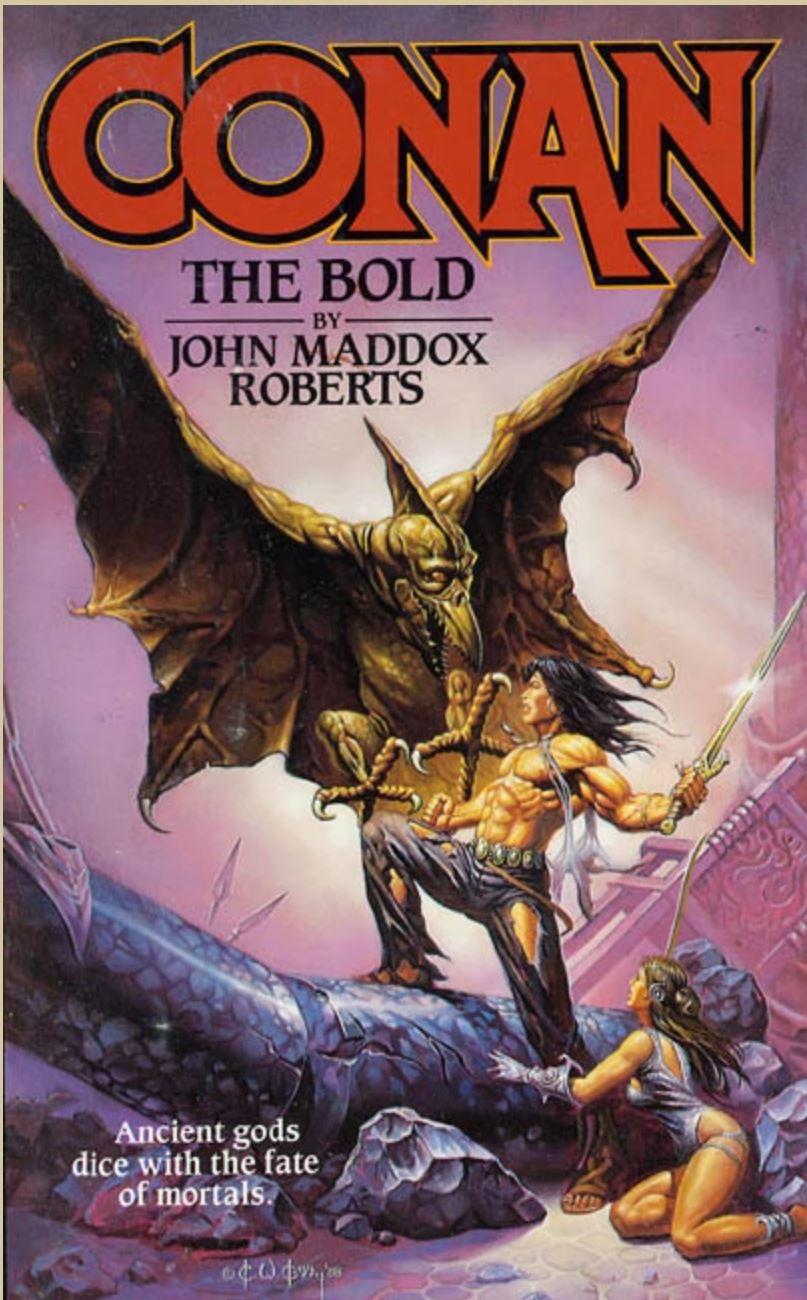
Conan - Conan the Bold

John Maddox Roberts is a Vietnam War veteran that served in the US Army from 1967 until 1970. His first novel, The Strayed Sheep of Charum, was published in 1977. Specializing in historical mystery and adventure, Roberts authored the successful Ancient Rome series SPQR, published as 13 installments between 1990 and 2010. He also authored titles like Stormlands, Hannibal, Space Angel, Cingulum, Island Worlds, and Falcon. My experience with the author is his contributions to the Conan pastiche novels published by Tor. Many Conan fans point to Roberts as one of the better authors of the post-Howard era of Conan literature. Roberts authored eight total novels featuring the hero, including Conan the Bold, originally published in 1989 with awesome cover art by Ken Kelly.

In Roberts' novel, he captures Conan's life at the age of 15 or 16, shortly after events in Conan of Venarium. After the sacking of Venarium, Conan headed south and wrestled with adventures in Pictland. It is here that he suffered injuries (off page), and as Roberts' novel begins, young Conan is being nursed back to health by a nice family in southwestern Cimmeria. In an interesting encounter, Conan is off hunting and reunites with a Great Valley Pict warrior named Tahatch. In reflection, Conan recounts his experience in the Pictish wilderness and battles with the Black Mountain Picts. After a battle, Conan first met Tahatch in a cave where the two struck up a friendship and Tahatch was able to mentor the young hero in ways of wilderness survival.  

When Conan returns from his hunting trip, he finds that his family, and the girl he was potentially to wed, all massacred by a band of slave raiders. Conan vows to track the raiders down and kill each of them. The book's narrative has Conan teaming with a swords-woman named Kalya, who has her own traumatic connection to the slave raiders. Together, the duo travel through Aquilonia, Ophir, Koth, Shem, and the River Styx over the course of nine months of hunting raiders.

Roberts compiles a lot of side-stories and small adventures in this 280 page novel. Aside from presenting these two heroes, the narrative spends a lot of time on the slave raiders led by a nefarious individual named Taharka. As the plot develops from different points of view, Taharka runs a gambit of slave raiding, pit fighting, robbing, and murder. These plot jumps feature an evil sorcerer named Alexandrias that uses drugs to bolster his fighting spirit. Readers experience the pit fights between slaves, Alexandrias, and Kalya, as well as prison breaks, boat fights, the liberation of a caravan, and numerous characters, the highlight being a dagger throwing phenom named Vulpio. 

Aside from too many story elements, Conan the Bold is a fantastic pastiche novel showcasing Conan's teenage years. At times the hero seems much older than 16, with dialogue suggesting he has lived a lot longer. But, the Conan Wiki has an excellent article justifying some of Roberts' writing and that Conan could have potentially experienced a lot of these things even at such a young age. If you are looking for a great adventure novel that fits into an old fashioned traditional western revenge yarn, then look no further than Conan the Bold. Recommended.

Buy a copy of this book HERE

Friday, April 28, 2023

The Rest Must Die

Kendell Foster Crossen (1910-1981) was a popular author that created and wrote the crime-fiction series Milo March and the pulp superhero Green Lama. He contributed to a number of genres, including radio scripts for series titles like The Saint and Mystery Theater. Crossen used a variety of pseudonyms like M.E. Chaber, Clay Richards, Christopher Monig, and Bennett Barley. I am a huge fan of post-apocalyptic fiction, so I was attracted to Crossen's The Rest Must Die. It was published by Fawcett Gold Medal in 1959 under the pen name Richard Foster. 

The author introduces readers to a handful of characters in the opening pages of the book. The locale is New York City and the two main protagonists are Bob, an advertising agency for Chaber, Crossen, and Monig (get it?), and a longshoreman named Joe. These are the guys you want on your team when a nuclear bomb wipes out the entire city. Conveniently, Bob and Joe, who don't know each other yet, each head to subway stations when they hear the siren wail of a bomb warning.

Inside Penn Station and 53rd Street Station, the survivors huddle together and listen to the ominous sounds of seven nuclear bombs pound the city into dust. Thankfully, Bob, Joe, and a dozen other survivors possess the wherewithal to understand that nothing above ground exists and that their only hope of survival lies in organizing roughly 3,000 people into small groups, each assigned to a group leader. 

The book's first half, roughly 90 pages, was mesmerizing as survivors traveled the subway on foot gathering supplies from the basements of pharmacies and department stores. Like any good post-apocalyptic novel, the true terror is humanity itself. It only takes a couple of days before people begin to spiral into savage depths of greed. The groups begin to war with each other, but the biggest threat is a mobster and a cop who team-up, oddly enough, to create a faction loaded with a supply of guns the mob had kept in a hidden underground locker. It's up to Bob and Joe to hunt down the faction's members and eliminate them. 

As you can imagine, I loved this book. It really has everything a good doomsday novel needs to be memorable and exciting. The bombs, fallout, radiation, rationing, dividing, conquering, it's all right here in these 200 pages. The novel still remains relevant today with many of the survivors dividing based on preconceived notions of stereotypes and former jobs. Bob is quick to notify everyone that whoever they were in a former life no longer matters. Despairingly, he reminds the survivors that they are now simply subway residents with no family and no home. By minimizing, Bob is able to calm most of the surviving population. It was so elementary, but a brilliant reminder that life resets often. The book's not-too-preachy message is that there's never an ending, only a reset and continuation. Sort of like Jeff Goldblum's Jurassic Park mantra - "Life Finds a Way". 

The Rest Must Die is an easy recommendation for anyone that loves post-apocalyptic fiction. It's a realistic look at how humanity is quick to turn on each other when the chips are down. But, the author laces the message with a lot of action and excitement. It simply doesn't get much better than this.

Buy a copy of this book HERE

Wednesday, April 26, 2023

Something for the Birds

Here's the deal. Amber Dean's real name was Amber Dean Getzin and she lived from 1902 until 1985. She wrote 17 total novels, but 10 of these were part of an amateur detective series starring Abbie Harris. What's left are stand-alone stories, mostly suspense or crime-fiction that uses odd plot devices to keep novels unique and innovative. Case in point, Something for the Birds (hardcover 1959, paperback 1961), which features bird watchers mixed up with a heist team. It's crazy. It's unbelievable. It's entertaining as Hell. 

First things first, if you love both Lionel White and Dan Marlowe's characters plotting to knock over a bank while also conspiring to knock off one or two of their own heist team, then you'll love half of this book. No question. From that perspective, Dean showcases Frank and his three teammates (2 male, 1 female) planning a bank heist in Rochester, NY. Mostly, they perform well and get away with the money. Interesting enough, they decide to mail the stolen loot to a general delivery address in the small town where they plan to chill until the heat is off. 

The small upstate New York town the heist crew picks is inhabited by a group of friends that spend their free time as “birders”. I had to look the term up, but it's basically Paperback Warrior nerdiness, only with birds instead of books. These jokers keep log books of flight patterns, migration, what bird is mating (giving the bird) to another bird, species, calls, etc. Like, totally spaced out on birds. 

One of the birders has a lazy daughter that ships a package of dirty laundry back home for washing. Inevitably, because this is a crime-fiction novel, the birder accidentally gets the box of stolen cash and the bank robbers receive the dirty clothes. The mail is so unreliable. However, the birders never stop to open the box they have mistakenly received because they are on the hunt for bird eggs. But, the robbers know the birders have the money and are suspicious that they will go to the police. Frank and his team, which are warring with each other over the botched plans, head into the forest to shoot the women. Thus, this book's second-half is a suspenseful womanhunt birdwatching adventure with some mild humor. 

Something for the Birds was a lot of fun to read and is on par with Deadly Encounter in terms of tight, concise plot development. Dean's novels possess quirky characters in unusual circumstances, performing “outside the box” hobbies or careers. She does create some reader abrasion by constantly changing character perspectives and locales. But, I was okay with the dizziness. In regard to the mailing fiasco, I believe the author had another novel with the premise wrapped around a New York Post Office, but the title escapes me.  

Overall, if you enjoy heist books and the ultimate fallout when the plan goes south, then Something for the Birds is a soaring recommendation. Don't let this one fly away.

Buy a copy of this book HERE

Monday, April 24, 2023

Zanthodon #02 - Zanthodon

The Zanthodon series was created by science-fiction and fantasy author Lin Carter. Inspired by “hollow Earth” concepts by Edgar Rice Burroughs and Jules Verne, the series explores the adventures of action-man Eric Carstairs and his zany employer Professor Potter as they navigate an immense underground world. The series ran five total installments, all published by DAW and now available through Wildside Press. Considering how much I enjoyed the debut, Journey to the Underground World (1979), I was excited to read the next novel, simply called Zanthodon (1980).

For new readers that are picking up the series at this juncture, Zanthodon begins by summarizing the events from the first book. In this novel, main characters like Eric, Potter, Darya, Jorn, and Hurok are misplaced in Zanthodon, each forced to fight to survive in the cruel, harsh landscape. There are dinosaurs, giant spiders, Neanderthals, Cro-Mags, pirates, and cave dwellers that all play a hand in the characters becoming alienated from each other. 

Through the narrative, these characters eventually reunite under unpleasant circumstances. While either stumbling blindly or captured, the characters find themselves trapped in a giant cave system that is occupied by slaves mastered by the evil Gorpaks. Rape, torture, and sacrifices to enormous bloodsucking leeches are all commonplace in the Hellish tunnels. Needless to say, Eric comes up with a prison break plan that occupies most of the narrative's second-half. 

Zanthodon is much better than the series debut and offers up wild adventure in so many different ways. Whether it is pirates, monsters, evil villains, deadly soldiers, prison breaks, and sword fights, the book is saturated with nonstop action. Lin Carter's prose is rather goofy at times, especially considering he was using the concept that all of this is a real manuscript simply published for the public's sake using an alias of “Lin Carter”. It reminds me of all the MAMs back in the day that were “told by the real participants to the unknown writer”. It's really silly, and I wish the whole thing was presented in third-person to avoid the confusion of “this was relayed to me”. But, aside from that, there is nothing to dislike about the story. 

If you are familiar with Lin Carter, you'll recognize the formula of one event leading to another crazy event, like one long chain-reaction that the characters are experiencing. It's a lot of fun and makes for a breezy, easy to read action-adventure worth its salt. Highly recommended. Bring on Hurok

Buy a copy of this book HERE.

Saturday, April 22, 2023

Conan - The Vale of Lost Women

Many of Robert E. Howard's stories weren't published during his lifetime. His Conan the Cimmerian original short “The Vale of Lost Women”, estimated to have been written in 1933, was published in Magazine of Horror in the Spring, 1967 issue. Glenn Lord discovered two versions of the story, one as a 17 page draft and another finished version at 21 pages. According to the Deep Cuts blog, there was never any indication that the story was submitted to the pulps. Aside from its original publication, it was featured in Conan of Cimmeria (Lancer 1967), The Conan Chronicles Vol. 1: The People of the Black Circle (Gollancz 2000) and Conan of Cimmeria: Volume One (Del Rey 2003). 

“The Vale of Lost Women” takes place after the events of “Queen of the Black Coast” and Belit's death. Conan has joined the Bamula tribe in the jungles of Kush, becoming their new tribal king. In an effort to propose a possible truce, Conan visits a rival tribe called The Bakalah. It is here that he meets a white female prisoner named Livia. He learns that both Livia, and her brother, are scientists from Ophir that were captured by Bakalah warriors. Livia's brother was tortured to death, and she's certainly next to die. 

Livia suggests to Conan that she is a virgin, and after he refuses to free her, she offers him her body. Conan then agrees to help her escape. Later that day, she sees Conan walking towards her carrying the bloody severed head of the Bakalah's tribal chief. In fear that Conan, now drenched in crimson, is coming for her, she escapes on horseback into the jungle. It's this portion of the story where things take a bizarre turn.

Livia falls from her horse and discovers she's in a beautiful valley that is home to a tribe of black lesbians! But, the lesbians are using poisonous orchids to create a hallucinogenic effect, placing Livia in a trance. She finds that these lesbians are sacrificing her on an alter to a giant black bat! Thankfully, Conan has trailed Livia and fights off the giant bat thing. Livia, fearing that Conan will attempt to claim her, becomes frightened. However, Conan simply advises her that he made a mistake in accepting her proposal to give herself to him. Arguably, he is suggesting there is no honor in that. Instead, he agrees to guide her to the Stygian border where she can eventually find passage to Ophir. 

There isn't much to Howard's story, which probably contributes to the possibility that it was never submitted for publication during the author's lifetime. The imagery of Conan slowly walking through carnage holding a severed head is memorable, but aside from that there isn't a whole lot to highlight. But, the story does present a rarely seen moment of the hero's life as the Bamula leader. 

Besides “The Vale of Lost Women”, Lin Carter and L. Sprague de Camp authored a 1969 story called “The Castle of Terror” that briefly recaps Conan's tenure with the Bamulas, stating he ruled the tribe for a year. It further states that a severe drought struck the region of Kush, which the Bamulas blamed on Conan, ultimately forcing him into exile. Roland Green's 1994 novel Conan at the Demon Gate also depicts Conan's time with the Bamulas and his rise to ruler of the tribe. Marvel's Conan the Barbarian adapted events from “The Vale of Lost Women” in issues #101-104. 

Personally, I feel that artist Ken Kelly's cover art for Conan the Bold, a 1989 paperback by John Maddox Roberts, is a good recommendation of Conan battling a "bat creature" while protecting a girl, an event that happens in "The Vale of Lost Women" but oddly never occurs in Roberts' novel. Also, Conan battles a "dark bat thing" while protecting a girl in Conan the Barbarian #9, an adaptation of Howard's 1934 horror story "Garden of Fear". Both Kelly's artwork for the novel and Roy Thomas's writing in the comic just remind me of "The Vale of Lost Women" for some reason.

Friday, April 21, 2023

Death of an Intruder/Twice So Fair

Nedra Tyre (1912-1990), who was born in Offerman, Georgia, received her B.A. from Atlanta's Emory University and her M.A. from Richmond School of Social Work in Virginia. She worked as a teacher, staff writer, social worker, typist, and a sales clerk in addition to being a notable mystery and suspense author. She wrote six stand-alone novels and approximately 40 short stories for magazines like Ellery Queen's Mystery Magazine, Sleuth, Alfred Hitchcock's Mystery Magazine, and Mystery Monthly

Stark House Press have recently reprinted two Tyre novels in one volume, Death of an Intruder (1954) and Twice So Fair (1971), along with an introduction by Curtis Evans. Tyre's name was new to me, but thankfully this twofer served as a wonderful introduction to this talented author. Billed as “suspense classics”, both of these novels deliver deeply embedded mysteries that are ratcheted up to higher levels of tension and psychological edginess that is similar to Elizabeth Fenwick (real name Elizabeth Phillips) or Margaret Millar

The better of the two novels, Death of an Intruder, introduces readers to Miss Allison, a middle-aged woman who strives for independence after the death of her aunt. Allison finds a charming house, purchases the home, and begins a solitary life of enjoyment and simplicity. However, her bliss is short-lived when an elderly woman, Miss Withers, knocks on her door and invites herself in. After complaining about a rainstorm, Withers begs to stay the night. Allison, a quiet, non-confrontational individual, agrees to allow her uninvited guest to sleep on the sofa. The next morning, Allison is horrified to learn that Withers hasn't left. And she never will.

Through 150ish pages, Allison must contend with an unwanted roommate that violates her sanctity. As the narrative grips readers, Allison learns that Withers may have killed her pet, ruined her relationship with a prospective boyfriend and close friend, and alienated her from the life she once enjoyed. Debating on how to rid herself of the woman, Allison's only choice may be murder. 

Like Allison's introspective problems within her own home, Twice So Fair presents a recent widow, Rosalind, learning about her late husband's mysterious involvement with one of his students. Both of them were found dead in a college studio, but what was their relationship? As Rosalind contends with the loss of her husband, and the obligatory affairs of dissolving a happily married lifestyle by unforeseen circumstances, she is thrust into a mystery when a stranger invades her home. In a darkened room, the man confesses to be an estranged friend of the student found dead beside Rosalind's husband, and begins a conversational journey explaining his orphaned upbringing and potential “six degrees of separation” from Rosalind's life. But, could this uninvited stranger be a killer?

Nedra Tyre is a phenomenal storyteller, and it pains me to know that I've now read nearly half of her novels. I'm surprised, and disappointed, that she didn't write more full-lengths, but due to publisher issues in her late career, she was submerged into the short story market. Her perspectives on life, literary work, social inadequacies, marital harmony, and paranoia are center-stage attractions of these novels. It's nearly uncanny how well she can enter the minds of the characters she creates. 

According to Twentieth Century Crime and Mystery Writers, Tyre had a niche for “superbly handled suspense”, evident with these novels and her short stories “Locks Won't Keep You Out” (1978, Ellery Queen's Napoleons of Mystery) and “On Little Cat Feet” (1976, Ellery Queen Mystery Magazine). I enjoyed her characterizations of both protagonists, with Allison and Rosalind sharing similar outlooks – as dreary as they may be. Interesting enough, there is a sense of wrongdoing on the part of supporting characters, those acquaintances of both Allison and Rosalind. When the support system is most needed, both intimately and professionally, it fails these less-than-confident protagonists. It was clever plotting and development by Tyre to force these characters into independent (irrational?) action. 

If you are new to Nedra Tyre, then by all means this twofer is highly recommended. In general, if you are new to female mystery and suspense writers, Stark House Press have an abundance of long-forgotten, entertaining classics by the likes of Mary Collins, Helen Nielsen, Dolores Hitchens, Ruth Wallis, and Jean Potts to name a few. 

Buy a copy of this book HERE.