Showing posts sorted by relevance for query Dolores Hitchens. Sort by date Show all posts

Tuesday, March 22, 2022

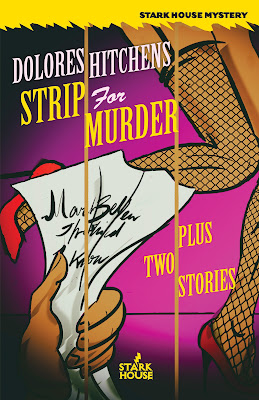
Strip for Murder

Dolores Hitchens was born as Julia Clara Catherine Dolores Robbins (1907-1973) in San Antonio, TX. After graduating from the University of California, Hitchens worked as a nurse and a teacher before turning to writing. She authored two novels starring Lt. Stephen Mayhew and 12 novels starring sleuth Rachel Murdock under the pseudonym D.B. Olsen. She also wrote under the pseudonyms Noel Burke, and Dolan Birkley. Her railroad detective fiction, co-authored with her husband Bert Hitchens, is highly respected, but using her own name, she had a remarkable career writing stand-alone mystery-suspense novels from 1951 through 1973. My first experience with Hitchens is Strip for Murder, a 130 page novella originally published in Mercury Mystery Magazine in 1958. Stark House Press has reprinted the novella along with two shorts originally appearing in Ellery Queen Mystery Magazine

Mark Bellew is employed as a Theatrical Representative. It sounds like a respectable job title, but in essence it's the “pimp” level on the corporate ladder. Bellew markets a variety of strippers, or exotic dancers, for various parties and social functions. If you are hosting a post-golf tournament men's party (in the 1950s) at the lodge, Bellew service's may be enjoyable. There's no hanky panky hi-jinks because Bellew keeps it on the up and up - quality T&A from entertainment veterans. At least until someone is raped and murdered.

Hitchens' protagonist is an Army veteran and prior boxer named Warne that works as an insurance detective. His office is conveniently next door to Bellew's and the two are acquaintances. One day, in a panic, Bellew confesses to Warne that he is receiving anonymous, threatening letters reminding him of an unfortunate incident from 20 years ago. Bellew explains that the incident occurred when he hired a young woman for a men's party. The woman advised Bellew that she was a professional stripper and could take care of herself, but after her performance, she stayed around a little too long and was raped by one of the men. A few days later she committed suicide by jumping out of a high-rise building. The ominous letters prophetically state that the same thing will happen again.

Warne takes the case and looks into the young woman's family history and what her life was like before her suicide. The woman's father is now filthy rich and his adopted son is an arrogant macho-man with a fast car and hot wife. The son makes for a great villain and the perfect adversary for the wise, tougher, and much older Warne. But, the real investigation begins when the letter-writer's prophecy comes to fruition. Bellew's most recent booking leads to a professional stripper named Candy jumping to her death from an apartment building. Is Bellew somehow behind the two deaths? Or, do the two girls have some criminal relationship that's separated by 20 years? 

Hitchens uses Warne as the hero, but she also presents separate events featuring Bellew and a determined reporter named Robinson. The mystery shapes up nicely and offers some enjoyable, yet perplexing questions. I loved the twists and turns of the plot and was slightly surprised when the killer was revealed. I also really enjoyed Warne's budding relationship with Bellew's adorable secretary. 

Dolores Hitchens was the real deal and Strip for Murder is another testament that mid 20th century women mystery writers were just as talented and brilliant as their male counterparts. Hitchens creates a riveting murder mystery complete with shady ladies, fast cars, and an admirable, competent hero to uncover the hidden truth. The storytelling is violent, fast-paced and brimming with conspicuous characters that make it a memorable and pleasurable reading experience. 

Get the book HERE.

Monday, May 18, 2026

The Abductor

Stark House Press has reprinted eight of Dolores Hitchens novels, including two short stories and analysis from literary scholars like Nicholas Litchfield and Curtis Evans. Admittedly, I've been behind on reading the Hitchens novels (her real name was Julia Clara Catherine Dolores Robbins) and needed to catch up. I read and enjoyed her 1958 novella Strip for Murder and decided to try her 1962 novel The Abductor, originally published in hardcover by Simon and Schuster. The book is now available in a SHP twofer that includes the author's 1965 novel The Bank with the Bamboo Door

The Abductor takes place in a quiet California beach town. In the eerie opening, a substitute teacher is standing on an elementary school playground when she hears a man whispering “Marion” from the bushes. He quickly takes off, but his message is puzzling. The teacher's own name is Marion, and one of her students is also named Marion. She reports the incident to the principal, and he dismisses it (different era).

Hitchens then welcomes the reader into three households, very distinctive from each other. The first is the Trent family, who have a daughter named Marilyn. This family has some weird security quirks, appearing overprotective of their daughter. They consistently ask about her whereabouts, if she has spoken to any strangers, and if she has anything odd happening at school. It is immediately clear that the Trents are running from someone. This is reinforced when a man calls their home and declares he has dialed the wrong number. This sets off panic alarms for the family as they contemplate where to move next. 

The second unusual household is that of the substitute teacher, Marion Kennick. After her minor investigation into the puzzling school whispering, she dresses up and hits the town's jukejoints despite having a man in her bed at home. Is she married? Living with a boyfriend? What's his story?

The third home is that of Mrs. Charles, an alcoholic widow who spends her day at the nearby bar. Her motherhood is the opposite of the Trent family – often, she has no idea where her daughter Marion is. Further, she tends to write off her own daughter in an effort to please her wealthy boyfriend. He sees Marion as an obstacle. 

All of these households and family members spiral into oblivion when an abductor captures both Marions – little Marion Charles and her substitute teacher Marion Kennick. He takes them both to an abandoned hotel. This scene was very disturbing as the tormentor questions whether to murder them both or use them as fodder in his grand scheme of torturing the Trents. In one of the most clever setups, the abductor actually meant to capture Marilyn Trent in a revenge plot against the Trent family. However, a misprint in a newspaper article had Marilyn Trent's name listed incorrectly as “Marion”. So this strange kidnapping takes place – the abductor captures the wrong kid and torments parents who know their child is perfectly safe. But they have to play along to rescue the kid. Brilliant!

The Abductor is an absolute masterpiece. The setup, characters, locale, and eerie nature of this kidnapping gone wrong were perfectly penned by Hitchens. I can't imagine how difficult it must have been for this novel to come to fruition. I became confused at times with the character names being similar, but I completely understood that this was necessary. The name snafu is such a pertinent portion of the plot and surely required a great deal of patience on the author's part to keep this plot tight and suspenseful.  Additionally, this was a bold undertaking for Hitchens, writing a disturbing novel about child abduction. I'm sure even as late as the 1960s, the subject was a bit taboo. 

There are some unsettling scenes with the phone calls that reminded me of John Farris's excellent 1967 novel When Michael Calls. As I mentioned, the abandoned hotel locale was fitting as well as the author's description of thick fog that permeates the air, draping the entire town in a bleak blanket of “unknown”. There's no doubt that writers like Hitchens helped propel the 1970s and 1980s suspense market, that hotbed of bestseller lists ruled by the likes of Mary Higgins Clark.

For all of the above reasons, you should be reading The Abductor next. Highest recommendation. You can get the book HERE.

Thursday, March 31, 2022

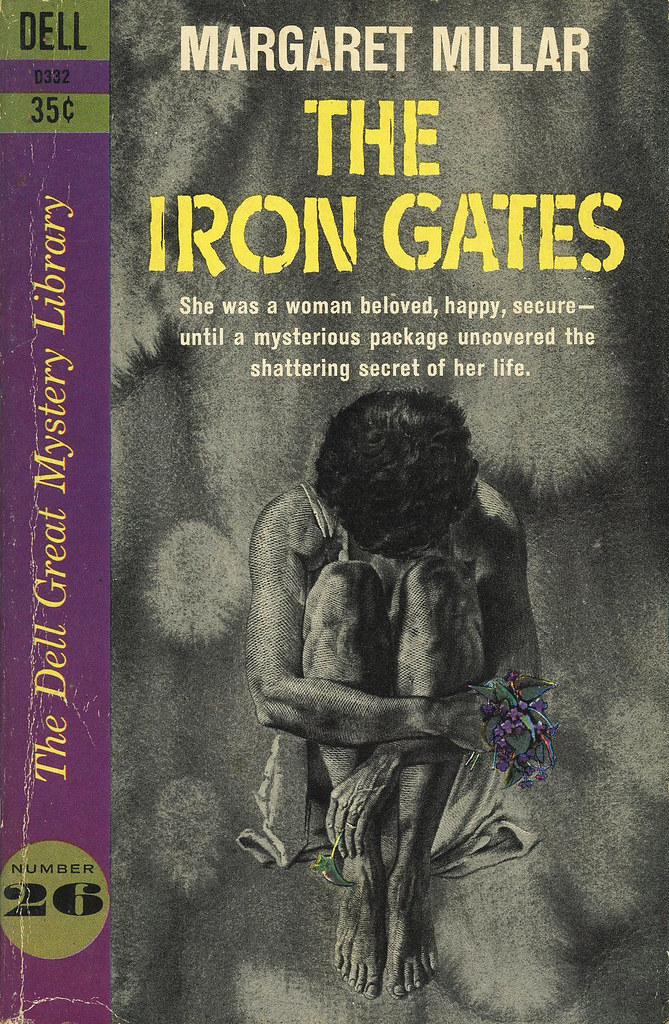
Inspector Sands #02 - The Iron Gates

Along with her contemporaries like Dorothy B. Hughes, Charlotte Armstrong, Dolores Hitchens and Helen Nielsen, California native Margaret Millar helped solidify the presence of talented female mystery authors in the 1940s and 1950s. She wrote over 25 original novels, mostly as stand-alone works. However, her first three novels starred a Canadian sleuth named Dr. Paul Prye and she repeated that creation with another Canadian detective, Inspector Sands. 

The Toronto homicide detective starred in Wall of Eyes (1943) and The Iron Gates (1945), as well as a short story called "The Neighbors Next Door" in a 1954 issue of Ellery Queen Mystery Magazine. I chose to read the latter novel based on an article by Curtis Evans (via Stark House Press) praising the book. It has been reprinted multiple times in hardcover, paperback, and most recently as an audio book. It was also printed in the U.K. as Taste of Fears.

In The Iron Gates, Millar's prose is pure psychological suspense. In the book's opening chapters, Lucille Morrow is mourning the unusual death of her friend Mildred. These scenes are beautifully written and drape the imagery in a white pane of frosted glass reflecting Lucille's loss and mental anguish. It's a hazy precursor to what eventually occurs later in the book as a historical flashback or retelling. 

Later, readers learn that Lucille is now married to a retired physician named Andrew, Mildred's previous husband. She is the stepmother of his two adult, but childish, kids and the in-law to his worrisome sister, all of which reside in the same house. Due to the death of Mildred, and Andrew's replacement of her with Lucille, there are strict dividing lines in the household based on suspicions and shifting judgments. These alliances and strategic family placements play into the novel's central themes of jealousy and lust.

Inspector Sands becomes involved in the narrative when Lucille goes missing. There's early discussion between characters about a nearby park where a grisly murder took place. There's a cautionary tale told about a wandering ax-man preying on park guests. The idea that Lucille is missing, the nearby murder, Mildred's prior death and this strange ax-man all play into the mystery. Sands doesn't know what to believe and finds the family obtuse about Lucille's whereabouts. Only Andrew seems genuinely concerned about her well-being, opening up a string of guesses on which family member committed murder.

The book takes an interesting twist for the second half. Without spoiling the plot development, a major character ends up in a mental asylum behind “iron gates”. Her reason for being there is cloudy, leaving Sands and a detective to investigate the events surrounding her confinement in the asylum. Most of the book's second half does take place in the asylum as the character interacts with other mental patients and the hospital's staff. I enjoyed these parts of the story, but felt it was a little distracting at times. The behavior of the patients and their involvement in the main character's psyche definitely contributes to the story's development, but it's a marathon. 

As a psychological suspense novel, Millar conveys a lot of emotion in her writing. I enjoy the shading she provides as she draws out each character for the reader to suspect. As I learn more and more about female mystery authors of the 20th century, my research always leads to Millar. She was a a real talent and sadly isn't as relevant now. Her work is mostly forgotten aside from a few reprint houses still preserving her novels. Her spouse, Ross MacDonald, the creator of the California detective Archer, is in more abundance, but honestly Millar may have been the one to read all along. 

The Iron Gates was optioned for film to Warner Brothers and allegedly Millar wrote the screenplay. It was to star either Bette Davis or Barbara Stanwyck, but the film never came to fruition. This novel remains rather timeless and would make for a great modern film with it's real world complexity. My vote is for director David Bruckner (The Night House, The Ritual). Anyone have his number? 

Buy a copy of this book HERE

Friday, April 21, 2023

Death of an Intruder/Twice So Fair

Nedra Tyre (1912-1990), who was born in Offerman, Georgia, received her B.A. from Atlanta's Emory University and her M.A. from Richmond School of Social Work in Virginia. She worked as a teacher, staff writer, social worker, typist, and a sales clerk in addition to being a notable mystery and suspense author. She wrote six stand-alone novels and approximately 40 short stories for magazines like Ellery Queen's Mystery Magazine, Sleuth, Alfred Hitchcock's Mystery Magazine, and Mystery Monthly

Stark House Press have recently reprinted two Tyre novels in one volume, Death of an Intruder (1954) and Twice So Fair (1971), along with an introduction by Curtis Evans. Tyre's name was new to me, but thankfully this twofer served as a wonderful introduction to this talented author. Billed as “suspense classics”, both of these novels deliver deeply embedded mysteries that are ratcheted up to higher levels of tension and psychological edginess that is similar to Elizabeth Fenwick (real name Elizabeth Phillips) or Margaret Millar

The better of the two novels, Death of an Intruder, introduces readers to Miss Allison, a middle-aged woman who strives for independence after the death of her aunt. Allison finds a charming house, purchases the home, and begins a solitary life of enjoyment and simplicity. However, her bliss is short-lived when an elderly woman, Miss Withers, knocks on her door and invites herself in. After complaining about a rainstorm, Withers begs to stay the night. Allison, a quiet, non-confrontational individual, agrees to allow her uninvited guest to sleep on the sofa. The next morning, Allison is horrified to learn that Withers hasn't left. And she never will.

Through 150ish pages, Allison must contend with an unwanted roommate that violates her sanctity. As the narrative grips readers, Allison learns that Withers may have killed her pet, ruined her relationship with a prospective boyfriend and close friend, and alienated her from the life she once enjoyed. Debating on how to rid herself of the woman, Allison's only choice may be murder. 

Like Allison's introspective problems within her own home, Twice So Fair presents a recent widow, Rosalind, learning about her late husband's mysterious involvement with one of his students. Both of them were found dead in a college studio, but what was their relationship? As Rosalind contends with the loss of her husband, and the obligatory affairs of dissolving a happily married lifestyle by unforeseen circumstances, she is thrust into a mystery when a stranger invades her home. In a darkened room, the man confesses to be an estranged friend of the student found dead beside Rosalind's husband, and begins a conversational journey explaining his orphaned upbringing and potential “six degrees of separation” from Rosalind's life. But, could this uninvited stranger be a killer?

Nedra Tyre is a phenomenal storyteller, and it pains me to know that I've now read nearly half of her novels. I'm surprised, and disappointed, that she didn't write more full-lengths, but due to publisher issues in her late career, she was submerged into the short story market. Her perspectives on life, literary work, social inadequacies, marital harmony, and paranoia are center-stage attractions of these novels. It's nearly uncanny how well she can enter the minds of the characters she creates. 

According to Twentieth Century Crime and Mystery Writers, Tyre had a niche for “superbly handled suspense”, evident with these novels and her short stories “Locks Won't Keep You Out” (1978, Ellery Queen's Napoleons of Mystery) and “On Little Cat Feet” (1976, Ellery Queen Mystery Magazine). I enjoyed her characterizations of both protagonists, with Allison and Rosalind sharing similar outlooks – as dreary as they may be. Interesting enough, there is a sense of wrongdoing on the part of supporting characters, those acquaintances of both Allison and Rosalind. When the support system is most needed, both intimately and professionally, it fails these less-than-confident protagonists. It was clever plotting and development by Tyre to force these characters into independent (irrational?) action. 

If you are new to Nedra Tyre, then by all means this twofer is highly recommended. In general, if you are new to female mystery and suspense writers, Stark House Press have an abundance of long-forgotten, entertaining classics by the likes of Mary Collins, Helen Nielsen, Dolores Hitchens, Ruth Wallis, and Jean Potts to name a few. 

Buy a copy of this book HERE.