Wednesday, June 22, 2022

Footsteps on the Stairs

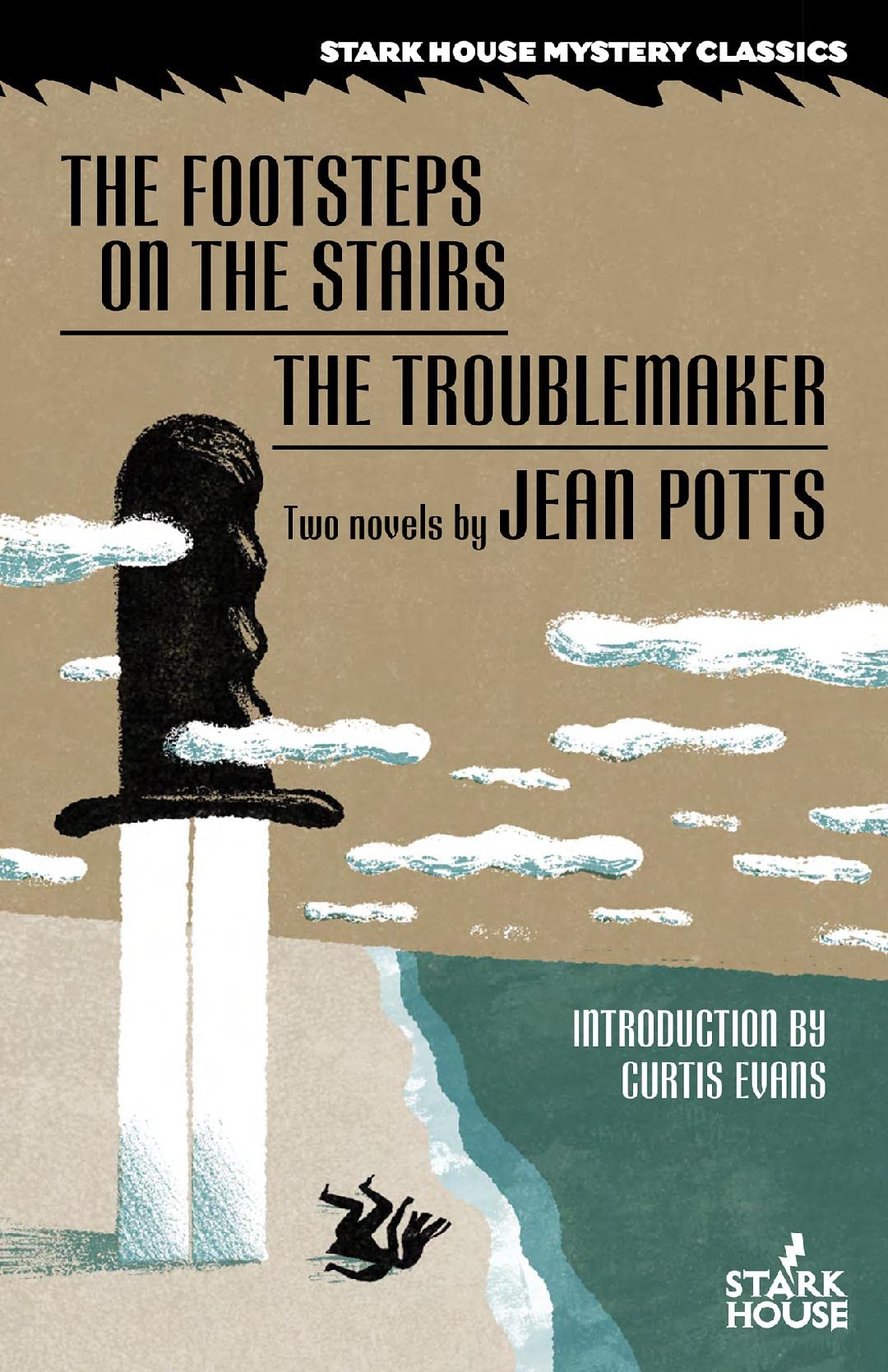
I enjoyed The Troublemaker, a 1972 mystery by author Jean Potts (1910-1999). It was packaged as a twofer in 2022 by Stark House Press with Footsteps on the Stairs, the author's 1966 crime-fiction novel. This new edition also features an introduction by author and Passing Tramp blogger Curtis Evans. Many point to Footsteps on the Stairs as the penultimate Potts experience, so I was curious to see how I would respond to it.

Vic is now married to an alcoholic lush named Thelma. But, four years ago he was involved in a relationship with New York interior designer Enid. Both have moved on, but run into each other again in Philadelphia. Pleasantries are made, awkward memories are relived, and soon Vic is cheating on his wife with Enid. The variable is Enid's good friend and neighbor Martin, a clumsy recluse that is recovering from his wife's mysterious murder. He suspects Enid and Vic are a thing, but he is suppressing desires for Enid. When Enid is found murdered, Martin is devastated and feels that Vic is the prime suspect. 

Despite being released as the culprit, Vic is still Martin's number one suspect days after the murder. Only, the murder mystery becomes convoluted when Thelma (again...Vic's wife) begins having an affair and Martin finds out. Did Thelma gain her revenge by offing Vic's mistress or simply by cheating on him? As Martin digs into the clues and becomes the amateur sleuth, he finds an unlikely ally in a young woman named Rosemary, a friend of Enid's. The two begin an investigation to learn who killed Enid, but the suspect list is lengthy. 

Footsteps on the Stairs is laced with all of the traditional genre tropes one would expect from a mid 20th century crime-fiction novel – numerous suspects, an amateur sleuth, clue-scavenging, and of course, the obligatory corpse. I found Martin to be a likable hero, perhaps enhanced with his mysterious past and his problematic self-awareness. His fondness for Enid is his curse, but it's a key to his own salvation as readers understand what Martin's challenges were in his prior marriage. There are a number of small intricacies that contribute to the much larger problem. How they work together is the marvel of Potts' literary work. 

Whether or not this is Potts' finest crime-fiction novel is in the eye of the beholder. I have nothing to compare it to other than The Troublemaker. I endorse both novels and highly recommend the twofer. It's money well spent. 

Buy a copy of this book HERE.

Tuesday, June 21, 2022

First Through Time (aka The Time Factor)

Most time travel stories concern going into the past and the ramifications of altering linear time - always a fun thought experiment. In 1962’s First Through Time, also published as The Time Factor, British novelist Stanley Bennett Hough (1917-1998), writing as Rex Gordon, tackles travel to the future.

Major Howard Judgen works for a U.S. military-funded science unit that has invented a device called a Synchotron that captures images of the future for modern study. Basically, it’s a time machine for a rudimentary motion picture camera. The camera goes through a hole in time created by science-fiction hokum and returns 30 minutes later with video footage of the future.

A recent video that returned from about 100 years into the future indicates a cataclysm has taken (or will take) place at the spot the laboratory now stands in Tennessee with global ramifications (I’m being intentionally vague here). The military wants to utilize this time portal to send a man into the future to avert this catastrophe. Our narrator, Howard, seems to be the man for the job.

The success or failure of a novel with this setup hinges on the coolness of the author’s depiction of the future and the quality of the adventure awaiting our hero. It’s all set-up quite nicely with the appropriate characters trudging up all the time travel paradoxes associated with jaunting to a determined future with hopes of changing it.

The end result was akin to a decent installment of Jeffrey Lord’s Richard Blade series - without the kinky sex. The author tried to shoehorn too many Big Ideas into what otherwise should have been a short, pulpy novel. Overall, First Through Time was a pleasant diversion, but it will be no one’s favorite science-fiction novel of the era. 

Buy a copy of this book HERE.

Monday, June 20, 2022

The Three Widows

Wisconsin native Bernice Carey (1910-1990) authored poems, short stories, and book reviews in newspapers and literary magazines before becoming the author of eight crime-fiction novels between 1949 and 1955. Stark House Press has reprinted all of these as twofers with introductions by author and blogger Curtis Evans. My first introduction to Carey is her 1952 novel The Three Widows. It has been packaged with the author's 1950 novel The Man Who Got Away With It in the 2019 Stark House Press reprint

This cozy mystery novel features three vacationing women as prime suspects for murder – Mrs. Smith, Ferguson, and Meadows. The three are introduced to the book's protagonist, Melvin, while on vacation in a California resort in Escondido. Prior to Melvin's arrival, he spent the prior days with his wife in Santa Cruz and Yosemite. Oddly, both locations featured law-enforcement recovering a corpse. With the murders following Melvin, he soon finds another dead person at the Escondido resort. Readers know Melvin isn't the killer, but after engaging in chit-chat with the “three widows” he soon discovers they were all vacationing in Santa Cruz and Yosemite. Do one of these women have a penchant for cross-country murder?

The Three Widows is a short, pleasant mystery with one of crime-fiction's most enjoyable tropes – the amateur sleuth. In a hilarious scene, Melvin begins piecing together his gumshoe manual by reading a mystery novel. Soon, he is on the trail breaking into the women's rooms, examining their belongings, and piecing together motives and peculiar pasts. Some of the mystery is removed when readers are placed into the minds of each of the three widows, creating intimate moments when readers learn more about the characters than the investigating bungler. 

Overall, The Three Widows was an excellent introduction to Bernice Carey's writing style, that of the prim and proper mystery novel complete with a dialogue heavy tenderness. Comparisons could be made with another mystery author of the era in Jean Potts, although she is a tad more abrasive. With tragedy afoot, a moderate mystery, and corpses 'aplenty, Carey delivers a solid crime-fiction novel with The Three Widows. Cheers to Stark House Press for keeping the torch lit on these early 20th century classics. 

Buy a copy of the book HERE.

Friday, June 17, 2022

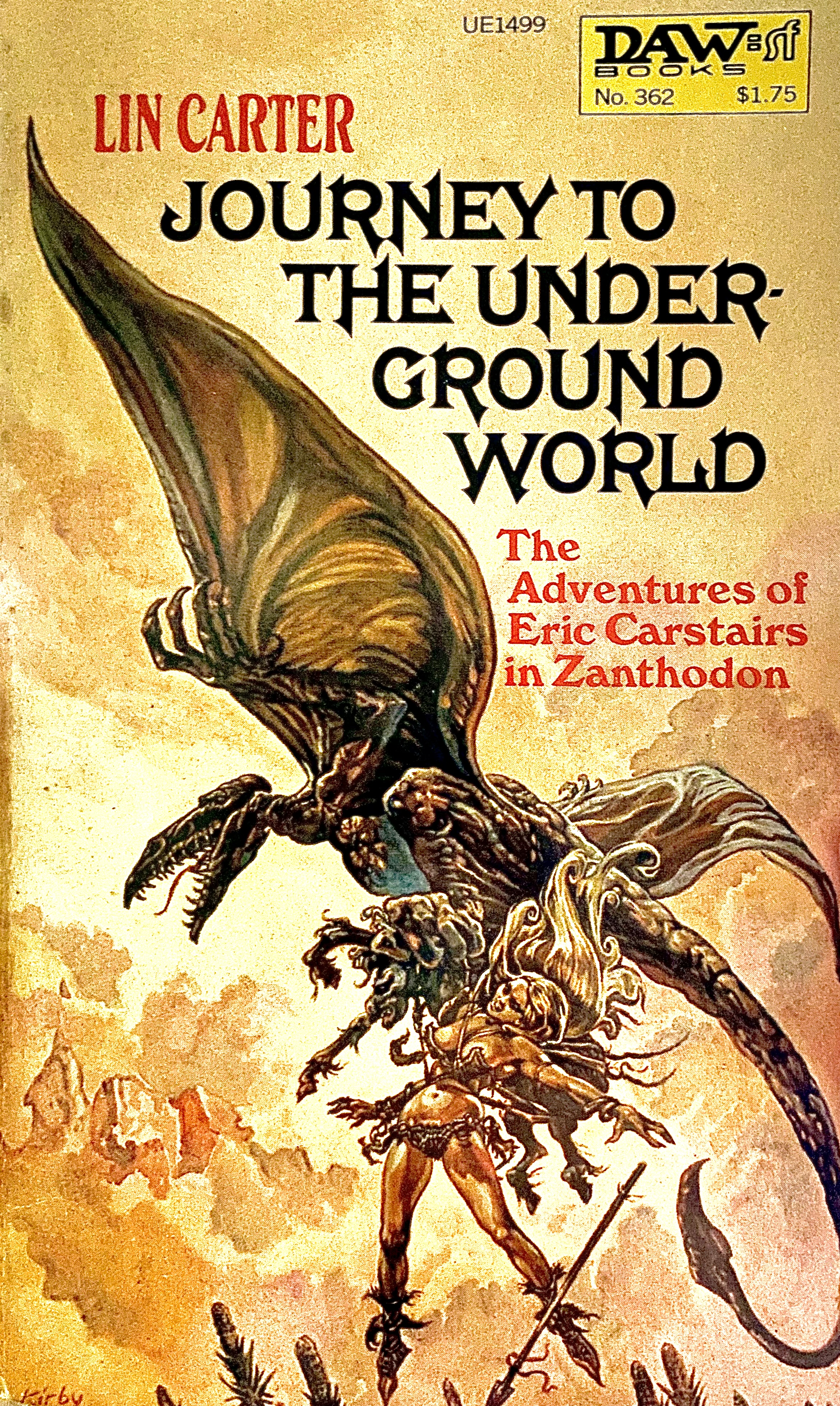
Zanthodon #01 Journey to the Underground World

As a longtime fan of science-fiction, fantasy, and the works of Robert E. Howard and Edgar Rice Burroughs, Lin Carter (1930-1988) authored a number of novels and series titles using unfinished manuscripts from his literary idols or by utilizing a pastiche to contribute future installments of established, classic titles. Using the Pellucidar series, written by Burroughs between 1914-1963, Carter created his own “hollow Earth” concept with the Zanthodon series. The five-book run, also inspired by Jules Verne and Arthur Conan Doyle, was published by DAW Books between 1979 and 1982. It has been reprinted by Wildside Press as one of their digital Megapacks featuring all five books for an affordable price. I'm starting with the series debut, Journey to the Underground World

The book's star is Eric Carstairs, the stereotypical 1970s action-hero that can pilot, captain, shoot, salvage, and deal with the best of them. He's in North Africa looking for work when he saves a professor named Potter from muggers. At the bar, where Carstairs stores his steep tab, he discusses Professor Potter's interesting proposition. Potter explains that he needs Carstairs to pilot a helicopter into an inactive volcano in an effort to locate the middle of the Earth, a place called Zanthodon. He provides evidence that many ancient cultures knew about Zanthodon and wrote about its whereabouts. The origin stems from a giant meteor that crashed to Earth, plunging through the volcano and making an impact on our planet's central core. The “Big Bang Theory” would have created a miniature Earth inside Earth. Make sense? Potter wants to locate it.

Carter doesn't waste the reader's time, and by page 40 both Carstairs and Potter have crashed the helicopter miles below the volcano. They crawl out of the aircraft and discover that Zanthodon is an evolutionary paradox. Dinosaurs roam free, along with two different types of humans – Neanderthal, which are the most basic of prehistoric humans and the slightly more advanced, evolved humans known as Cro-Magnon. As we know it, roughly a 350,000 year difference between the two on the evolutionary scale. But, in Zanthodon they are both alive and active, although warring with each other.

Aside from being a fighting man, Carstairs has a key advantage by carrying a .45 handgun to shoo away the pests. But, the duo is soon captured by the Neanderthals and taken on a long trek through the wilderness. It's here that Carstairs meets Darya, the captive daughter of the Cro-Magnon's tribal king, as well as Jorn, a fierce warrior-hunter. The narrative builds around Carstairs' attempts to become free while working together with an unlikely ally in Hurok. The book introduces future plots while familiarizing readers with the series vibrant and dangerous landscape.

As pure popcorn fiction, there's nothing to dislike about Journey to the Underground World. It obviously pays homage, and takes some liberties, from prior works like The Lost World and Journey to the Center of the Earth. Carter spends ample time with each character detailing the separate perils they are facing. The plot is spacious, allowing multiple events to occur in different areas – different enemies and challenges that rotate for the characters. I really liked that aspect of the storytelling. 

As a fast-paced, descriptive adventure novel, Carter delivers the goods. Journey to the Underground World is a journey worth taking. Recommended! 

Buy a copy of this book HERE. Get the eBook omnibus HERE

Thursday, June 16, 2022

To Venus! To Venus!

Robert Silverberg said that Donald A. Wollheim (1914-1990) was one of the most significant figures in 20th century American science-fiction publishing. He was the editor for Avon Books between 1947 through 1951, then left to spearhead the new publisher Ace Books. He invented the adored “Ace Double” and spent 20 years as the publisher's editor-in-chief. He later left Ace to form one of the most instantly recognizable publishers in science-fiction literature, DAW Books (Wollheim's initials). But, Wollheim also wrote a lot of science-fiction stories and books, including To Venus! To Venus!. It was published under his popular pseudonym David Grinnell by Ace in 1970. The flip story of this double is The Jester at Scar by Edwin Charles Tubb. Cover art by John Schoenherr.

The book begins with a U.S. Space Agency's crew, led by protagonist Chet Duncan, navigating a difficult task on the Moon's surface. It is presented as a bit of foreshadowing, eventually culminating later in the narrative as Duncan is forced to navigate more challenging tasks on the surface of Venus. Once the crew is back home in CA, Duncan's senior management discusses the next mission.

Russia (then the Soviet Union) made a transmission from what appears to be a communication station on Venus. This would be unlikely considering that the U.S. and world leaders have established that Venus contains an atmosphere that is over 500 degrees. However, the Reds state that the information is inaccurate and that the atmosphere is similar to Earth's. In an effort to gain credibility, and in the fairness of competition, the Americans want their own people on Venus. A three-man crew led by Duncan will train extensively for the flight to Venus and make the voyage. Thus, a narrative is born.

The flight to Venus is somewhat boring as readers endure daily activities, training exercises, and some flat banter between the characters. The only entertaining aspect is that another group of Russians are en route to Venus as well, so the rivalry between the two space capsules is interesting. The Russians are heavily stereotyped, which made the dialogue unintentionally humorous. But, eventually the Americans land on Venus only to discover that the Russians are in need of medicine and assistance. The mystery on whether Venus is sporting the inner rings of Hell or the atmosphere of Central Park comes to fruition as the story reaches its central apex. Unfortunately, it was like a faulty firework on the 4th of July. A bummer instead of a starburst.

There's nothing about To Venus! To Venus! to recommend. The narrative just plods along with no  real enjoyment beyond simple escapism. The finale, which I thought was surely going to be an entertaining sequence of American/Russian cooperation to escape the fiery doom of Venus turned out to be about a paragraph in length. Just when I was fully invested, I turned the page and found an advertisement for more Ace books before the pages flipped upside down. Needless to say, I was underwhelmed with the ending. To Venus! To Venus! isn't Hall of Shame worthy, but it is certainly in the neighborhood. Take a hard pass. 

Buy a copy of this book HERE

Wednesday, June 15, 2022

The Terrified Heart

According to the internet, New York native Irving Greenfield was a youthful runaway, a Korean War veteran, a merchant seaman, professor, and author. He authored the 16-book series Depth Force for Zebra as well as the Navy trilogy under the pseudonym of Roger Jewett. His most popular novel is Only the Dead Speak Russian, which spent six weeks on the New York Times bestseller list. My first introduction to him is his gothics. He authored 11 gothic novels from 1966 through 1976 under the pseudonym Alicia Grace. I'm trying out The Terrified Heart, originally published by Belmont Tower in 1973. 

Danielle has experienced a tumbled love affair in New York. Breaking away from the past, she moves to cozy Vermont to work as a college professor teaching Greek History. It's here that she begins struggling with an awkward friend relationship with a man that just can't accept no as an answer. Needing a break from her new job and residence, Danielle spots a dreamy part-time job as a research assistant working on a Greek project. She's all in.

When Danielle meets Keith Wyler, he explains his entire convoluted past and job to her. Keith grew up on Long Island on a sprawling estate called Eleusis. He became married to a woman named Nina, who was then murdered and dumped on the shoreline. Keith was the main suspect in her murder, but the jury acquitted him and he left the family home for many years. Keith studied abroad, became enthralled with Greek culture, and now has returned to the U.S. hoping to write a book about an ancient Greek text. But, he wants to return to Eleusis to write the book while also reclaiming his birthright to inherit the estate. To accept the job as an assistant on the book, Danielle must agree to pose as Keith's wife upon his return to Eleusis. 

Greenfield's prose is elementary with a particular dryness to the characters. There's nothing to really like or dislike about any characters – even the murderer. Instead, Greenfield spends most of the 192 pages as banter between Danielle and Keith about his upbringing and the rivalry between himself and his crippled brother James. Readers can figure out who killed Nina instantly, which doesn't prove much credibility to the local law-enforcement. 

The unbelievable portion of the plot is that Nina and Danielle are nearly identical. What are the chances that Keith can find a woman who has a Greek History degree, looks identical to his previous wife, and is willing to pretend to be his current wife on a trip to the 'ole homeplace? That alone should be enough evidence that this is a complete mess. With a paper-thin plot, and disposable characters, The Terrified Heart is a literary deadbeat. 

Buy a copy of this book HERE

Tuesday, June 14, 2022

Logan #02 - Killers at Sea

Jon Messmann authored comic books before moving into men's action-adventure paperbacks in the late 1960s. He contributed installments to the spy-fiction series Nick Carter: Killmaster as well as creating and writing his own titles like The Revenger, The Trailsman, and The Handyman. In 1970, Messmann wrote two novels starring a begrudged boatman named Logan. Thanks to Brash Books and Cutting Edge, two publishers that have concentrated on releasing brand new additions of Messmann's literary work, I had the opportunity to read the first book, the eponymous Logan. Enjoying the novel, I'm back to the well again with the book's sequel, Killers at Sea

Messmann moves the action from Panama to the quiet South Carolina coast for this second Logan adventure. The battle-scarred protagonist receives a letter from an old friend in the fictional one-horse town of Kingdom Point. Upon his return, Logan discovers an elderly man's body lying on a secluded beach. Before he can notify the authorities, the bullets start to fly. The dead man's young friend, a gorgeous woman named Julie, begins taking potshots at Logan believing he is the murderer. Wrestling the gun away from Julie, Logan is then forced to kill one of three savage tough-guys that arrive at Julie's house. 

Like a mid 20th century crime-noir novel, Logan unexpectedly finds himself a murder suspect and must prove his innocence. In doing so, Logan is forced to contend with the group of criminals that killed the old man searching for something valuable he possessed. Now, the criminals believe that Logan somehow knew the old man and has the goods. But, how does Julie fit into this robbery and murder? 

Killers at Sea isn't quite as effective as its predecessor, but still retains the same ingredients. Lots of sex, gunplay, and violence that reminded me of the Netflix original show Ozark. While Logan's signature is his fast boat, The Sea Urchin, most of the book's violence surprisingly occurs on dry land. Messmann's plot development moves at light speed, never pausing for lengthy dialogue. It's a sacrifice of character building in exchange for the pure adrenaline rush brought on by the hero's struggle.

With Logan's sexual prowess, “big” Colt Python, sleek speedboat, and savage instincts, Killers at Sea is a fun romp through the wild formula of men's action-adventure. Recommended.

Notes – Despite the book titles, I honestly feel as though Messmann wrote Killers at Sea first, then followed it up with Logan. In reading both books, Killers at Sea is a looser outline of the character. First, a little more backstory is revealed with Logan's charity in Sister Mary Angela. This has the genre tropes of an origin tale. The Logan installment briefly mentions Sister Mary Angela as if readers are already familiar with that character. Second, I'd venture to say that Messmann's writing isn't as good in Killers at Sea as it is in Logan, as if he was still working out the hero's characterization.

There is also the character of Julie, which I find interesting. In this book, Julie is Logan's lover and she experiences violence and criminality before Logan ditches her on an island on the last page. In the opening pages of Logan, he is arriving back at his boat with a girl named Julie. If this isn't the same person, why name two female characters the same? The Julie in the Logan novel doesn't really say much to reveal her past, and she quickly leaves Logan when bullets start flying. It was as if the Julie chapter of Logan's life had reached its conclusion. 

The end result is that Killers at Sea was first, Logan second. 

Buy a copy of this book HERE.