Friday, December 2, 2022

Conan - The Treasure of Tranicos

The first issue of the short-lived Fantasy Magazine was published in February, 1953. It's a notable issue  due to the inclusion of a previously unpublished Robert E. Howard story, “The Black Stranger”. The backstory on how this story appeared in the magazine, and its evolution into the later, novella-length version, The Treasure of the Tranicos, is interesting. 

“The Black Stranger” in the 1930s:

Like many of Robert E. Howard's Conan stories, “The Black Stranger” was submitted to various publishers in the 1930s, but wasn't purchased for print. Re-working the story without Conan, Howard morphed “The Black Stranger” into “Swords of the Red Brotherhood”, a pirate story featuring one of his lesser known heroes, a 17th century Irish peasant named Terence Vulmea, or simply Black Vulmea. This story wasn't published in Howard's lifetime, instead first appearing in the 1976 hardcover Black Vulmea's Vengeance in 1976 by Donald M. Grant.

“The Black Stranger” and “The Treasure of Tranicos”:

According to L. Sprague de Camp's introduction in Conan the Usurper, a 1967 Ace paperback collection first featuring “The Treasure of Tranicos”, de Camp discovered unpublished manuscripts written by Howard in 1951. With one of the manuscripts, “The Black Stranger”, de Camp took the liberty of editing and re-writing the story as an adaptation into the Conan saga, specifically Aquilonian revolution. Lester del Rey, editor of Fantasy Magazine, made further additions and deletions and published the manuscript as “The Black Stranger”. The story was re-titled to The Treasure of Tranicos and included the same year in a Gnome Press hardcover omnibus called King Conan. de Camp explained that the title change was a result of too many of Howard's Conan stories containing the word “black” in their titles.

The Treasure of Tranicos after 1953:

In Conan the Usurper's introduction, de Camp further explains he edited and revised the original “The Black Stranger” manuscript again for its inclusion into Ace's collection. He elaborates that he omitted del Ray's edits and additions to align the story even more with the Conan mythology. It was this version that was released as an Ace paperback in 1980. Howard's original manuscript, before any of de Camp's edits, was included in the Tor novella collection Echoes of Valor in 1987. It has since appeared in numerous collections and omnibus editions.

Review:

My review of The Treasure of Tranicos is based on the story's appearance in Conan the Usurper. It is essentially the “truest” version that relates to Conan. In the story's beginning, the titular hero is running through the Pictish Wilderness, crossing Thunder River and brushing up against the Western Sea. Chased by Picts, Conan is shocked when the painted, savage warriors refuse to venture forward. Instead, as if scared of this part of the mountainous shoreline, they retreat. Conan, puzzled by the experience, finds a wooden door recessed into the mountain. Forcing it open, he discovers a dark cavern filled with preserved bodies and shiny piles of hidden treasure. But, he's quickly choked by hands that appear out of a dark mist. Then, Conan disappears for the bulk of the narrative's first half. 

In the next chapters, readers learn that this shoreline is a residence inhabited by Count Valenso. The Count, and his people, became shipwrecked and trapped on the shore months ago. Caught between the ocean and the savage Picts, the Count built a fort and has defended it since. Two rivals appear before the Count's fort, both greedy, savage pirates with a multitude of nefarious crewmen. It turns out that they have read pieces of a treasure map that points to the shoreline's location as home to hordes of precious loot. But, as Conan learned, it might come with a deadly price.

I can see that Howard's original manuscript was borderline Conan material. The Cimmerian isn't necessarily integral to the story, but by adding in a few descriptive details, and a brief mention of Aquilonian history, it works as another installment of the Conan mythos. As an aside, Howard scholars have previously noted that Howard's story has a western-frontier feel to it. Conan is mentioned as a “white man” and it isn't lost on readers that the Picts could be Native Americans. The shoreline fort is similar to the American southeast, notably the Carolinas and Floridian forts braced for French, Spanish, and English invasions. 

If you enjoy a rousing, men's action-adventure story or novella, then The Treasure of Tranicos is sure to please. Conan fans, like myself, will obviously flock to anything written, or partially created, by Robert Howard. As a Conan tale, it's a little off-center, but possesses enough villains, sorcery, and barbaric action to keep it within the realm. 

Buy a copy of this book HERE.

Wednesday, November 30, 2022

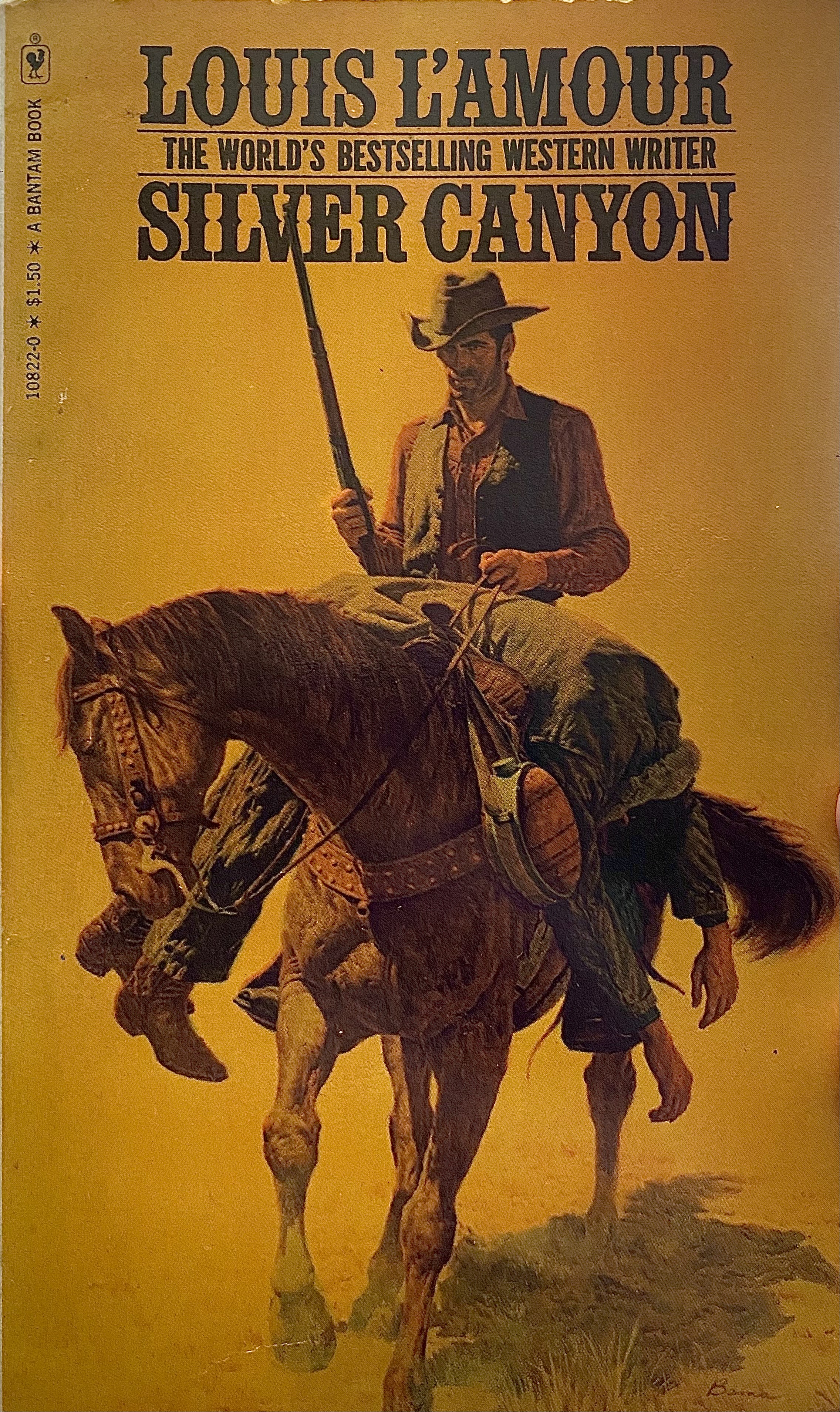
Silver Canyon

"Riders of the Dawn" originally appeared as a short story in Giant Western's June, 1951 issue. L'Amour expanded the story into a full-length novel, Silver Canyon, in 1956. I typically struggle with the old-fashioned range-war westerns, and this novel, like many of L'Amour's works, uses that same, well-worn plot device. I've always found the concept uninspiring and dull, but I was hopeful this one would surprise me. 

Silver Canyon lies near a fertile, plentiful range that is perfect for growing burgers and steaks. The issue is that it's divided three ways. The Two-Bar is a ranch on the eastern side. The Boxed M, and the CP brand make up two separate ranches on the west. In the middle is water, a place named Cottonwood Wash, which is almost completely controlled by the Two-Bar “good guy”. He wants peace and prosperity, but the other two need him out, thus they can continue their fight over what's left. The deciding factor could be a lanky, gun-fighting drifter named Matt Brennan.

L'Amour makes it clear that Brennan is a seasoned pro, a man's man that has worn many different hats over the years. He's been a gambler, lawman, gun-fighter, cowpoke, and a plain 'ole fighter for many years. So, another range-war isn't anything new. Brennan's name proceeds him, so when he arrives in town the ranges immediately want to hire his gun. Quickly, Brennan finds that the old man solely running the Two-Bar is an honest, hardworking rancher that just wants lines clearly defined between right and wrong. If there is any allegiance to be had, Brennan wants to back the Two-Bar. 

Brennan makes a deal with the old man. He can own a small piece of the Two-Bar, settle down, and raise some beef if he can assist in the ranch's defense. It all goes as planned until Brennan finds the old man a bloody heap full of holes. Surprisingly, the old-timer leaves Brennan the whole ranch as his dying wish. But, nothing has really changed other than Brennan is the new target for the rival ranches. Can he survive the onslaught? Further, can he successfully sway one of the rival rancher's daughters into marriage?

While not being innovative, or particularly fresh, Silver Canyon was still a lot of fun to read. The range-war stuff, while not my favorite dish, was still easily digestible. The reason is that L'Amour adds a murder mystery into the narrative, one that involves a murdered man prior to Brennan's arrival in town. This man apparently possessed clues that something beyond river water is what the ranches all want. It's no secret based on the book's title what the main objective is. It doesn't spoil any reading pleasure. Silver Canyon is recommended. 

Buy a copy of this book HERE.

Monday, November 28, 2022

Best of Manhunt: Volume 3

The good people at Stark House Press have blessed us with another compilation of hardboiled crime stories from the pages of Manhunt Magazine, the premier digest for crime noir fiction in the 1950s and 1960s.

The introduction by scholars Jeff Vorzimmer and David Rachels tackles the literary mystery of the identity behind the house name of Roy Carroll, a pseudonym employed by the Manhunt editors when an author had more than one story in a single issue. The thought was that magazine readers desired a great diversity of names in the Table of Contents and would somehow feel ripped off if the same author appeared twice.

Several of the Roy Carroll stories in Manhunt are now known to be written by Robert Turner - but not all. The editors performed some investigative legwork worthy of Paperback Warrior to firmly-establish that the Roy Carroll story appearing in the November 1956 issue under the title “Death Wears a Grey Sweater” was, in fact, written by fan-favorite Gil Brewer for which Brewer was paid a tidy sum of $260.

With that mystery about a mystery solved, it’s only fair that we begin our tour of this anthology with the story itself.

Death Wears a Sweater by Gil Brewer writing as Roy Carroll (November 1956)

The story opens with the horrific death of an 11 year-old girl in a broad daylight hit-and-run while her father watches helplessly nearby. After verifying that his little girl is, in fact, dead, her dad — his name is Irv Walsh — goes bananas, hops in his car, and begins pursuing the hit-and-run driver. The confrontation with the car occupants goes poorly for Walsh, and his quest for quick justice is thwarted while his desire for revenge burns hot.

As vendetta stories go, this one is pretty dark, gruesome and sadistic. Brewer’s strongest works were his short stories and this one is no exception. It’s a tough and tension-filled read that packs the appropriate emotional punch.

Services Rendered by Jonathan Craig (May 1953)

Henry Callan is a crooked, hard-drinking police lieutenant investigating the murder of a florist. A suspect named Tommy is in custody, but refuses to talk. The dirty cop visits Tommy’s wife and makes her an offer of regular sex with Henry in exchange for Tommy’s freedom and avoidance of the electric chair.

This is the kind of dark and twisted story that made Manhunt great. Jonathan Craig (real name: Frank Smith) is always a reliably great writer, and this story is consistent with his hardboiled output. Don’t skip this one.

Throwback by Donald Hamilton (August 1953)

Donald Hamilton was the author of the esteemed Matt Helm spy series, but this short story predates his groundbreaking Death of a Citizen by nearly seven years. “Throwback” is an unusual story for both Hamilton and Manhunt as it is a post-apocalyptic story set shortly after the atomic destruction of the USA.

George Hardin and his wife are among the shambling survivors wandering among the smoldering ruins of a freshly-destroyed America. Hamilton’s writing is characteristically beautiful and descriptive. Unfortunately, a coherent plot never comes together, making this story perfectly skippable.

The Red Herring by Richard Deming (December 1962)

Richard Deming appears twice in this Manhunt compilation, and “The Red Herring” won the coin toss for the prestigious Paperback Warrior review. The story stars a Private Detective named Matt Gannon, who is engaged by a corporate CEO.

The company manufactures a radiation detector similar to a Gieger counter but way more sensitive. The company bought the technology from the inventor for a song, and now the creator is apparently sending threatening notes. Gannon is hired to make the case. As expected, Deming does a fine job with a compelling, if rather standard, PI mystery.

The Verdict

The brain-trust behind these Stark House Manhunt anthologies has another winner on their hands. I hope these collections never stop, and they expand to the other hardboiled magazines that popped up in the wake of Manhunt’s success. These short crime stories are an important part of American literary history and need to be preserved for modern audiences and future generations. 

Buy a copy of this book HERE.

Sunday, November 27, 2022

Conan - The God in the Bowl

Robert E. Howard's Conan the Cimmerian short story “The God in the Bowl” wasn't published in the author's lifetime. It was rejected by pulp magazine Weird Tales, and after Howard's death, went undiscovered until 1951. It was then edited by L. Sprague de Camp and first published in Space Science-Fiction's September, 1952 issue. It has since appeared in collections like The Coming of Conan (1953), Conan (1967), and Conan of Cimmeria: Volume One (unedited, 2022) among others. 

Of the Howard Conan short stories, “The God in the Bowl” is easily one of the strangest. It doesn't really feel like a Conan story and fails to represent what we all know and love about the savage hero, or anti-hero. The premise reveals that “thief” Conan accepts a job from Nemedia's Governor's son to break into an antique house to steal a precious diadem. This diadem is being kept in a sarcophagus that was apparently discovered in the dark realm of Stygia. But why hire Conan? I assume the nobleman owes money for gambling debts or whoring and he wants the job done discreetly and efficiently. 

There's a sense of Golden Age Detective fiction when the antique house's overnight clerk is found dead. All fingers point to Conan as the murderer, and in a unique twist, the titular hero is forced to defend himself verbally. The accusation that Conan killed the clerk is hotly debated inside the museum, but as the discussion intensifies, things seem to be amiss. Between the police, the nobleman, and Conan, lies a monster in waiting. By the story's end, Conan is the victor, but it's an odd trip to get there. 

Other than the boss fight at the end, and a well-timed decapitation, this isn't your typical Conan story. Howard depicts Conan in a way that makes him seem weak, indisposed, and timid. At one point, the hero struggles with the conversation and is described as just shaking his head in puzzlement. It's similar in the way that Howard describes Conan in “Rogues in the House”. In that story, there's a scene where this priest is explaining a series of tubes he created that uses mirrors to create an illusion. Conan doesn't understand it and dismisses it as witchcraft. There's a difference between savagery and neanderthal dumbness, which is sometimes blurred in these stories, but I also understand that a hint of humor is injected through the befuddlement. That was Howard's intent, but I thought it cast a poor light on the hero here. 

Overall, I can recommend “The God in the Bowl”, but there are plenty of other Conan stories you should be reading before this one. Your mileage may vary. 

Buy a copy of this book HERE.

Friday, November 25, 2022

The Stalkers

The Stalkers, which sounds like a Matt Helm title, is a western paperback by Philip Ketchum, originally published as a paperback by Berkley in 1961 (#6510). In 1964, Berkley reprinted the paperback with different artwork (#Y930, pictured). Thankfully, I received this vintage western as a gift from a friend, and I'm a Ketchum fan, evident on the Paperback Warrior Podcast, Episode 94

The book stars Captain Sherman Galway, an American Civil War veteran that has received a special assignment from the U.S. Government. Galway's task is to locate $50,000 in missing gold. It is explained to Galway, and readers, that 20 years prior, a stage coach containing the gold was attacked by an Apache war-party. Despite the coach's military accompaniment, the Apache killed everyone in what is referred to as The Table Mountain Massacre. The gold went missing, but officials believe they now have clues that point to Iron City, a small desert town, as a place the gold may be hidden. 

In the book's opening pages, Galway is en route to Iron City when he's ambushed and nearly killed by an old nemesis named Rostig. With the help of an elderly outlaw, who happened to be in the vicinity, Galway is able to kill two of Rostig's men. Later, Galway runs into Rostig and realizes he's created another trio in an attempt to kill him. 

The book's narrative has Galway, the old outlaw, simply known as The Loner, and a beautiful woman all on a perilous journey to find the gold. The path to riches is filled with bad guys, pursuing lawmen, some romantic chemistry, and a load of violence. The book's finale is 30 pages of double-crosses, uneven alliances, and discarded friendships as greed overtakes goodwill.  

Ketchum's westerns tend to rely on female characters, and The Stalkers is no different. Galway's on and off connection with the woman is intriguing and makes for a mostly happy conclusion (barring a few key deaths). There's some thoughtful elements to the story that allow for personal conflict, mostly centered around Galway's allegiance to his job and mission versus “take the money and run” spontaneity. The old outlaw character provides insightful questions on morality. Overall, The Stalkers is an easy recommendation. If you enjoy the not-so-traditional western, then Philip Ketchum is your guy. 

Buy a copy of this book HERE.

Wednesday, November 23, 2022

Gingerbread Girl

Stephen King’s novella “The Gingerbread Girl” first appeared in the July 2007 issue of Esquire Magazine. It was later compiled into King’s 2008 short story collection, Just After Sunset. The publisher also sells the story separately as a two-hour audiobook.

Our heroine is Emily, and she’s in a pretty bad emotional state due to the recent crib death of her infant daughter. The trauma of her child’s demise triggers the end of her marriage, and the only thing keeping her sane is running.

To regroup and rebuild her life, Emily embarks on a three-week solitude retreat at her father’s “conch shack” on the beach in Florida not too far from Naples. The shack and the beach are pretty isolated, so it’s the perfect place to go for long runs while mourning her kid and contemplating her next moves. She also has time to read vintage paperbacks by Raymond Chandler, Ed McBain and John D. Macdonald.

On one of her jogging jaunts, Emily is overcome with a bout of nosiness and spots a dead girl in the open trunk of a car parked at a house down the beach. Before she can decide what to do, Emily is conked on the head and awakens tied to a chair in the maniac’s kitchen. The villain is the kind of loathsome creep you often encounter in King’s stories, and Emily’s dilemma is not unlike the “escape or die” problems tackled in Misery, Cujo and Gerald’s Game.

The plot is familiar territory for King, and that’s good news for the reader because he’s the absolute best at this kind of tense suspense. In that respect, “The Gingerbread Girl” delivers exactly the kind of scary, bloody, frightening thrills you’ve come to expect from the author. If this one slipped by you, do yourself a favor, circle back, and give it a read. You won’t be disappointed. Highly recommended. 

Buy a copy of this book HERE.

Tuesday, November 22, 2022

Conan - The Tower of the Elephant

Robert E. Howard scholars typically cite “The Tower of the Elephant” as the best representation of Conan the Cimmerian literature. The story first appeared in the March 1933 issue of Weird Tales. It later appeared in the 1946 Arkham collection Skull-Face and Others, the 1953 Gnome Press hardcover The Coming of Conan, the 1968 Lancer paperback Conan, and a 1975 hardcover collection by Donald Grant simply titled The Tower of the Elephant. It was adapted into comic form three times, Conan the Barbarian #4, Savage Sword of Conan #24, and Conan #20-22

The story begins with a young Conan arriving in Arenjun, the “City of Thieves”. It’s in this city that he overhears a conversation involving some drunk men talking about theft and coveted wealth. A boisterous Kothian mentions a place called The Tower of the Elephant, and the impossibility of ever robbing it of its vast riches. Conan, who loves a sparring challenge, disputes the notion, matching wits with the Kothian over the possibility. Agitated with the conversation, a candle is extinguished and Conan quickly kills the loud-mouthed Kothian under cover of darkness. Challenge accepted - rob the Tower of the Elephant!

At night, Conan begins his attempt to climb the smooth-walled tower. He finds that the structure itself is surrounded by rings of thick shrubbery, like a grassy moat. Surprisingly, another thief, a seasoned pro named Taurus, “Prince of Thieves”, has the same plan to infiltrate the tower and runs into Conan. Taurus kills deadly, fierce lions with poison gas and Conan strangles one of the guards. Using a grappling hook, both Taurus and Conan ascend the tower and enter through a window. It’s here that Taurus is somehow poisoned in a doorway, and Conan finds an alien being named Yag-kosha. This alien explains to Conan that he became imprisoned in the tower by an evil sorcerer named Yara. For Conan to capture the riches, and a famed ruby elephant heart, he must contend with the sorcerer, a giant, hideous spider, and figure out a way to free Yag-kosha.

Howard’s endless imagination just flows onto the page with this wild, action-packed adventure. It quickly pulls you into the story with just a few opening paragraphs. The author's prose is just so smooth and stimulating, providing excellent plot development and pacing. 

Considering this is a tale concerning a savage, alpha male, Howard is still able to create a colorful, cautionary tale about greed and its effect on the human condition. Metaphorically, Yag-kosha could be the billionaire trapped by his own wealth. Or the idea that the upper class is a very ugly thing. Conan’s role as the anti-hero, purely a rouge scoundrel that's self-serving, justly receives his comeuppance. Regardless of its social, not-so-preachy commentary, "The Tower of the Elephant" is an enjoyable, rousing pulp sword-and-sorcery tale that lives up to its long-lasting legacy. It doesn’t get much better than this. Highly recommended. 

Buy a copy of this book HERE.