Tuesday, December 20, 2022

Bloodroots Manor

Author Jon Messmann cut his teeth writing for the Golden Age of Comics before moving into full-length novels. At the height of men's action-adventure fiction, Messmann created and authored the vigilante series The Revenger, the Travis McGee-styled Logan books, and the enormously popular adult western series The Trailsman. But, Messmann also capitalized on the gothic paperback craze of the 1960s and 1970s. As Claudette Nicole and Pamela Windsor, Messmann authored a number of gothic mystery and romance novels for Fawcett Gold Medal and Pyramid. Cutting Edge Books has published a number of Messmann titles in new editions, including his gothic paperbacks like Bloodroots Manor. It was originally published by Fawcett in 1970 and has been out of print for more than 50 years.

Nancy Hazleton married a man named Dirk and the two set off for a “happily ever after” life in New York. But, Dirk refused to become intimate with Hazleton and often placed her in audacious stunts to impress his friends. In a wild chain of events, Nancy realizes that Dirk has been attempting to murder her throughout their short marriage. During a life or death struggle, Nancy escapes Dirk's wrath and he plunges to his death. Nancy is placed into a mental hospital to rehabilitate.

After regaining her mental stability, and working through her horrendous past, Nancy becomes enrolled in an interior design school. Upon graduation, Nancy is hired by a man named Samuel Howell to redesign his spacious country house. As the book begins, Nancy is riding a train to Deepwell Junction in the rural mountains of Kentucky. When she arrives late at night, she is shocked to discover that Deepwell Junction's train station is an abandoned husk. Further, the directions leading to Howell's estate lead Nancy to a large abandoned house that's severely damaged. To escape a thunderstorm, Nancy takes shelter inside of the old dwelling. In a terrifying sequence, a horribly disfigured man emerges from the shadows and attacks Nancy in the house. She attempts to escape through the forest and collapses. Is this a nightmare or reality?

At 150 pages, I read Bloodroots Manor in one sitting. Messmann was such a craftsman and he builds this narrative into a crescendo of mystery and white-knuckle suspense. Nancy's exploration of the mysterious town, the Howell family legacy, and her relationship with a local historian all add small ingredients to the much larger mystery. Messmann conveys a real sense of isolation and panic as Nancy contends with the idea that she may have been lured into a deadly trap. Each chapter felt like one more step to some grisly discovery. 

If you love the traditional, atmospheric haunted house tale and the “evil thing down the hall” type of storytelling, then Bloodroots Manor is an easy recommendation. With its cursed heirs, family secrets, phantoms on the hillside, and cavernous mansion, this one has everything we all love about the old fashioned gothic novel. 

Buy a copy of this book HERE.

Monday, December 19, 2022

The Heisters

Robert Page Jones (1931-2012) authored nine stories for Manhunt Magazine during the 1960s, including one in 1961 titled “The Big Haul.” The story was expanded into Jones’ first full-length novel, a 1963 Monarch Books paperback called The Heisters. The novel was adapted into a 1967 French film called That Man George (aka L’homme de Marrakech).

Johnny Womack is a truck driver headed from a long-haul home from El Centro, California with an empty load. This is problematic because he could really use some dough. His hot, faithless wife is home with god-knows-whom and the rent is overdue.

Mechanical troubles sideline Johnny in a small California desert town where a three-man heist crew are scheming and planning an armored car knock over. The armored vehicle delivers $750,000 cash to an Army base every two weeks, and it’s just begging to be taken by the right crew. If only the crew had a reliable truck driver to join the plunder squad…

To his credit, the author does an admirable job with character development. The reader gets to spend time with Johnny and the heisters to gauge everyone’s motivations. The heist itself is exciting and well-written, and the aftermath is worthy of Lionel White or Richard Stark. He throws in a great sequence involving an armored car security guard that will knock your socks off.

The aftermath of the heist and getaway has some fantastic unexpected twists that I didn’t see coming and kept me up late turning the pages. The ending violence of this short paperback is worthy of a Quentin Tarantino movie. I can honestly say that The Heisters is one of the finest hardboiled crime caper novels I’ve ever read. It’s never been reprinted, but you should definitely seek out a copy ASAP. 

Buy a copy of this book HERE.

Friday, December 16, 2022

The Best of Manhunt #04 - The Jack Ritchie Stories

In this fourth volume of stories from Manhunt, the good folks at Stark House Press took a different approach by focusing on a single author, Jack Ritchie. If you’ve never heard of Jack Ritchie, consider it further evidence that short-story writers don’t get the respect and adoration lavished upon novelists.

Jack Ritchie was the prolific pseudonym of Wisconsin native John G. Reitci (1922-1983). During his career as an author, he sold countless stories to publications including Manhunt, Murder!, Alfred Hitchcock’s Mystery Magazine, Mike Shayne Mystery Magazine, The Saint Mystery Magazine and on and on. To my knowledge, he never wrote a novel - short works were his specialty.

As Paperback Warrior fans are well aware, Manhunt was the premier fiction digest for hardboiled, noir crime stories in the 1950s and 1960s, and Ritchie began selling his grittiest work to Manhunt in 1954. In total, Manhunt published 23 of Ritchie’s stories through the year 1965.

Mystery fiction scholar Jeff Vorzimmer lovingly compiled this chronological collection of Ritchie’s Manhunt work — as well as five extra stores from similar publications of the era. Vorzimmer’s introduction is also an insightful look into this largely-forgotten, but insanely productive, crime fiction master.

Let’s sample some stories and see if this guy is the real deal.

“My Game, My Rules” (July 1954)

A slumlord is forced to pay protection money to a local mobster. When he refuses, his buildings start mysteriously catching fire. The crime boss has also taken over the local gambling racket as well as the politicians and police force. A coalition of displaced leaders wants the thug gone, and approach our narrator Johnny to make it happen. Johnny has his own reasons for wanting the crime boss eradicated. This was Ritchie’s first sale to Manhunt, and it’s outstanding.

“Hold Out” (May 1955)

As with most of Ritchie’s stories, this one opens in the middle of the action. Ed and his partner have kidnapped a guy named Pete with the intention of holding him for ransom. Pete’s boss is a nightclub owner and may be willing to pay fifty grand to get his right hand man back in one piece. This story has a nasty twist you won’t see coming until it hits you like a gut punch. Top-shelf stuff.

“Shatter Proof” (October 1960)

An assassin arrives at the narrator’s house. It’s abundantly clear that his much younger wife commissioned the hit. Despite the unusual circumstances, the interaction between the victim and his soon-to-be-murderer is surprisingly cordial and businesslike. The patter is so alluring that you may not even see the double-cross coming. Another solid entry.

“Going Down?” (July 1965)

Ritchie’s final appearance in Manhunt finds the narrator on a urban building ledge prepared to jump while a police sergeant tries to keep him talking. The poor copper didn’t ask for this assignment. He was just walking by the building at the wrong time. The comedic back and forth between would-be-suicider and would-be rescuer is a stitch as the men compare their problems and failures. Another winner with a fun ending.

The Paperback Warrior Verdict?

This superb collection is proof positive that Jack Ritchie was a master of the hardboiled short story game. His work exemplifies everything that made Manhunt great, and this compilation should go along way toward cementing his legacy as one of the greats. Buy a copy of this book HERE.

Thursday, December 15, 2022

The Big Grab

Marvin Leroy Schmoker (1933-2008) changed his name to Zekial Marko in his adult years. It is under this name that he wrote scripts for shows like The Rockford Files, Kokchak the Night Stalker, and Toma. But, as an author of fiction, Schmoker/Marko authored seven novels under the pseudonym John Trinian. Most of these novels have been reprinted by Stark House Press as twofers, including The Big Grab. This heist novel was originally published in 1960 by Pyramid, and then later was adapted into the French film Any Number Can Win. The book was re-titled to match the film name and published again in 1963. Stark House Press has a new edition of the novel out now with another Trinian title, The Savage Breast (1961).

When the novel begins, protagonist Karl Heisler has just been released from a five-year prison stint, his third imprisonment to date. With 14 years behind bars, Heisler reflects on his life as a criminal and family man. Walking through San Francisco, Heisler thinks to himself that he has to find his old cellmate Frank Toschi. The two have a heist to plan.

In the clinger, Heisler met a wiseguy mobster who once worked at a posh Syndicate casino. On his deathbed, the mobster provides Heisler intricate details on how to rob the place. Who would even dream of stealing from the mob? Heisler dwells on the proposed heist during his last few months in the pen. With the help of his former cellmate Toschi, the two hope to knock over the casino and then split for parts unknown. 

The Big Grab reads like a typical heist novel penned by the likes of Richard Stark, Lionel White, or Dan Marlowe. Trinian's novel is compelling and driven by the details and planning of the heist. An interesting addition is Heisler wife and child – the former ready to divorce him and the latter believing that Heisler is a sales guy. Like most of these crime-fiction novels, the heist never goes according to plan. The Big Grab adds some twists and turns in the finale that added an additional spark to the predictability. 

Heisler is a dynamic main character with an abundance of emotional and family baggage. I enjoyed Trinian's rich subtext of the lifetime criminal finding himself imprisoned with civilian life and the overbearing strains of normalcy. Trinian cleverly reveals the addiction of criminality through an enjoyable, exciting prose. If you enjoy the caper or heist novel, then The Big Grab is sure to please. 

Buy a copy of this book HERE.

Wednesday, December 14, 2022

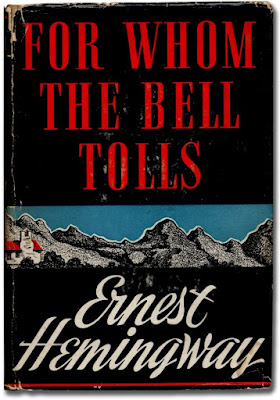
For Whom the Bell Tolls

Men of five, still alive, through the raging glow” were song lyrics that I've sung for 30+ years. It's a line in a classic Metallica song, “For Whom the Bell Tolls”. In fact, I never understood any of the lyrics to the song, but knew that it referenced a war novel or film. After recently reading Ernest Hemingway's The Old Man and the Sea, I've been wanting to revisit the beloved author. With one foot in front of the other, I marched over to his 1940 novel For Whom the Bell Tolls. It was Hemingway's seventh total work, including both fiction and non-fiction. The novel resolved my yearning for more Hemingway, but also connected me to the old Metallica track of my youth.

Much can be said about For Whom the Bell Tolls. There are endless reviews, essay papers, and podcast episodes dedicated to the novel and its characters. Heminway wrote it in different locations, Cuba, Florida, and Idaho, and based it on his experiences covering the Spanish Civil War for the North American Newspaper Alliance. At this point in the author's career, Hemingway had already witnessed firsthand the atrocities of World War I as an ambulance driver for the Red Cross. I believe both experiences contributed to his writing style and subject matter in For Whom the Bell Tolls

From a sky-level perspective, the novel is very simplistic in nature. But, deep in the scorched Earth, with the bullets, dirt, and rubble, it is a more complex tale of war and the insurmountable circumstances that force humans to kill humans in an endless cycle of violence and bloodshed. It is just as relevant today as it was in 1940, as America was on the cusp of entering World War II. In that sense, it is a timeless novel that will unfortunately still be relevant 50 years from now. War is war, no winners, just combatants. 

Robert Jordan, an American professor of Spanish, left the University of Montana to teach in Spain. As the country turned into a melting pot of civil unrest and saber-rattling, Jordan finds himself as a fighter for the republicans, a doomed opposition to the fascist forces that would eventually envelope Spain under Francisco Franco's dictatorship. Through perseverance, and luck, Jordan becomes an experienced dynamiter. Off-page, he is asked by a Russian general to aid a band of local guerrillas in destroying a bridge. With the bridge's destruction, it will prevent fascist forces from advancing their troops. 

The local guerrilla force is made up of an old gypsy, an alcoholic leader, a lazy fighter, a strong female fighter, and an assortment of experienced, middle-aged fighters. None of these people want to join the republican military, but instead independently conduct military exercises. Unfortunately, their only major accomplishment in the war is the destruction of a train. Beyond that, it is mostly just all talk. But, it is Jordan's role as the experienced dynamiter, to somehow work with these men and women to complete the mission.

At roughly 500 pages, Hemingway spends most of the narrative conducting deep discussions between his assortment of diverse characters. Perhaps the best of these is presented in Chapter 10. As an avid reader of ultra-violent men's action-adventure novels, gritty vigilante sagas, and rip-roaring westerns, I've never encountered more powerful, unrestrained passages as what Hemingway puts to paper as Pilar and Pablo describe the liberation of the small town of Avila. The homicidal, savage killing of the town's fascist leaders and businessmen is one of the most brutal and disturbing things I've ever read. My assumption is that this chapter alone probably excluded the novel from being recognized for a Pulitzer Prize. It is such a moving piece in its surreal, heart-wrenching detail of men dying for their beliefs. 
Equally as disturbing is Chapter 31, an account made by Jordan's love interest, his “little rabbit” Maria.  I was teary-eyed as I read the terrifying ordeal she faced as the fascists destroyed her town, killed her parents, and then took turns brutally raping her. She confesses to Jordan that she has been physically injured by the ordeal, a wound that becomes very painful when the two make love. This passage, appearing later in the novel, balances the war-torn strife – republicans kill fascists, fascists kill republicans. Hemingway's presentation is terrifyingly brilliant, showing that both sides are equally evil and corruptible.  

As a literary powerhouse, For Whom the Bell Tolls is a masterpiece. But, specifically for Paperback Warrior fans of high adventure, military-fiction, and men's action, there is plenty to love about this mainstream classic. Hemingway places the action in Spain's high passes and snowy mountains. This is a narrative that possesses intense action sequences as the guerrillas attempt to defend a mountain from an onslaught of fascist forces and planes. It's this scene in particular that is a consuming, bullet-ridden piece of the narrative that is excellently described by Hemingway. The reader gains a unique sense of destruction, despair, and impending doom. The same can be said for the book's flourishing finale, an epic, high-octane sequence of events that places Jordan in a final conflict against waves of enemy troops. These scenes are staggering and left me feeling gutted.

Nothing else can really be said here to express the magnitude of For Whom the Bell Tolls. You owe it to yourself to read the novel, to feel and hear the novel in your own way. It is just a powerful piece of literature that could never be fully served by a theatrical approach. Despite nine Oscar nominations for the 1943 film, the old adage “the book is better than the movie” has never rang more true. 

Buy a copy of this book HERE.

Tuesday, December 13, 2022

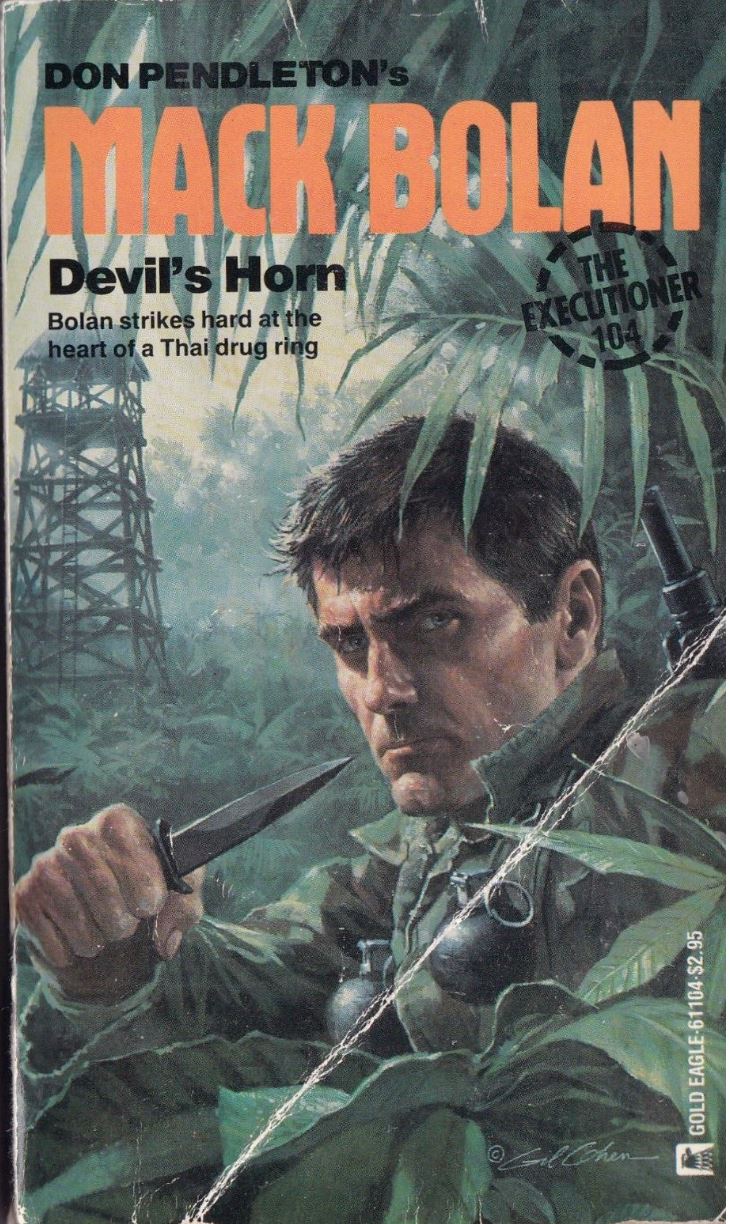
The Executioner #104 - Devil's Horn

Remember the one where Mack Bolan becomes the star of the Chuck Norris “bring'em back” alive flick Missing in Action? Well, it never happened, but it should have based on Dan Schmidt's The Executioner installment Devil's Horn (1987), the 104th book in the series. Like a combination of Missing in Action, Rambo 2, and an installment of MIA Hunter, Devil's Horn deposits Bolan and Jack Grimaldi in a Southeast Asia Hellhole as prisoners in a drug cartel's brutal labor camp. Interested? Read on.

When Devil's Horn begins, Bolan is in The Bowery, the Lower East Side of Manhattan Island, trailing the origins of a massive amount of domestic drug imports. His trail leads to Ronny Brennan, a top-tier drug dealer with arms in various criminal factions as a Mob businessman. After Bolan destroys a drug warehouse, he pressures Brennan to reveal the source of a huge opium farm in Thailand. After a furious firefight, Bolan forces Brennan to ride shotgun as drug enforcers and low-level dealers tail the two to a local airstrip where Grimaldi is waiting. Quickly, Bolan and Brennan climb aboard as Grimaldi rockets the trio to Southeast Asia. 

With a large load of armament and equipment, Grimaldi's plane flies over the whereabouts of the drug farm. But, he gets a little too low and the plane is shot down on the outskirts of the farm. While pushing Brennan into the bush, both Grimaldi and Bolan attempt to escape the onslaught of waves of Vietnamese soldiers, hired mercenaries, prison sentries, and drug enforcers. In a scene right out of Rambo 2, Bolan and Grimaldi climb a hill to make a final stand against the invading forces. Eventually, the two are forced to surrender and are ushered into the living Hell of prison life in the jungle. 

A sadistic warlord named Torquemandan controls the Thai drug farm and has two top henchman inflicting years of punishment on the farm's prisoners. Bolan and Grimaldi discover that a large majority of the prisoners are American military prisoners-of-war that have been transported into Thailand by the Vietnamese government. Bolan also learns that there's a CIA spook imprisoned as well as many South Vietnamese prisoners that were allies to the U.S. during the Vietnam War. 

The orientation outlines what Bolan and Grimaldi will expect in their new lives. The duo will join the other prisoners as slave labor. They work from dawn until dusk scraping the sap off of poppy seeds (opium) and placing it in buckets. Their only nourishment is a handful of rice and a cup of water at dinner. Most of the prisoners are on the verge of death and are routinely beaten, whipped, tortured, and killed. Bolan is warned by the prisoners to never eat the meat that is served with the rice - it's the cooked flesh of the prisoners that are executed! After the harvest season, the prisoners will carry 100-pounds of opium on their backs and forced to march 200 miles to deliver it. Most will then be executed or die of exhaustion. 

I read Dan Schmidt's Eagle Force installment Death Camp Columbia years ago and loved it for all of the same reasons I loved Devil's Horn. I enjoy Schmidt's workmanlike writing style and his use of ultra-violent prison settings for both of these novels. Death Camp Columbia was authored just two years after Devil's Horn, and features a similar premise when the four-man mercenary team Eagle Force becomes imprisoned in a Columbian jungle Hell. It was obvious that Devil's Horn served as a template for that particular novel. 

Schmidt is an on-the-nose writer that uses a low dose of gun-porn to describe and detail the harrowing action sequences in his men's action-adventure novels. His style incorporates a violent, gory combination laced with plenty of brutal scenes of torture and dismemberment. If you need “brains bashed into pulpy matter” then Schmidt is your guy. He was an active Bolan scribe and had a great handle on the high-numbered version of the character. In Devil's Horn, Schmidt also incorporates a human element to Bolan's suffering, but also a sympathetic, endearing quality to Bolan's love of American soldiers and the overpowering need to free the prisoners-of-war. I also enjoyed both Grimaldi and Bolan's chemistry while enduring the harsh elements and horrendous torture dished out by Torquemandan's henchmen. Needless to say, good things come to those who wait. The inevitable confrontation was worth the price of admission and felt like a satisfying conclusion to one of the most violent Executioner novels I've read. Devil's Horn is an absolute must-read if you love Mack Bolan

Buy a copy of this book HERE.
Monday, December 12, 2022

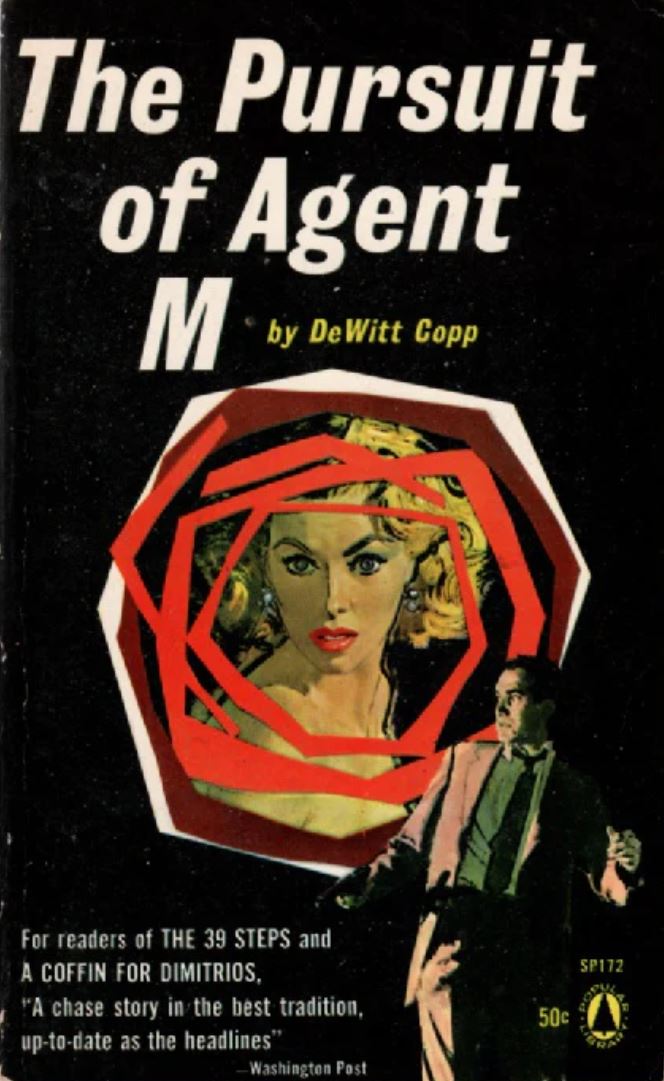
The Pursuit of Agent M

DeWitt Samuel Copp (1919-1999) authored fiction and nonfiction books with themes relating to military history, aviation, the Cold War, and espionage. His experience in the Army Air Corps during WWII, and role as a flight instructor pilot provides a unique realism to his writing. Copp also served in the Central Intelligence Agency and taught history and civics at St. Luke's School in Connecticut. 

Copp's literary work includes Notebooks, a three-book series of action-adventure novels written under a pseudonym of Sam Picard. As Nick Carter, Copp authored two novels in the Nick Carter: Killmaster series. The talented writer penned a screenplay for an episode of One Step Beyond, a Twilight Zone-esque anthology show on ABC and scripted episodes for other television programs like Three Musketeers, Kraft Theatre, and Lux Video Theatre

His spy-thriller The Pursuit of Agent M has been recently released in a new edition by Cutting Edge in digital and physical formats. The book was originally published as a hardcover in 1961 by Hammond and in paperback by Popular Library a year later. It has remained out of print until now. 

Agent M is Mark Costain, an American spy working for the CIA under the name Mark Vorak. His cover is that he is an engineering director at a Czechoslovakian company that manufactures rockets and missiles. In the time-period of the book's release, Czechoslovakia was a communist country controlled entirely by the very red Soviet Union. 

When readers first meet Costain, he is desperately struggling through the cold, harsh landscape of Czechoslovakia attempting to reach the freedom of the Austrian border. In close pursuit is the Czech military, who have positioned Costain as Public Enemy #1. Considering the novel is a man-on-the-run suspense-thriller, the book's simplistic title is perfectly fitting. 

The Pursuit of Agent M is presented in four acts that feature Czech characters aiding Costain's escape. In the first act, Costain meets an old man tending to his sheep. The brief relationship examines Costain's confession that he was stealing government secrets. The wise old man, who hides Costain from the military, doesn't chastise Costain over killing a police officer. Instead, the old man is infuriated over Costain's “theft” of government intelligence. This surprising response to theft versus murder is an intriguing debate. 

Costain's second meeting is with a poet-philosopher that lives in a one room apartment. The poet insists that he isn't Costain's enemy and allows him safe harbor with food and rest. The only repayment requirement is for Costain to hesitantly listen to the poet's readings asking for praise. When the poet risks death for Costain's getaway, Copp's narrative is morally uplifting, showing readers a most basic human principal. 

The third act, and arguably the most exciting, features Costain's hostage, a woman that is revealed to be the mistress to Krupina, a Czech official coincidentally leading the manhunt to find Costain. This sequence is a fevered, tight-laced portion of Copp's narrative that focuses on the woman's relationship with Krupina, and her efforts to assist Costain as a way to extract revenge on her lover. These events are central to a rural farmhouse with plenty of cat-and-mouse tactics between Costain, Krupina, and the mistress that they both are relying on. It's a brilliant premise that leads to Costain's retrieval of an aircraft, that eventually leads to disaster. 

The book's final act is a resounding resolution that introduces key characters that are paramount to Costain's original mission in Czechoslovakia. The characters include a young woman, Lisa, that shares a romantic chemistry with Costain. It's this satisfying conclusion that breathes a new life into the story, revealing Costain's experiences during WWII, both as a pilot and a prisoner-of-war. The circle becomes complete as Copp presents a roaring sequence of events that spring from a treacherous doctor and his association with the communist government. It's a unique twist on the story relevant to Costain's employer and the horrifying atrocities committed while serving as an undercover agent in the German Gestapo. 

The Los Angels Times said, “The writing and style of the book are superior”, when reviewing The Pursuit of Agent M. I would wholeheartedly agree with their praise as Copp's writing was certainly unique, charismatic, and often endearing. The book, rightfully categorized as a spy-thriller, contains a remarkable amount of emotion - human endurance, philosophy, the consequences of war, moralistic thinking, and personal indebtedness. It's a mature approach to the old-fashioned Cold War, espionage thriller that leaves a strong, noticeable effect on readers. 

As a casual, man-on-the-run story, the novel can be enjoyed as pure escapism, but it would be a travesty to ignore Copp's fundamental, underlining messages sprinkled throughout his work. It really sets him apart from his other military-fiction and espionage contemporaries of that era in a Hemingway style – invigorating circumstances propelling human need and suffering. Whether there is a happy ending is in the eye of the beholder. 

Buy a copy of this book HERE.