Wednesday, December 15, 2021

Walking Wounded

According to his Amazon author page, Robert S. Stokes majored in journalism at the University of North Carolina. In the early 1960s, Stokes served in the U.S. Army in Europe before becoming a full-time freelance writer for various magazines including Newsweek and Life. His career led him to Saigon to cover the Vietnam War, an experience that aided him in writing his first novel, Walking Wounded. It was originally published by Dell in 1980, and I can't locate any information to suggest it was ever reprinted.

The novel begins by introducing readers to Jim Bonner, a former Vietnam veteran that now works as a hitman for the C.I.A. After numerous years of death and violence, Bonner is beginning to crack up. During an assignment to physically assault a target in Manhattan, Bonner snaps and fatally shoots the man. Fearing that he's now on a C.I.A. hit list, Bonner flees to Las Vegas to consult with a former military buddy named Cobb.

In the deserts of Nevada, Bonner hightails it in a van loaded with weapons. He knows the agency has targeted him, but he plans to stay alive as long as possible. On a rural stretch of blacktop, Bonner finds a woman named Karen stranded with her young son. Granting them a lift, Bonner discovers that Karen is a druggie that's been booted from her apartment. She has nowhere to go, so she's in for the Hellish ride with Bonner.

The narrative settles in as Bonner, Karen and her son make the long road trip to destinations unknown. Along the way, Bonner stops in to see old war buddies and friends he's made throughout his career with the agency. On cue, Bonner's boss sends a veteran named Gereke to locate, and eliminate, Bonner. Thus, the narrative builds to the inevitable confrontation between the experienced government assassins. 

Walking Wounded is the perfect title for the novel because it describes Bonner's inability to cope with his responsibilities. He's in continuous pain from horrific burns he experienced during a napalm drop (which makes me wonder how he even gained the agency gig). He's on a steady stream of heavy narcotics that have really spaced him out. He's also suffering from severe PTSD and finds it hard to decipher reality from war-torn Southeast Asia. 

Stokes' validates Bonner's condition with numerous flashbacks to Bonner's war experience. These scenes range from drug use in the jungles and barracks to firefights with Vietcong. In a unique parallel, Bonner recounts memories of his father and the mental anguish he endured from World War 2. The author has a lot to say about the poor state of Veteran Affairs in the 1980s, the cyclical nature of violence, and America's dependence on narcotics (a timeless statement). It's clever that Bonner replaces his father in war, and Gereke replaces Bonner in post-war operations. It all ties in as a Yin-Yang concept.

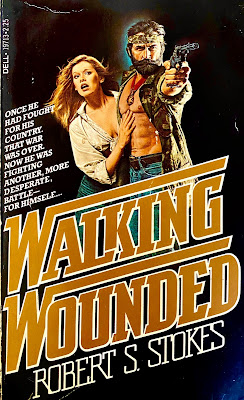
Despite the book's cover, Walking Wounded isn't really what I would consider a strong candidate for a 1980s men's action-adventure novel. This is more of a thriller with action sequences mostly replaced with social commentary and drug use. In that regard, Dell performed a disservice to Stokes. It's never a boring novel, but the cover suggests a Rolling Thunder sort of premise with a more traditional hero fighting some sort of stereotypical bad guy. Stokes' is delivering much more, with heroes and villains that aren't as easily defined. If you want something remarkably different, Walking Wounded may be worth the investment.

Tuesday, December 14, 2021

The Revenger #02 - Fire in the Streets

Paperback Warrior continues to devour the literature of Jon Messmann. We've covered his series titles like The Trailsman, Handyman, Canyon 'O Grady, The Revenger, and even his gothic stand-alone novels under various pseudonyms like Claudette Nicole. My first experience with the author was the debut novel in The Revenger series. Inspired by Don Pendleton's The Executioner, the Signet series began in 1973 and ran six total volumes. The entire series has been reprinted in new editions by Brash Books with an introduction by yours truly. 

The book begins with some flashbacks to the events that occurred in the series debut. The quick story is that New Yorker Ben Martin is a Vietnam veteran who experienced the death of his son by mobsters. Avenging his son's murder, Martin became a one-man army and destroyed the local mob. At the end of that novel, he left his wife to pursue an indiscreet lifestyle using the new name of Ben Markham (Messman had never intended the series to continue). 

Now, it's explained to readers that Ben has lived in the Chicago suburbs for a year. He began working for Alwyn Beef Products and worked his way up to a senior manager due to his experiences as a grocery shop owner. But, Ben is attacked one evening at work by enforcers working for mobster Nick Carboni. After killing the attackers, Ben returns home and starts to question his life. In his own headspace, Ben realizes that he has always wanted to kill again, to right the wrongs, and fight evil. But, in a reversal, he also wants to live a normal existence that isn't smeared in blood. 

What makes The Revenger so great is that Messmann doesn't deliberately set out to create a hero for readers. It's never just a good guy with a gun. Like the debut, he slowly has unfortunate events consume Ben's life. It is like an erosion of sanity that reveals Ben's hard-hitting talents. He's meant to kill the bad guys, and he has the skills and talents based on his experiences in Vietnam, but he is hesitant. Slowly, Ben is pulled into this mystery and must fight again.

Ben's employer is a friend, but he's also a terrible gambler. After losing a great deal of money in the gambling rackets, Carboni has struck a deal with him. The mob will infiltrate his business and in return, Carboni wipes the IOUs off the table. Once Ben learns the reasons for the attack, he puts together an elaborate plan to wipe out the mob at strategic locations. From rooftops, he begins assassinating key personnel with different European rifles, weapons he leaves at the scene to confuse Carboni. But Messmann also has Ben fistfighting with mobsters as well as a fiery car chase on the highway. 

What makes this story unique is that it involves three separate women that are experiencing individual struggles directly related to Ben's mission. Carboni's wife is resistant to her husband's criminal behavior and wants out. When Ben's friend and co-worker is killed, he falls into a friendly relationship with the man's widow. But, Ben's love interest in the story is his employer's wife, a defiant woman that knows her husband is a gambling junkie. These three women are liberally featured throughout the 135-page narrative. 

Fire in the Streets is just as good, or better, than its predecessor and rivals some of Pendleton's best single-digit efforts on The Executioner. Imitation is the best form of flattery and Messmann clones a Mack Bolan styled story while also injecting a great deal of emotional drama. It's violent when it needs to be, and Ben proves to be a capable hero when the gunfire begins. The end result makes The Revenger simply fantastic.

Get the new edition HERE

Monday, December 13, 2021

To the River's End

Rant - Kensington continues to swindle their fan base by suggesting that William W. Johnstone, who died in 2004, is still alive. On the back inside cover of the publisher's recent release, To the River's End, it states, “William W. Johnstone IS the New York Times and USA Today bestselling author of over 300 books...” Further, it states that he authored titles like Flintlock and Will Tanner: Deputy U.S. Marshal. The fact of the matter is that Mr. Johnstone had been dead over 10-years by the time those books were actually authored by ghost writers. Additionally, it states J.A. Johnstone is the co-writer of this book and that she had a hand in writing a number of prior titles. The reality is that she is Johnstone's niece, heir to the empire, and she hasn't written a published word. The back cover proclaims to readers that William and J.A. “...are the greatest western writers of the 21st century.” Hell, it even states you can email Mr. Johnstone at dogcia.two@gmail.com. If he responds, then I'll tap-dance on water and turn your milk into moonshine. 

ReviewTo the River's End hit store shelves in October, 2021 and is only the second trade paperback to emerge from the William W. Johnstone camp. Unlike prior Mass Market Paperbacks, this one has a different color scheme, texture, art design and feel. The only other trade paperback that I'm aware of being the Target exclusive, Go West Young Man, from May, 2021. As I stated above, the cover states this is authored by William W. Johnstone and J.A. Johnstone but in reality it is written by one of a handful of revolving ghost writers – some great, some mediocre and some just plain 'ole bad. 

The book is about two trappers, Luke Ransom and Jug Sartain, that partner up to independently capture beaver pelts in the fertile Rocky Mountains. Luke is the weapons expert and fighting man while Jug provides the comedy and tasty biscuits. While the two are skilled trappers, their fierce independence makes them a vulnerable target for the Blackfoot tribe. Without the support of the American Fur company or Hudson Valley, their presence alone infuriates the Blackfoot tribe. This rivalry is the premise of the book.

Like an assembly line, Luke kills the approaching Blackfoot throughout the long winter. But, not just fighting and killing them. It's a slaughterhouse so thick that the main problem isn’t the amount of Blackfoot warriors. Instead, Luke's biggest issues are A) Where to dump all of these bodies and B) What to do with all of the horses he acquires after mowing down these presumably inexperienced, incompetent Native Americans. Jug plays second fiddle and exists just to be shot twice and then nursed back to health. 

To the River's End would be a gripping cold-weather survival tale ripe with action if the protagonists actually faced stiff opposition. Instead, it's like a Friday the 13th film where the immortal Luke elevates the body count using knives, arrows and lead. Readers, you deserve better than this. Author, whoever you are, I'm glad you are working and being paid to write. Everyone deserves the right to make a living with the talents they possess. However, I wish you had more time to write quality books instead of meeting deadlines for this sketchy western brand.

Get the book HERE

Friday, December 10, 2021

Steve Midnight #01 - The Dead Ride Free

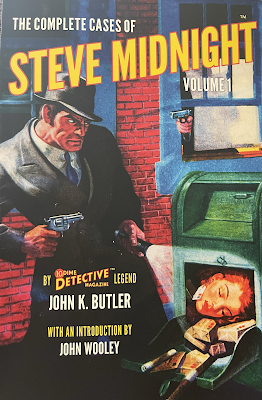
Before breaking into movies and television, pulp author John K. Butler (1908-1964) wrote nine novellas in Dime Detective Magazine starring a mystery-solving cab driver named Steven Middleton Knight, AKA: Steve Midnight. The stories have been collected into two attractive volumes by Altus Press, and I read the series debut, “The Dead Ride Free,” from May 1940.

Our narrator Steve Midnight was a wealthy playboy who lost it all during the Great Depression. He’s working as a cabbie for the Red Owl Cab Company in Los Angeles one cold night when a tall guy wearing a turban wants to be taken to Topanga Canyon. Steve immediately recognizes the fare as an old vaudeville magician named Zohar the Great. It’s been 20 years since Steve saw Zohar sawing a woman in half, and now he’s in the back of Steve’s taxi.

Zohar asks Steve to load a large parcel into the cab. After Steve agrees, he learns that the parcel is a locked coffin weighing about 150 pounds. Zohar explains that the casket houses a mummy from 1300 BC - a prop for his act. Upon arrival at Zohar’s shack, the magician offers to show Steve the mummy. However, upon opening the coffin, the men find the body of a freshly-dead woman with a dagger protruding from her chest.

For reasons best explained in the novella’s narrative, Steve is left to solve this mystery without the help of the police or the shady magician. There are some pretty cool curve balls thrown into the mystery’s plot, and Steve is a fine character to serve as our guide over the course of 50-pages.

Overall, “The Dead Ride Free” is a solid 1940s pulp mystery, but nothing earth-shattering, hardboiled or revelatory. I enjoyed the story and will revisit the collection when I’m in the mood for this particular flavor of comfort food.

Get your copy HERE

Thursday, December 9, 2021

The Sea-Wolf

Jack London (John Griffith Chaney, 1876-1916) is one of those authors that populates every library or indispensable high school reading lists. As a kid, I remember reading his classic White Fang (1906) and promising myself that I would read more of his work. Over 30 years later, I finally decided to read another of the author's classics, The Sea-Wolf. It has been filmed 13 times and was featured as a series for BBC Radio 4 in 1991.

Humphrey Van Weyden is a newspaper columnist living in San Francisco. One afternoon, Hump is pleasantly boating off the California coast when he's rammed by a large schooner called the Ghost. The vessel is captained by Wolf Larsen, an abrasive individual that is described as highly intellectual and materialistic. Hump has the option of sinking, swimming, or hitching a ride on the Ghost. Unfortunately, he climbs aboard and quickly realizes he's in for a Hellish ride.

Hump declares that he wants a u-turn back to the coast so he can return home. Larsen refuses and orders that the ship continue its journey to Japan. Larsen offers to pay Hump to work aboard the ship and orders him to be a cabin boy. Hump resists but eventually his will is broken and he submits to long days of cooking, cleaning, and contending with a seasoned, very violent crew.

London provides some unique perspective through Hump's eyes. The excessive hard work and perseverance strengthen Hump. He realizes that he has been sleeping through life with his cushy desk job and a complacency to perform the most mundane tasks. As the narrative continues, Hump discovers that beneath Larsen's granite veneer, he is a literary scholar and possesses an atypical knowledge for math calculations and navigation. Because of the commonality, Hump and Larsen spend hours discussing books and art.

Eventually the abused crew turns on Larsen and attempts a mutiny. Larsen's tactical experience allows him to fight back against the crew, eventually torturing specific catalysts. Due to the violence and madness, Hump swears to kill Larsen. Things grind to a screeching halt when a woman, Maud Brewster, is rescued from the seas. Her background as a writer immediately connects with Hump. Together, the duo hopes to escape Larsen and his rebellious crew.

I really enjoyed London's novel and found Larsen (whom is the premise of the book's title) a multifaceted nemesis. The story has a couple of offshoots that I felt really solidified the storytelling: Hump's rivalry with a murderous cook, Larsen's vendetta against his brother, Hump's romanticizing with Maude, the arctic survival finale, etc. London's emphasis on Larsen's approach to life, work, and resilience provides so many great passages and quotes, my favorite being:

“Surely there can be little in this world more awful than the spectacle of a strong man in the moment when he is utterly weak and broken.”

I've read that The Sea-Wolf has similarities to Rudyard Kipling's 1897 novel Captains Courageous. London, who was proven to perform plagiarism, wasn't the only writer to use this plot. I would imagine there are a number of nautical novels with heroes that are trapped at sea with a tyrannical captain. But, I would say that Max Brand's (real name Frederick Schiller Faust) 1941 novel Luck of the Spindrift is nearly a carbon copy of The Sea-Wolf in terms of storyline. In Brand's novel, a San Francisco philosopher finds himself trapped on a ship headed to the South Seas. He has an interest in the only female on board and there's a devious captain to brutalize the crew.

If you enjoy more modern nautical adventures by the likes of Clive Cussler, Hammond Innes, Kenneth Bulmer and Patrick O'Brian, I think you owe it to yourself to read early 20th century novels like this one. Without these pioneering efforts, nautical fiction wouldn't have such strong and solid sea legs.

Wednesday, December 8, 2021

Dirk Pitt #03 - Iceberg

Clive Cussler (1931-2020) was a massively-popular novelist who dominated the bestseller lists for the duration of his writing career. His most enduring series character was Dirk Pitt, a troubleshooter for the fictional National Underwater and Marine Agency. My first exposure to the author and the character was his third installment, 1976’s Iceberg.

The book opens with a U.S. Coast Guard mission mapping the locations of icebergs floating in the North Atlantic near Newfoundland. From the air, the Coastie crew spots one impossibly large iceberg - 200 feet high weighing upwards of one-million tons. Closer examination of the iceberg reveals the impossible - an entire ship embedded within the ice but still visible from the sky. The Coast Guard estimates that once the iceberg drifts into the gulf stream, it's sure to melt - likely submerging the ghost ship into the depths of the sea. The iceberg must have dislodged from some northern glacier, but there’s no way to know its origin.

Enter Dirk Pitt. He’s an U.S. Air Force Major on permanent loan to NUMA - the National Underwater and Marine Agency. NUMA dispatches Pitt to a Coast Guard cutter with a mission to get inside the ghost ship and better understand what’s happening. As a character, Pitt is a combination of James Bond and Doc Savage. He’s a funny and likable hero stacked with core competencies. He can fly a helicopter, dive to great depths and bag the babes as needed. His deductive capabilities rival those of the great Sherlock Holmes.

The providence of the ship-in-the-berg is a plot point that I won’t spoil for you here, but it only serves as starting point into a variety of mysteries Pitt is called upon to solve over the 400-pages. He’s a smart cookie and not afraid to kick ass when needed. His relationship with his Admiral boss and the boss’ lovesick personal secretary make for some fine human moments throughout the paperback.

I was expecting Iceberg to be filled with dense plotting and littered with incomprehensible nautical jargon that would cause my eyes to glaze over. I’m pleased to report that Cussler avoids this trap and makes the pages fly by with a basic good guys vs. bad guys plot and a propulsive story. His books are about twice as thick as other men’s adventure paperbacks from the same era, so I was expecting a complex story akin to the work of Tom Clancy. Instead, Iceberg was pulpy as all-heck. The action and villainous motivations were over-the-top like a good Destroyer novel, and the layered twist endings were pedestrian, outrageous and fun. No one should ever accuse Cussler of writing high-brow, smartypants fiction. I hereby stand corrected.

The appeal of Cussler’s novels is now clear. If Iceberg is any indication, the series is a lot more fun than you might expect. The books can apparently be read in any order, and there are plenty of lists online ranking them based on quality. I look forward to diving deeper into this author and his famous series. Recommended. Get it HERE

Tuesday, December 7, 2021

Brother

Ania Ahlborn is a contemporary horror fiction author born in Poland who emigrated to the United States where she earned an English degree from University of New Mexico. She writes disturbing novels from her Greenville, South Carolina home that have earned acclaim from the Horror Writers Association and a huge social media following of rabid fans. My first introduction to her work was her 2015 novel, Brother.

The year is 1980, and it’s time to meet the Morrows, the serial killer family at the center of the novel. Daddy Wayne is a Vietnam vet who handles the killing of female hitchhikers they bring back to their horror house in the woods. Momma’s own childhood trauma undoubtedly set the table for her own adulthood of bloodthirsty psychopathology. Their oldest kid is named Ray. He’s in his 20s now and prefers to be called Rebel. He gets off on tormenting his sensitive younger brother Michael, now 19. Meanwhile, Michael is protective of his sister Misty Dawn. There’s also another sister named Lauralynn, but we don’t even say her name out loud.

The Morrows are poor. Not like the urban poor we have today with smartphones and HD televisions. They are country poor. Appalachia poor. They make ends meet by shoplifting and collecting whatever trinkets they can find on the women they kidnap, torture and kill. The bodies are buried out back of their ancient, dilapidated West Virginia farmhouse sporting faded clapboards and filthy windows. They pretty much keep to themselves except when Rebel and Michael venture into town to stalk possible victims, steal food or chat up girls at the local record store.

Brother’s third-person narrative follows Michael, who, despite being a complicit member of a psychopathic serial killer family, is actually a very sweet boy. Through flashbacks, the reader receives glimpses of this awful family’s origin story, and it’s every bit the nightmare you’d expect. Older sister Lauralynn was the nice, compassionate girl of the bunch who looked after Michael when he was young. You’ll notice that she’s not present during the contemporary scenes, and the story of her departure from the Morrow house is doled out gradually as one of the novel’s central mysteries.

Brother is basically a bloody and gruesome coming of age suspense story about young Michael growing to understand his own dysfunctional upbringing in this messed-up family. There’s a puppy love story to enjoy and lots of abuse of Michael at the hands of his loathsome older brother. Throughout the novel, Ahlborn’s writing is exceptionally good and the pages fly from one atrocity to another. The book is a real bloodbath and incredibly compelling, but I didn’t find it particularly scary. Instead, the paperback presents a gripping suspense story that chooses to focus on the characters instead of the gore. By now you know if this is your kind of thing. If so, Brother is an easy recommendation. 

Get a copy HERE