Monday, January 24, 2022

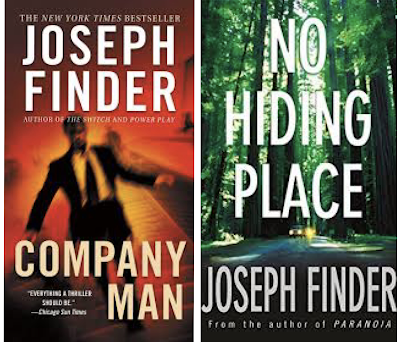
Company Man

Joseph Finder is a Boston-based bestselling author of modern contemporary thrillers. His books sell like hotcakes and are readily available at your local airport newsstand near the $25 neck pillows. My first exposure to his work is his 600-page paperback behemoth from 2005 titled Company Man, also released as No Hiding Place in the U.K.

Our protagonist is Nick Conover, the CEO of a giant office furniture manufacturer whose resistance to outsourcing production to China has resulted in major layoffs at home. The Michigan-based corporation is owned by shadowy venture capitalists from Boston who are looking for a better return on their investment than current conditions will allow. Nick’s also a widower raising two kids on his own.

The novel wastes no time propelling Nick and the reader into a whirlwind of anxiety. Lately, someone has been breaking into his empty, gated community McMansion and spray-painting veiled threats on the walls. Nick assumes the stalker/vandal is yet another disgruntled former employee pissed about a prior or pending round of layoffs. The stalker’s menace escalates with the slaughter of the family dog, and the local cops are being less-than-helpful to the guy responsible for the small-town’s rising unemployment rates.

Identifying the stalker is easy business, but things are more complicated than they seem. A bad decision in dealing with the stalker situation puts Nick in serious peril and legal jeopardy. This escalates into some high-stakes corporate skullduggery with so many plot twists that neither Nick nor the reader knows who to trust. A dogged and likable female police detective is thrown into the mix as a co-protagonist.

The author delivers the narrative in a smooth and readable style similar to John Grisham or Harlan Coben. The chapters are short and punchy with a big typeface and ample space between lines, making 600 pages feel like 400 — less than a modern doorstop paperback but still way too long for the novel’s relevant content. I recognize that big books allow a publisher to overcharge for a paperback, but the novel made me repeatedly mutter, “Get on with it, already.”

Pro-Tip: If you skip or skim all of the sections regarding Nick’s kids and dead wife and eliminate the sections about the female police officer’s family, you’ll cut out a lot of completely extraneous filler and be left with a decent thriller.

There is some good white-collar crime, corporate stuff in this paperback along with a credible police procedural crime story. The ending of the novel has a plot twist that I didn’t find completely believable, and I didn’t fall in love with any of the characters. Overall, I enjoyed Company Man enough to give the book a tepid recommendation. Get the book HERE

Friday, January 21, 2022

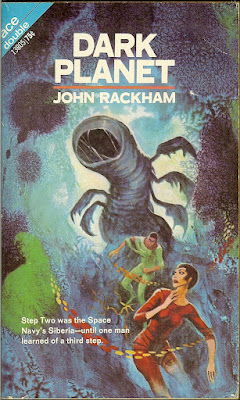
Dark Planet

John Thomas Phillifent (1916-1976) used the pseudonym John Rackham to author a number of science-fiction and fantasy novels. Under his real name he also wrote three novels related to The Man from U.N.C.L.E. Along with 20 stand-alone novels, he also wrote two series titles, Space Puppet (1954-1955) and Chappie Jones (1960-1963). I recently acquired a crate of Ace Doubles that included a few novels under the Rackham name. Looking for adventure in a galaxy far, far away, I chose to read his 1971 novel Dark Planet.

In the future, war has enveloped the entire galaxy. Earth discovered an inhospitable planet deemed Step Two as a stopping point for vessels to re-supply and re-energize. The planet's atmosphere will eat materials like plastic and metal. Due to the acidic air, a specially designed dome was placed over a portion of the planet that functions as a military installation.

The book's protagonist, Query, has upended his military career and now finds himself doing labor as punishment on the planet of Step Two. Being a rebel at heart, Query continues to wander outside of the dome using a special space suit. In the opening pages, Query sees a figure in the distance and realizes the planet is inhabited by some sort of people.

Captain Evans and his daughter Christine arrive in Step Two and find Query. The war has escalated and their team needs an experienced ship mechanic, one of Query's many skills. The three of them fly out of the dome on an adventure to save the galaxy. But, the ship malfunctions and they free fall from 15-miles up, crash landing in Step Two's far-flung, unexplored reaches. Together, they must learn how to survive in an atmosphere that literally eats everything.

Unfortunately, there's not a lot that really happens in Dark Planet. Inevitably, the three find the bizarre people that live on the planet and they must learn from them how to survive and communicate. It's a fish out of water adventure, complete with giant worms and tree people. The hope that Rackham would write a stirring action novel was quickly dissolved by Query's romantic chemistry with one of the inhabiting females. If long conversations about the purpose of our existence is your thing, then this novel may entertain you. If not, turn the light off on Dark Planet.

Thursday, January 20, 2022

The Haunting of Ashburn House

In 2012, author Darcy Coates self-published an e-book horror novella titled Once Returned. This kick-started a self-publishing career that lasted 22 novels. She eventually signed with mystery imprint Poisoned Pen Press, which bought up the rights to all of her self-published work and made her bank account swell. Her novels mostly consist of young characters in their 20s dealing with the supernatural, often in a haunted place. From a sky level view, she is capitalizing on the 1960s and 1970s gothic suspense novels for atmosphere and imagery. But unlike those vintage “women running from houses” books, Coates switches out the romantic angle for a scarier approach. I was curious about her brand of horror after seeing stacks of her novels at my local Barnes & Noble. But, instead of laying down a hard-earned $15, I borrowed a friend's copy of The Haunting of Ashburn House. It was originally self-published in 2016 and now exists in multiple formats through Poisoned Pen Press.

Like a William Ross novel, the book begins with a familiar genre trope. Financially strapped, young Adrienne learns that her mother's grandmother's sister's daughter Edith Ashburn (that's a great aunt for those constructing an org chart) has bequeathed a large Victorian house to her. Adrienne, nicknamed Addy, arrives in a very small town with her cat Wolfgang and $50. Upon entering the little province, she finds a lot of staring eyes. Later, she learns that the house she has inherited is believed to be haunted and many of the town's citizens believed the prior owner was wacko. 

Addy's new home is 10-miles outside of town and nestled in a deep blend of forest and fields. Only the first floor has power and there is no cell coverage (and 20-yr old Addy doesn't own a phone). The upstairs is rather spooky with a lot of rooms and darkened halls due to the lack of electricity. Perhaps the strangest thing is that Edith has carved bizarre messages into the walls like, “Is it Friday, Light the Candle” or “No Mirrors”. Needless to say, strange things begin happening immediately. The power downstairs is shut off numerous times in the night, portraits seemingly come alive, and a new acquaintance is nearly killed. Oh, and zombies. 

If you've watched the cult horror flick Evil Dead 2, then you'll love your 350-page stay in Ashburn House. The wacky scenes of a corpse doing bizarre things reminded me of the unusual movements performed by Sam Raimi's characters. But, it's not designed to be funny. At least I don't think it is. The mystery is compelling with a backstory that kept me motivated to flip the pages. I didn't particularly like Abby and chastised myself for hoping she would be injured or hurt more. Coates makes her too vulnerable and weak when faced with stiff opposition. Sure, she's the hero, and by the book's end, she's a real sweetheart, but her judgment and behavior left me a bit deflated. 

I'll probably try another of Darcy Coates' books in the near future. I'm hoping there is a better result than this one. Haunting of Ashburn House is just below average when it comes to a spooky haunted house novel. But, I would imagine it is appealing to the young adult crowd. As an introduction, this is a training bra in preparation for more visceral horror ahead. It's a catchy cover and title, and God knows there are stacks of her books in the retail shops to pave the way to King, Keene, Malfi, Bates, etc. Cheers to that. 

Get the book HERE

Wednesday, January 19, 2022

Dark Legend

With nearly 300 novels, Canadian native William Edward Daniel Ross is probably the most prolific gothic writer of all-time. He wrote multiple series titles under a variety of pseudonyms as well as contributing to the paperback canon of Dark Shadows television tie-ins. I've read a few of his Marilyn Ross penned gothics and find them average at best. With a lot of driving time, I decided to listen to Ross's 1966 gothic title Dark Legend. It was originally published by Paperback Library and exists as an audio download from Paperback Classics.

The story takes place in the late 1800s in a large lakeside mansion in Maine.  Protagonist Jan wakes up in a bedroom with one of the most common soap opera tropes – amnesia. She doesn't know who she is or any prior events that have placed her in this enormous mansion. Thankfully, a man she doesn't recall comforts her and explains he is her fiance and that they had a train wreck on the way from Virginia to Maine. Further, she is introduced to her cousin, aunt, former childhood nanny, and the town doctor. 

After the splendid bedside manner, Jan learns a lot about herself. She's filthy rich after inheriting her grandfather's fortune. She also learns that the neighbor is a crazy psycho that keeps vicious howling hounds patrolling his manor. Further, it's revealed that her mother was murdered by a man wearing black gloves and her father committed suicide. Because of all of this, there's supposedly a masked man wearing black gloves that haunts the mansion. Oh, and there's a summer cottage nearby that Jan is warned of. Apparently, it hosted some sort of heinous act that the family is now distancing itself from.

Dark Legend is better suited as a romance novel with a sprinkling of gothic suspense. The narrative mostly consists of Jan deciding if she wants to remain engaged despite the fact she knows nothing about her fiance. She's also attracted to the dashing town doctor and jealous of her cousin's relationship with both men. Ross spends a great deal of time on building these romance angles or having the characters organize a massive ballroom dance. There's wardrobes, guest lists and food to prepare and it stomps the brakes on any propulsive plot developments. 

There is a hint of suspense when Jan is attacked by the hooded killer repeatedly. There's some mystery surrounding the death of her mother and the weird neighbor next door to flesh out the story. None of it can really save the tired storyline though. Ross is literally just cutting and pasting these plots – estranged granddaughter with dead parents, that inherits a haunted mansion, but must contend with a bitter family member while sparking a relationship with a handsome male. Ross' inability to create unique stories makes me appreciate authors like Jon Messmann (writing as Claudette Nicole) and Michael Avallone (writing as Edwina Noone). Your mileage may vary.

Tuesday, January 18, 2022

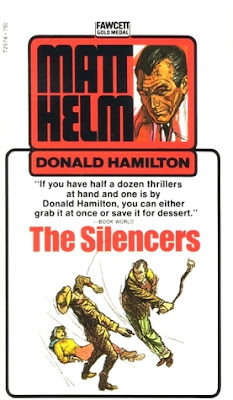
Matt Helm #04 - The Silencers

Matt Helm is starting to stir the place up. After dismissing the first two installments of this Donald Hamilton spy series, I knew I owed it to myself to just keep reading these titles. Thankfully, the author's western traditionalism elevated the third book, The Removers, and I found myself liking it. While I've always been critical of Helm's actual heroism, I still love Hamilton's hard-boiled storytelling. The dialogue is snappy, the complex wrinkles of international espionage are smoothed over, and these stories seem to improve more and more. Needless to say I was happy to pursue the series fourth installment, The Silencers. It was published by Fawcett Gold Medal in 1962 and now exists as a reprint in physical, digital and audio.

On the last page of The Removers, Mac instructed Helm that his next assignment would involve a rural mountainside retreat. In the opening pages of The Silencers, Helm has completed this mission (details were never revealed) and is now on his newest job in New Mexico. Mac instructs Helm to cross the border into Mexico to extract a female agent code-named Sarah (she was a minor character in the series debut, Death of a Citizen). There, he teams up with another agent named Pat LeBaron to find Sarah working as a stripper in a rowdy bar in Juarez. After making eye contact with Sarah, the room explodes in violence as she is fatally stabbed (mission failure) and LeBaron is shot to death (secondary mission failure). But, Helm manages to get Sarah's sister Gail to safety. 

In talking with Mac, Helm learns that Sarah had sold-out the U.S. to become an asset for a foreign enemy. Upon her death, she had a microfilm of stolen secrets ready to provide to the enemy. Luckily, Gail has the microfilm and Helm seduces her out of her clothes to find it. In a motel room, Helm is attacked by two bad guys, but learns they are working for another U.S. agency that doesn't necessarily want to coordinate their efforts with Mac's department (CIA vs FBI feud). 

Mac advises Helm that the main bad guy is a spy named Sam Gunther, a man Gail describes as a smooth talking cowboy. The two pursue Gunther into Carlsbad, California and learn that he has aligned with top scientists to launch a missile into a group of politicians and scientists running highly-publicized seismic tests in the area. Got it? It took me a while. But, all of this is told in a rapid-fire pace that places Helm in fights with various foreign agents and an awesome finale in an old ghost town church.

There's nothing to dislike about The Silencers and, once again, the series shows improvement. In a minor way, this Helm assignment was like a Nick Carter: Killmaster installment with the layers of over-the-top action and stereotypical criminals. There's a little more comedy inserted in between fights, leading some fans to believe Hamilton was displaying a fondness for Richard Prather. I could sense some similarities, but Helm is a far cooler character than silly 'ole Shell Scott

The Silencers is another great installment to this highly respected series. Helm and I started off on the wrong foot, but after that mess with his wife (The Revengers), I'm starting to like this guy. Hamilton writes with conviction and energy, and doesn't necessarily drown the reader in details. He does just enough to make Helm a hero, but doesn't overdo it. The end result makes it a fantastic reading experience and a worthy Bond opponent (if the literary world needed one). Get a copy HERE

Monday, January 17, 2022

The University #01 - Sympathy for the Devil

Sympathy for the Devil is the first in the series of espionage novels by contemporary New York author Terrence McCauley. The novel was originally released in 2015 but has found new life as the inaugural release by Wolfpack Publishing’s newly-acquired imprint Rough Edges Press.

The novel stars spy James Hicks (not his real name). He’s employed by an odd organization informally known as The University. It was created by an executive order during the Eisenhower Administration to operate outside the official intelligence community to protect the USA without federal (or ethical) oversight or funding.

The University gains its power through the recruitment of high-value “Assets” — people with secrets to hide that the agency blackmails into providing expertise, information and resources. Hicks recruits these reluctant assets with information gleaned from The University’s futuristic data analytics computer called OMNI. More on that later.

The day-to-day work of The University is to embed its agents inside suspected terrorist groups with the hopes of preventing acts of terror before they happen. Hicks runs The University’s New York office and oversees these operations. For this series debut, Hicks is dealing with a group of radical Islamic Somalis operating out of a Long Island taxi stand. Somehow the Somalis figured out that they were under investigation, and they stage an ambush targeting Hicks and killing a well-placed undercover operative.

There’s a lot of world-building to give the reader a feel for the intel environment in which The University operates. Nearly the entire first half of the novel is Hicks setting the stage, recruiting help and gathering resources for the mission at-hand. In the novel’s second half, Hicks employs technology, informants, enhanced interrogation and gunplay to investigate the bad actors behind the Somali cell.

My biggest criticism is the author's over-reliance on the agency’s OMNI computer system. The system is all-knowing, all-seeing and completely unrealistic — much like the one in the 1998 Tony Scott film Enemy of the State. The problem is that this trope robs the main characters of problem-solving within the plot. A digital, crystal ball like OMNI takes the story out of the world of hardboiled gritty realism and into the realm of paranoid sci-fi. The computer system also relegates Hicks to the sidelines and in front of a computer screen for much of the novel.

Despite these structural flaws, I mostly enjoyed riding along with Hicks on this adventure. The author is at his best when writing scenes filled with violent action, and there are several of these peppered throughout the paperback - mostly toward the end. When he leaves his laptop behind, Hicks is a great hero and the author is a fine writer.

While I didn’t love Sympathy for the Devil, I’m intrigued enough by the character and the agency to continue with the series. McCauley can write his ass off when he allows his action characters to do action stuff. Mostly, I trust the editorial hand of Wolfpack Press to shepherd this series in the right direction. For that reason, I’ll probably be back for more. 

Buy a copy of the book HERE

Friday, January 14, 2022

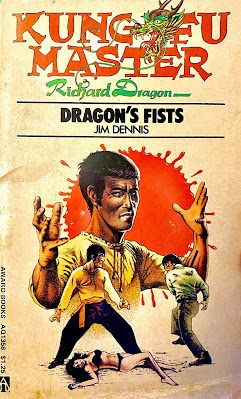
Dragon's Fists

There's an interesting backstory behind the vintage paperback Dragon's Fists. It was published in 1974 by Award Books, a subsidiary of Universal Publishing under the pseudonym Jim Dennis. The novel was actually written by Dennis O'Neil and James Berry. O'Neil was a prolific comic book writer with works including Green Lantern, Amazing Spider-Man, Batman, and X-Men. Berry was a comic strip artist associated with the long-running Berry's World

The 1970s provided a fertile landscape for men's action-adventure paperbacks, so the proposal was for Dragon's Fists to become a series. The title page inside states #1 and the book is a clear origin story. It was designed to propel Kung-Fu master Richard Dragon, the book's main character, into a long-running publication. Unfortunately, the book wasn't a success and Award Books canceled the series. Was the novel that bad?

Through numerous flashbacks, readers learn that Richard Dragon's parents were very wealthy. Dragon, in defiance, wasted his childhood by creating a lot of chaos for himself and the family. He was kicked out of numerous schools and universities and refused to conform to his father's rules. As a young adult, Dragon became a thief in Japan and attempted to rob an older gentleman. The man ridicules Dragon, but finds that he has the ability to do good things if he can change his attitude. This man, referred to as O-Sensei, is a Kung-Fu master. He teaches Dragon martial arts and how to live life in a positive way. 

With his new skills, Dragon joins an espionage agency called G.O.O.D. (Global Organization of Organized Defense) and serves as an agent for a number of years. After he leaves the agency, Dragon becomes a martial arts teacher. In the opening pages, Dragon's friend Carolyn comes to him to ask for help. In a quick fight scene, Carolyn is kidnapped by a male villain named The Swiss. He also murders Carolyn's uncle in a quest to locate a series of numbers.

The bulk of the narrative is spent with Dragon trying to locate The Swiss in Paris. There's a number of violent fight scenes to keep readers engaged, but the story is fragmented due to the flashback sequences. It reminded me of the old Kung-Fu television show where the main character finds conflict and is reminded of some important lesson he learned from his master. The action is great, the story is convoluted, and the pace is jarring. Beyond collectible nostalgia, there probably isn't a reason to hunt this book down.

Fortunately, Richard Dragon continued in comic book format and has become a stable, popular character within the D.C. Comics universe. The character first appeared in comic book format in 1975 under the title Richard Dragon, Kung-Fu Fighter. That series lasted 18 issues. The Richard Dragon series launched again in 2004 and ran 12 issues. Since the 1970s, the character has appeared repeatedly as both a hero and villain. Most recently, Richard Dragon appeared on the television show Arrow and the animated Batman film Soul of the Dragon

Buy a copy of this book HERE