Friday, January 28, 2022

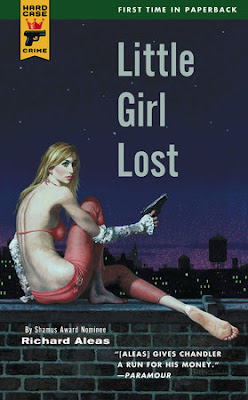
John Blake #01 - Little Girl Lost

Charles Ardai is the founder and publisher of the Hard Case Crime paperback imprint. Using the pseudonym Richard Aleas, he wrote two original, contemporary mystery novels starring a New York private eye named John Blake for Hard Case Crime. The first Blake novel, Little Girl Lost (2004), was nominated for an Edgar Award and remains available today in all formats.

The paperback opens with Blake remembering Miranda Sugarman, the sweet neighborhood girl who took his virginity years ago. She left Blake behind after high school to attend a university with a goal to become a doctor. Blake learns of her death from an exploitive newspaper headline reading, “Stripper Murdered.” Without a client, he decided to investigate her death and gain a better understanding of his former friend’s life and death.

One of my favorite elements of the set-up is Blake’s boss in the PI firm, a much older ex-cop named Leo, who plucked Blake out of college and mentored him in the investigation racket. He’s the perfect, world-weary antithesis to Blake’s youthful idealism and quest for justice. He’s also well-connected within the NYPD and a great asset to Blake’s side.

The trail to the truth takes Blake into the behind-the-scenes world of seedy NYC strip clubs. It’s a fascinating look behind the curtain as Blake encounters a conspiracy of dope, missing college girls and much more. Blake is a fallible hero who takes more than a few beatings, but is always smart, capable and upbeat. His narration moves the plot forward at a good pace and is never boring.

Ardai is a much better writer than I was expecting, and Little Girl Lost was a solid, workmanlike private eye mystery with plenty of twists leading to the satisfying solution. It’s an easy recommendation, and I look forward to reading the sequel, Songs of Innocence, from 2011.

Thursday, January 27, 2022

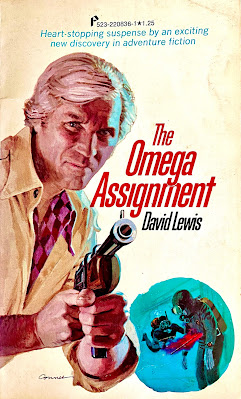
Steve Savage #02 - The Omega Assignment

David Lewis, real name Patton D. Lewis, authored a two book series of spy novels for Pinnacle in 1976. In my research, I couldn't locate anything about Lewis other than a lot of Google hits on the western writer Lewis B. Patten. The series stars part-time British Secret Intelligence Agent Steve Savage. The first novel is The Andromeda Assignment and the follow-up is The Omega Assignment. In working backwards, I'm reading and reviewing The Omega Assignment

Savage's origin tale, printed on the back of each novel, advises readers that he joined a freighter at the age of 14. He was later degraded by the Captain and beaten for six straight weeks. He managed to escape into Hong Kong and learned martial arts in exchange for cleaning a gym. He then returned to London and trained as a photographer. He has covered war and fighting throughout the world, including Vietnam, the Middle East and Belfast. His agent, Gregor de Freitas, operates as an SIS frontman after escaping the Soviet Union. Savage's capabilities to enter communist countries as a photographer allows him to work part-time as a secret agent under Freitas' guidance. Lewis warns readers that “This man is dangerous!”

In The Omega Assignment, a multi-millionaire German man named Braeder frequently entertains politicians and members of NATO on an ocean liner called Clytherea. On board, Braeder provides sadistic thrills that includes various types of sex, S&M, rape, and torture. Braeder “liberates” these sick leaders and allows them to engage in their wildest fantasies. But, he records all of this on video tape in an elaborate ruse. Here's how it works:

Braeder sinks Clytherea and uses the recorded tape as blackmail to obtain a small hydrogen bomb that fits into a suitcase. He then trades this bomb to Middle East fanatics for an extremely large supply of heroin. He then makes connections with the largest mafia families in America to become their chief supplier. With a surplus of heroin, he slowly begins to reduce the supply to the mob. To free up the supply chain, Braeder demands more money for the drug. Thus, Braeder begins raking in the dough and makes himself...king of the world?

While I don't know exactly what Braeder hopes to accomplish with all of his money, the narrative outlining all of this was a real pleasure to read. Savage becomes involved as an underwater photographer gaining footage exploring the sunken Clytherea. Lewis writes the underwater exploration portion so well. He thrusts the reader into these gloomy, dark hallways and rooms as Savage explores the ship. There are floating corpses and a plethora of art and jewels to photograph, but Savage is placed in peril when his diving partner is killed by a booby trap inside the ship.

Without ruining the fun, Savage teams up with an American female narcotics agent named Destiny, while assisting the CIA and British intelligence. The explosive narrative has Savage facing a variety of criminals on land, air and sea. Most of the plot develops in Cyprus and culminates in Destiny being captured and taken to Braeder's enormous beach-side fortress. Savage purposefully becomes captured in an effort to free her from the inside. He also teams up with an older Greek paramilitary unit known as EOKA for the finale. 

I felt that the first two acts of The Omega Assignment was a lot of fun and read like a B version of a Jack Higgins novel. The last act was really over the top with Savage forced to fight in the nude gladiator style against Braeder's “strong guy.” I thought that this final battle was more like a Richard Blade adventure complete with zany antics that made the conclusion a bit cartoonish. If you love action-packed adventure and espionage, then The Omega Assignment is an entertaining read. I liked it enough to search for the first book online. To my knowledge, these books have never been reprinted, but remain fairly affordable as used paperbacks.

Note: Thanks to Spy, Guys, and Gals for additional information about this series.

Wednesday, January 26, 2022

Vee Brown - The Complete Cases #01

Vee Brown starred in 18 violent mini-novels between 1932 and 1936 in the pages of Dime Detective Magazine. The stories were authored by Carroll John Daly, the inventor of hardboiled crime fiction and his popular Race Williams character. Steeger Books has released two volumes of Vee Brown novellas comprising the entire series run. I sampled two of the stories from the first compilation to get a taste for the character. 

Vee is a violent gun-toting police detective who is also a mild-mannered and educated Tin-Pan Alley songwriter of sentimental tunes — a secret side-hustle that brings the supercop tremendous wealth. Think Cole Porter or George Gershwin with a taste for justice and criminal blood. The Vee Brown stories are narrated by a newspaper reporter named Dean Condon who shadows Vee on the job and writes about his adventures for the paper.  

“The Crime Machine”

I started at the beginning with the first Vee Brown adventure - a short story called “The Crime Machine” from 1932. 

As the novella opens, reporter Dean Condon is preparing to meet Vee and ride-along with him for a newspaper article. Condon is nervous because Vee has earned a reputation as the most relentless hunter and killer of criminals on the police force. When Vee and Condon meet face-to-face, they make the connection that the two knew one another back in college as passing acquaintances. 

Because “The Crime Machine” is the series intro, it exists to establish the Holmes-Watson relationship between the crime-fighter and his sidekick documentarian - a dynamic that persists throughout the entire series. As such, the plot is rather thin - like a TV series pilot episode. 

On their first outing together, they are hunting Killer Regan, who shot up a theater during a robbery murdering a female cashier. Vee’s orders from the District Attorney’s office is to produce Regan dead or alive. On the prowl, Vee is stealthy as The Shadow — seeming to disappear while infiltrating the criminal’s lair with a perpetually-amazed Condon in-tow. 

There’s plenty of tough talk and violent pulpy action to enjoy - as well as the big reveal where Condon learns that the deadly hero is also “The Master of Melody” who publishes popular sheet music under his given name of Vivian. Despite the simplicity of the plot, the short-story was a total blast and left the reader hungry for more. 

“The Price of Silence”

The ninth Vee Brown adventure is “The Price of Silence", the final story in Volume One of the Steeger Books collection. It’s a 50-page novella from 1933 published when Daly had hit his stride with the series. 

The story opens with the crime scene investigation of a wealthy woman stabbed in the chest in her own home while her husband slept upstairs. Because it’s 1933, a police inspector comments that such things are to be expected in the city’s Italian neighborhood, but not in the victim’s upscale community. 

Fortunately, the killer left behind a calling card identifying himself as “The Black Death” which seems like a decent lead for Vee to launch his investigation. He quickly deduces that the victim was likely a blackmail victim who failed to pay off her tormenter resulting in death. 

Vee quickly identifies a suspect for the murder - a society dandy behind a gang of racketeers handling the dirty work of shaking down the blackmail victims. Vee’s plan is to squeeze the henchmen with death threats until they identify their boss. 

As the narrator, Condon finds himself at the center of the action when he is held captive by the thugs awaiting Vee’s return. When they reunite, Vee and Condon follow leads through a rather convoluted mystery plot leading to the exciting confrontation you always knew was coming. 

I enjoyed these two Vee Brown stories enough to continue with the series in the future. Steeger Books have released a second volume compiling the final nine novellas. I’m looking forward to checking them out. Recommended. Get your copy HERE.

Tuesday, January 25, 2022

Arrow #01 - Wine, Women...and Death

According to his website, Walter Deptula Jr. graduated from Columbia University and became both a Naval Aviator and an educator at California community colleges. Along with acting, writing, and producing community theater, Deptula also authored a six book series of men's action-adventure novels in the 1970s. The Arrow series stars Franco Arronelli, known as Frank Arrow, as a professional thief living in Hawaii. The debut, Wine, Women...and Death was published by Curtis Books (a subsidiary of CBS) in 1974. 

As a young man, Arrow worked the beat in Staten Island as a patrol officer. During a bank heist, Arrow is shot in the leg while fatally shooting the thief. During the struggle, Arrow swiped $4,000 from the bank drawer. Being wet behind the ears, Arrow buys a new car and is eventually kicked from the force. Arrow then develops a long career as a self-employed thief. He is paid by clients and insurance companies to steal back stolen goods – a thief of thieves. 

In the backstory, readers learn of Arrow's most recent undertaking, but it's only later in the novel that the events are explained in detail. A criminal named Serranto, possibly working for someone, robs a prominent jewelry store. After the successful heist, Serranto hides the jewels in a tomb on a large New York estate. The insurance company hires Arrow to find the jewels and agrees to his 25% commission fee. But, Arrow learns that some of the jewels are ancient relics traced back to an early English empire. If he can retrieve the jewels, his commission will be an extremely lucrative payout. 

Deptula's middle chapters are dedicated to Arrow's preparation and planning to retrieve the stolen jewels. These chapters were written so well and reminded me of great mid-20th century heist fiction by the likes of Dan Marlowe and Lionel White. In these chapters, Deptula absolutely shines. I loved the setup, planning, disguises, team players, and ultimately the execution. It's not imitation, but clearly the author was influenced by the crime-noir masters.

Surprisingly, Wine, Women...and Death isn't just a heist novel. Instead, the events of the heist lead Arrow into an underworld of bloody violence. Someone on Arrow's team sells him out to Serranto and his fiance is murdered. In a desperate bid for revenge, Arrow must not only find and kill Serranto, but also discover who the real mastermind is. It's this part of the book that is simply a product of its time. This is straight-laced, 1970s gritty action that is probably spawned by Mack Bolan and countless other paperback vigilantes of the era. 

I loved all of the little nuances that are associated with the character. Arrow lives in a beach-side mansion and possesses all of the luxuries one would expect – private plane, helicopter, employees, a compound and a pet shark (which plays into the book's finale). While not completely over the top with gunplay, the book still packs a serious punch in terms of action-oriented fight scenes. The author's presentation of Arrow and his fiance was really important and added a personal investment for me. I wanted Arrow to kill the SOBs that tortured and killed his lover. The book made me feel something, and that's always an important factor.

While this series mostly receives lukewarm reviews online, I can honestly say I thoroughly enjoyed the debut. I hope to borrow or buy the final installments. In reading the author's online comments about the series, I learned that six total books were written, but CBS shut down Curtis Books after Arrow #3 was published. The remaining books are now manuscripts that I'm sure Deptula is still hoping to publish someday. Anyone interested in releasing this trio of original novels, plus three unpublished works?

Monday, January 24, 2022

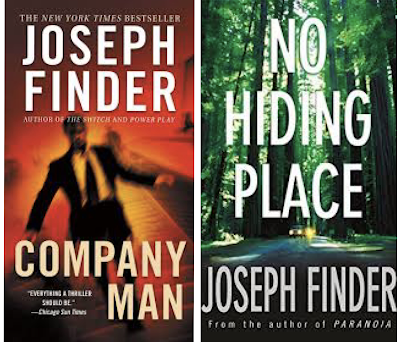
Company Man

Joseph Finder is a Boston-based bestselling author of modern contemporary thrillers. His books sell like hotcakes and are readily available at your local airport newsstand near the $25 neck pillows. My first exposure to his work is his 600-page paperback behemoth from 2005 titled Company Man, also released as No Hiding Place in the U.K.

Our protagonist is Nick Conover, the CEO of a giant office furniture manufacturer whose resistance to outsourcing production to China has resulted in major layoffs at home. The Michigan-based corporation is owned by shadowy venture capitalists from Boston who are looking for a better return on their investment than current conditions will allow. Nick’s also a widower raising two kids on his own.

The novel wastes no time propelling Nick and the reader into a whirlwind of anxiety. Lately, someone has been breaking into his empty, gated community McMansion and spray-painting veiled threats on the walls. Nick assumes the stalker/vandal is yet another disgruntled former employee pissed about a prior or pending round of layoffs. The stalker’s menace escalates with the slaughter of the family dog, and the local cops are being less-than-helpful to the guy responsible for the small-town’s rising unemployment rates.

Identifying the stalker is easy business, but things are more complicated than they seem. A bad decision in dealing with the stalker situation puts Nick in serious peril and legal jeopardy. This escalates into some high-stakes corporate skullduggery with so many plot twists that neither Nick nor the reader knows who to trust. A dogged and likable female police detective is thrown into the mix as a co-protagonist.

The author delivers the narrative in a smooth and readable style similar to John Grisham or Harlan Coben. The chapters are short and punchy with a big typeface and ample space between lines, making 600 pages feel like 400 — less than a modern doorstop paperback but still way too long for the novel’s relevant content. I recognize that big books allow a publisher to overcharge for a paperback, but the novel made me repeatedly mutter, “Get on with it, already.”

Pro-Tip: If you skip or skim all of the sections regarding Nick’s kids and dead wife and eliminate the sections about the female police officer’s family, you’ll cut out a lot of completely extraneous filler and be left with a decent thriller.

There is some good white-collar crime, corporate stuff in this paperback along with a credible police procedural crime story. The ending of the novel has a plot twist that I didn’t find completely believable, and I didn’t fall in love with any of the characters. Overall, I enjoyed Company Man enough to give the book a tepid recommendation. Get the book HERE

Friday, January 21, 2022

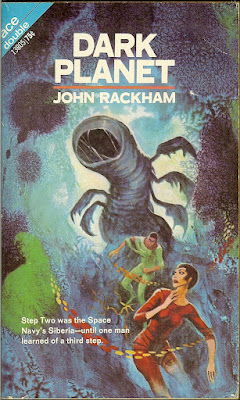
Dark Planet

John Thomas Phillifent (1916-1976) used the pseudonym John Rackham to author a number of science-fiction and fantasy novels. Under his real name he also wrote three novels related to The Man from U.N.C.L.E. Along with 20 stand-alone novels, he also wrote two series titles, Space Puppet (1954-1955) and Chappie Jones (1960-1963). I recently acquired a crate of Ace Doubles that included a few novels under the Rackham name. Looking for adventure in a galaxy far, far away, I chose to read his 1971 novel Dark Planet.

In the future, war has enveloped the entire galaxy. Earth discovered an inhospitable planet deemed Step Two as a stopping point for vessels to re-supply and re-energize. The planet's atmosphere will eat materials like plastic and metal. Due to the acidic air, a specially designed dome was placed over a portion of the planet that functions as a military installation.

The book's protagonist, Query, has upended his military career and now finds himself doing labor as punishment on the planet of Step Two. Being a rebel at heart, Query continues to wander outside of the dome using a special space suit. In the opening pages, Query sees a figure in the distance and realizes the planet is inhabited by some sort of people.

Captain Evans and his daughter Christine arrive in Step Two and find Query. The war has escalated and their team needs an experienced ship mechanic, one of Query's many skills. The three of them fly out of the dome on an adventure to save the galaxy. But, the ship malfunctions and they free fall from 15-miles up, crash landing in Step Two's far-flung, unexplored reaches. Together, they must learn how to survive in an atmosphere that literally eats everything.

Unfortunately, there's not a lot that really happens in Dark Planet. Inevitably, the three find the bizarre people that live on the planet and they must learn from them how to survive and communicate. It's a fish out of water adventure, complete with giant worms and tree people. The hope that Rackham would write a stirring action novel was quickly dissolved by Query's romantic chemistry with one of the inhabiting females. If long conversations about the purpose of our existence is your thing, then this novel may entertain you. If not, turn the light off on Dark Planet.

Thursday, January 20, 2022

The Haunting of Ashburn House

In 2012, author Darcy Coates self-published an e-book horror novella titled Once Returned. This kick-started a self-publishing career that lasted 22 novels. She eventually signed with mystery imprint Poisoned Pen Press, which bought up the rights to all of her self-published work and made her bank account swell. Her novels mostly consist of young characters in their 20s dealing with the supernatural, often in a haunted place. From a sky level view, she is capitalizing on the 1960s and 1970s gothic suspense novels for atmosphere and imagery. But unlike those vintage “women running from houses” books, Coates switches out the romantic angle for a scarier approach. I was curious about her brand of horror after seeing stacks of her novels at my local Barnes & Noble. But, instead of laying down a hard-earned $15, I borrowed a friend's copy of The Haunting of Ashburn House. It was originally self-published in 2016 and now exists in multiple formats through Poisoned Pen Press.

Like a William Ross novel, the book begins with a familiar genre trope. Financially strapped, young Adrienne learns that her mother's grandmother's sister's daughter Edith Ashburn (that's a great aunt for those constructing an org chart) has bequeathed a large Victorian house to her. Adrienne, nicknamed Addy, arrives in a very small town with her cat Wolfgang and $50. Upon entering the little province, she finds a lot of staring eyes. Later, she learns that the house she has inherited is believed to be haunted and many of the town's citizens believed the prior owner was wacko. 

Addy's new home is 10-miles outside of town and nestled in a deep blend of forest and fields. Only the first floor has power and there is no cell coverage (and 20-yr old Addy doesn't own a phone). The upstairs is rather spooky with a lot of rooms and darkened halls due to the lack of electricity. Perhaps the strangest thing is that Edith has carved bizarre messages into the walls like, “Is it Friday, Light the Candle” or “No Mirrors”. Needless to say, strange things begin happening immediately. The power downstairs is shut off numerous times in the night, portraits seemingly come alive, and a new acquaintance is nearly killed. Oh, and zombies. 

If you've watched the cult horror flick Evil Dead 2, then you'll love your 350-page stay in Ashburn House. The wacky scenes of a corpse doing bizarre things reminded me of the unusual movements performed by Sam Raimi's characters. But, it's not designed to be funny. At least I don't think it is. The mystery is compelling with a backstory that kept me motivated to flip the pages. I didn't particularly like Abby and chastised myself for hoping she would be injured or hurt more. Coates makes her too vulnerable and weak when faced with stiff opposition. Sure, she's the hero, and by the book's end, she's a real sweetheart, but her judgment and behavior left me a bit deflated. 

I'll probably try another of Darcy Coates' books in the near future. I'm hoping there is a better result than this one. Haunting of Ashburn House is just below average when it comes to a spooky haunted house novel. But, I would imagine it is appealing to the young adult crowd. As an introduction, this is a training bra in preparation for more visceral horror ahead. It's a catchy cover and title, and God knows there are stacks of her books in the retail shops to pave the way to King, Keene, Malfi, Bates, etc. Cheers to that. 

Get the book HERE