Tuesday, February 15, 2022

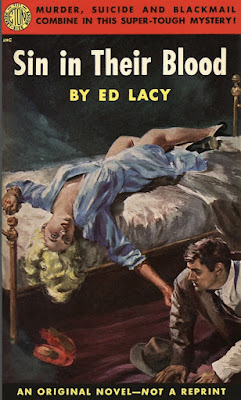
Sin in Their Blood

Sin in Their Blood is a 1952 hardboiled crime paperback by under-appreciated author Ed Lacy (real name: Leonard Zinberg, 1911-1968) that remains available today as a reprint. 

Our narrator is Matt Ranzino. He’s a musclebound former boxer, cop and tough-guy private detective who set his practice aside to fight in the Korean War. While serving overseas, he suffered a head wound that almost killed him and contracted a case of tuberculosis that landed him in a hospital bed for 11 months. He’s now back in his unnamed hometown looking to rebuild his life with no money or job. 

His first stop is to visit his old PI partner, Harry. While Matt was overseas, Harry’s business really took off when Harry discovered the lucrative business of blackmailing businesses into allowing Harry to screen their employees for Commies. Harry offers Matt a job with his new Red-Scare firm, but Matt declines. 

Matt’s time in the hospital left him with a scarred lung that could burst open and kill him if he gets involved with any rough stuff, so he really wants to take it easy and live off his military pension. Because that wouldn’t make for much of a mystery novel, Matt finds himself at a crime scene where he is cajoled into investigating the murder of a dead socialite for a lofty fee of $50 per day. 

Once Matt has the gig, we have a rather typical private eye mystery - albeit with a rather exhausted and fragile hero at the helm. Ed Lacy was at the top of his writing game in 1952 when he authored Sin in Their Blood. The story moves along at a great clip, and the characters are all vividly drawn and interesting. It’s a conventional mystery tale, but it’s also the story of a shattered war hero regaining his confidence after the trauma of combat. 

There’s also a damn fine love story featuring a unique female character among the tough-guy patter and fisticuffs. I’ve enjoyed the romantic elements in other Lacy books, but this one is the tops

Overall, we have a fairly perfect private-eye yarn that deserves to be remembered. I’m happy to do my part by reviewing it. Now go do yours by reading it. 

Buy a copy HERE

Monday, February 14, 2022

Phantom Manor

Author William Edward Daniel Ross (1912-1995) specialized in gothic paperbacks of the 60s and 70s. Using a variety of pseudonyms, the Canadian writer authored over 50 stand-alone gothics as well as an abundance of novels related to the television show Dark Shadows. My experience with the author is the gothic titles written under the pseudonym Marilyn Ross. After enjoying his 1965 novel Fog Island, I decided to read Phantom Manor. It was published just a year later by Paperback Library with the allure of another vulnerable beauty trapped in a mansion shrouded in evil. 

Phantom Manor is set in the late 1800s and stars a Philadelphia woman named Jan. She finds herself financially strapped when her sick father passes away. Her immediate relative is a grandfather living in England, an aggressive man that had an estranged relationship with Jan's mother. Before Jan's mother died, she swore that she would never return to her family's fog-shrouded Phantom Manor. But, Jan wants to know more about her family and sends a letter to her grandfather explaining her father’s recent passing. Her grandfather responds with an urgent invitation for Jan to finally visit her family home.

The family's robust estate is a coastline manor situated on a small peninsula. When the tide rises, the only road leading from the estate to the village is enveloped in seawater. This is an important part of the book's finale and also lends some isolation to the book's narrative. Upon Jan's arrival at the manor, she discovers that her grandfather had died from health complications prior to her visit. She also learns that one of her uncles is now deceased and another has ran off to Australia chasing women and good fortune. He hasn't been heard from in decades and most fear he is now dead. Remaining is the estate's staff, the dead uncle's widow, her disabled son, and a distant cousin that serves as the manager of the manor. With no immediate relatives available, the grandfather named Jan as the sole heiress of Phantom Manor. 

Jan learned that years ago (and recapped in the book's prologue) that her grandfather and a nearby monk order had feuded over land rights. It was rumored that the feud led to the death of a monk named Francis. Supposedly, Phantom Manor's third floor is haunted by the monk's vengeful ghost. Oddly, the estate staff has Jan's lodgings on the third floor. Needless to say, she's immediately attacked by this skeleton specter. Later, she falls to an unseen attacker in the house's wine cellar and is also nearly crushed by a large falling stone outside. After multiple attempts on her life, she begins to align herself with the family attorney. Together, the two suspects that the dashing and handsome distant cousin (the only family member remaining alive) could be the mysterious attacker (you think!?!).

Phantom Manor is rather dull with a bulk of the narrative spent on Jan's relationship with the distant cousin and her new role as the manor's sole heir – learning the staff, new instructions for the staff, fighting with the staff, firing the staff, etc. It's like reading a human resources guide on running a mansion. I didn't find any of it particularly spooky and mostly it was missing the atmospheric touches that made Ross's Fog Island work so well. I did enjoy the crime-mystery aspect of the book's closing finale, but I had already figured it out in the book's opening chapters.  

Overall, there are hundreds and hundreds of these gothic paperbacks. There's no reason to spend any of your precious time reading this. 

Buy a copy of this book HERE

Friday, February 11, 2022

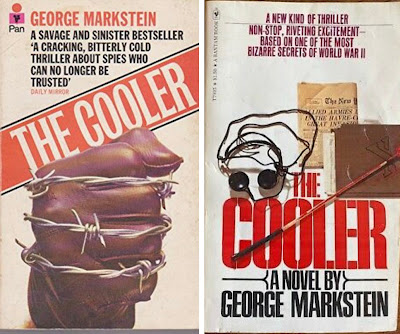
The Cooler

George Markstein (1926-1987) was a Canadian-born British journalist and television writer best known for his work scripting the TV show The Prisoner. He was also an author of espionage thrillers, including his first novel, The Cooler, from 1974.

The Cooler takes place during World War 2 in 1944 England. The British employ an obscure spy agency known as the Inter Services Research Bureau for incursions into Nazi territory - mostly France - for assassinations and sabotage. The novel follows three spies - two Brits and one German. Here are the players:

James Loach is a seasoned spy in London. The day before he is to embark on a dangerous mission behind enemy lines in Nazi-occupied France, he learns that his team, already there, has largely disappeared. The last message that London receives from the team’s radio operator instructs Loach not to join them because of the imminent danger. As such, Loach is sidelined in London awaiting word on the fate of his team, and he gets into some trouble at home. Weird trouble. Kinky trouble. Sending a violent sex maniac like Loach on another mission in France just isn’t an option.

We also meet Claire. She’s a sexy trainee in the secret agent saboteur program learning how to infiltrate, fight and kill Germans with Ninja-like skills. Her training sequences were among the best I’ve read in adventure fiction. The problem is that maybe Claire is just a little too violent and unsuitable for the subtle work of spy tradecraft. Until the agency figures out how to use her, she is also benched. That’s where she meets Loach - in a remote holding facility for wayward spies called The Cooler.

Finally, we meet a German spy named Grau operating in London with false identity papers. His mission in London — I won’t spoil it here — is really, really clever. Any reader of spy fiction will be able to appreciate the ingenuity of the author’s inclusion of this storyline.

Markstein takes his sweet time introducing the principals and putting them in their places before the plot takes shape. That’s the problem. It takes forever for a storyline to develop. For what it’s worth, I was never bored because the characters were all vividly-drawn, seriously-flawed intel officers. But at some point, all these great characters need to actually do something, and that doesn’t happen until the very end.

It turns out there is someone spying for Germany from inside The Cooler, and the book quickly becomes a whodunnit. None of this really worked very well despite some fine writing. The ending felt rushed, and the solution was anticlimactic. I’m not giving up on Markstein as an author, but this debut needed some serious reworking before it was released for public consumption.

Bottom Line: Time is a precious commodity. Don’t bother with this one. 

Buy a copy of this book HERE

Thursday, February 10, 2022

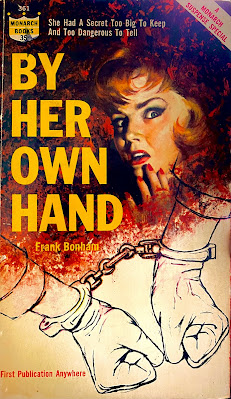
By Her Own Hand

Los Angeles native Frank Bonham (1914-1988) specialized in westerns, young adult fiction, and television scripts. Between 1941 and 1952, Bonham honed his skills by writing for the pulps. He authored only three crime-noir novels, including By Her Own Hand. It was originally released in 1963 by Monarch Books. 

In an undisclosed California city, Captain Chilton is taking over the Plaza Division police station. Before Chilton, the department had spiraled into a rather chaotic, under utilized precinct. This portion of the city reflects the old guard and braces for the new. Caught in the transition are two Vice Squad Sergeants Skip Kawano and Lou Michikowski. Both are feeling the heat as Chilton increases the pressure to clean up the streets.

Like most traditional police precincts, the way to topple the top echelon of crime is through prostitutes. They are the perfect informants and mostly the police lay off their profession in exchange for valuable bits of information on criminal rings. The same thing occurs here as both Kawano and Michikowski utilize prostitutes to gain valuable intel. In turn, other precincts rely on these same prostitute informants to minimize crime waves. But, Chilton doesn't see it that way. 

At 126 pages, Bonham's novel is more like a quick novella. Mostly, the action is around an investigation into a murdered prostitute to determine what information she was withholding. Chilton's department faces intense opposition for arresting the prostitutes and removing them from the streets. Included in the investigation is a side-story that leads into the porno movie business. For a 1963 novel, Bonham doesn't pull any punches in terms of explicit imagery. This side-story involves a gangbang that's recorded in an after hours park. The scenery, time of day, and skill of the photographer allows the investigation to branch off into some unusual places. 

Overall, I really enjoyed this quick read and found it to be slightly ahead of its time. Also, the characters and plot are soaked in realism due to Bonham's involvement in youth gangs and urban violence. He advocated for peace and was often riding along in police cars to learn firsthand the negative influences affecting California's youth. To my knowledge, By Her Own Hand has never been reprinted, but affordable used copies are still available. It's worth your time. 

Buy a copy of this book HERE

Wednesday, February 9, 2022

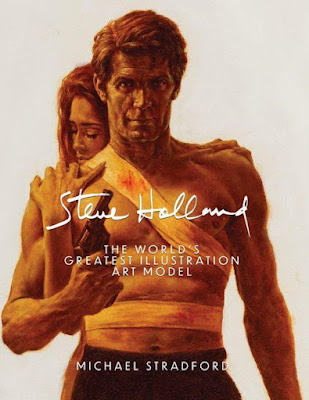
Steve Holland: The World's Greatest Illustration Art Model

On the Paperback Warrior Podcast, and on this very blog, I've often reminisced about my early childhood and my father's love of 20th century paperbacks. I can still remember summer days walking up our creaky staircase, hoping to discover something new or exciting about my humble, and often very quiet, father. In an unfinished guest bedroom, there were leaning stacks of welding manuals and plastic bins of old bolts. There were also stacks of boxes spilling over with western paperbacks. Occasionally, I would read one just to break up the monotony of Stephen King and Dean Koontz, but sifting through the books was the real pleasure for me at that age. Thumbing through the stacks, I began to think the vivid gun-slinging character depicted on the covers was actually the same hero, but was just calling himself Buchanan, Nevada Jim or some other tough-as-nails sounding name to fit the book. It wasn't until many years later that I discovered it was the same hero, only his real name was Steve Holland.

In a new coffee-table book called Steve Holland: The World's Greatest Illustration Art Model, author Michael Stradford reveals that he had a similar experience in the 1960s when he discovered Doc Savage in a Cleveland book store. In this visual and informative book, Stradford delves into the life and career of Holland, the most iconic male model of 20th century literature. My softcover version weighs in at over 200 pages and features hundreds of paperback covers, exclusive photos, and larger than life paintings that honor the man that launched a thousand paperbacks. 

The book's introduction is written by Jason Savas, a friend of mine that inherited Holland's crown in the 1980s. Savas, a former model employed by the esteemed Wilhelmina Model Agency, has been featured on a 1,000 book covers himself. Savas details his experiences in the industry working with Holland, a man he deemed “the consummate pro.” Stradford includes a biography of Savas, featuring a handful of stirring, action-adventure book cover scans as well as the beautiful Steve Assel painting The Iron Marshall (Louis L'Amour) that Savas posed for. 

Stradford's layout is divided into sections dedicated to various eras of Holland's career. For example, numerous pages detailing his paperback career are divided into genres like action, adventure, romance, western, sci-fi, etc. There is a complete section focusing on just the men's adventure magazine paintings, the Doc Savage era, and various advertisements featuring Holland's face or likeness. There is a biography on Holland, and a detailed interview with Holland's daughter Nicole and third wife Jean. Also, author Will Murray's expanded interview with Holland from Starlog is expanded and exclusively included. Murray has been the primary contributor to the Doc Savage series for decades. 

I really enjoyed artists Bob Larkin (Conan, Iron Fist, Hulk) and Bob Caras (The Avenger) discussing their experiences painting Holland. There are so many amazing artists and photographers interviewed for the book, including Alex Ross, Frank Reilly, Joe DeVito, Robert Osonitsch, and Jack Faragasso. It was personally rewarding to learn how humble and kind Holland was as described by his peers, friends and family. I never needed validity, but the real life Holland seemed to parallel the admirable, heroic characters he became on canvas.

Steve Hollad: The World's Greatest Illustration Art Model is absolutely a mandatory reference for anyone fascinated by 20th century paperbacks, magazines and male-oriented advertisements. I was enthralled for days just researching the paperbacks and building my shopping list based on these incredibly vivid covers. More than 20 years after his death, Holland's face is still selling publications. That is a testament to his phenomenal physique, likable face and ability to provide the perfect likeness for all of these amazing visuals. Stradford has honored Holland in such a beautiful way and I can't thank him enough for his labors in creating it. 

Get the book HERE

Tuesday, February 8, 2022

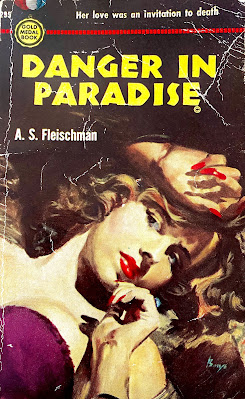
Danger in Paradise

Stark House Press continues to reprint the literary work of A.S. Fleischman. The talented Navy veteran, magician, and author began writing genre paperbacks in 1948, a career that led into his more prominent role as a children's storyteller. Among his westerns, movie novelizations, and crime-fiction, the genre that most feel was Fleischman's strong suit was exotic adventure. Novels like Shanghai Flame, Counterspy Express, Malay Woman, and Blood Alley are set in and around Asian locations. In 2018, Stark House reprinted Fleischman's Malay Woman and Danger in Paradise as a two-in-one with an introduction by David Laurence Wilson. Having read, reviewed, and enjoyed Malay Woman, I was excited to read 1953's Danger in Paradise to experience more of the author's thrilling exotic adventures.

Jefferson Cape is a Montana native that works as an international geologist in the Far East. After a long voyage across the Java Sea with a crazy Australian captain, Cape is happy for a day stop in Buleleng, Indonesia. The temperature is red hot, the beer is hotter, and the mosquitoes are like a thick drapery of disease and despair. But, Cape is on dry land, at a bar, enjoying these tiny moments when a beautiful woman approaches him for an unusual request.

The woman explains that she has a very tiny package that she needs to export out of Buleleng. It's a business card with Russian wording on the back. She explains that this has to do with terrorists in the country and arms trading. She wants him to carry it back to the states and deliver it to the CIA. Unfortunately Cape agrees and his entire world comes crashing down. The woman seemingly disappears and Cape finds himself stranded and on the run from a Chinese gunman, a powerful businessman, and terrorists as his ship sails away. His only ally is a sexy, mysterious woman, but she somehow knows the lady from the bar and is connected to this whole deadly fiasco. 

Danger in Paradise wasn't as entertaining as I had hoped. I felt that Fleischman had too many ideas and couldn't really flesh them out in a uniform way. In fact, in the first couple of pages, Cape looks at the woman in the bar and says, “Okay, I'll bite.” I felt like this was Fleischman after writing a couple of the early pages for a plot he hadn't quite constructed yet. He's reminding himself that he has this American man in a bar meeting a mysterious woman. Where can he take this rudimentary idea? Unfortunately, he takes it too far.

At 160 pages, the narrative is saturated in chase sequences that left me bewildered about which characters were after each other. I wanted the story to be explained quickly so I could enjoy the twists and turns, but once it was unveiled, I needed some story elements concealed to keep it interesting. Gunrunning, terrorists, exotic locales and shady ladies should be an easy story to tell. But, Danger in Paradise drowns in the details and becomes a convoluted chore. Of course, Fleischman can write his tail off, but the end result left me exhausted. Get the book HERE.

Monday, February 7, 2022

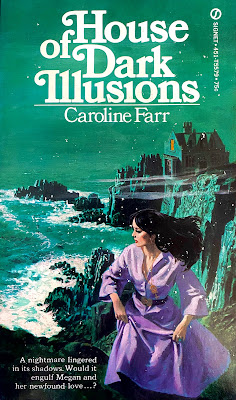
House of Dark Illusions

There are over 30 gothic novels authored by Caroline Farr between the mid-1960s and 1970s. Most of these books were originally published in Australia by Horwitz Publications and then reprinted in the US by Signet with vivid, traditional painted covers of beautiful women fleeing from gloomy mansions and castles. Depending on who you ask, the Caroline Farr name is a pseudonym for a revolving door of authors. The most consistent author associated with the Farr name is Richard Wilkes-Hunter, a New South Wales native that also authored books under pseudonyms like Alex Crane and Tod Conrad. 

Another name associated with the Caroline Farr novels is that of Allan Geoffrey Yates, the popular author that became a household name by writing crime-fiction as Carter Brown. My sources close to the Yates estate confirm that he did author some Farr novels, but the titles are unknown. There is also another Australian author closely associated with the Farr name, Lee Pattinson. According to papers held by the National Library of Australia, Pattinson was employed as a writer with Horwitz and authored romance novels under names like Teri Lester, Noni Arden, Kerry Mitchell, and Caroline Farr. 

The conclusion is that Caroline Farr was a house name used by at least three different authors that were published by Horwitz. Most recently, I gained a couple of these Signet reprints of Farr novels and I decided to try one out – House of Dark Illusions. It was originally published in 1973 and begins with a familiar gothic genre trope, a young woman learning of her inheritance. 

In the opening pages of House of Dark Illusions, young Megan has just experienced the loss of her father. She's a student at Boston College and lives in an apartment on Boston's North Shore. With her father's death, Megan fears she won't have enough financial support to remain in college. Thankfully, Megan receives a letter from her Aunt Lissi with a tantalizing offer. Lissi invites Megan to the family's coastal mansion in Nova Scotia, Canada. 

In the backstory, readers learn that Megan's mother is a descendant from a wealthy Canadian family. Unfortunately, she died when Megan was very young. The family never liked Megan's father so he left the family behind and raised Megan as a struggling single father in Boston. Megan debates returning to her childhood home, but feels that enough time has passed and it's important that she visit the only remaining family left, Aunt Lissie.

When Megan arrives at the spacious shoreline estate, she learns that her mother possessed telekinetic powers – the ability to move inanimate objects with her mind. Lissie feels that Megan has the same talents as well, but needs help discovering them. Lissie insists on having a séance so that Megan can harness her own hidden energy and possibly connect psychically with her dead mother. Additionally, the séance will include two distant cousins, a medium, and two doctors. But, when the séance begins, Megan begins seeing visions of an Indian prince being murdered in a palace. How does any of this connect to the story? 

At 140 pages of large font, House of Dark Illusions reads more like a short story. There isn't really enough time to delve too far into these characters to properly introduce them. I felt the narrative was missing huge chunks of importance or simply shortened to meet a publishing deadline. The entire story does play out, including answers to Megan's questions about her family and inheritance, but it feels like a rushed job. The book's finale left something to be desired, but possessed a fitting conclusion to the average plot. Whoever crafted the book used foggy roads, the misty coastline, and the cavernous house as atmospheric plot enhancers, but even the spook factor wasn't enough to save the book. I'd recommend passing on this unless you really love the artwork of these old books and must possess everything. Otherwise, just move on to much better books.