Friday, April 1, 2022

The Many

The Many (2016) is the first book in a trilogy of psychological horror thrillers by American author Nathan Field. I sampled the first chapter on my Kindle and was sufficiently creeped out to continue reading.

The novel begins with a blind date in Portland, Oregon, where Stacey quickly becomes charmed by a British doctor named Adam, whom she originally met on a dating app. The wine and dinner portion of the date went swimmingly well, but things get seriously weird in the car ride back to Adam’s place to consummate the good night.

The third-person perspective changes to Karl Morgan. He’s Stacey’s brother and he is super-concerned about Stacey’s well-being. Karl is flopping on his sister’s couch, and Stacey has been acting seriously weird since her date with the doctor. The change in Stacey’s behavior triggers Karl to leave Stacy’s place and set off on his own. Maybe some time apart will be good for the siblings.

When Karl reconnects with his sister, her weirdness and creepy behavior only increases. The central mystery of the novel’s first act: “What the hell is going on with Stacy?” No one spoiled the book for me, so I was wavering between demonic possession and an alien body-snatching. There were some legit terrifying scenes depicting Stacey’s descent into weirdness or madness or however you want to characterize her changes. Fans of horror fiction will be super-pleased. Leave it at that.

The initial solution to the mystery is revealed halfway through the novel, and the book then slides into straight-up thriller territory. Two characters pair up to solve the mystery, and their relationship follows the beats of a young adult novel. A late-novel plot twist turns everything you’ve read on its head, making the reader want to know more about the conspiracy of The Many promised in the title.

Beyond that, there’s not much I can say about the plot that won’t spoil the fun for you. My only complaint is that the paperback is part one in a trilogy, and not much is resolved in The Many. To the publisher’s credit, all three installments have been released in one 900-page volume, which I’ll need to tackle one day to find out what the Hell happens.

Bottom line, The Many - at least the first installment - is inventive, periodically terrifying, and often hard to put down. It’s a puzzle-box mystery with an intriguing solution that kept the pages turning. If this sounds like your kind of thing, it probably is. You won’t be disappointed. 

Get the ebook HERE.

Thursday, March 31, 2022

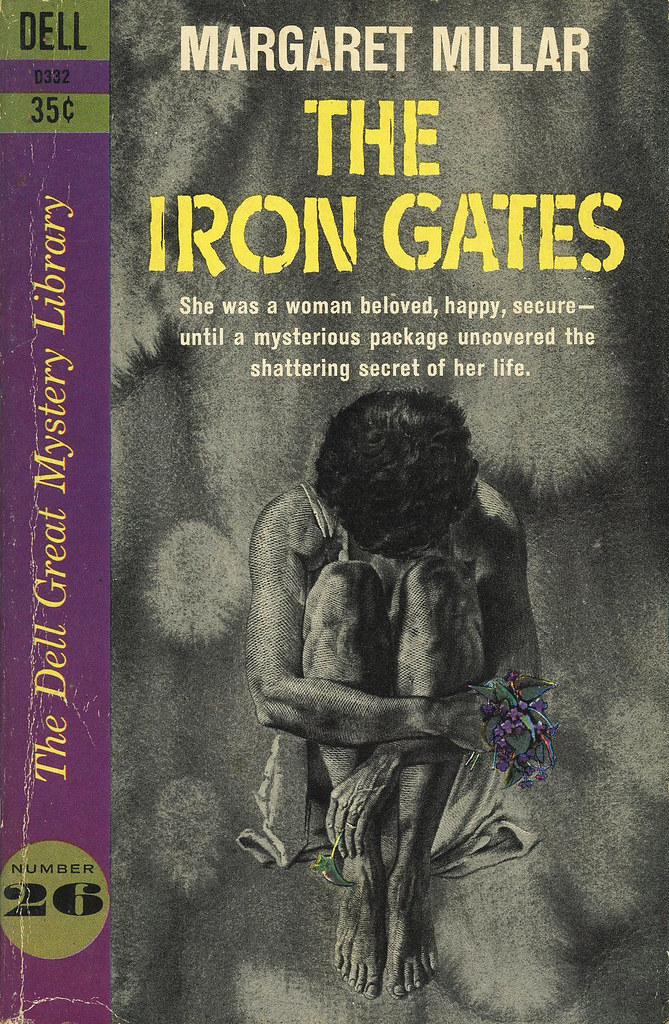
Inspector Sands #02 - The Iron Gates

Along with her contemporaries like Dorothy B. Hughes, Charlotte Armstrong, Dolores Hitchens and Helen Nielsen, California native Margaret Millar helped solidify the presence of talented female mystery authors in the 1940s and 1950s. She wrote over 25 original novels, mostly as stand-alone works. However, her first three novels starred a Canadian sleuth named Dr. Paul Prye and she repeated that creation with another Canadian detective, Inspector Sands. 

The Toronto homicide detective starred in Wall of Eyes (1943) and The Iron Gates (1945), as well as a short story called "The Neighbors Next Door" in a 1954 issue of Ellery Queen Mystery Magazine. I chose to read the latter novel based on an article by Curtis Evans (via Stark House Press) praising the book. It has been reprinted multiple times in hardcover, paperback, and most recently as an audio book. It was also printed in the U.K. as Taste of Fears.

In The Iron Gates, Millar's prose is pure psychological suspense. In the book's opening chapters, Lucille Morrow is mourning the unusual death of her friend Mildred. These scenes are beautifully written and drape the imagery in a white pane of frosted glass reflecting Lucille's loss and mental anguish. It's a hazy precursor to what eventually occurs later in the book as a historical flashback or retelling. 

Later, readers learn that Lucille is now married to a retired physician named Andrew, Mildred's previous husband. She is the stepmother of his two adult, but childish, kids and the in-law to his worrisome sister, all of which reside in the same house. Due to the death of Mildred, and Andrew's replacement of her with Lucille, there are strict dividing lines in the household based on suspicions and shifting judgments. These alliances and strategic family placements play into the novel's central themes of jealousy and lust.

Inspector Sands becomes involved in the narrative when Lucille goes missing. There's early discussion between characters about a nearby park where a grisly murder took place. There's a cautionary tale told about a wandering ax-man preying on park guests. The idea that Lucille is missing, the nearby murder, Mildred's prior death and this strange ax-man all play into the mystery. Sands doesn't know what to believe and finds the family obtuse about Lucille's whereabouts. Only Andrew seems genuinely concerned about her well-being, opening up a string of guesses on which family member committed murder.

The book takes an interesting twist for the second half. Without spoiling the plot development, a major character ends up in a mental asylum behind “iron gates”. Her reason for being there is cloudy, leaving Sands and a detective to investigate the events surrounding her confinement in the asylum. Most of the book's second half does take place in the asylum as the character interacts with other mental patients and the hospital's staff. I enjoyed these parts of the story, but felt it was a little distracting at times. The behavior of the patients and their involvement in the main character's psyche definitely contributes to the story's development, but it's a marathon. 

As a psychological suspense novel, Millar conveys a lot of emotion in her writing. I enjoy the shading she provides as she draws out each character for the reader to suspect. As I learn more and more about female mystery authors of the 20th century, my research always leads to Millar. She was a a real talent and sadly isn't as relevant now. Her work is mostly forgotten aside from a few reprint houses still preserving her novels. Her spouse, Ross MacDonald, the creator of the California detective Archer, is in more abundance, but honestly Millar may have been the one to read all along. 

The Iron Gates was optioned for film to Warner Brothers and allegedly Millar wrote the screenplay. It was to star either Bette Davis or Barbara Stanwyck, but the film never came to fruition. This novel remains rather timeless and would make for a great modern film with it's real world complexity. My vote is for director David Bruckner (The Night House, The Ritual). Anyone have his number? 

Buy a copy of this book HERE

Wednesday, March 30, 2022

Old Man's War

Old Man’s War by California author John Scalzi is one of those books that often appears on lists of the "Greatest Science-Fiction Books of All Time." The novel was first published as a serial and released as a book in 2005. The novel was nominated for a Hugo Award and inspired multiple sequels.

Here’s the set-up:

It’s about 200+ years in the future, and Earth is engaged in a forever war with several alien races in colonized interstellar space. However, Earth’s military doesn’t want strong, young soldiers. Instead, they want senior citizens for reasons the novel will make clear to you when you read it. If a volunteer oldster serves in combat for two years and survives, the senior is awarded a sizable plot of land on one of the many colonized planets. They also get some life-extending medical procedures, so they don’t keel over on the battlefield. Extending life in exchange for dangerous combat is a good deal for the elderly looking into the Great Beyond.

Enter John Perry, our narrator. He is a 75 year old widow living in Ohio that is now joining the military. The idea of extending his life and leaving Earth behind forever seems like a good idea. The catch is that you can never return, nor can you have any contact with the people you leave behind. As a result, information about combat as part of the Colonial Defense Force is spotty. You need to sign on in a leap of faith to learn the whole scoop.

The geopolitics of Earth’s space colonies are pretty fascinating and also best left explained in the novel. Same for the inventive physics devised by the author to catapult senior citizens into the far reaches of space. I also wasn’t expecting how funny the book would be. The narrative voice of John Perry reminded me of Andy Weir’s novels The Martian and Hail Mary. It’s the kind of science-fiction that doesn’t ask too much of the reader as the world-building is so smooth and effortless to read.

The Colonial Defense Force has many of the hallmarks of our own military culture with intensive training by intense drill sergeants. It’s only when the oldster soldiers are briefed on their mission and the enemies they will be encountering that it becomes clear that this isn’t going to be a walk in the park. By the time you actually get to combat battles, you’re in for a real treat (think of the film Starship Troopers).

The many battle scenes will please action-adventure paperback fans, and this is a perfect novel for people curious about science-fiction who don’t know where to begin. Overall, Old Man’s War is an absolute winner and I look forward to exploring the sequels. 

Get the book HERE.

Tuesday, March 29, 2022

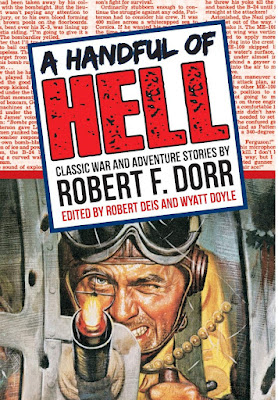
A Handful of Hell: Classic War and Adventure Stories by Robert F. Dorr

Back in 2016, Robert Deis and Wyatt Doyle teamed up for a book titled A Handful of Hell: Classic War and Adventure Stories by Robert F. Dorr. It is part of the duo's The Men's Adventure Library, published by New Texture. We've covered a number of these volumes, including I Watched Them Eat Me Alive, Barbarians on Bikes, and Cuba: Sugar, Sex, and Slaughter. Deis remains active with this project as well as his Men's Adventure Quarterly publication co-edited by Bill Cunningham. 

In A Handful of Hell's opening pages, Deis explains that he had received an email message from Dorr in November, 2009 concerning the recently-launched MensPulpMags.com blog. Dorr had explained, with exclamation, that he wrote hundreds of articles for the men's pulp adventure magazines and wasn't aware that there was still a large fan base for those vintage publications. Deis was aware of Dorr's work and the two struck up a friendship which led to the creation of this book.

The book includes a 20 page chapter written by Dorr titled “My Plan Was To Be a Writer and an Adventurer...” Dorr writes that he had two main interests since childhood, the Air Force and writing. His first paid publication was in Air Force Magazine's November, 1955 issue. Although he couldn't be an Air Force pilot due to a hearing impairment, Dorr still served in the military in a very unique role. He enrolled in Army Language School and studied the Korean language for 20 months. He was then sent to Korea to listen to North Korean radio communications between 1958-1960. 

After his military stint, Dorr actively pursued writing and sold “The Night Intruders” to Real for their April, 1962 publication. He states in the book that this was the first of what became several hundred men's pulp adventure stories. Thankfully, Deis and Doyle include the story in this volume. In fact, the duo collected 17 stories (by my count) that are written by Dorr and culled from vintage magazines like Stag, Man's, Bluebook, Male, Real, and Man's Illustrated. Handful of Hell also includes color scans of the magazine covers and interior artwork that accompanied these original stories. That in itself makes the book wildly entertaining, but I'm a reader and here are a few short reviews of included stories.

“5 Downed GIs Who Gutted Ambush Alley”

This story was featured in the June, 1967 issue of Men. The setting is South Vietnam's Ia Drang Valley, a hotbed of violence controlled by The People's Army of North Vietnam. San Diego native Sid Reeder and his crew plunge into the valley when their chopper is shot down. As the helicopter lies upside down, the soldiers inside formulate a plan. The enemy forces are descending from the hillside to destroy what's left of the downed chopper. They have to choose whether they want to call in support and risk another chopper being shot down or just call in the coordinates and go on killin' and dyin'. When Reeder thinks about the helicopter's two ground-to-air rockets, he comes up with a new plan. I loved the story and the frantic pace in which it is told. Dorr showcases a distinct understanding of helicopter aviation and protocols and is able to transport that to the printed page in a way that isn't technically jarring for the reader. This was such a great story.

“The POW General Who Tried to Kill Himself”

In the November, 1965 issue of Man's, Dorr tells this real-life account of U.S. Major General William F. Dean's harrowing ordeal as a prisoner-of-war in North Korea. Dorr explains to readers that Dean was on the run through the Korean countryside after narrowly escaping incoming enemy forces. Separated from his men, Dean's journey took him through jungles, fields, and villages desperately searching for food and medial supplies. Eventually, he's betrayed by a Korean and turned over to the North Korean People's Army. After months of starvation, dehydration, and lack of medical treatment, Dean reached the point of physical torture. After endless rounds of interrogation, for weeks and weeks, Dean is instructed that he will be tortured to gain information about American forces, locations, and strategies. Dean knows that he has reached a tipping point where he may divulge information under the harsh treatment. His only rescue is suicide. Honestly, this is really a tough story to read considering the levels of violence and torture. However, Dean's real life account is vividly told by Dorr as a tribute to his perseverance, patriotism, and internal fortitude. Dean is an American hero and I love that Dorr had the courage to write this. It's a true testament to human endurance and honor. Note - For more information, read Dean's autobiography titled General Dean’s Story.

“The Impossible Raid”

Stag, January 1966 featured this WW2 aviation story about a solo run by a lone B-17 bomber piloted by Captain Barry Helm. His mission is to utilize thick fog to make a daring bombing run on a German base. By targeting a large fuel supply, the bombing can create maximum damage to the Germans. But, in order to execute this nearly impossible assignment, the bomber must enter the airspace at tree level. This avoids field-swept radar that picks up higher elevation aircraft. Combining the low entry level with the thick fog makes it a valiant opportunity to strike a major blow to the German offense. This is just a classic, simple aviation tale that utilizes Dorr's descriptive storytelling. I liked the story's presentation from both the American forces as well as the Germans. In a short story, the narrative's presentation of events in the air and on the ground was just so epic and compelling.

You can buy this book and other collections HERE. Don't forget to check out Men's Adventure Quarterly for even more fantastic vintage stories and artwork.

Monday, March 28, 2022

Reprisal

Arthur Gordon (1913-2002) was a Yale graduate and Rhodes scholar that fought in WW2 and later became an editor for slick magazines like Good Housekeeping, Cosmopolitan, and Guidepost. His family has a rich lineage in Georgia. His aunt created the Girl Scouts organization and his great-grandfather started the Central of Georgia Railroad. His literary work includes the military-fiction novel Target Germany, A Song Called Hope, and an acclaimed biography about Norman Vincent Peale. 

My focus is on his only crime-fiction novel, Reprisal. It was originally published in 1950 as a hardcover by Simon & Schuster. Its success warranted a second printing by the publisher. In 1951, the novel was published in paperback by Pocket Book (#801) with a cover by Harvey Kidder (he painted the cover of another book we reviewed HERE).

The book's synopsis, printed on the back cover, peaked my interest. It says:

My name is Nathan Hamilton. I am black. My wife has been lynched! God knows what they did to her before they tied her to a tree and riddled her body with bullets. The killers were tried by jury. They were acquitted. Every white man in Hainesville knows that these men are guilty. But the town wants to forget. I can't forget. They lynched my wife because they know they could get away with it! They were sure nothing would happen! But something can happen. Something will happen! I'm starting for Hainesville tonight. There's a loaded gun in my valise with a bullet in it for each man who had a hand in the murder of my wife!

The book begins in a courtroom as the judge and counsel tensely await a jury's verdict. Three white men are on trial for the heinous murder of four African-Americans in the small, southern town of Hainesville. When the jury reconvenes, they find the men not guilty despite evidence that proves otherwise. The judge provides a verbal scolding to the courtroom and cautions the jury that he's ashamed of the justice system and the events that have unfolded to allow the men to walk free.

Gordon then begins introducing various characters and side stories that ultimately make up Hainesville. The main character is Melady, a brave reporter from the North that's covering the trial and its aftermath. He attempts to remain somewhat neutral early on, but by the book's end, he becomes heavily involved. Unity is another star, a receptionist who is involved in a relationship with a very bad man named Shep. Perhaps the most influential character is Yancy, an admirable African-American undertaker that tries to be the peacekeeper in the black section of town. Threading the characters is Nathan, a black man now living in New York after his wife was raped and murdered in Hainesville. Once he learns of the trial's outcome, he travels south with a gun.

There is way too much to unpack in one simple blog review. Reprisal is nearly 300-pages and has a character list that seemed a mile long. It's a lot to keep up with, almost like watching an entire season of Game of Thrones while running an org chart. There are affairs, attacks, backwoods justice, romantic relationships forming and ending, scandals, jobs, families, news-hounds, and so forth. It's daunting at times, but the investment is worth it. All of the stories tie together to present a turbulent era in the deep South. 

Surprisingly, Reprisal isn't as well known as Harper Lee's To Kill a Mocking Bird, predating it by 10 years. That could be due to the length, the complexity of the characters, or the amount of sheer violence that Reprisal possesses. The central theme is revenge, similar to a dusty western tale as the protagonist hunts the killers. There are no real heroes, only misfortune and death told in a doom 'n gloom style by Gordon. Shockingly, I found passages that I re-read numerous times due to their similarities to what we still experience today. Reprisal is a prophetic, iron-fist look at the heart-wrenching extremes humans seek to hurt one another. While never preachy or condescending, Gordon presents a fictional account of real-world violence, then and now, that leaves a distinct mark on the reader. It's a powerful novel.

Reprisal was adapted to film in 1956, but unfortunately it was poorly devised. The setting changed to the 1800s and the entire narrative was modified into a western revenge tale. Sadly, Reprisal has never been reprinted.

Note - The hardback version of the book shows the main character as a white man. It is evident that the cover is depicting Nathan as he is retrieving the pistol from his valise. I assume it was too controversial to put a black man with a gun on the hardcover? 

Buy a copy of this book HERE

Friday, March 25, 2022

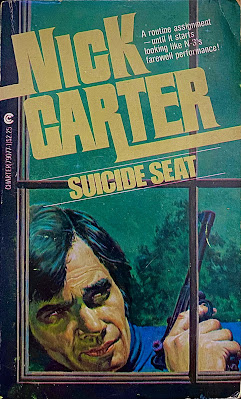
Paperback Warrior Primer - Nick Carter: Killmaster

The character of Nick Carter (or Nicholas Carter) was created by Ormond G. Smith and John R. Coryell in 1886. Smith was heir to the New York City publisher Street & Smith, the early catalyst for dime novels and pulp fiction as far back as 1855. Smith wanted a private-eye or detective character similar to Old Sleuth or Old Cap Collier to star in various forms of media. The first Nick Carter literary appearance began in New York Weekly, September 18, 1886, in a story called "The Old Detective's Pupil" or "The Mysterious Crime of Madison Square." The serial ran 13 total installments with the setting mostly being Victorian-Edwardian New York.  

Carter is described as 5' 4" and having bronze-skin, gray eyes, dark hair and a square jaw. The character was trained by his father, Old Sim Carter, to fight criminals, essentially becoming the opponent of global evil. He's a genius that is inhumanly strong and a master of disguise. The character was so popular with readers that Street & Smith created the Nick Carter Weekly dime novel series. These stories would later be reprinted as stand-alone titles under New Magnet Library. 

With its premier issue on October 15, 1915, the Nick Carter Weekly publication transitioned into Street & Smith's new Detective Story Magazine (just 10-cents twice a month!). The magazine ran 1,057 total issues, most of which concentrated on short crime-fiction with appearances from pulp heroes like The Shadow. The magazine's first 20 years featured covers by illustrator John A. Coughlin. In 1935, the magazine began suffering financial stress and officially stopped publishing in 1949.
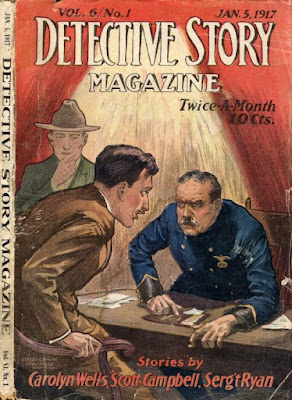
Between 1924 and 1927, Street & Smith attempted a revival of the Nick Carter character in the pages of Detective Story Magazine. These stories also featured many of the same villains that Carter had faced in the prior Nick Carter Weekly publication (Dazaar the Arch-Fiend, Dr. Quartz, etc.). It seemed as if Carter's appearance in literature was over in 1927, but due to the success of The Shadow and Doc Savage, Street & Smith revived the character again. Between 1933 to 1936, the Nick Carter Detective Magazine was published. These stories introduced Carter as a more traditional hard-boiled detective. 

Beyond the page, two Nick Carter shows were featured on radio. Nick Carter, Master Detective radio show aired on Mutual Broadcasting System from 1943 to 1955. Nick Carter's son was the star of Chick Carter, Boy Detective from 1943 to 1945, followed by a film in 1946 under the title Chick Carter, Detective.

In 1908, the French film company Eclair ran a six-episode series starring Pierre Bressol as Nick Carter. Two French films were released, Nick Carter va tout casser (1964) and Nick Carter et le trefle rouge (1965). In Germany, four silent Nick Carter films were released: The Hotel in Chicago (1920), The Passenger in the Straitjacket (1922), Women Who Commit Adultry (1922), and Only One Night (1922). In the US, MGM released a trilogy of Nick Carter films: Nick Carter, Master Detective (1939), Phantom Riders (1940), and Sky Murder (1940). A television show called The Adventure of Nick Carter filmed one pilot, later released as an ABC movie.

The pulp version of Nick Carter continued in comic book form, with appearances in The Shadow, Army & Navy, and Doc Savage comics from 1940 through 1949. There was also a 1972 Italian comic strip and a Nick Carter comic book series from 1975. It lasted 12 issues and stars a character named Nick Carter that is a British soldier in WW2. However, it is not related to the Nick Carter spy series.

Little did fans know that a British secret-agent named James Bond would play a part in reviving the literary character 37 years later.

In the 1960s, Lyle Kenyon Engel began his plunge into paperback publishing. He was heir to his father's magazine publishing company, but sold that to become a publicity agent (supposedly one of his clients was the Today Show) and also a producer of children's records. To make an impact in publishing, he revived the familiar character of Nick Carter to capitalize on the 1960s spy fiction market. 

Nick Carter: Killmaster debuted in 1964 as a marketing attempt to cash-in on Ian Fleming's James Bond. The character was reinvented as a secret agent instead of a detective or private-eye. These novels were to be international adventures with a more robust approach compared to the serials, pulps and dime detective magazines. Basically, everything prior to 1964 was erased and this series was a complete reboot.

The general theme is that Nick Carter is an American secret-agent or spy working for an organization called Axe. The organization's leader is David Hawk. Axe and Hawk work closely with the American government and Hawk answers to "The Chief", presumably the U.S. President. Carter is referred to as N3 and we know there are other agents like him, also known as an N/number combination. In the first book, Run Spy Run, readers learn that Carter served in WW2 and also worked for OSS, the pre-cursor to what is now known as the CIA (like Matt Helm). Read our review of the book HERE.

One of the predominant characteristics of this version of Nick Carter is the three weapons he uses in the field. In the debut novel, it is explained that Carter took a Luger handgun from a German SS officer he killed in Munich during WW2. Carter named the gun Wilhelmina and it's included in nearly every novel. Hugo is the name for his Italian stiletto. He also carries a marble sized gas pellet that goes by the name Pierre. Carter can twist each half of the marble in separate directions and it will release a deadly toxin within 30-seconds, giving Carter enough time to flee the area. 

The Nick Carter: Killmaster series became immensely successful, running from 1964-1990 and offering 261 total novels. Each book on average sold 115,000 copies. Ironically, the series just lists Nick Carter as the author. The real authors aren't credited on the book's copyright page, a painful trademark of the series that frustrates readers, fans and collectors to no end. Engel typically split 50-50 with the authors he hired. He demanded lightning fast work, sometimes novels written in less than three weeks to meet furious deadlines. These books were released monthly, first by Avon and then later by Charter.

Notable author statistics:

- Valerie Moolman authored or co-wrote 11 novels between 1964 and 1967.

- Michael Avalone authored or co-authored 3 novels in 1964

-Manning Lee Stokes, of Richard Blade fame, wrote 18 novels

-Popular crime-fiction author Lionel White authored one Nick Carter book, the 18th installment from 1966. This was his second foray into spy fiction. He also wrote a stand-alone novel called Spykill under the name L.B. Blanco.

- Jon Messmann wrote 15 installments. Messman was a heavy contributor to action-adventure paperbacks. He was behind the popular adult western series The Trailsman along with the short-lived series titles Handyman: Jefferson Boone and The Revenger.

- George Snyder did 8 installments. He also wrote novels for the Grant Fowler series.

- Ralph Hayes authored 8 volumes in the series. He is known for his John Yard: Hunter series and Check Force among others.

- Martin Cruz Smith wrote 3 installments. Smith is primarily known for his Arkady Renko series that is still current to this day. The 1983 film Gorky Park was an adaptation of that series debut.

- Surprisingly, Chet Cunningham only wrote 1 book, # 72 Night of the Avenger, that was co-authored with Dan Streib

- Dennis Lynds authored 9 and his wife at the time, Gayle Lynds, wrote another 4. I've read one of Dennis Lynds' novels and I really enjoyed it. It was #211 Mercenary Mountain and it is reviewed HERE. Many will know Dennis Lynds as American author Michael Collins. He wrote the popular Dan Fortune series before his death in 2005.

- Saul Wernick wrote 5. Many remember him as writing the first Mack Bolan novel after Don Pendleton sold the series to Gold Eagle. 

- David Hagbert authored 25 books. He is primarily known for his CIA series starring Kirk McGarvey

- Death Merchant creator Joseph Rosenberger wrote 1.

- Jack Canon is the heaviest contributor with over 30 installments. I lost count, but I think it was 35. Not to be confused with Nelson Demille pseudonym Jack Cannon. 

- Robert Randisi authored 6 in the series. He's a respected western writer who also wrote 3 Destroyer books as well.

- Joseph Gilmore wrote 8.

- There are numerous authors that authored three or less that I haven't mentioned, but you can find a detailed list on spysandgals.com or Wikipedia.

- There is yet another Nick Carter series that ran from 2011-2019 called Project. It's written by Alex Lukeman and again features a starring character named Nick Carter that is an anti-terrorist sort of hero. Again, not related to the Nick Carter spy series.

Lyle Kenyon Engel would go on to create Book Creations in the 1970s. Ultimately, it was a cash cow and a rather unique company. Engel would create a series, imagine the story, hire authors to write it and even create book cover art. Then he sold these to various publishers. He was the paperback king and died a multi-millionaire in 1986. 

You can listen to the Paperback Warrior Podcast episode dedicated to Nick Carter HERE and the episode spotlighting Lyle Kenyon Engel HERE.

Thursday, March 24, 2022

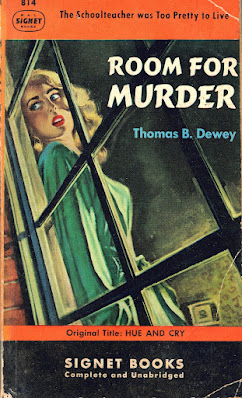
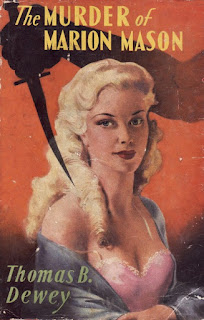
Singer Batts #01 - Hue and Cry (aka Room for Murder/The Murder of Marion Mason)

Thomas B. Dewey originally worked in Hollywood at a correspondence school called Storycraft. In 1942, he moved to Washington, D.C. to be an editorial assistant for the U.S. State Department during WW2. As a side hustle, Dewey began writing paperback original novels. Along with stand-alone titles, Dewey created three series titles – Mac, Pete Schoefield, and Singer Batts. In fact, his very first novel introduced the character of Singer Batts, a hotel owner in a small Ohio town that solves mysteries. It was called Hue and Cry in the U.S. and The Murder of Marion Mason in the U.K. Later, it was reprinted under the title Room for Murder. The book now exists in a bundle through Wildside Press with the other three series installments. 

Dewey uses Rex Stout's strategy, and authors before him, to create a narrator that tells the tale of the formidable hero. Like Archie Goodwin's narration in Stout's Nero Wolfe detective series, Dewey uses a  character named Joe Spinder to narrate the story starring Singer Batts. The setup is quite simple: 

Batts is a thirty-something scholarly fellow that has recently inherited the Hotel Preston from his late father Emory. The hotel is in the sleepy mid-western town of Preston, Ohio. The town's goofy marshal is Pete Haley, a friend of the hotel's staff. Batts resides at the hotel and leaves all of the heavy lifting to the hotel's manager and story narrator, Joe Spinder. The staff includes capable night clerk Jack Pritchard, sleepy day clerk Old Harry Baird, and janitorial laborer Nancy Wheeler. 

Before all of the murdering, sleuthing, and solving, Spinder describes Batts in the opening pages: “Never wait for Singer Batts to ask a personal question. He doesn't operate that way. You live your life, he'll live his. It's only when there's something he thinks he's got a right to know that he'll ask questions. Then he'll ask plenty. Questions to drive you crazy.”

The book begins with two drunk young men being wrangled into the hotel by Pete. These are good 'ole boys that tipped a few too many bottles and Pete doesn't want to lock them up and ruin their family's good graces. Instead, he wakes up Joe and Batts and works out an arrangement for the boys to sleep it off in the hotel. The night gives way to the day and Joe leaves for errands in town. When he returns, there is a mob of people outside of the hotel and a corpse inside. A young woman named Marion Mason has been stabbed to death in her room.

Batts has the armchair detective tendencies, but isn't intimidated enough to just stay seated. When three lawmen from the state arrive, including the District Attorney, Joe goes into overdrive explaining the prior night's activities, the short list of guests, and that Marion Mason is new in town and a school teacher. But, Dewey paints the lawmen and the D.A. as the bad guys. They point fingers at Joe and things escalate into a physical brawl. The author doesn't beat around the bush and places a deadline on the novel: 24-hours to find the real killer or Joe is taking the fall. 

Joe mentions other cases that Batts has solved, including one or two that foiled the same D.A. But, Batts doesn't want to solve crimes. He's content living in his small bedroom and just gazing through the window. Joe eventually talks him into action and the two start the investigation by interviewing various town citizens, including two specific men that Marion slept around with. 

The case takes the mandatory twists and turns by leading readers out of Preston and into some seedy places out of town. The action and violence was a step up from what I expected and I really enjoyed Joe's wisecracking demeanor as the storyteller (he's really the show's star). He reminds me of Al Wheeler in the Carter Brown mysteries. Also, the language was surprisingly profane considering this is a 1944 novel. 

Managing my expectations, I went into Dewey's first novel thinking it may be a quirky small town hotel mystery. It is, but it's written very well as Dewey proved he could write crime-fiction with the best of them. I really enjoyed this first Singer Batts novel and I'll check in at the front desk for three more nights: As Good as Dead (1946), Mourning After (1950), and Handle with Fear (1951). 

Get the ebook HERE.