Thursday, May 26, 2022

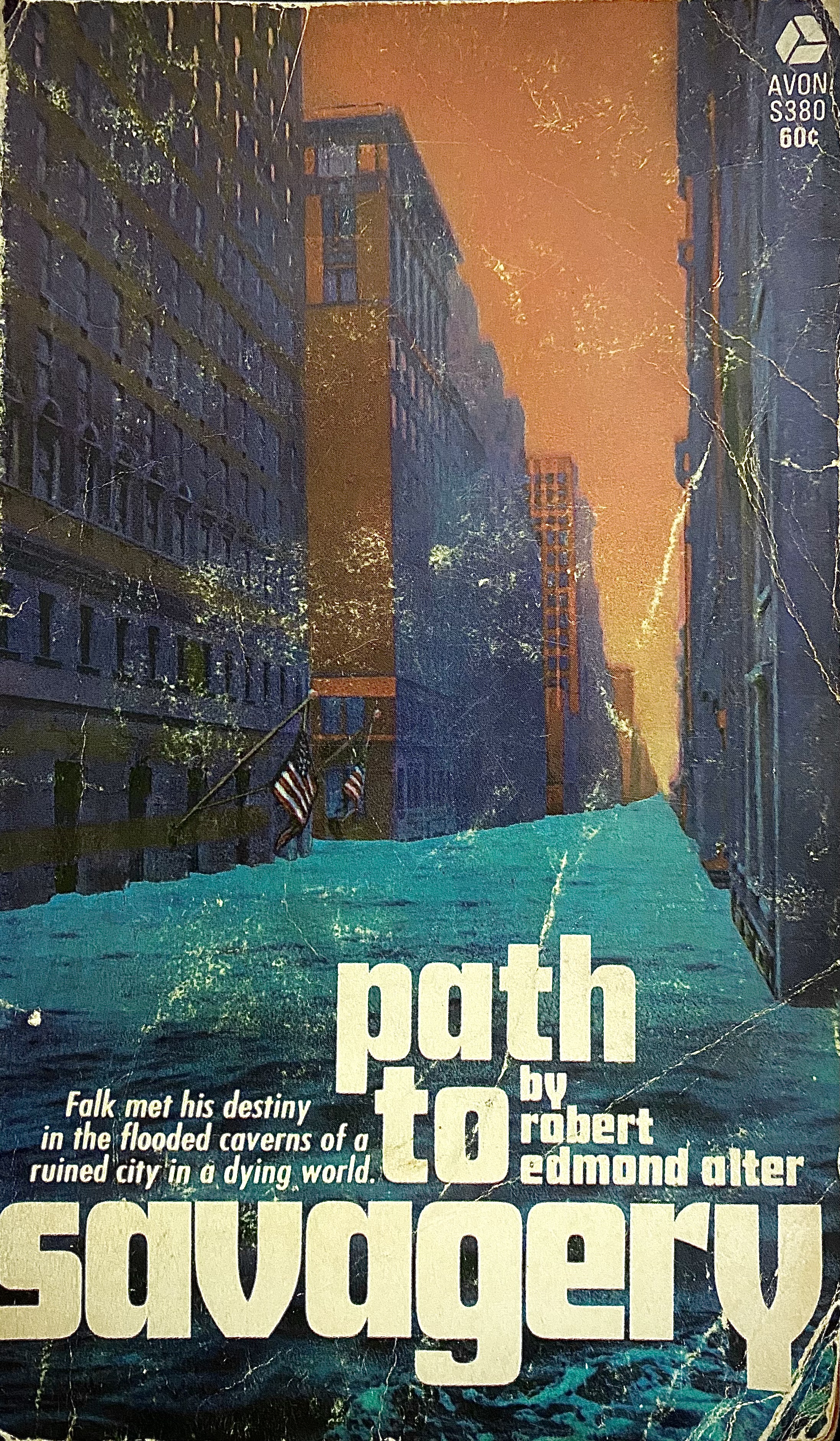
Path to Savagery

According to Mystery File, Robert Edmond Alter authored over 40 stories for magazines and digests like Mike Shayne, Man from UNCLE, Argosy, Alfred Hitchcock Mystery Magazine, and Manhunt. He wrote two novels that were published by Fawcett Gold Medal, Swamp Sister in 1961 and Carny Kill in 1966. Both of those were reprinted by Black Lizard in 1993. We reviewed Swamp Sister in 2020 and it failed to impress us, but we went back to the well again with Alter’s novel Path to Savagery. It was published posthumously by Avon in 1969, three years after Alter's death. The post-apocalyptic novel was adapted into the 1979 Sony Pictures film The Ravagers starring Ernest Borgnine and Richard Harris. 

The book is set about 20 years after a global nuclear war. What's left are large swaths of wilderness, packs of wild dogs, and large cities that have mostly been ransacked. On the coasts, some of these cities are now marshy islands due to excessive flooding from broken seawalls. Civilization now exists in three classes. Flockers guard their food, water, and weapons and exist in packs. Neanderthalers are your common savages that use barbarism on a quest for dominance. The Loners are guys like Falk, the book's protagonist, that simply exist as troubadours scouring the countryside for supplies in an effort to live a peaceful existence. But, Falk packs a .45 and a Thompson submachine gun in case things get hairy. 

The first thing you need to know is that Path to Savagery is nearly awesome. It begins and ends with total awesomeness. What's in the middle is just plain 'ole great. Alter's pace is sometimes sluggish, but at 174 pages he spends productive time on characterization, something that was not afforded to him writing shorts. His descriptions were so vivid and real. For example, in the book's opening pages, Falk finds a dark, cavernous mansion that's been ransacked and abandoned. Bad guys follow him inside, hoping for a quick and quiet kill. Alter's descriptions of Falk fighting the enemy in the dark mansion's bedrooms and hallway were exhilarating. I loved that Falk couldn't see his attacker's faces until they were illuminated by his gun's muzzle flashes. 

Falk moves through the bogs and brambles and stumbles upon a woman named Faina, which he buys for the night using spare tobacco. Faina becomes a supporting character and surprises Falk when he reaches a flooded coastal city. In what becomes the book's central location, Falk and Faina find a large, multilevel department store. The store has different sections like sporting goods, housewares, furniture, camping, clothing, etc. This large department store becomes a hunting ground when Falk and Faina discover it is occupied by a large band of Flockers. 

Without spoiling too much of the story, Falk and the leader of the Flockers, a strong, combative man named Rann, enter a contest of survival. Each of them enters the department store naked without weapons. Once inside the enormous store, they can use anything they find as a weapon to hunt and kill their opponent. Falk and Rann's battle will determine the winner of the tribe's sexiest woman. Falk has a prior connection with the lady, so his efforts to kill Rann are elevated. Rann is fighting to hold his place as tribal leader. 

Needless to say, the idea of living in an abandoned shopping mall is a neat one. Alter makes fun use of this combat arena and adds in some surprising elements that add a dose of horror to the narrative. There is a crime-fiction ingredient as well when Rann conspires with another Flocker to secretly murder someone. The book's premise borders on both science-fiction and post-apocalyptic, making this alternate version of Earth a pretty scary place. 

Despite reading tons of doomsday fiction, and viewing an equal assortment of genre films, I was thoroughly pleased with the book's innovation and ideas. Alter really had a great thing going and I can't help but think this would have been a series if he would have lived long enough to tell it. Unfortunately, Path to Savagery is all we have of this great concept. 

Buy a copy of this book HERE

Wednesday, May 25, 2022

The Razorblades in my Head

According to his Amazon bio, Donnie Goodman runs the YouTube show The Horror Hypotheses and loves reading, book shopping, and playing video games. The Central Virginia native is a fan of Paperbacks from Hell and enjoys writing. His short stories have appeared in anthologies like Gorefest and Served Cold. In June of 2021, Goodman self-published his short story collection The Razorblades in my Head with a colorful and terrifying cover by Justin T. Coons. As a fan of horror and a native of Central Virginia myself, I was drawn to this macabre collection. 

The book is 140 pages long and features 12 shorts, original black and white cover sketches, and notes from the author on what inspired each story. I'm not a short story enthusiast, but Stephen King's Night Shift, Skeleton Crew, and Nightmares & Dreamscapes were always on hand throughout my childhood. I appreciate the art form, but prefer novellas if it isn't a full-length. That being said, Goodman's work was really enjoyable. This is his first collection and I would imagine some of these stories have been with him for a long time. 

Here are a few stories that I found as real highlights of Goodman's storytelling talent:

“The Stranger in the Squared Circle” is about Goodman's love of professional wrestling, entertainment that he describes as “the last bastion of true performance art in modern culture.” I love wrestling as well, so the idea of a vampire story set in the wild world of independent wrestling was appealing. It's written in first-person by an indy wrestler named Luke (indy meaning not contracted to one of the bigger organizations like WWE). He's a veteran of the indy circuit and starting to draw bigger money in Japan. So, it's with great hesitancy that he agrees to fill in at a local show from an old wrestling promoter named Jim. The gig is at a small, but packed venue, where Jim hoped to have a big main event. But, the headliner has gone missing in Mexico, so Jim wants Luke as the replacement. But, his opponent is a mysterious international wrestler called The Stranger, a performer Luke isn't familiar with. Jim shows Luke a video tape of an archived performance where it appears that The Stranger has supernatural agility and strength. It also looks like The Stranger legitimately kills his opponent. The Stranger may be the strangest opponent he has ever faced. The story is perfectly plotted with a great beginning, a compelling narrative, and a rousing finale. If this is a sign of things to come, Goodman is going to be a rock star. 

“The Old Bay King” is set on Virginia's eastern shores and features two likable, struggling crabbers that owe a loan-shark named Otis. Hoping to eventually make ends meet, they head north looking for a big haul. At sea, they discover an old abandoned ship. Inside are human remains and a huge box of solid gold covered in ancient writings. The two haul the box back to their ship, but run afoul of Otis and his enforcers. When he attempts to take the gold, all Hell truly breaks loose. Again, this was written in first-person and is one of the longer stories featured. I loved the atmosphere and characters, and Goodman's pacing was fantastic. This is Goodman at the top of his game.

“Hourglass” is an example of what Goodman feels is true horror - “a gated community with a homeowner's association.” I've been there and done that, and couldn't possibly agree more. This story reminds me of Bentley Little with its dark nod to the funny side of horror. It's a fairly simple story about a group of suburban men that make violent sacrifices in their garage. It's symbolic of greed and the sense of entitlement in pursuit of self-interest. I loved the story and it is set in a community called Greenfields, a place that Goodman uses in another story about killer snowmen called “Magic in the Hat.”

Razorblades in my Head represents an author that is passionate about literary horror. His stories resonate with a deep, disturbing look at our culture and the negative impact it creates. From snooty gated community residents to post-apocalyptic visions, Goodman isn't afraid to cross multiple sub-genres. This collection includes spatter-punk, crime-fiction, traditional horror, and the Creepy Pasta styled shorter shorts. I love his imagination, passion, and talent and to coin an overly-used phrase...he could be the next big thing. Recommended. 

Buy a copy of this book HERE.

Tuesday, May 24, 2022

Showdown

Norman Danberg (1905-1995) was a prolific multi-genre paperback author under the name Norman Daniels. He utilized the pseudonym Peter Grady for a hardcover western called Showdown in 1963 — later credited to Norman Daniels for the subsequent paperback release by Lancer Books. 

The novel is set in a small town misnamed Tranquility. The town was once tranquil, but it has fallen into anarchy, lawlessness, and dysfunction. Feuds, disputes, and grudges are settled with shootout duels on Main Street, where the townsfolk gather to watch as if it were a sporting event. Just as Daytona and Indianapolis are known for auto racing, Tranquility is known for its public gunfights and public hangings. The fans love it, and it’s great for business at the local saloon.  


Jase Quinlan and Dan Ingram are ostensibly best friends. However, Jase recently went on a trip to visit his brother, and Jase’s whore of a girlfriend has taken up with Dan in Jase’s absence. No bueno. Of course,  all this culminates in one of Tranquility’s famous gunfights, and Jase gets the worst of it. 


All of this is a setup for the arrival of Jase’s Texas cowboy brother, Cass. He received word that his brother was gunned down in one of Tranquillity’s bloodsport events, and he’s come for revenge. The first meeting between Cass and Dan is fascinating reading and sets the tone for the novel, which is way smarter and more nuanced than you’d expect. Cass also has another agenda for coming to Tranquility which is one of this novel’s delightful surprises. 


Norman Daniels is always a safe bet for solid, if unremarkable, pulp fiction. In Showdown, he threw aside the trappings of the genre and authored a novel about the power of human decency packaged as a simple old-west vendetta tale. While the western genre has always been about frontier justice, Showdown also works as a fable making a case for due process and the rule of law. 


Showdown is an interesting western novel if you’re looking for something completely different. There’s not much action or violence, but the story and the themes are unique and the writing is solid. Recommended. 


Buy a copy of this book HERE

Monday, May 23, 2022

Paperback Warrior Podcast - Episode 96

The boys are back in town! On Episode 96, Tom brings you all of the action at the Windy City Pulp and Paper Con from Lombard, Illinois and reviews a vintage Robert Colby paperback called Kim. Eric examines the birth of the Sword & Sorcery genre with Robert E. Howard's Kull character. He also delves into the Lancer paperbacks, Conan, graphic novels and magazines. Listen on any podcast app, paperbackwarrior.com or download directly: https://bit.ly/3lt5NOS

Listen to "Episode 96: Windy City Pulp & Paper and Robert E. Howard's Kull" on Spreaker.

Friday, May 20, 2022

Too Early to Tell

Between the 1930s and 1950s, John D. MacDonald authored over 500 short stories for the pulp magazines and digests. Often, he used pseudonyms so he could appear multiple times in the same issue.  Shortly after moving his family to Florida, and before his first paperback original was published (The Brass Cupcake, 1951 Fawcett), MacDonald's fight story “Too Early to Tell” was published in the October, 1950 issue of Adventure. The story and entire issue is available for free HERE.

The story is presented in first-person narrative by Lew, a gym rat that is friends with an older, veteran fight-trainer named Micky. At a rough local dive bar, Micky watches an irritating kid named “Junior” badmouth the patrons, then proceed to waylay a half-dozen men before being sapped. Micky drives the drunk and dazed kid home and then later gains his life story.

Junior's real name is Harkness Willoughby Franklin the Third and he's living with a sizable emotional burden. His father died, his mother remarried and they moved to California where she started a new family. Considering Junior a forgettable bad apple, his mother sends him to a private school in Massachusetts. Over the years, Junior has asked to visit the family, only to be rejected and then promptly receiving a check in the mail. Now, Junior is mad at the world and Micky thinks he can channel that negative energy into boxing.

Most fight stories simultaneously spin a rags-to-riches lesson on responsibility, humility, determination, and internal fortitude. MacDonald's story is interesting because Junior is never a likable protagonist. That's what makes this so unique and engaging. The story, approximately eight pages in length, contains Junior's rise through the ranks to attain the coveted title shot. But, there's a side-story involving the sister of Micky's former protegee falling for Junior despite his angry, emotional barricade.

If you love in-ring action, MacDonald delivers a great, climactic bout in the story's conclusion. With its clash of characters, fighting, and emotional undertakings, “Too Early to Tell” was an enjoyable reading experience.

Thursday, May 19, 2022

Time War

Lin Carter (Linwood Vrooman Carter, 1930-1988) was a longtime science-fiction and fantasy fan. Along with his writing mentor, L. Sprague de Camp, he authored a number of Conan novels either as original tales, or by finishing original, unfinished drafts by Robert E. Howard. He also contributed edits to Howard's Kull character while also creating his own series titles like Gondwane, Terra Magica, and Thongor of Valkarth. Carter only authored a few stand-alone novels, one of which is the science-fiction novel Time War. It was originally published by Dell in 1974 with an amazing cover by Frank Frazetta. It was reprinted by Wildside Press in 2021 in both physical and digital editions. 

John Lux is a scientist, industrialist, entrepreneur, and a military veteran. He's also the target of an invisible assassin. In the book's opening pages, John is shot at by an invisible force that somehow lifted his own revolver from his desk drawer. In another murder attempt, John is nearly run over in the street by a maniacal driver. Why is he being targeted for assassination by this intelligent, murderous entity?

After visiting a local friend and professor, John awakens the next day to learn the man is dead and the police are searching for him as the prime suspect. On the run from the police and an assassin, John learns more about his nightmarish predicament from a strange woman who claims she is from the future. Her explanation of John's trials and tribulations is similar to that of Skynet and John Connor, two time-traveling opponents that battle through the years in the popular Terminator franchise of movies, books, and comics.

In the future, Earth's population is pampered in a sprawling urban metropolis known as the Living City, governed by a super computer. It is here that civilization has spiraled into a luxurious world where every want and need is supplied by the city. Because of this slothful lifestyle, humans have evolved into simply existing with no ability to think for themselves. They can no longer survive without the assistance of the computer, thus the development of this long-lasting parent-child nurturing. Instant entitlement and gratification is the way of existence.

John learns that this computer has built a cocoon around the city, a nearly impenetrable shield that protects everything and keeps this rather elementary form of living intact. But, a rebellion created a Weapon Machine to destroy the computer, only it is stuck inside the shield with no way to penetrate the exterior, and no method of retreating. To John's surprise, he learns he is the only human in existence that has neuro-radiontic powers. In essence, he is a time-traveling superhuman that can teleport himself anywhere. Since his powers are new and underused, this dormant skill can only be utilized if his body is facing an emergency. Thus, these future agents are attempting to kill John to awaken his ability to teleport. If he can teleport through time, and through this city shield, he can bring the Weapon Machine to its destination and liberate humanity.

The author's note from Carter states that he authored Time War as an affectionate tribute to author A.E. van Voget, a contributor to the Golden Age of mature science-fiction led by John W. Campbell Jr. and his Campbellion revolution. In doing so, Carter inputs a lot of startling social awareness into his precognitive narrative on mankind's modern dependence on technology. Much of Carter's future, filled with frivolousness and a rudimentary need for immediate satisfaction, resembles our present. While it isn't preachy or chastising, Time War certainly predicts and warns of many present day struggles.

As an action-oriented science-fiction novel, I found the narrative was busy and bogged down with explanations of what, when, where, and how. There just wasn't enough space to allow the anticipated front-cover action to develop properly. I encourage short novels, but the 150 page count was too short in this instance. If you love a dense, smart story, then Time War should be a wonderful experience. Those of you looking for a soaring stellar war should look elsewhere. 

Buy a copy of this book HERE.

Wednesday, May 18, 2022

News of the World

After graduating from University of Missouri-Kansas, author Paulette Jiles (b. 1943) was employed by the Canadian Broadcasting Corporation. Her original novels and poetry collections include Waterloo Express (1973), Blackwater (1988), and The Late Great Human Road Show (1986). After extensive travels, Jiles settled in San Antonio, TX in 1991. My first experience with the author is her western News of the World. It was published in 2016 by William Morrow and adapted to film in 2020 by Universal Pictures and Netflix International. The movie, starring Tom Hanks, won Academy Awards in 2021 for Best Cinematography, Score, Production Design and Sound. I've never seen the film, because I'm a reader not a watcher. 

The key to fully experience News of the World is understanding the time period and place in which it takes place. The book is set in 1870 and begins along the border between Texas and Indian Territory. Texas is a political hotbed after Republican Edmund Davis was elected in 1869 as the state's governor, barely defeating Democrat Andrew Hamilton. Tensions were high, the Texas State Police had privileged power, and a civil rights commitment had been made. The introduction of public printers made way for state journals and newspaper to provide official notices. It was a Reconstruction period for Texas.

The book's main character is Captain Kidd, a 71 year-old man and veteran of the War of 1812 and the Mexican-American War. After becoming a widow, Kidd began traveling the country reading national and international newspapers for a dime a listener. His business isn't a lucrative one, so Kidd becomes interested when he's offered money to transport a young girl named Johanna.

Johanna's parents were killed by Kiowa warriors when she was six. After four years of being a captive, she is freed from the Kiowa and placed in the hands of a man named Johnson, who then hands her off to Kidd to take the girl back to her only relatives, an aunt and uncle in Castroville, TX. Johanna's experiences with the Kiowa result in her being a wild child with very little possession of the English language or modern customs. She speaks fluid Kiowa, minimizes animals to food, eats with her hands, and wears primitive clothing. She's a fish out of water with Kidd.

Like any great mono myth, Kidd's journey through Texas brings elements of danger and adventure that transform the elderly individual into the unlikely hero. Kidd must carefully navigate the political landscape, balancing a bipartisan stance while contending with fierce supporters of both Hamilton and Davis. He's also threatened by perverse men who want Johanna for their harem or themselves. When he's not being asked to provide a fee for traveling through towns, he's dealing with Johanna's struggles with communicating with him or her complete recklessness and rebellion. Kidd has a lot to deal with throughout the book's narrative. 

News of the World isn't an action-packed western, but it does have one of the better gunfights I can recall. In fact, Jiles offers a lot of surprising insight on guns, ammunition, load sizes and feet-per-second velocity that I found especially interesting. The gunfight between Kidd and a group of criminals is innovative with the alternate strategy of using dimes in shotgun loads. Beyond this scene, the narrative is mostly verbal jousting. Jiles is much more literary than traditional western storytellers.

This novel provides an excellent history of Texas during this tumultuous time period and compares to today's political rivalries between the parties. As Americans, we continue to fight with each other over allegiances to parties and this book proves that nothing has really changed in 150 years. It probably never will. But, Jiles also provides insight on the historic alienation experienced by children captured by Native Americans and then returned years later to modern society. Jiles credits Scott Zesch's The Captured as an influence. 

Overall, I was deeply moved by News of the World and the relationship formed between Kidd and Johanna. As the centerpiece of the novel, I found it remarkable. I look forward to reading more of Paulette Jiles including her 2010 novel Color of Lightning, which also features the Kidd character.

Buy a copy of this book HERE.