Friday, June 24, 2022

Wyatt #01 - Kickback

The Wyatt series by Harry Disher was an Australian pastiche of Richard Stark’s Parker novels. The series has nine installments and began with 1991’s Kickback.

If you’re familiar with the Parker books, you know Wyatt’s background. He is a stoic, independent heist man in his 40s who prides himself on his professionalism among a community of scumbags and amateurs in his chosen profession. In Kickback, Wyatt is based in Melbourne, a city with ample opportunities for heist targets, although the underworld is largely under the control of the Syndicate in Sydney.

As the novel opens, Wyatt is pulling off what should have been an easy job. He is partnered with the 21 year-old kid brother of a business associate and the kid sees himself as a real cowboy. As a result of the kid’s malfeasance, the job goes completely sideways and an innocent woman winds up dead. Wyatt vows never to work with the young cowboy (who calls himself “Sugarfoot”) again, but the kid sees an opportunity to profit from intercepting the money on Wyatt’s next heist.

The novel is basically the story of Wyatt looking for that next score amid increasing financial pressure and sparse opportunities. He lands on a bent lawyer with a safe full of cash and a beautiful secretary willing to help from the inside. Can Wyatt pull off this heist, get the girl, and neutralize Sugarfoot before the whole thing goes sour?

I’ve heard people degrade the Wyatt series for “ripping off” the Parker series. However, I feel that there is plenty of room for these types of novels whether they are written by Richard Stark, Lionel White, Max Allan Collins, Dan Simmons or this very talented Australian author.

Inasmuch as Donald Westlake is deceased and we’re not getting any more books from his Richard Stark pseudonym, the Wyatt series seems to be a great way to fill that void in your life. For its part, Kickback is right in-line with the quality of an average Parker book, which is high praise. 

Buy a copy of this book HERE

Thursday, June 23, 2022

Cryptozoology Anthology

In my I Watched Them Eat Me Alive review, I reminisced about being a kid and watching wacky horror movies that starred nature as the dastardly villain. On any weekend, you could find me glued to TBS or USA Network watching films like Day of the Animals (1977), Grizzly (1976), Empire of the Ants (1977), and Piranha (1978). These movies were so much fun because they put me into a realm of real-world horror. There was a slim possibility that I could meet my end facing a hockey-masked killer at a campsite. But, my own backyard had ants, bees, bear, and leaping squirrels that could easily bring my demise under extreme circumstances. 

Thanks to Robert Deis and Wyatt Doyle, the concept of man versus nature is explored within the confines of the literary world. Like their prior volumes, Weasels Ripped My Flesh, the aforementioned I Watched Them Eat Me Alive, and Maneaters, these two literary scholars have been scouring the pages of vintage pulps and men's adventure magazines (MAMs for short) for strange and mysterious creature stories. Combining their efforts with David Coleman (Ancient Lake, The Bigfoot Filmography), the trio edited Cryptozoology Anthology, a 2015 publication by New Texture. It contains a total of 13 stories culled from the pages of True Weird, Men, Sir!, and Man's World among others. The book also contains two informative, introductory articles about creatures in various pop-culture trends and media.

The whole collection is highly recommended, with these stories in particular as solid standouts:

“MacDonald's Nightmare Safari”

This was originally published in Man's Conquest, August 1959 and it's one of those stories supposedly written by the main character to convey his harrowing, real-life encounter to the reader. In this case, the protagonist and author is Jim MacDonald, a former WW2 engineer that theorizes where a motherlode of diamonds is located in the Mato Grosso jungles of Brazil. To obtain it, he'll need to travel through tribes of head-hungry Indians known as the Morcegos. With the help of an enemy (you read that right) and a sexy babe, Jim finds the diamonds and the truth behind the Morcegos' worship of a strange white beast referred to as The Guardian. The story begins and ends with a furious shootout, and is laced with the traditional escapism these stories are known for. This one will be memorable for a variety of reasons.

“The Man from Another Age”

Like the above story, Mike Flint is listed as the author and the protagonist in this story that appeared in Man's Illustrated, November 1958. The creature at hand is the Abominable Snowman, also known as the Yeti, one of the most popular creatures to appear in pop-culture. Flint and other adventurers form a hunting expedition on Mt. Everest. The story, at about 20 pages in length, documents Flint's struggle with the harsh elements. But, my favorite aspect of the story is Flint's interactions with a beloved character named Billy, a young man hoping to finally overcome his fears after years of living in cowardice. Essentially, it's Billy's story, who arguably could be “The Man from Another Age” instead of the dangerous creature. Again, escapism laced with danger, high-adventure, and terror makes this story a real standout. 

“Monster Bird That Carries Off Human Beings!”

With a title like that, how could it not be a riot? I've always liked Jack Pearl's writing, and we've covered several of his books and even devoted a podcast episode to his work. He mostly authored crime-fiction, military-fiction, and biographies. But, he dipped into the Cryptozoology stories in the MAMs, including this wild “non-fiction” article in Saga, May 1963. Pearl describes “real-life” events where humans have been snatched by giant birds, often referred to as Thunderbirds in ancient civilizations. These are crazy, sometimes terrifying stories of man versus nature gone wild. Pearl points out that early American pioneers like Jim Bridger and Daniel Boone have written accounts they've experienced with giant birds. It is far-fetched, unbelievable shock-writing, but it is just so much fun to read. It's a testament to an era of imagination and curiosity. Much like many of the stories featured in this anthology.

These stories all feature wild animals and creatures wreaking havoc on mankind. There's tales of dinosaurs in jungles, sea-monsters terrorizing ships, and more Yeti, Sasquatch, and Bigfoot stories. They are all enjoyable, fast-paced, exciting action-adventure yarns surely to please fans. The artwork on the magazine covers and inner-pages is included in glorious full-color, including artists like John Pike, Jack Dumas, Gil Cohen, Mort Kunstler, and Norm Eastman just to name a few. As a bonus, there's even a hidden story buried inside the book. When searching for it, just be careful where you place your fingers. You never know what hairy, horrific creature you're liable to touch! 

Buy a copy of the book HERE.

Wednesday, June 22, 2022

Footsteps on the Stairs

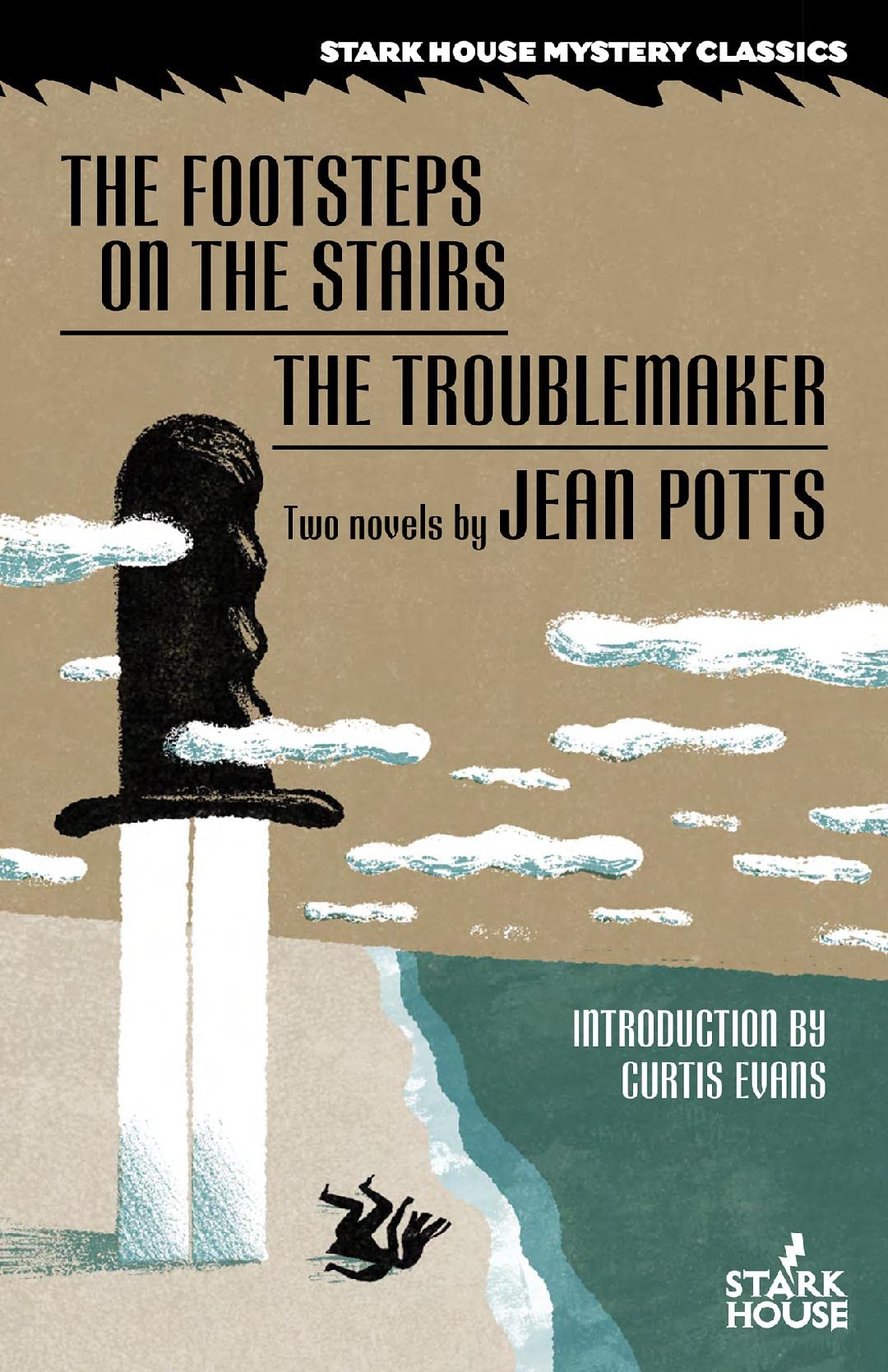
I enjoyed The Troublemaker, a 1972 mystery by author Jean Potts (1910-1999). It was packaged as a twofer in 2022 by Stark House Press with Footsteps on the Stairs, the author's 1966 crime-fiction novel. This new edition also features an introduction by author and Passing Tramp blogger Curtis Evans. Many point to Footsteps on the Stairs as the penultimate Potts experience, so I was curious to see how I would respond to it.

Vic is now married to an alcoholic lush named Thelma. But, four years ago he was involved in a relationship with New York interior designer Enid. Both have moved on, but run into each other again in Philadelphia. Pleasantries are made, awkward memories are relived, and soon Vic is cheating on his wife with Enid. The variable is Enid's good friend and neighbor Martin, a clumsy recluse that is recovering from his wife's mysterious murder. He suspects Enid and Vic are a thing, but he is suppressing desires for Enid. When Enid is found murdered, Martin is devastated and feels that Vic is the prime suspect. 

Despite being released as the culprit, Vic is still Martin's number one suspect days after the murder. Only, the murder mystery becomes convoluted when Thelma (again...Vic's wife) begins having an affair and Martin finds out. Did Thelma gain her revenge by offing Vic's mistress or simply by cheating on him? As Martin digs into the clues and becomes the amateur sleuth, he finds an unlikely ally in a young woman named Rosemary, a friend of Enid's. The two begin an investigation to learn who killed Enid, but the suspect list is lengthy. 

Footsteps on the Stairs is laced with all of the traditional genre tropes one would expect from a mid 20th century crime-fiction novel – numerous suspects, an amateur sleuth, clue-scavenging, and of course, the obligatory corpse. I found Martin to be a likable hero, perhaps enhanced with his mysterious past and his problematic self-awareness. His fondness for Enid is his curse, but it's a key to his own salvation as readers understand what Martin's challenges were in his prior marriage. There are a number of small intricacies that contribute to the much larger problem. How they work together is the marvel of Potts' literary work. 

Whether or not this is Potts' finest crime-fiction novel is in the eye of the beholder. I have nothing to compare it to other than The Troublemaker. I endorse both novels and highly recommend the twofer. It's money well spent. 

Buy a copy of this book HERE.

Tuesday, June 21, 2022

First Through Time (aka The Time Factor)

Most time travel stories concern going into the past and the ramifications of altering linear time - always a fun thought experiment. In 1962’s First Through Time, also published as The Time Factor, British novelist Stanley Bennett Hough (1917-1998), writing as Rex Gordon, tackles travel to the future.

Major Howard Judgen works for a U.S. military-funded science unit that has invented a device called a Synchotron that captures images of the future for modern study. Basically, it’s a time machine for a rudimentary motion picture camera. The camera goes through a hole in time created by science-fiction hokum and returns 30 minutes later with video footage of the future.

A recent video that returned from about 100 years into the future indicates a cataclysm has taken (or will take) place at the spot the laboratory now stands in Tennessee with global ramifications (I’m being intentionally vague here). The military wants to utilize this time portal to send a man into the future to avert this catastrophe. Our narrator, Howard, seems to be the man for the job.

The success or failure of a novel with this setup hinges on the coolness of the author’s depiction of the future and the quality of the adventure awaiting our hero. It’s all set-up quite nicely with the appropriate characters trudging up all the time travel paradoxes associated with jaunting to a determined future with hopes of changing it.

The end result was akin to a decent installment of Jeffrey Lord’s Richard Blade series - without the kinky sex. The author tried to shoehorn too many Big Ideas into what otherwise should have been a short, pulpy novel. Overall, First Through Time was a pleasant diversion, but it will be no one’s favorite science-fiction novel of the era. 

Buy a copy of this book HERE.

Monday, June 20, 2022

The Three Widows

Wisconsin native Bernice Carey (1910-1990) authored poems, short stories, and book reviews in newspapers and literary magazines before becoming the author of eight crime-fiction novels between 1949 and 1955. Stark House Press has reprinted all of these as twofers with introductions by author and blogger Curtis Evans. My first introduction to Carey is her 1952 novel The Three Widows. It has been packaged with the author's 1950 novel The Man Who Got Away With It in the 2019 Stark House Press reprint

This cozy mystery novel features three vacationing women as prime suspects for murder – Mrs. Smith, Ferguson, and Meadows. The three are introduced to the book's protagonist, Melvin, while on vacation in a California resort in Escondido. Prior to Melvin's arrival, he spent the prior days with his wife in Santa Cruz and Yosemite. Oddly, both locations featured law-enforcement recovering a corpse. With the murders following Melvin, he soon finds another dead person at the Escondido resort. Readers know Melvin isn't the killer, but after engaging in chit-chat with the “three widows” he soon discovers they were all vacationing in Santa Cruz and Yosemite. Do one of these women have a penchant for cross-country murder?

The Three Widows is a short, pleasant mystery with one of crime-fiction's most enjoyable tropes – the amateur sleuth. In a hilarious scene, Melvin begins piecing together his gumshoe manual by reading a mystery novel. Soon, he is on the trail breaking into the women's rooms, examining their belongings, and piecing together motives and peculiar pasts. Some of the mystery is removed when readers are placed into the minds of each of the three widows, creating intimate moments when readers learn more about the characters than the investigating bungler. 

Overall, The Three Widows was an excellent introduction to Bernice Carey's writing style, that of the prim and proper mystery novel complete with a dialogue heavy tenderness. Comparisons could be made with another mystery author of the era in Jean Potts, although she is a tad more abrasive. With tragedy afoot, a moderate mystery, and corpses 'aplenty, Carey delivers a solid crime-fiction novel with The Three Widows. Cheers to Stark House Press for keeping the torch lit on these early 20th century classics. 

Buy a copy of the book HERE.

Friday, June 17, 2022

Zanthodon #01 Journey to the Underground World

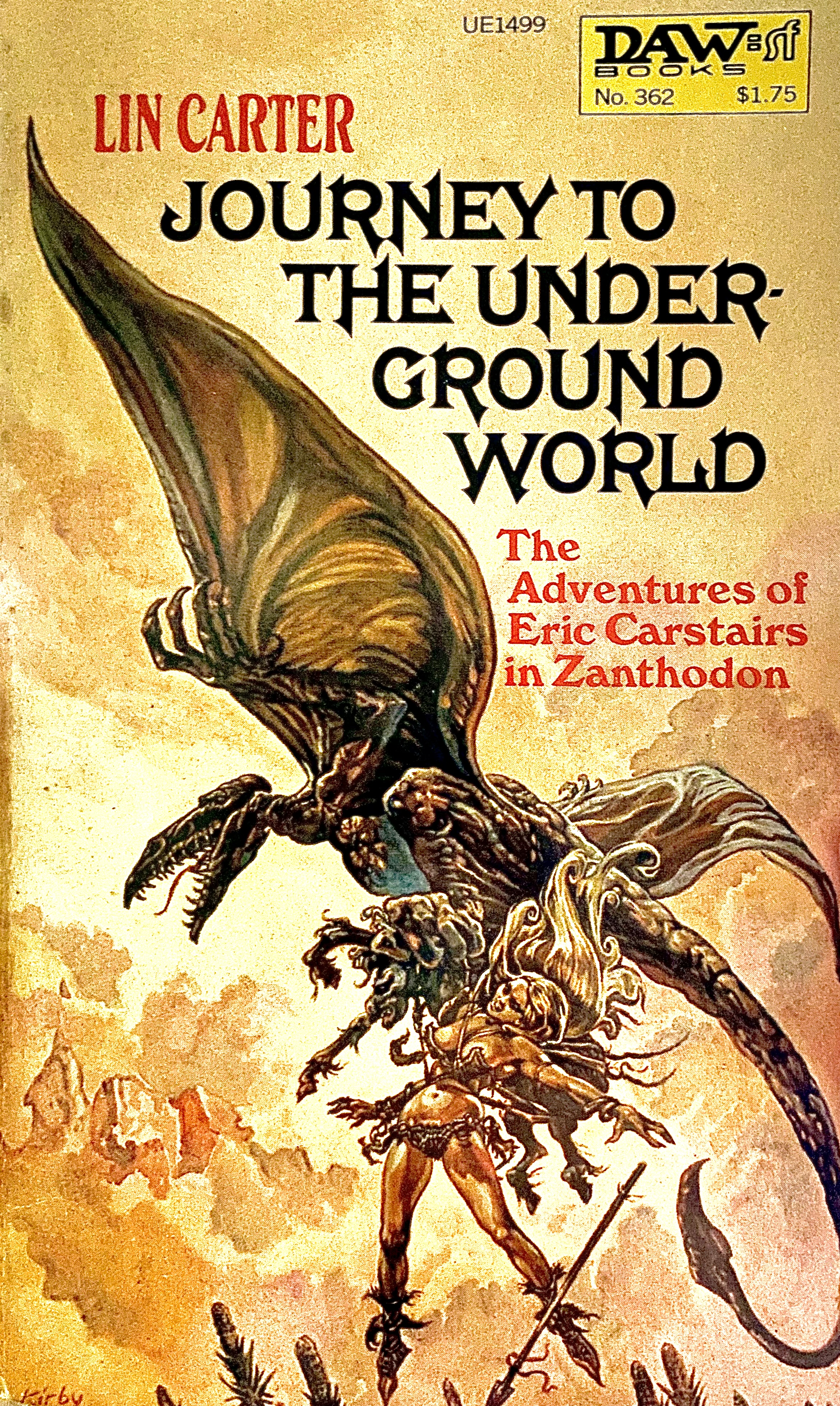
As a longtime fan of science-fiction, fantasy, and the works of Robert E. Howard and Edgar Rice Burroughs, Lin Carter (1930-1988) authored a number of novels and series titles using unfinished manuscripts from his literary idols or by utilizing a pastiche to contribute future installments of established, classic titles. Using the Pellucidar series, written by Burroughs between 1914-1963, Carter created his own “hollow Earth” concept with the Zanthodon series. The five-book run, also inspired by Jules Verne and Arthur Conan Doyle, was published by DAW Books between 1979 and 1982. It has been reprinted by Wildside Press as one of their digital Megapacks featuring all five books for an affordable price. I'm starting with the series debut, Journey to the Underground World

The book's star is Eric Carstairs, the stereotypical 1970s action-hero that can pilot, captain, shoot, salvage, and deal with the best of them. He's in North Africa looking for work when he saves a professor named Potter from muggers. At the bar, where Carstairs stores his steep tab, he discusses Professor Potter's interesting proposition. Potter explains that he needs Carstairs to pilot a helicopter into an inactive volcano in an effort to locate the middle of the Earth, a place called Zanthodon. He provides evidence that many ancient cultures knew about Zanthodon and wrote about its whereabouts. The origin stems from a giant meteor that crashed to Earth, plunging through the volcano and making an impact on our planet's central core. The “Big Bang Theory” would have created a miniature Earth inside Earth. Make sense? Potter wants to locate it.

Carter doesn't waste the reader's time, and by page 40 both Carstairs and Potter have crashed the helicopter miles below the volcano. They crawl out of the aircraft and discover that Zanthodon is an evolutionary paradox. Dinosaurs roam free, along with two different types of humans – Neanderthal, which are the most basic of prehistoric humans and the slightly more advanced, evolved humans known as Cro-Magnon. As we know it, roughly a 350,000 year difference between the two on the evolutionary scale. But, in Zanthodon they are both alive and active, although warring with each other.

Aside from being a fighting man, Carstairs has a key advantage by carrying a .45 handgun to shoo away the pests. But, the duo is soon captured by the Neanderthals and taken on a long trek through the wilderness. It's here that Carstairs meets Darya, the captive daughter of the Cro-Magnon's tribal king, as well as Jorn, a fierce warrior-hunter. The narrative builds around Carstairs' attempts to become free while working together with an unlikely ally in Hurok. The book introduces future plots while familiarizing readers with the series vibrant and dangerous landscape.

As pure popcorn fiction, there's nothing to dislike about Journey to the Underground World. It obviously pays homage, and takes some liberties, from prior works like The Lost World and Journey to the Center of the Earth. Carter spends ample time with each character detailing the separate perils they are facing. The plot is spacious, allowing multiple events to occur in different areas – different enemies and challenges that rotate for the characters. I really liked that aspect of the storytelling. 

As a fast-paced, descriptive adventure novel, Carter delivers the goods. Journey to the Underground World is a journey worth taking. Recommended! 

Buy a copy of this book HERE. Get the eBook omnibus HERE

Thursday, June 16, 2022

To Venus! To Venus!

Robert Silverberg said that Donald A. Wollheim (1914-1990) was one of the most significant figures in 20th century American science-fiction publishing. He was the editor for Avon Books between 1947 through 1951, then left to spearhead the new publisher Ace Books. He invented the adored “Ace Double” and spent 20 years as the publisher's editor-in-chief. He later left Ace to form one of the most instantly recognizable publishers in science-fiction literature, DAW Books (Wollheim's initials). But, Wollheim also wrote a lot of science-fiction stories and books, including To Venus! To Venus!. It was published under his popular pseudonym David Grinnell by Ace in 1970. The flip story of this double is The Jester at Scar by Edwin Charles Tubb. Cover art by John Schoenherr.

The book begins with a U.S. Space Agency's crew, led by protagonist Chet Duncan, navigating a difficult task on the Moon's surface. It is presented as a bit of foreshadowing, eventually culminating later in the narrative as Duncan is forced to navigate more challenging tasks on the surface of Venus. Once the crew is back home in CA, Duncan's senior management discusses the next mission.

Russia (then the Soviet Union) made a transmission from what appears to be a communication station on Venus. This would be unlikely considering that the U.S. and world leaders have established that Venus contains an atmosphere that is over 500 degrees. However, the Reds state that the information is inaccurate and that the atmosphere is similar to Earth's. In an effort to gain credibility, and in the fairness of competition, the Americans want their own people on Venus. A three-man crew led by Duncan will train extensively for the flight to Venus and make the voyage. Thus, a narrative is born.

The flight to Venus is somewhat boring as readers endure daily activities, training exercises, and some flat banter between the characters. The only entertaining aspect is that another group of Russians are en route to Venus as well, so the rivalry between the two space capsules is interesting. The Russians are heavily stereotyped, which made the dialogue unintentionally humorous. But, eventually the Americans land on Venus only to discover that the Russians are in need of medicine and assistance. The mystery on whether Venus is sporting the inner rings of Hell or the atmosphere of Central Park comes to fruition as the story reaches its central apex. Unfortunately, it was like a faulty firework on the 4th of July. A bummer instead of a starburst.

There's nothing about To Venus! To Venus! to recommend. The narrative just plods along with no  real enjoyment beyond simple escapism. The finale, which I thought was surely going to be an entertaining sequence of American/Russian cooperation to escape the fiery doom of Venus turned out to be about a paragraph in length. Just when I was fully invested, I turned the page and found an advertisement for more Ace books before the pages flipped upside down. Needless to say, I was underwhelmed with the ending. To Venus! To Venus! isn't Hall of Shame worthy, but it is certainly in the neighborhood. Take a hard pass. 

Buy a copy of this book HERE