Wednesday, August 3, 2022

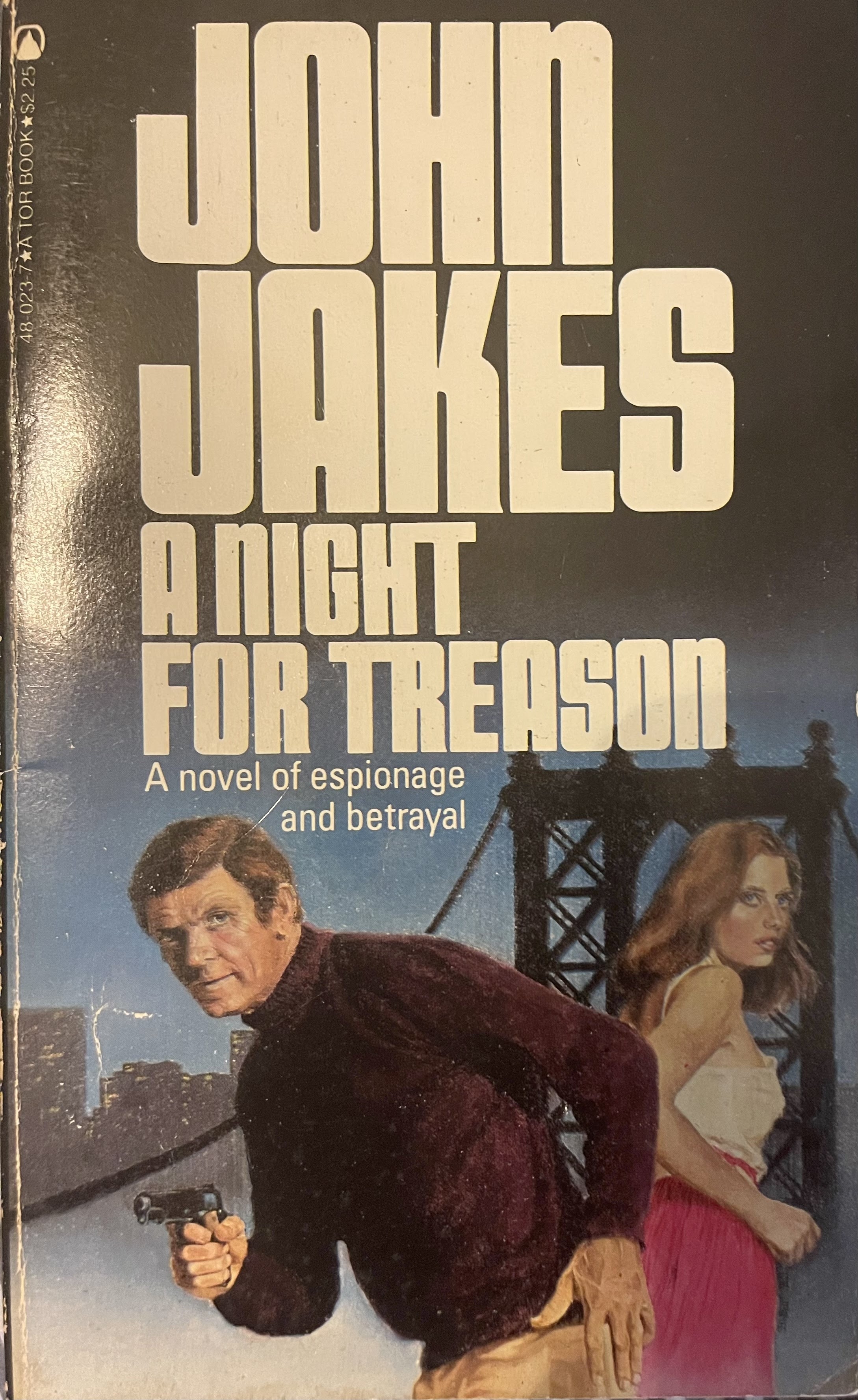
A Night for Treason

Before John Jakes struck gold with his Civil War epic North and South, he was a paperback author for dudes like us. A Night for Treason was a 1956 spy thriller that was released as an Ace Double with many subsequent reprints over the years. 

Our hero is an American secret agent named Max Ryan. The novel begins with an exciting action set-piece with Max hijacking a truck filled with military supplies. It’s a violent and fast-paced opening that sets the tone for this short, peppy paperback. 

We are quickly introduced to our villains: a shadowy European-based organized crime and intelligence cabal known only as The Combine seeking to steal American industrial secrets for its own profit and benefit. The focal point for this showdown between The Combine and Max’s agency is an Atomic energy conference hosted on the estate of an Air Force colonel. It’s up to Max to figure out who the technology thieving Combine spies are among the guests and neutralize them without getting whacked himself. 

The Air Force colonel has a sexy, 26 year-old niece named April who is the hostess of the conference and a pivotal player in the weekend’s intrigue. John Jakes keeps the narrative exciting with well-crafted action scenes every few pages. His plotting is basic but serviceable. 

Overall, this early work from a future famous author is about as good as one of the better Nick Carter: Killmaster installments. If you can score a cheap copy of A Night for Treason, you won’t regret reading it. However, it’s unlikely you’ll remember it for long after you’ve moved onto the next paperback in your stack. 

Buy a copy of this book HERE

Tuesday, August 2, 2022

Whiteout #01 - The Snow

Flint Maxwell is an Ohio native and author of horror and fantasy titles. He's authored a post-apocalyptic series called Jack Zombie, co-wrote the Midwest Magic Chronicles novels, and contributed to the short-story collection 25 Gates of Hell featuring horror authors like Brian Keene. The author's own short-story collection, The Bitter Cold, was published in 2018. My first experience with the author is his 2020 five book series of post-apocalyptic novels, Whiteout. I'm starting with the series debut, The Snow, published in multiple formats by Dark Void Press.

Through first-person perspective, readers are introduced to Grady Miller, an Ohio firefighter that experienced a harrowing tragedy that left a little boy dead. Trying to recover from the trauma, Grady pals around with his two childhood friends, Stone and Jonas. The three buddies want to celebrate July 4th in tradition in a lakeside cabin at fictional Prism Lake. The festivities of drinking beer and telling stories is fun for the trio, and the author conveys their friendship and inner-loyalty to the printed page quite well. However, “The Three Musketeers” are about to experience outright horror.

The three awaken to find that it's snowing. On the fourth of July. In Ohio. Once the snow starts falling, it never stops. The friends soon learn that the radio stations and internet are out and soon the power begins to fade. As a blizzard soaks the landscape, the three also learn that their fears, the things that trouble them the most, are becoming real things outside. The dead kid begins calling to Grady from the snow. Dark figures are seen in the distance. Spiders as large as cars start crawling. It's a nightmare scenario. But, is it any good?

For the most part I enjoyed the book for what it was. This is clearly the origin tale, and it ends right when the action begins to escalate. The setup was appropriate, the characters introduced, and doomsday ushered in to create the backbone of the series. I found it to be truly scary at times, but for the most part it's just gloomy and depressing. Like most post-apocalyptic tales, the team-building is a necessity and the survivors have to possess some sort of past tragedy to overcome in the post-apocalypse. It suspiciously reminded me of Christopher Golden's more superior novel Snowblind, which has nearly the same concept.

I plan on reading the next installment soon. I found The Snow to be enjoyable enough to warrant an extended look at the series. Flint Maxwell is creative, has a plan, and forms the story well. Recommended. 

Buy a copy of the book HERE.

Monday, August 1, 2022

The Big Steal

Irish author Athwill William Baker used pseudonyms like Howard Baker, W. Howard Baker, W.A. Ballinger, John Long, Desmond Reid and Richard Williams to write crime-fiction, science-fiction, and espionage novels. He began his career as a journalist, joined the Army during WWII, and later became the editor in charge of Panther Books. He's mostly remembered for his contributions to the serial police procedural Sexton Blake, inspired by Sherlock Holmes. He also authored a 16 book series starring Richard Quintain, a British Secret Service agent. My first experience with the author is his stand-alone caper novel The Big Steal. The book was published in 1964 and has been printed a total of four times, each with different artwork and different publishers.

Sep Ryder was an Italian veteran of WWII that fought for the Fascists and personally knew Mussolini. Due to his violent behavior, and military record, he was placed in the mental institution Broadmoor by the British government. However, he escapes the facility and puts together a plan to rob $2.5 million from Heathrow Airport. But, he needs a team.

Baker writes this short novel as one long series of introductions. We meet Phineas Norton and his wife Marcia and quickly learn that Ryder and Marcia are having an affair. Then there is Bill Simmons of the Daily Post, his ex-wife, guys named Bruno and Clifford, and the list goes on and on. The plan is for Phineas to become a passenger on board one of the aircraft landing at Heathrow. He will warn the crew that he has a bomb on the plane. This puts the entire airport on lockdown and a lot of people on the ground preparing for the plane's arrival – ambulances, cops, journalists, etc. While all of this commotion is happening, Ryder and his drivers, gunmen, and strong guys will rob the place and drive an ambulance out of town. Phineas then will tell them he made the whole thing up. Because there is no bomb. Until there is one.

This book was mostly enjoyable and could have been something special if the cast of characters was cut in half. The pacing was a frenzy of activity, propelling the plot and creating a lot of drama, intrigue, and excitement for the book's payoff. But, there's just so many characters that it was hard to keep track of histories and where all of these people are in the plan. I spent a majority of my reading experience confused, but Baker's writing was really good and kept me interested. In the future, I'd like to read another Baker novel to compare quality. Lukewarm recommendation for The Big Steal

Buy a copy of this book HERE

Friday, July 29, 2022

The Deadly Deep

Jon Messmann created and authored the long-running adult western series The Trailsman. He authored series titles like The Revenger and Jefferson Boone: Handyman. He also wrote novels in genres like gothic, romance, and espionage. At the height of the Jaws frenzy, Messmann authored an aquatic horror novel called The Deadly Deep. It was published by Signet in 1976. 

The book stars a journalist named Aran, who specializes in complex scientific discoveries. He has a unique talent of describing these highly intelligent theories and results in an easily understandable language for casual readers. This talent has led to Aran being a notable journalist and literary awards winner. But, Aran is about to take on his most difficult writing assignment – chronicling the end of the world. 

Across the globe, the fishing and tourism industry is suffering serious setbacks due to violent deaths in oceans and rivers. The cases range from people swallowed by whales, consumed by lobsters, or severely bitten by an array of historically docile fish. There is no central location for the occurrences, although Aran specializes his research in the American Northeast. There are a number of controversial theories from professionals in various lines of work, but no one has the answer. Does Aran?

What I really loved about The Deadly Deep was the very last page. It closed a chapter of my life that I never want to remember. I believed Messmann was the invincible wordsmith, a literary hero of epic proportions. But, this novel proves he was less than perfect, which is totally acceptable considering the amount of novels he cranked out year after year. 

In 220 pages of plodding, directionless writing, Messmann places his protagonist on the phone with various authorities agreeing or disagreeing with numerous theories on aquatic animals and trends. There are attacks sprinkled throughout the narrative, but these characters are never properly introduced, so their dismemberment by crabs doesn't have much meaning. At one point I expected some hero to jump in and save the day, but the whole novel is just endless discussions about sea life. 

The Deadly Deep is deep boredom. Don't waste your time. This one is nothing short of awful. 

Buy a copy of this book HERE

Thursday, July 28, 2022

Matt Helm #05 - Murderer's Row

Murderer's Row, the fifth installment in Donald Hamilton's Matt Helm series of spy-fiction, was published in 1962 by Fawcett Gold Medal. The novel was loosely adapted into a film of the same name in 1966. I've mostly enjoyed the series and Hamilton's writing, so I'm continuing in proper order with this installment.

Like the last entry, The Silencers, the next dangerous mission involves a female agent working for the same three-lettered, clandestine organization as Helm. Mac, Helm's boss, explains that the coast of Virginia – Chesapeake Bay – is experiencing an elevated amount of foreign vessels. The theory is that the area is hosting a trafficking operation with foreign powers extracting key personnel from the U.S., including a top-rated scientist with important knowledge regarding American security. The agency wants to locate the scientist and either retrieve or kill him.

A female agent has been inserted into the operation to gain intelligence, however, her perceived credibility has been compromised. Mac, and the agency, need her to regain credibility through nefarious means. Helm is to travel to her hotel room and dish out a scolding punishment from the agency, a savage, violent beating to whip her into shape. The room is bugged by the bad guys, so they will hear and see the beating and realize that this agent does in fact work for the U.S. and is being reprimanded for her poor performance. Mac's last agent, a young rookie sensation, failed miserably on the assignment. Helm is pulled from a Texas vacation to do the job right. Mostly, it all goes accordingly until the female agent unexpectedly dies during the beating.

Helm “killing” a fellow agent creates a tidal wave of issues for him and the agency. Mac attempts a retrieval, and at one point Helm is set-up in an attempt to bring him back to Washington. Helm wants to complete the mission, his superiors feel he is unable to. Against orders, and without support, Helm eventually finds the scientist's daughter, and gets tangled in a wild set of circumstances where he pretends to be a mob hitman named Petroni. There's a dense, complicated family affair between the woman, the scientist, and a bitter married couple. Individually, they each want to pay Helm/Petroni to kill another family member. Surprisingly, Helm accepts the jobs.

Hamilton really threw a curveball into this series installment by creating a unique, nearly comedic approach to the typical spy formula. The female agent dying during the beating was shocking, but where Helm goes after that opening event was just so bizarre and entertaining. Helm's insertion into a high-level, deadly family dispute was amazing, especially considering he agrees to kill two family members for money. It's all for show, of course, but the means to an end is an exciting chain of events that eventually leads from hotels to back-roads, then jail to a boat, then a massive hurricane that bounces the characters around during the book's rousing finale. It was superb pacing and plot development. 

Murderer's Row is probably a high-point in the Matt Helm series. It has a really clever storyline, a plausible sequence of extraordinary events, and a deep character study of the family dynamic and the strenuous ties that bind. This one is just fantastic and highly recommended. 

Buy a copy of this book HERE.

Wednesday, July 27, 2022

Steve Bentley #04 - Mistress to Murder

Mistress to Murder, the fourth installment in the Steve Bentley series, was published in 1960 by Dell. The book's author, E. Howard Hunt, wrote the series using the pseudonym Robert Dietrich. Bentley is former military and runs a successful accounting business in Washington D.C.'s turbulent political beltway. While dabbling with stocks and blondes, Bentley always finds himself as a pseudo private-eye working random cases that fall into his lap. In the aptly titled Mistress to Murder, now available in a brand new edition by Cutting Edge, Bentley becomes entangled with a wealthy international family in the posh D.C. suburbs. 

From a rural stretch of Northern Virginia blacktop, Bentley sees a young woman fall from her horse. After running to her aid, Bentley is stopped by the woman's chauffeur. Helping the woman into the car, the chauffeur becomes aggravated with Bentley's assistance and nearly K.O.'s him with one punch. Thankfully, Bentley memorizes the vehicle's license plate. Later, back at his home, Bentley discovers that the woman secretly placed a necklace in his pocket.

Consumed with the woman's odd behavior and injury, Bentley hires his old PI friend, and series staple, Artie to locate the vehicle's residence. It belongs to Baron Alejandro Esquivel, located in the high-end district of Georgetown. Bentley goes to the home, receives a cool welcoming, and meets Esquivel's young wife Anita, which eventually leads to a quick make-out session. Bentley pries himself away from Anita and is re-introduced to 19-yeard old Megan, the woman Bentley helped previously. Megan behaves normally, is “sick in bed” due to the fall, and both Anita and The Baron are keeping watch. But, Megan slips a note to Bentley asking him to meet her that night.

At the meeting, Bentley learns that Megan, and her half-sister Anita, are originally from Venezuela. Their father, the original Baron, was partners with Esquivel in a shady, yet lucrative, business. Long story short, their parents were suspiciously killed, Esquivel became the new, yet fraudulent Baron, married Anita and now the three of them live unhappily ever after. Anita cheats on Esquivel and Megan is the princess trapped in the castle. But, the wrench in the gears is a string of pearls that are internationally coveted and now owned by Esquivel. They are a sort of collector's piece worth well over $100K. Like these things tend to go, murders begin, the pearls are stolen, and Bentley is caught up in the deadly ruckus.

Hunt borrows similar plots of the first two Bentley novels. In the series debut, Murder on the Rocks, the plot involves a precious emerald, a South African ambassador and two women searching for the stone. In the series second installment, End of a Stripper, a man being dragged from a strip club discreetly places a small camera in Bentley's pocket. The camera is then traced back to the man and the purpose of the novel. However, Hunt writes Bentley so well that the recycled elements can be easily overlooked. 

Mistress to Murder, and the Steve Bentley series as a whole, is excellent crime-fiction written by an experienced, seasoned pro. While Bentley doesn't receive the same fanfare as other private-eye literary heroes, I think his steadfast willingness to do good things for people in peril is unmatched. The crimes are detailed, the characters dynamic, and the pace is flawless. All of the elements contribute to Mistress to Murder's success. This is just another great novel proving that this series is a cut-above your average gumshoe procedural. 

Buy a copy of this book HERE.

Tuesday, July 26, 2022

The Devil's Collector

Between 1975 and 1980, Robert Colby (1916-2006) authored six stories starring a mercenary vigilante named Brock — all published in Alfred Hitchcock Mystery Magazine. The stories — along with a previously-unpublished installment — have been compiled into a single volume called The Devil’s Collector.

Each of the stories is titled “Paint the Town…” followed by a color. So, the first story is “Paint the Town Black” and the last one is “Paint the Town Aquamarine.” When we meet Brock in the opening story, he’s dressed as a fancy dandy walking into a roadhouse bar in a seedy part of town. After attracting all sorts of attention from the rough characters inside, Brock leaves the tavern and walks toward the city.

Of course, some hoods accost the soft target on the street, and Brock goes Charles Bronson on the punks taking their money in the process. Later in the story, he dispatches another thief while also swiping the cash and explaining, “There is a tax on evil…and I am the collector.”

Colby was clearly influenced by the men’s adventure vigilante paperback craze of the 1970s, when he crafted the first story. His innovation was making the vigilante a foppish gentleman seeking to line his own pockets with crime money rather than a ‘Nam vet with a vendetta.

In later stories, Brock graduates from street punks and begins targeting con-artists, counterfeiters, and thieves. These stories (including “Green”) are more con-man tales where Brock’s cleverness wins the day, recalling the Saint series by Leslie Charteris. In other stories (“White”), he’s more of a Travis McGee salvage consultant who recovers stolen loot for a victim while extracting his “tax” for himself.

Overall, The Devil’s Collector is an innovative short story collection with a unique lead character given room to evolve over seven stand-alone stories. You may or may not want to mainline all these short works back-to-back. I think the collection would be more satisfying as a palate cleanser between longer pieces. In any case, call it a winner. Recommended. 

Buy a copy of this book HERE.