Friday, August 12, 2022

Gun Hell

Riley Ryan only wrote one novel in his life, but he gained some mileage. His sole novel was a western that began its shelf-life as The Dakota Deal, originally published by Lion Books in 1954. It was later reprinted by Lion Books again as Gun Hell. In 1966, it was published by Tower as The Oath. It was translated into Swedish and released as Blod for Blod. Most recently, it has been published by Cutting Edge Books as Gun Hell and also included in the publisher's compilation Big Bold West 12. Why so many printings? It's an unusual western. 

Johnny Burr makes a habit of burying his guns. In fact, he buries them and then shortly has a revelation and digs them back up. Readers learn he does this a lot. But, Burr is conflicted on what he wants in life. Should he attempt to live a happy existence free from his past or ride the trail for vengeance? That's the conflict that saturates Ryan's narrative.

In flashback sequences, Burr recounts the night that his farm was burned by bandits and his wife was raped and killed. During the attack, Burr sliced the bandit leader on the chest, leaving several deep gashes. These cuts were a mark, and now Burr is hunting for the scarred man. But, he isn't a violent guy, and generally isn't cut from the same cloth as your typical paperback hero. So, it's unique in the way that the hero is weak and discouraged. 

Like most westerns, Ryan uses the old western trope of a range war as the battleground for Burr and the bandits to settle the score. There's the Big Horn and Little Horn ranges, one filled with livestock, but very little water, the other the exact opposite. The range war erupts near Fargo, North Dakota and Burr finds himself employed by both ranches as he hones in on his wife's killer. There's a load of violence at the end, and occasional skirmishes leading to the finish. There's also a romantic relationship introduced that brings Burr full circle – bury the guns or fire them.

If you enjoy range war westerns and unlikely heroes, then Gun Hell should be a rewarding reading experience. It's certainly different, but carries the same traditional staples as the typical mid-20th century western. Recommended. 

Buy a copy of the book HERE.

Thursday, August 11, 2022

Judge Not My Sins

As I documented in my Frisco Flat review, Stuart James was a staff writer for True and Popular Mechanics as well as a sports reporter for the Delaware Valley Advance. He authored original paperbacks for lowly publishing houses like Tower and Monarch. Thankfully, some of his novels have been dusted off and resurrected thanks to Cutting Edge Books. Enjoying their new edition of Frisco Flat, I chose to read Judge Not My Sins next. It was originally published in 1951 by Midwood.

What I enjoyed the most about James' narrative may be something he didn't intend for me to enjoy all that much – pulp story writing deadlines and publishing. David Markham, the book's protagonist, is a 34 year old pulp writer living in New York City. He wants to write the great American novel, but his agent encourages him to grow as a writer and take the necessary stepping stones to achieve greatness. He puts David through the paces, first with newspapers, then on to writing for the pulps, and then articles as he moves into a better market. But, readers are introduced to David as he navigates the world of pulp fiction, the middle rungs on the tall literary ladder. 

David's life is at a crossroads. He's become complacent with writing pulp fiction, a problem he analyzes by suggesting he has already “written the same damned story fifty times” and to write another will simply require changing the characters. His agent says the writing is very good, it isn't literary garbage, and that “blood 'n guts” sells. Money is the reason David clicks the typewriter keys. He's married, although separated. He has two kids, but he only sees them once a month. His paychecks mostly go to his wife and their mortgage. All of these headaches catapult David into the arms of a mentally deranged woman named Leslie.

Like a Gil Brewer or Orrie Hitt novel, Judge Not My Sins develops into a devilish relationship study. Leslie is gorgeous, lives with her dog, and meets David for a one-night stand at a bar. David becomes engrossed with the woman and finds himself hopelessly falling in love. But, Leslie doesn't like David's commitments to his wife and kids. She also doesn't understand his writing career and what he hopes to achieve. As she beckons chaos and confusion, David's agent and wife prove to be responsible and less pretentious. It's this storm of emotions that drive David to the brink of madness while competing to meet five writing assignments and a movie novelization, his so-called “big break.” 

Based on publishing houses and lack of a household name, it's so easy to write Stuart James off as a hack sleaze writer. But, his career deserved better. He's such a great author and injects a personal insight into this novel, what is essentially a book about the writing experience. I'm sure that the career turmoil and rejections riding David were all firsthand experiences James suffered throughout his journey. 

Judge Not My Sins is a powerful look at self-absorption, complacency, mental illness, and the complexities of marriage and divorce. It's a paper life, but its life. I'm not sure why James wasn't able to break into the middle echelon of paperback writing (at the very least), but based on this book alone, he deserved a better hand than he was dealt. Hopefully, this new shuffling of the deck by Cutting Edge Books will deal him a win. 

Buy a copy of the book HERE.

Wednesday, August 10, 2022

Cut Me In

According to Stark House Press, the publisher that reprinted Cut Me In (1959) via their subsidiary Black Gat Books, Jack Karney was born in New York in 1911 and specialized in crime-fiction. He was married with three children and spent his entire life in the same Lower East Side neighborhood in New York City. He tried out for the police department, but ultimately ended up working in the Civil Service within the District Attorney's office. He authored a number of titles like Tough Town (1952), Cop (1952), and Knock 'em Dead (1955). As Mike Skelly he authored the novel There Goes Shorty Higgins (1953). Cut Me In is my first experience with Karney's work.

This novel is similar to other 1940s and 1950s crime-fiction where the rise from rags to riches becomes a captivating look at criminality. Like Benjamin Appel's The Life and Times of a Tough Guy (1960) and Ed McBain's Big Man (written as Richard Marsten, 1959), Jack Karney centers his narrative on Coley Walsh, a young beat cop working the New York streets. His wife died, and now he raises his crippled son while living with his mother on swing shifts. Coley's righteous path becomes corrupt with the simple longing for a patrol car and a promotion to investigator. Coley decides to cut some corners on the way to the top.

While working the beat, Coley saddles an armed robber that is fleeing from the police. In a devilish conversation, Coley learns that the police precinct is corrupt with several key personnel working hand-in-hand with the Syndicate. They run the protection rackets, gambling joints, and swindle politicians to do their bidding. Coley conceives the idea that he should assemble a small group of police officers willing to push the Syndicate out. But, these criminal elements would then be replaced by Coley and his guys. Instead of looking out for the Syndicate, they should become a new Syndicate. 

Through 200 pages, Karney documents Coley's rise through the ranks from small time to the big man. The most compelling portions concern Coley's relationship with a small business owner named Joseph Cantor and his adopted daughter. Coley looks out for Cantor, and understands he represents everything right about America – work hard, build a legitimate owner-operator business, serve the community. In creating his criminal empire, Coley realizes guys like Cantor are prime targets for protection rackets, thus an emotional conflict arises within Coley's pursuit of fortune. It's this conflict that really propels Karney's well-written narrative.

Cut Me In was a wonderful reading experience laced with criminal plans, fall-guys, payoffs, heartbreaks, and violence. Karney's writing style relies heavily on dialogue to tell the tale, and the author created enough diverse characters to keep the story alive and moving. The book's beginning and ending are its strongest parts, with the finale a real barn-burner with flourishes of action and cool-headed resolve. The balance was exceptional, and a difficult feat considering the moving parts. Karney was a pro and Cut Me In must surely represent some of his best work. Recommended. 

Buy a copy of this book HERE.

Tuesday, August 9, 2022

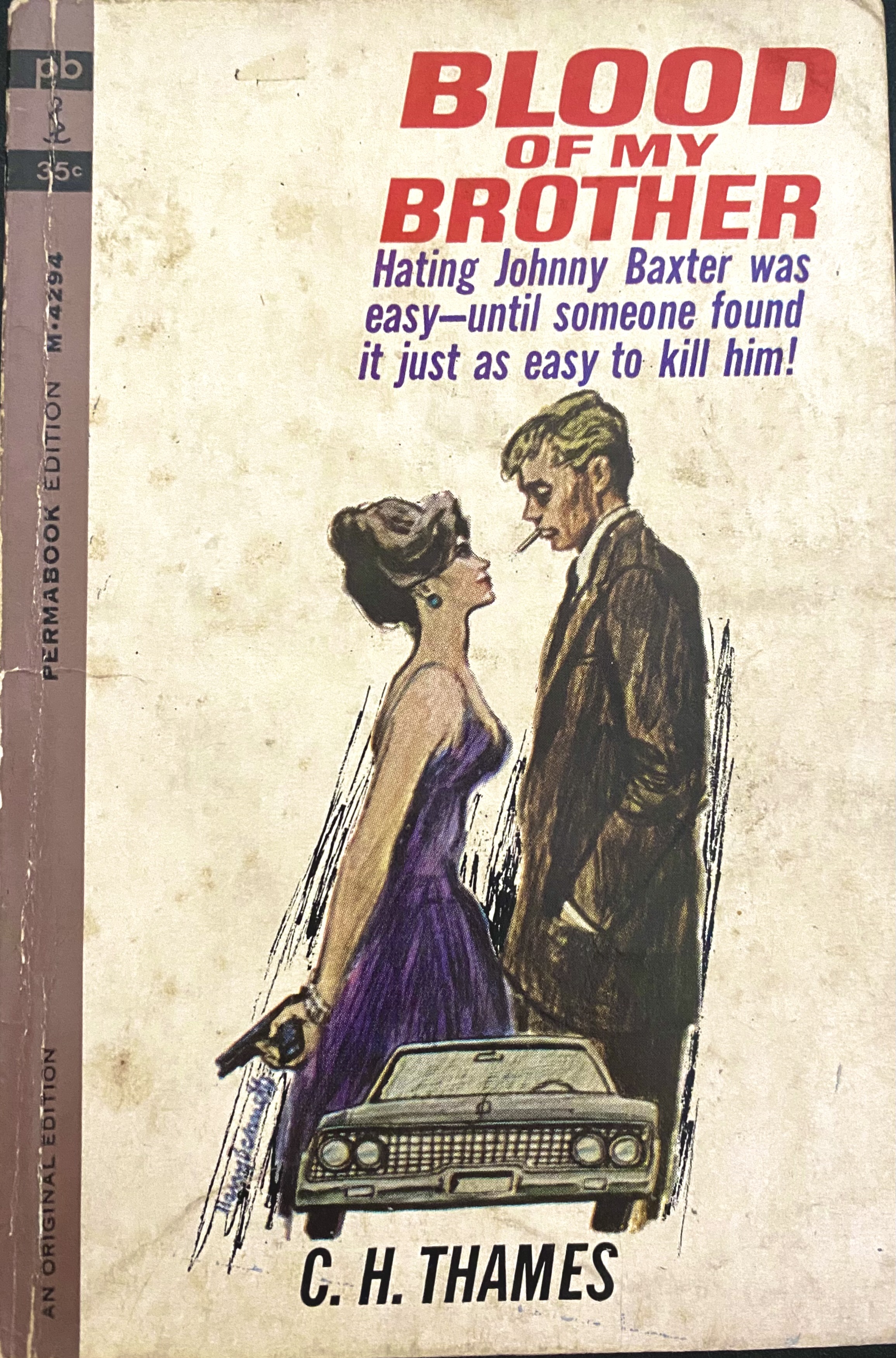
Blood of my Brother

Roll out the red carpet. Vacuum it. Fluff it a little with the heel of your shoe. Why? The festivities are about to begin. The Hall of Shame is receiving its newest member, the 1963 paperback Blood of my Brother, written by the very talented Stephen Marlowe (real name Milton Lesser). Only, Marlowe didn't want to use his name for this turd. Instead, he used the name C.H. Thames. To rub salt in the wound, Armchair Fiction reprinted this book. 

In the opening chapter, spoiled college kid Johnny Baxter is with an unknown person cracking a safe in a mansion. Next chapter, Johnny is found floating in the ocean. Dead. His car went off of an embankment and crashed into the lake. Johnny's father is devastated and regrets some of his fatherly decisions in life. Johnny's step-brother Dave is a modest attorney in town and the star of the family. He goes to identify the body and believes his brother was murdered. 

Dave believes there is foul play because Johnny's car is turned the wrong way in the lake. That's it, that is the big piece of evidence. Pay no mind to the flask, the fact that his brother was an alcoholic, the reckless lifestyle, the fast Jaguar. Just the wrong direction in the lake. The next 129 exhausting pages consist of Dave interviewing the college faculty, Johnny's roommate, the fraternity brothers, and Johnny's father. Readers already know that Johnny was stealing money from his father, so that little little morsel is quickly chewed up and dismissed. Second, if Dave can't figure out that Johnny's roommate, Tony, is the killer, then there is no reason for him to be an attorney. Here's some clues:

1 – Tony is flatass broke. 
2 – Tony has clothes and jewelry belonging to Johnny.
3 – Tony has a freakin' gun under his bed.
4 – Tony won several medals for killing a ton of bad guys in the Korean War.
5 – Tony tells lies.
6 – Tony seems jealou....nevermind, you get the idea. TONY IS THE DAMN KILLER! 

But, Dave interviews hundreds of people and discovers that Johnny has cleverly blackmailed every one of them. He's taken photos of them doing the humpty-hump, caught them in elaborate forgeries, threatened to report cheating to the faculty, and on and on. It's ridiculous to think Johnny Baxter has this many blackmailing schemes in the works and that this little California college is hosting this many blackmailing schemes. These people aren't that interesting. But, none of it matters! Pages 12 through 141 serve absolutely no purpose whatsoever. You can read the first 12 pages and the last 9 and that's the book. Open, shut, the end. A pointless endeavor. My suspicion is that Marlowe knew this book sucked. That's why he didn't want his name associated with it. I also think that he gave his readers a secret code so they would stay away from this novel - the title. The acronym is B.O.M.B. 

It brings me great pleasure to return this book to its little plastic book condom, complete with a piece of sticky scotch tape across the horizontal flap. I have no plans to ever open it again. I'm placing it in our virtual purgatory for bad books. Thus, the Hall of Shame remains open. This book does not. 

Buy a copy of this book HERE.

Monday, August 8, 2022

Paperback Warrior Podcast - Episode 99

On this last double-digit episode of the Paperback Warrior Podcast, Tom and Eric delve into the life and career of an underrated crime-fiction author named James McKimmey. Tom talks about a new Day Keene reprint and Eric discusses two brand new Stark House Press editions. Reviews include a 1984 spy novel called The Girl from Addis by Ted Allbeury and House of Evil, a 1954 crime-noir by Clayre and Michael Lipman. Listen on any podcast app, paperbackwarrior.com or download directly HERE

Listen to "Episode 99: James McKimmey" on Spreaker.

Friday, August 5, 2022

Dark December

According to Wikipedia, Alfred Coppel, real name Jose de Arana-Marini Coppel (1921-2002), served as a fighter pilot in the United States Army Air Forces during WWII. The Oakland author then began a prolific writing career using pseudonyms like Alfred Coppel, Robert Cham Gilman, and A.C. Marin while writing for pulp magazines. Coppel is mostly known for science-fiction, but he also authored action-adventure and espionage. He transitioned into full-length original novels, including his bestseller, Thirty-Four East, about the Arab-Israeli conflict. My first experience with the author is his post-apocalyptic novel Dark December, published by Fawcett Gold Medal in 1960. 

U.S. Major Kenneth Gavin spent WWIII in an underground bunker in Alaska. From that safe and secure location, Gavin was a “missile-man”, a launch pad operator in charge of firing nuclear warheads at the Soviet Union and other foreign enemies. After two long years of global destruction between warring countries, the military, and ordinary life, has crumbled. Sensing no real purpose to the missile launches, Gavin is released from his service in Alaska.

It is Gavin's intention to travel south into San Francisco to finally reunite with his wife and daughter. It has been months since he had spoken with them and he just wants to return home. But, the journey won't be easy. Most of the population has descended into anarchy, with diseases, malnutrition, and radiation being catalysts for humankind's ruin. There is still a military presence available, so Gavin aligns with a military patrol led by Major Collingwood, an arrogant, mentally unstable superior that feels right at home within the destruction and chaos. When Gavin witnesses Collingwood ordering a group of bandits to be executed, the two come to a disagreement. The end result – Collingwood swears he will murder Gavin. 

Escaping from Collingwood, Gavin meets up with a young woman and a boy and the three form a partnership to travel safely through California. Unfortunately, they run into a fanatical group of teenagers that have a penchant for torture and depravity. When Gavin discovers they have a Soviet pilot locked in a shed, he learns just how dark and sadistic civilization has become.

Alfred Coppel does everything right in his nightmarish look at a bombed out America. It's the traditional monomyth featuring the lone hero on a quest through a perilous landscape, essentially the oldest storytelling formula. Coppel's examination of humankind's descent into sadism and nearly Neanderthal behavior is the book's real strength. Gavin is the unconventional hero, a man who has seemingly killed millions with the press of a button, but now can't cope with the idea of taking another life. His journey through the wasteland, as a pacifist, is really a unique twist on what would otherwise be an “all guns blazing” survival tale like the numbered men's action-adventure titles that would arrive 20+ years later – The Survivalist, Deathlands, The Last Ranger, Phoenix, etc. Coppel's writing is more insulated, concentrating on human psychosis or the boundaries of sanity when threatened with extinction. It's smart.

If you enjoy post-apocalyptic novels, then this is an easy recommendation. But, if you enjoy books ranging from Lord of the Flies to novellas like Heart of Darkness, then this should be an appealing, disturbingly entertaining read as well. 

Buy a copy of this book HERE

Thursday, August 4, 2022

Thirty Pieces of Lead

It's hard to believe that just down the road from me, here in the Sunshine State of Florida, the Nazis invaded. It's a little known fact, something that isn't often discussed in the history books. But, on June 16th, 1942, a submarine assisted four German spies to step on the sands of Ponte Vedra Beach, just south of Jacksonville. Their mission was to destroy bridges and the parts of the railroad system using dynamite. Thanks to the efforts of the FBI, they were captured and executed before their mission was accomplished.

Using this unique piece of history, Frank Kane, author of the successful Johnny Liddell private-eye series, constructed a short-story called "Thirty Pieces of Lead" for the September, 1945 issue of Crack Detective Stories. To my knowledge the story has never been reprinted, but you can read it for free HERE or scrolling below.

At the story's beginning, an Italian prisoner-of-war named Musico is being interrogated by a Gestapo colonel. Musico has served time in a concentration camp, along with his mother and wife. The bullish interrogator suggests that Musico was separated from them at some point, and would probably wish to visit with them again. Musico tells himself that he already knows the fate of his loved ones. But, he plays along. The colonel explains that a group of highly trained professionals is planning a landing on the American coastline, and they want Musico to assist them. In return, Musico will get to see his wife and mother again. 

Musico is an ex-mob runner that ran bootleg products out of Chicago ten years ago. Musico tells the colonel to call his old mob boss, and explain the landing operation and ask that they pave the way with the police and Coast Guard. To insure the request is legit, Musico provides his interrogator a password so the mobster will know the request came from him. Musico says the mob has no loyalty to America and will work with the Nazis. Further, Musico volunteers to join the landing in an effort to accomplish the mission and to see his loved ones again. But, Musico has a clever plan for revenge in mind. 

At just a few pages, this story has so much life in it. It explodes with detail and ties into this little piece of history in a really unique way. I love the mobster aspect to it, and the idea that the mob and the Nazis are featured in the same story – two despicable factions that are being combated by this courageous, yet defenseless prisoner. Short stories can really be hit or miss, but this one was a sure-fire winner. Recommended!