Monday, October 31, 2022

Left to You

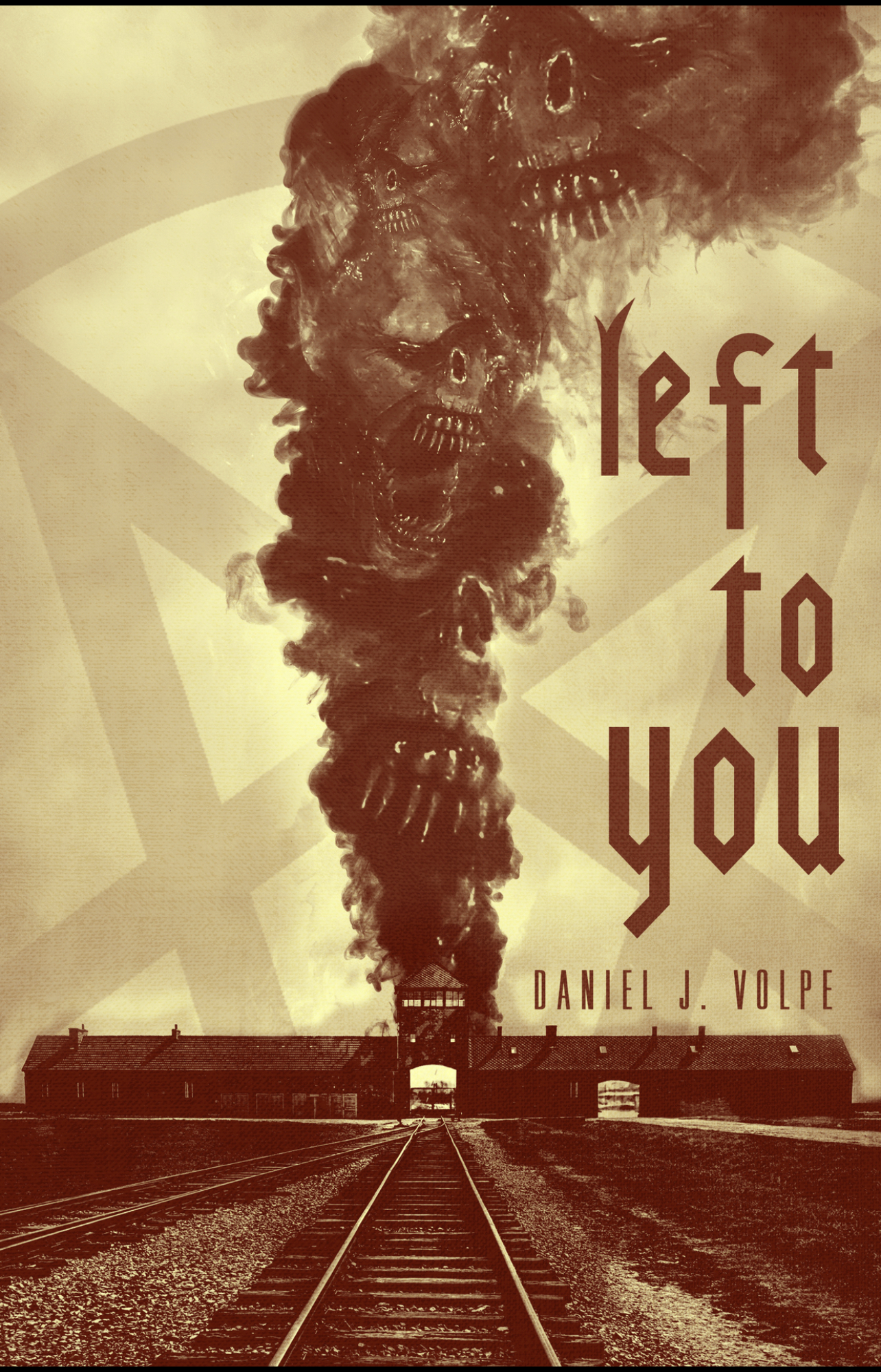
Independent American horror author Daniel Volpe created a critical hit in 2021 with his self-published novel, Left to You. The paperback combines a modern-day occult story with extended flashbacks to the horrors of a WW2 concentration camp.

The main protagonist is Robert Sinclair, a twentysomething stock clerk at a big box store who attends community college while caring for his cancer-ridden mother at home. He strikes up an unlikely friendship with an elderly Polish customer named Josef Lazerowitz who, we quickly learn, is a survivor of the Auschwitz concentration camp during WW2.

The reader is treated (?) to an extended flashback to Josef’s time at Auschwitz as a young man. There’s plenty of ripped-from-the-history books horror as the Jews are subjected to murder, torture and indignities at the hands of their Nazi captors. We also learn how Josef survived when so many of his cohorts did not. The dynamic between Josef and the camp leadership was one of the novel’s strongest attributes largely due to the questionable ethics baked into the situation.

There is very little supernatural horror here in the paperback’s first half. If you are good enough at math, you’ll begin to understand that there’s something weird happening with old Josef who does not appear to be aging normally. Leave it at that.

Once we learn how the death camp story ties into Robert’s contemporary story, we are fully in the muck of a gross-out, bonkers, demonic horror novel. The author does a nice job of creating a parallel between the monstrous choices made by men during the war and the real-life monsters of contemporary horror fiction.

This is a very compelling - but very grim - novel that is definitely not for everyone. It reminded me a bit of Stephen King’s Apt Pupil. You need to make peace with moral ambiguity and the idea that stories don’t always need to have a happy ending for everyone. The writing is crisp and you’ll never be bored. But, man, this isn’t for the squeamish. Consider yourself warned. 

Buy a copy of this book HERE.

Friday, October 28, 2022

Zorro: Zorro's Pacific Odyssey #01

Johnston McCulley's Zorro character first appeared in “The Curse of Capistrano” (aka “The Mark of Zorro”), a five-part serial that debuted in All-Story Weekly on August 9th, 1919. For decades McCulley authored stories starring the caped crusader. Spinning off the pulps, Zorro became a pop-culture phenomenon in international television shows and films. Additionally, many authors have taken turns writing Zorro stories and novels, including Susan Kite. The Indiana native authored a trilogy of Zorro novels called Zorro's Pacific Odyssey. The trilogy's first book, Zorro and the Outward Journey, was published by Bold Venture Press in 2022 as both a paperback and ebook. 

Don Diego de la Vega, son of the wealthy caballero Don Alejandro, lives in Mexican governed California in the early 1800s. By day, Diego displays a bit of cowardice to disguise the fact that he is the famed vigilante Zorro. After a series of attacks on prominent citizens perpetrated by terrorists, Zorro rescues a kidnapped child in the mountains. However, days later Diego is captured by the terrorist group, drugged, and then sold into slavery to a British ship headed to Singapore.

When Diego realizes what has happened, he is faced with his fate. The ship's Captain, a horrible individual named Beatty, explains that Diego is an indentured servant that has been purchased for two years of hard labor aboard the ship. When Diego explains the unfortunate incident of the terrorists, his background as an aristocrat, and the kidnapping, Beatty dismisses it as a fabrication. He soon realizes that Diego is quite different and places him as a trustee of the Spanish workers. Additionally, Diego is placed in care of the ship's Supercargo, a man named Bowman. Diego is fond of Bowman and the two quickly establish a father-son type of relationship.  

As the first of a three book series, it is clear that this book is simply the journey. Zorro is being transported from A to B and must contend with the nefarious elements of the ship's crew and his limitations as a slave. I love prison-styled stories and this one certainly fit that sub-genre of men's action-adventure. What makes this such a compelling narrative is the fact that Diego can't transform into Zorro to fight his way out of the situation. He's trapped in a small space without the ability to don a disguise or do battle with a sword (he does later, but I'm not spoiling your enjoyment here). The fact that Diego is ultimately the hero makes this a unique Zorro story. 

While Zorro on the high seas has been done before, Kite's version of this “fish out of water” adventure is very entertaining. It was also an emotional charge reading about the human condition - a panicked, desperate father hunting for his missing son. It was a really effective part of the whole story. There's also an expected cliffhanger that demands the reader to quickly buy the next book. Needless to say, my account has been debited and Bold Venture Press is shipping it out to me as I write this. Money well spent.

 Buy a copy of this book HERE.

Wednesday, October 26, 2022

Coldiron #02 - Shadow of the Wolf

Shadow of the Wolf is the second installment in the Coldiron western series authored by F.M. Parker. It was originally published in 1985, one year after the series eponymous debut Coldiron. The series stars Luke Coldiron, a former trapper turned horse rancher in mid-1800s Colorado. There isn't much backstory required to enjoy the series, other than Coldiron has a friend named Cliff and that this book is set in 1864, one year after the series debut. 

At the book's beginning, Coldiron and Cliff are attacked by horse rustlers during a bitter, icy period of winter. Cliff is unfortunately killed, but Coldiron kills the rustlers and promises to bury Cliff. Later, Coldiron is in Denver gambling and wins a long poker game with a rival. On his way back home to the Steel Trap ranch, he's overtaken by robbers and left for dead in a ravine. However, the robbers are quickly killed by two other robbers. It sounds confusing, but these robbers are explained in separate side-stories.

The first robber is a Native-American named Ghost Walker, a renegade who was ousted from his tribe due to killing a fellow warrior over a woman. With no land to call home, and a tribe that has erased him from existence, Ghost Walker settles down to live a solitary, yet corrupt life. The second robber is Jubal Clason, a Union soldier that kills his commanding officer in war-torn Virginia and goes AWOL to Colorado. It is here that he meets up with Ghost Walker and the two scheme to rob Coldiron's robbers. Later, the duo rob yet another group by killing a man and his brother, then take the man's widow captive. There is no shortage of murders and robbery in this book. 

Shadow of the Wolf's second half is simply Coldiron trying to kill the men who robbed him. Along the way, he ends up freeing the woman and finds he has romantic chemistry with her (before her late husband's grave has even settled). While this sequel isn't as good as Coldiron, it still maintains a furious pace filled with a large body count and nearly endless action scenes (too many?). But, it is just enjoyable as Hell and makes for another fine western tale told by the talented F.M. Parker. I have no complaints and have high hopes to read the series third installment, Distant Thunder

Buy a copy of this book HERE.

Monday, October 24, 2022

The Book of the Phantom Bullet

Dan Turner: Hollywood Detective was the popular creation of Robert Leslie Bellem (1902-1968) for many of the 3000+ (not a typo) stories and novellas Bellem authored for the pulps before he wrote for TV shows including The Lone Ranger, Adventures of Superman, 77 Sunset Strip and Perry Mason. Many of the Dan Turner stories have been reprinted as affordable ebooks, including 17-page “The Book of the Phantom Bullet,” originally from the December 1945 issue of Hollywood Detective Magazine.

As the story opens, Turner is on the set of a Los Angeles soundstage during a big-budget movie production. The star is a hammy actor named Ben McBride, who is repeatedly filming a scene where two co-stars shoot him at the same time, followed by a dramatic fall down the stairs. The director is dissatisfied with each take, and McBride is growing impatient. In the actor’s final attempt, he mimics getting murdered - quite realistically - because someone actually shoots McBride dead.

This is a great story, but the mystery of who shot McBride – or rather who loaded a real bullet into one of the prop guns – is secondary to the reader’s enjoyment. The real star of the show is Turner’s first-person narrative vernacular and the joy you’ll experience from swimming in his hardboiled slang. Eyes are peepers. A gun is a roscoe. Fists are maulers. A mouth is a kisser. Women are frails. And so on and so forth. Turner’s jazzy bebop is so fun to read. Check this out: “A slug tunneled all the way through his think tank and he’s deader than minced clams.” Pure poetry.

Because this is a pulp mystery story, we know that the killing of McBride is not some unfortunate accident. Turner begins looking closely at the prop man and both of the actors who simultaneously fired their guns on camera for the scene. Turner works closely with the police to get to the bottom of the matter, despite a vexing sub-mystery involving a missing bullet. The final solution was logical and satisfying with bonus points for a bloody and violent climax. What more can you ask for?

It’s been a long time since I had this much fun reading a short story from the pulp era. “The Book of the Phantom Bullet” was my first Dan Turner: Hollywood Detective mystery but it won’t be my last. Highly recommended. 

Buy a copy of the book HERE.

Friday, October 21, 2022

The Letter Death Wrote and Other Stories

Bruno Fischer (1908-1992) was another popular author of the paperback original era who honed his craft with short fiction in the pulp magazines. Our friends at the Pulp Fiction Bookstore have released a compilation of Fischer’s pulp stories from that era titled, The Letter Death Wrote and Other Stories. Here’s a review of two selections reprinted in the new eBook release.

“Murder Turns the Curve”

“Murder Turns the Curve” is an 11-page short story that originally appeared in the September 1948 issue of Popular Detective. The story opens in the aftermath of a two-vehicle car wreck with smoldering, twisted metal strewn across the road. Harry Shay is the young, rookie sheriff’s deputy dealing with the aftermath of the crash and the body of the unidentified woman killed in the accident. 

Why would anyone take that blind curve so fast? Harry wonders. It’s almost like the driver was courting death. The unfortunate accident is one of several lately with fatalities caused by an epidemic of bad decision-making by drivers. Harry becomes convinced that there is more happening here than mere chance. Is it possible that there is a serial killer of sorts who is somehow orchestrating these accidents for some sick reason?  

This is a very inventive police procedural murder mystery with a likable main character in Harry, who is fighting against the police establishment to test his unlikely theory. In short, a very satisfying quick read with a satisfying solution.

“A Grave is Waiting”

“A Grave is Waiting” is a 12-page story with origins in the September 1952 issue of Popular Detective – noteworthy because Fischer was already making a good living with paperback original novels at the time. The story begins with thoughtful private detective Ben Starke being forced into a car at gunpoint by two thugs insisting to know the location of a missing boy named George. Ben knows nothing about the kid and successfully escapes from his captors.

On the next day, Ben is hired by a woman to investigate a gang seeking to kidnap a 12 year-old boy named George. What are the odds? Ben seems to inadvertently have a jump on the case and the would-be kidnappers from his encounter the night before. The client is George’s legal guardian, and she has hidden the boy away until the kidnap gang can be neutralized. The boy’s parents are dead, and there’s a modest inheritance that the crooks want for themselves.

Ben suspects there is more to the story, but he takes the engagement since he already has some skin in the game. This leads to a violent and deadly confrontation with the adversaries where the truth of this plot is revealed. The solution is a dark and macabre treat that readers of sick crime plots will relish. Chalk this one up as another winner from this great vintage author. 

Buy a copy HERE

Wednesday, October 19, 2022

Coldiron #01 - Coldiron

F.M. Parker (Fearl Parker) worked in factories as a laborer, herded sheep, served as a bellhop, served in the Navy and is a Korean War vet. After earning a degree in geology, Parker went into mining, oil drilling, and a long career within the Bureau of Land Management. He became a full-time author, penning over 20 westerns beginning with his novel Skinner in 1981. New to his writing, I wanted to experience the author with one of his bestselling novels, Coldiron. It was originally published in 1984 and led to four subsequent novels starring the Luke Coldiron character. It remains available in ebook under the title Coldiron: Judge and Executioner.

What is interesting about the Coldiron series is that the order of the books really doesn't matter after the second installment, Shadow of the Wolf (1985). The books jump around in time, for example Coldiron begins in 1843 but covers a 20 year time period until 1863. The second installment, Shadow of the Wolf, is set in 1864. Distant Thunder, aka Thunder of Cannon, the series fourth installment, is set in 1862. Spoils of War, aka The Thieves, is in 1846. Basically, one could just jump around in the series because the past doesn't matter too much. All you really need to know is that Coldiron owns a large horse ranch (The Steel Trap Brand) in what was then known as the Colorado Territory. 

At 223 pages, this Coldiron novel serves as an excellent, detailed origin story. Beginning in 1843, Parker explains that the trapping industry was nearing the end of an era. Luke Coldiron and his partner are in their fourth year of trapping in The Rocky Mountains (Sangre de Cristo). Through a wild skirmish, Coldiron's partner is killed by a gang attempting to steal furs. This ordeal forces Coldiron to help his partner's pregnant Native-American widow. This new relationship is nearing a long-term romance when she is injured by a mountain lion. She gives birth to a baby girl and then dies. Coldiron then carries the baby into the plains where he gives her to a team of settlers to raise.

Fast-forward 20 years, Coldiron has worked hard to create the best horse ranch within a 500 mile radius. He breeds horses to sell to the U.S. Army and makes great money with his Steel Trap Brand. In the novel's second act, Coldiron faces deadly horse wranglers and an odd visit from a young woman named Cris pretending to be a cowboy. It's no secret that she was the baby that Coldiron gave up. She wants to kill Coldiron for “killing” her mother. It's all a misunderstanding, but makes for an inventive narrative.

F.M. Parker's Coldiron shares similarities with the early William W. Johnstone's The Last Mountain Man, which was published the same year. Both Parker's Luke Coldiron and Johnstone's Smoke Jensen were mountain men trappers turned ranchers. Coldiron has the Steel Trap and Jensen is the Sugarloaf. Both experienced the loss of their mentors in the mountains, both face rustlers and killers, and both are tough as nails. One could say that any western hero worth his salt has all of these same characteristics and history, but the two are written in the same way. 

I enjoyed Coldiron, and loved learning about his origin and how the horse ranch began. There's a small backstory dedicated to Cliff, a former alcoholic that Coldiron saved and put to work as the ranch chef. The story on Cris, the abandoned baby, was presented well and paired nicely with Coldiron's grief over her mother and his partner's murder. The duo of Cliff, Coldiron, and Cris was a great assemblage of characters with different strengths and weaknesses. If you want military-fiction, unbridled western action, a formidable hero, and realistic descriptions of the mid-1800s frontier, then Coldiron is absolutely a must-read. Honorary mention to Parker's depth of knowledge of horses and ranching. This was educational and enjoyable. Highly recommended. Get a copy of the book HERE.

Coldiron Series

Coldiron (aka, Judge & Executioner, 1984)
Shadow of the Wolf (1985)
The Shanghaiers (1987)
Distant Thunder (aka Thunder of Cannon, 1999)
Spoils of War (aka The Thieves, 2017)

Monday, October 17, 2022

The Creeping Siamese

Dashiell Hammett (1894-1961) was a pulp fiction pioneer who authored enduring titles, including The Thin Man and The Maltese Falcon. For my money, his best recurring character was The Continental Op, an unnamed hardboiled PI on assignment from San Francisco's Continental Detective Agency. “The Creeping Siamese” was a story that originally appeared in the March 1926 issue of Black Mask that was later reissued as the anchor of a Dell Mapback paperback story compilation.

A tall guy walks into the Continental offices and immediately collapses dead onto the floor. An examination of the stranger reveals he was killed by a stab wound to the chest with the gory wound hastily dressed by a piece of silk that appears to be a sarong. The corpse's pocket contains a hotel key, and The Op’s boss dispatches him to the hotel to gather some intel. After all, it’s bad for business for unsolved murders to be happening in the lobby of a prestigious detective agency.

At the hotel, The Op learns the dead guest’s name but has no idea who would want to stab the poor bastard. The only relevant clue is the sarong, so The Op begins to scour the area for “Hindus” and “Brown Men.” Nearly 100 years later, the vernacular comes off as more quaint than offensive, but consider yourself warned if that kind of thing ruffles your feathers. The initial search for an “Asiatic” stabber produces no solid leads, but a lucky break introduces our hero to a clue indicating that the murder was conducted by a Siamese (we now call them Thai) guy.

The ensuing puzzle surrounds a mysterious package about the size of a bread loaf containing unknown contents worthy of murder – at least to the stabby Saimese. The solution, however, comes pretty quickly to The Op and seemingly out of nowhere. The clue that leads him to the conclusion just wasn’t credible to a reader with critical thinking skills. The whole endeavor felt rushed as if Hammett hit his contractual word count and needed to rush to the gym or something.

“The Creeping Siamese” is not a waste of your time, but it's an awful introduction to this vivid and normally hardboiled character. There was nothing particularly edgy or violent about the events, and it could just have easily been an Agatha Christie Miss Marple mystery story. The Op is normally a resourceful badass, but in this one, he was more Sherlockian. If you’re already a fan, you might as well check this one out. If you’re looking to read this awesome character at his best, check out “The House in Turk Street” and be prepared to have your socks knocked off. Get the books HERE.