Wednesday, December 28, 2022

Drop Into Hell

Lou Cameron (1924-2010) mastered so many genres of written entertainment from comic books to westerns to mysteries and so on. Drop Into Hell was a 1976 WW2 combat adventure “in the breathtaking tradition of Allistair MacLean” released by Fawcett Gold Medal.

The year is 1944 and Paratrooper Captain David Evans has been given a secret mission. Hitler has developed a new super-tank and fighter jet that could cause some real problems for the Allied Forces. The plan? Hit Germany’s fuel refinery capabilities, leaving the Kraut’s new war machines with their gas tanks on empty.

The specific target is a refinery that shares space with a Red Cross Hospital housing injured American and British POWs. Conveniently for the novel, the hospital/refinery is right next door to a Concentration Camp filled with Jews and Gypsies working as slave labor in the refinery. Bottom line: Bombing the refinery into the stone ages isn’t an option.

Enter Paratrooper Dave and his crew of commandos, which includes the mandatory American Indian soldier. Their mission is to parachute into Nazi turf, sabotage the refinery, and get back across the lines safely into the warm embrace of the Allied forces. The problem? No one really has any idea how to get the saboteurs out of Germany once the damage is done.

The entire paperback is a very smooth and easy read as the cast of characters tackle problems and obstacles along the way. However, the novel‘s action lagged a bit in the middle. For my money, I think Len Levinson’s The Sergeant series is a stronger choice, but if you’re looking for Allistair MacLean Lite, this paperback will more than suffice. 

Buy a copy of this book HERE.

Monday, December 26, 2022

Conan - Black Colossus

“Black Colossus” is a Robert E. Howard story starring Conan the Cimmerian. It originally appeared for the first time in Weird Tales, June 1933. It was reprinted in the 1954 Gnome Press collection Conan the Barbarian with edits made by author L. Sprague de Camp. The website spraguedecampfan points out that de Camp's edits were very minor. Additionally, the de Camp's edited version appeared in the Lancer collection Conan the Freebooter (1968) and subsequent printings by Sphere, Prestige, and Ace. Howard's original version, without de Camp's edits, appeared in Black Colossus (1979), The Conan Chronicles Vol. 1 (2000), Conan of Cimmeria Vol. 1 (2003), and The Weird Writings of Robert E. Howard Vol. 1 among others. The comic adaptation appears in Savage Sword of Conan #2

Shevatas is a legendary thief that readers are introduced to in the early pages. He possesses a special combination that will open a long sought after room in an ancient, abandoned Stygian temple. Once inside, Shevatas is nearly blinded by the glare of gold, silver, and heaps of diamonds. But, a recurring theme in Howard's books, is that the thief never gets the precious goods. In this case, a primeval Stygian sorcerer named Thugra Khotan awakens from a 3,000 year slumber and readers are left to their own conclusions that Khotan kills the thief.

By saying his last name backwards, Khotan takes on the name Natohk (clever, right?) and begins building an evil empire. He crushes and conquers Hyborian nations one by one, amassing their armies into his. The next destination is Khoraja, a country that is led by a brother-sister combination. The king becomes a prisoner in nearby Ophir and the queen, a beauty named Yasmela, hits the streets and pubs seeking a new military leader based on the wisdom she receives from her god Mitra. 

Yasmela, spiritually guided, locates a very drunk Conan at a local bar and convinces him to follow her back to her family's castle. There, she offers Conan the job of leading her royal armament, military, and commanders into a fierce battle with Natohk's controlled forces. A Lord Thespides (a general), is shocked by Yasmela's choice in Conan. Thespides defiantly contends Conan's leadership, but the entire military might of Khoraja soon arrives at the Well of Altaku to battle Natohk's forces. In grand fashion, the field of battle spills onto the page as Howard describes the chaos of the fight and the technical aspects of this confrontation. 

“Black Colossus” is a near-masterpiece of extraordinary battle scenes, large-scale invasion, and a classic showdown between Conan and the evil Natohk. Howard's imagination runs wild with vivid imagery, exceptional descriptions of these barbaric, iron-clad warriors, and a sense of quick plot development considering the short length. I can imagine “Black Colossus” as a full-fledged 500+ pager. 

There are a couple of interesting aspects to the story. The first is Howard's use of Biblical history, particularly Moses. In this story, Natohk throws a spear or staff on the ground and it transforms into a serpent. This mirrors the account in Exodus when the Lord asks Moses to throw his staff to the ground. When Moses obliges God, the staff turns into a serpent. On a much higher level, I believe Howard used Exodus as a blueprint for this story. When Yasmela asks Conan to lead Khoraja's military, the muscular hero questions her choice. He's a lone-wolf, inexperienced leader and the most unlikely military commander. The same could be said for Moses. God asks Moses, an unlikely leader lacking experience, to lead the nation of Israel. The similarities are striking. 

As an enjoyable reading experience, “Black Colossus” provides plenty of action-adventure, sorcery, chase sequences, and steel-meets-steel rallies. It's nearly perfect, flawed only by complicated character names and unnecessary backstory. Further, it is Conan's early development as an emphasis of the story. This work is forming the origins of Conan's eventual rise to King of Aquilonia, so it's important to the overall Conan mythos. Just as a stand-alone story, with no inkling of past or future events, it's still a rip-roaring good time. 

Buy a copy of this book HERE.

Friday, December 23, 2022

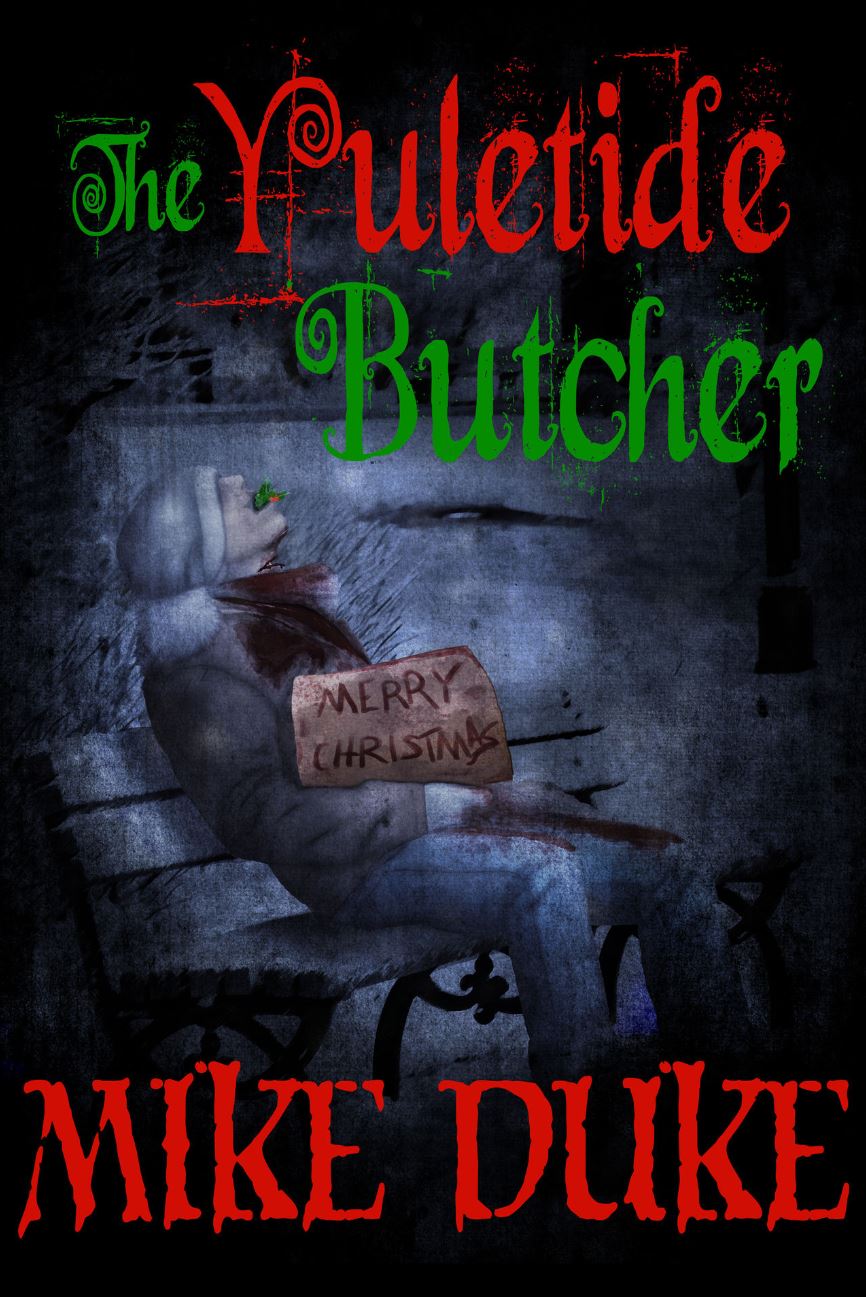
The Yuletide Butcher

According to his Amazon bio, author Mike Duke was a police officer for 12 years and now instructs military, law enforcement, and bodyguards blade and hand-to-hand combat techniques. He's a fan of horror and science-fiction, which I assume led to his love for writing it. In 2021, he launched a three-book series of science-fiction novels called Amalgam. His horror books include Crawl, Ashley's Tale, and Low. My first experience with the author is his Christmas-themed horror novella The Yuletide Butcher, released in 2021. 

For 20 years a killer nicknamed “Yuletide Butcher” murders a random person in Detective Rick Allen's city (Allen with two arms, not one). The killings are innovative and feature a calling card. The killer places holly leaves in one of the body's natural, or newly created, orifices. This year, the city has called in an FBI agent to review Allen's most recent profiling in hopes of avoiding another senseless murder.

While all of that is sorting itself out in the narrative, the author also has another storyline fashioned about a jaded suburbanite family man that becomes mentally unhinged. Jack Randal engages in a heated argument with his wife at a nearby shopping mall. He leaves the wife and kids and checks in at a hotel with his favorite hooker. After numerous sex romps, mostly off the page, Randal comes up with an idea. 

The day before Christmas Eve, he breaks out his fake ID (that he just happened to reserve for this very occasion) and meets with his accountant to transfer all of his money to an offshore account so it can't be traced. Together with his tramp, the two can go to Cambodia and live it up exploring exotic temples. But, he has some baggage to sort through that may involve killing a family, staking their corpses on the lawn, and then burning down their house. Could this Jack Randal crazy family man be the Yuletide Butcher? Can Detective Allen and a stereotypical idiot FBI agent trace the clues?

This 55-pager isn't fantastic by any means. In fact, it is just downright stupid at times. Like the police officer asking Randal's wife if they can check her spouse's credit report and credit card transactions. How, or why, would she have anything to do with providing permission? Or, the FBI agent shocked to discover that the detective actually used profiling techniques to narrow down the suspect list. Or, the entire investigation halting because Randal's “basement door” is locked and there's no key. Or that the guy is paying for dirty movies on PPV at the hotel. Who does that in the 21st century?

However, as a kooky horror tale loaded with violence and horrific outcomes, The Yuletide Butcher is still a wildly good time. Think of it as watching a late Friday the 13th installment – you suspend disbelief to have a good time watching people maimed and knocked off in savage style. If you can do that, and not be offended by grotesque brutality, then these 55 pages will just fly by and you'll ask for a sequel. So, Mr. Mike Duke, is there a sequel? Please take my money, or at the very least show me where that life-size Alien Xenomorph statue is from the book's biography page. 

Buy a copy of this book HERE.

Thursday, December 22, 2022

The Shark-Infested Custard

A few years after crime fiction author Charles Willeford’s 1988 death, his estate released The Shark-Infested Custard, an unsold trunk novel written in the 1970s. It’s a polarizing novel of Florida male hedonism that remains available today.

The book is set in a Miami singles-only apartment complex with a pool where four dudes — each around age 30 — hang and drink vodka martinis from Dixie cups. In short, it’s a great town to pick up chicks in a target-rich environment. Each of the four main characters gets a featured section of the book, which consists of four largely stand-alone noir novellas about these swinging guys.

Our first narrator is Larry Dolman, an ex-cop working in the business office for a big PI firm. He and his horny rat pack spend a lot of time strategizing about how to get laid most efficiently. One of these excursions opens the door to a real dilemma when one of the fellows picks up an underage girl and she dies of an overdose in his car. The guys then bumble into a murder they are generally unequipped to handle. All of this is played for laughs in a dark, comedic tone - think Donald Westlake meets Weekend at Bernie’s meets Quentin Tarantino.

The second narrator is a pharmaceutical salesman named Hank, who has been seeing a married woman. When someone takes a shot at Hank, he can only assume it’s her husband. As the attempts on Hank’s life escalate, we get an interesting look at the job of a legal drug dealer and the nuances of the career. It’s another great story with a tidy ending that brings all the plot threads nicely together.

The third novella follows mostly Don, the Florida sales rep of a British silverware manufacturer, in his attempt to heist his employer’s inventory and get away scot-free. It’s a story that could have been slightly edited to fit in quite nicely with Manhunt or any other purveyor of edgy crime fiction.

Lastly, the boys are back together again reflecting on the drama of the other stories and the fallout of their decisions when a sexual encounter takes a very dark turn.

I was completely delighted by these four stories, yet the consensus among reviewers is that is a below-average effort for Willeford. Let’s be clear: I’m right and they’re wrong. These are four dark, humor-filled crime stories about guys whose inability to control their libidos get them into hot water. Willeford’s writing is predictably awesome, and he’s funny as hell. Okay, the book’s title is staggeringly stupid, but the contents inside are four aces. 

Buy a copy of this book HERE.

Wednesday, December 21, 2022

Conan - The City of Skulls

In the very first edition of the Lancer Conan (1967) paperback, the table of contents lists a Lin Carter and L. Sprague de Camp story “Chains of Shamballah”. But, on page 189 the story title appears as “The City of Skulls”, and in future editions of the book, both the TOC and page 189 both lists “The City of Skulls”. It's one of those oddities in Conan literature. But, drilling down to the review of the story, this is only one of two stories in Conan that is authored by both Carter and de Camp. The other story is “The Thing in the Crypt”. All of the remaining stories in the collection are combinations of Robert E. Howard/Carter or de Camp. The story is also included in Sphere's 1989 omnibus The Conan Chronicles (pictured).

Like “The Hand of Nergal”, Conan is serving as a mercenary soldier for Turan's military. His detachment has been assigned the duty of escorting Princess Zosara to her wedding date with a powerful nomad. As the entourage crosses the plains at the base of a large, and snowy, mountain range, they are overrun by a tribe of savage warriors. Conan's entire squad is massacred, leaving him with two survivors, his friend Juma and the Princess Zosara. 

In an epic, short-lived 20ish pages, the three are forced through bitter cold winds, across the mountains, and into a warm jungle environment called Shamballah, the City of Skulls. It's here that Zosara is promised to a Toad-God-Thing named Jalung Thongpa and Juma and Conan are sold into slave labor aboard a ship. In a violent, brutal struggle, Conan is forced to row for days as he's whipped by a slave master and nearly starved. In an upheaval, Conan and Juma escape the ship and head back to save Zosara. 

In a book that contains Howard classics like “The Tower of the Elephant” and “Rogues in the House”, I'm surprised at how much enjoyment the two Carter/de Camp stories brought me. “The City of Skulls” feels epic, which is really impossible considering it's 33 pages. The story locations are described so well and thrust these characters – unwillingly – into the heart of madness with high altitudes and low temperatures. Mix in the ruthless rowing expedition as testaments to Conan's internal fortitude to soldier on. That's why we read these harrowing adventure tales. Carter and de Camp can tell a great story and I feel like “The City of Skulls” is a worthy addition to this stellar Conan collection. Recommended. 

* An interesting addition to the story is the introduction of a regular character in Juma. His backstory is explained in detail, placing him on the same path as Conan in terms of tragic childhood and harsh lessons in the terrifying wastelands of the Hyborian Age. Juma is featured in both Conan the Buccaneer and Conan the Hero novels. I believe he is also featured in many issues of Conan the Barbarian and Savage Sword of Conan

** “The City of Skulls” was adapted into comic form in the Savage Sword of Conan #59 and very loosely in Conan the Barbarian #37.

*** The Conan: The Adventurer animated television show used a portion of this story, specifically the "Ship of Blood" chapter for Season 1/Episode 2/"Blood Brother". The episode was written by Christy Marx, who had previously provided comic writing for Red Sonja, Conan the Barbarian, and Savage Sword of Conan. The show swaps out the story's character of Juma with an ongoing character named Zula. 

Buy a copy of this book HERE.

Tuesday, December 20, 2022

Bloodroots Manor

Author Jon Messmann cut his teeth writing for the Golden Age of Comics before moving into full-length novels. At the height of men's action-adventure fiction, Messmann created and authored the vigilante series The Revenger, the Travis McGee-styled Logan books, and the enormously popular adult western series The Trailsman. But, Messmann also capitalized on the gothic paperback craze of the 1960s and 1970s. As Claudette Nicole and Pamela Windsor, Messmann authored a number of gothic mystery and romance novels for Fawcett Gold Medal and Pyramid. Cutting Edge Books has published a number of Messmann titles in new editions, including his gothic paperbacks like Bloodroots Manor. It was originally published by Fawcett in 1970 and has been out of print for more than 50 years.

Nancy Hazleton married a man named Dirk and the two set off for a “happily ever after” life in New York. But, Dirk refused to become intimate with Hazleton and often placed her in audacious stunts to impress his friends. In a wild chain of events, Nancy realizes that Dirk has been attempting to murder her throughout their short marriage. During a life or death struggle, Nancy escapes Dirk's wrath and he plunges to his death. Nancy is placed into a mental hospital to rehabilitate.

After regaining her mental stability, and working through her horrendous past, Nancy becomes enrolled in an interior design school. Upon graduation, Nancy is hired by a man named Samuel Howell to redesign his spacious country house. As the book begins, Nancy is riding a train to Deepwell Junction in the rural mountains of Kentucky. When she arrives late at night, she is shocked to discover that Deepwell Junction's train station is an abandoned husk. Further, the directions leading to Howell's estate lead Nancy to a large abandoned house that's severely damaged. To escape a thunderstorm, Nancy takes shelter inside of the old dwelling. In a terrifying sequence, a horribly disfigured man emerges from the shadows and attacks Nancy in the house. She attempts to escape through the forest and collapses. Is this a nightmare or reality?

At 150 pages, I read Bloodroots Manor in one sitting. Messmann was such a craftsman and he builds this narrative into a crescendo of mystery and white-knuckle suspense. Nancy's exploration of the mysterious town, the Howell family legacy, and her relationship with a local historian all add small ingredients to the much larger mystery. Messmann conveys a real sense of isolation and panic as Nancy contends with the idea that she may have been lured into a deadly trap. Each chapter felt like one more step to some grisly discovery. 

If you love the traditional, atmospheric haunted house tale and the “evil thing down the hall” type of storytelling, then Bloodroots Manor is an easy recommendation. With its cursed heirs, family secrets, phantoms on the hillside, and cavernous mansion, this one has everything we all love about the old fashioned gothic novel. 

Buy a copy of this book HERE.

Monday, December 19, 2022

The Heisters

Robert Page Jones (1931-2012) authored nine stories for Manhunt Magazine during the 1960s, including one in 1961 titled “The Big Haul.” The story was expanded into Jones’ first full-length novel, a 1963 Monarch Books paperback called The Heisters. The novel was adapted into a 1967 French film called That Man George (aka L’homme de Marrakech).

Johnny Womack is a truck driver headed from a long-haul home from El Centro, California with an empty load. This is problematic because he could really use some dough. His hot, faithless wife is home with god-knows-whom and the rent is overdue.

Mechanical troubles sideline Johnny in a small California desert town where a three-man heist crew are scheming and planning an armored car knock over. The armored vehicle delivers $750,000 cash to an Army base every two weeks, and it’s just begging to be taken by the right crew. If only the crew had a reliable truck driver to join the plunder squad…

To his credit, the author does an admirable job with character development. The reader gets to spend time with Johnny and the heisters to gauge everyone’s motivations. The heist itself is exciting and well-written, and the aftermath is worthy of Lionel White or Richard Stark. He throws in a great sequence involving an armored car security guard that will knock your socks off.

The aftermath of the heist and getaway has some fantastic unexpected twists that I didn’t see coming and kept me up late turning the pages. The ending violence of this short paperback is worthy of a Quentin Tarantino movie. I can honestly say that The Heisters is one of the finest hardboiled crime caper novels I’ve ever read. It’s never been reprinted, but you should definitely seek out a copy ASAP. 

Buy a copy of this book HERE.