Friday, January 27, 2023

The Happy Man

Eric C. Higgs is a Southern California writer who has only published three novels in his career, including The Happy Man, a 1985 Paperjacks release with an unlikely cult following. The short novel has recently found new life as a reprint from Valancourt Books. 

Our narrator is Charles Ripley, a typical suburbanite in Chula Vista, California - right near San Diego, three-miles from the Mexican border. He works for a defense contractor and lives a dull suburban life with his wife. Things change when new neighbors move in next door. Their names are Ruskin and Sybil Marsh, and Charles takes the time to invite them over for a drink in their first night in the neighborhood. The couples hit it off, and a transformative friendship is formed. 

The first chapter (a flash-forward in the novel’s greater timeline) spoils the trajectory of the book, and the paperback would have been better if the reader could have read about Charles’ evolution more organically. Instead, you’re told right off the bat that things get rather violent for the people in Charles’ immediate orbit. 

Despite this foreshadowing misstep, The Happy Man is a really well-written novel. The story of Charles and his conflicted relationship with his new neighbors made for compulsive reading. It was particularly fascinating to see how the new neighbors altered the behavior of the entire subdivision based solely on the force of their influence. Things get decidedly wild as the book heats up - both sexually and violently. Swingers parties. Secret societies. Drug use. Mysterious murders. And things way darker. 

It’s not a perfect book. The big revelation about the neighbors wasn’t all that surprising and the sudden shift to a culty horror novel was a bit clumsy and abrupt. Despite all that, I found myself enjoying The Happy Man immensely. Recommended. 

Buy a copy of this book HERE.

Thursday, January 26, 2023

Battling Britons #04 - Future War Special

Paperback Warrior generally offers two types of reviews. The first, and most common, is the experienced examination of a novel or a story based on a prior history with the author, book, or series title. For example, we can talk for miles about Mack Bolan, Matthew Scudder, or Quarry because we have a fondness for the character, authors, and series and have read a great deal on the subject. The second type of review is what I refer to as the discovery review. This is our writings and musings of a book, author, or genre that we don't have as much experience with. Our discovery is more of an emotional thing – how it affects us directly and the interest it creates in pursuing the author, future books, or related series titles. 

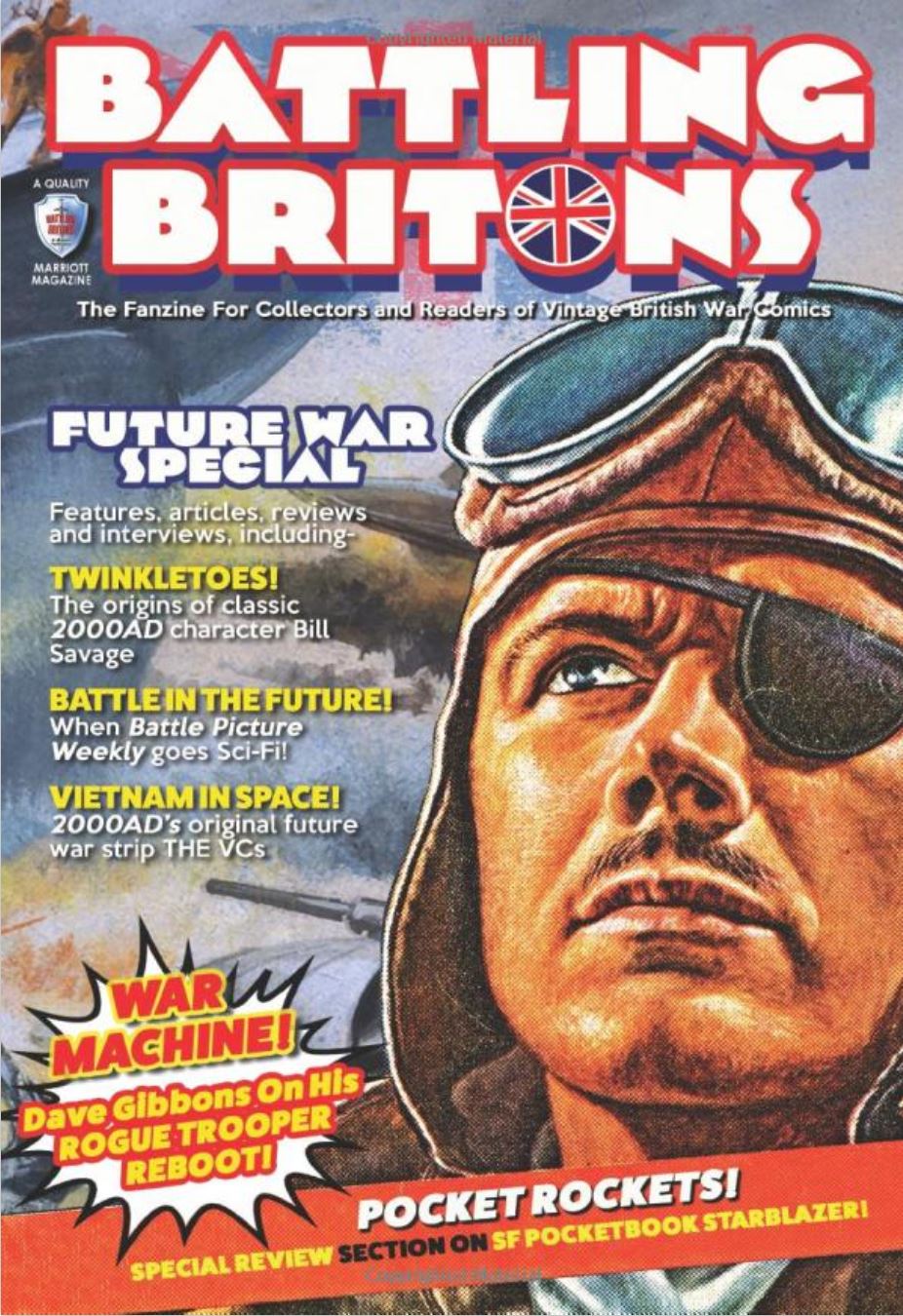
This review is pure discovery, prompted by our genuine love for the fanzines and articles compiled, edited, and written by Justin Marriott and his colleagues. Marriott is a literary scholar of paperbacks, comics, magazines, and pulps, all of the stuff we live and breathe here at PW. Normally, we try to refrain from discovery reviews, but even more so, we generally don't review books about books. It seems silly to review reviews, right? But, Marriott's newest endeavor, his second run of a series of books called Battling Britons, prompted me to learn more about British war comics. Honestly, I had never heard the term until I read about Marriott's series launch a year ago. 

I ordered a copy of the newest issue of Battling Britons, number four, published in November, 2022. The theme for this issue is "Future War Special", covering a variety of war and science-fiction titles, comics, strips, and graphic novels. The only experience I've had with any British comics, sadly, is 2000AD character Judge Dredd. That's probably par for the course for snooty Americans like myself who solely dabble in the US branded comic companies like Marvel, DC, Dark Horse, Image, and Boom. In my defense, I only read books related to one title, X-Men. So, I'm a snoot among snoots I suppose. 

My first impression is that Battling Britons is a 160 page book with a kick-ass glossy cover and design created by Paperback Warrior reader and fan Bill Cunningham. This guy does fantastic work with everything he touches (like the MAM Quarterly books) and this is no different. I would also speculate that Battling Britons might be Marriott's most professional fanzine, a well-structured book that maximizes each page size with an abundance of book covers, columns, articles, and a whopping amount of information on the subject. Granted, the interior pages are black and white, but the content and scope of the material more than make up for that small nuisance. 

Here's the thing. I have no Earthly idea what some of these columns are referring to considering I know zilch about British comics. But damned if my interest isn't peaked, and my education a little better after reading through the book. Titles like Commando, Starblazer, Rogue Trooper/War Machine, and 2000AD look absolutely amazing and I found myself questioning my existence for 46 years around the sun without having this stuff in my life. Where have I been? 

This series title offers eight regular columns and 14 features that are related to the "Future War" theme. 

Highlights:

“A Brief History of Time (Travel in British Comics)”, is four pages about comics and story arcs featuring time travel in world war settings. Starlord 1977's strip “Timequake”, for example, features a bleak alternative future where the Germans prevailed in WW2. Another variation of that comes in the form of “The Sentinels”, featured in Misty 1977. 

There are two articles with James Bacon discussing the reboot of Rogue Trooper, which was informative to me because I never knew about the first version. Now I know, and knowing is half the battle, right? 

“Savage by Name, Savage by Nature” is six awesome pages featuring a look at Bill Savage, a character that appeared in the early issues of 2000AD. The character and premise sounds cool as Hell. A vigilante -esque guy, Savage, is fighting a force called the Volgan who have invaded England. Double-barreled shotguns and grimaced faces make this one look like a must have.

“Pocket Rockets” concerns the anthology comic book series Starblazer, which ran 281 issues from 1979 through 1991. The article is written by Alan Holloway and reviews 18 stories appearing in the series in the 1980s. These stories range from classic science-fiction, fantasy, sword and sorcery, and even space crime-noir. These write-ups and the issue cover art makes me want to retire and just read Starblazer all day. 

Battling Britons was an unfamiliar, new journey for me, but one I'm glad I took. This was a resourceful, intelligent book about books designed in an easy to follow format. The amount of information collected on these British publications including titles, characters, history, writers, and industry was staggering. Justin Marriott continues to produce the best fanzines on the planet and Battling Britons continues his greatness. Recommended. 

Buy a copy of this book HERE.

Wednesday, January 25, 2023

Armless O'Neil #01 - Seekers of the Glittering Fetish

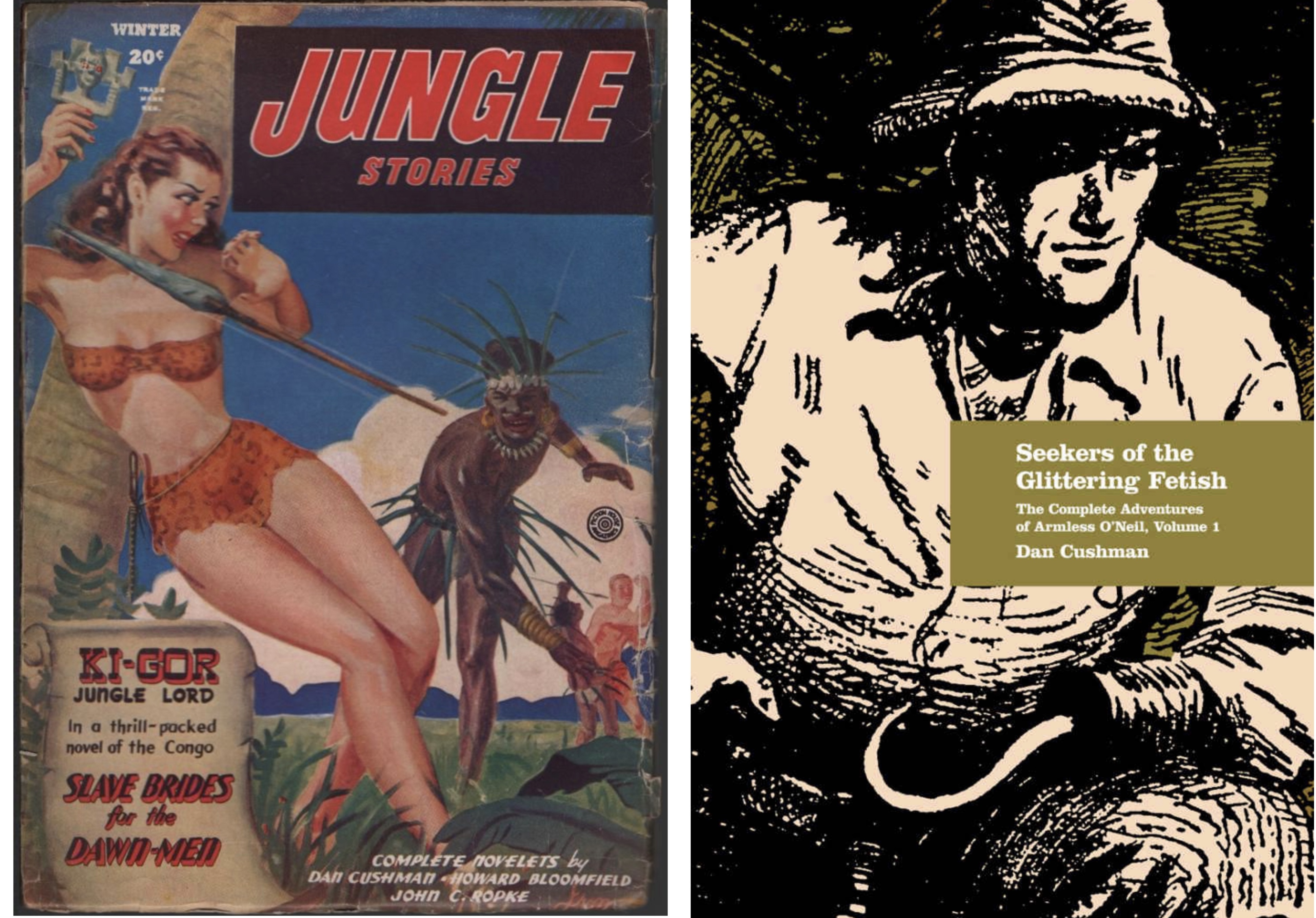
Armless O’Neil is a hardboiled adventurer who starred in 12 pulp novellas by Dan Cushman (1909-2001) between 1945 and 1953. The stories have been compiled into two collections by Steeger Books including the first adventure, “Seekers of the Glittering Fetish” - originally from Jungle Stories Magazine.

Armless O’Neil isn’t exactly armless. He does have a steel hook projecting from the left sleeve of his jacket in place of an arm, but the right hand seems to be intact. He’s described as being ugly, but an “Irish ugliness which a person would enjoy looking upon.”

The story takes place in the port city of Brazzaville, what is now known as the Republic of Congo, back when it was a French colony — a combination of Wikipedia and Google Maps are good supplements to a Dan Cushman story. We join Armless in a seedy tavern where he’s meeting an acquaintance named Swede to discuss some rare blue diamonds.

It quickly becomes clear that the Swede won’t show at the meeting because he was double-crossed and murdered by his business partner, the Dutchman. Armless has zero interest in doing business with the Dutchman because of his practice of flaying the skin off African natives.

Recovering the cache of missing diamonds is the focus of this story. Armless has a sidekick named Tommy who falls in love with a girl along the way in a nice subplot. Cushman writes shockingly violent fight scenes — among the best I can recall in pulp fiction. Having a sharpened hook for a hand sure helps.

Armless is a gruff and charmless character, but you’ll find yourself rooting for him nonetheless.

If you’re sensitive to antiquated African stereotypes, you may want to skip this one as the natives are all of the ooga-booga variety. But if you enjoy old-fashioned hardboiled treasure hunt stories, you’re bound to enjoy this one. 

Buy a copy of this book HERE.

Tuesday, January 24, 2023

Children of the Dragon

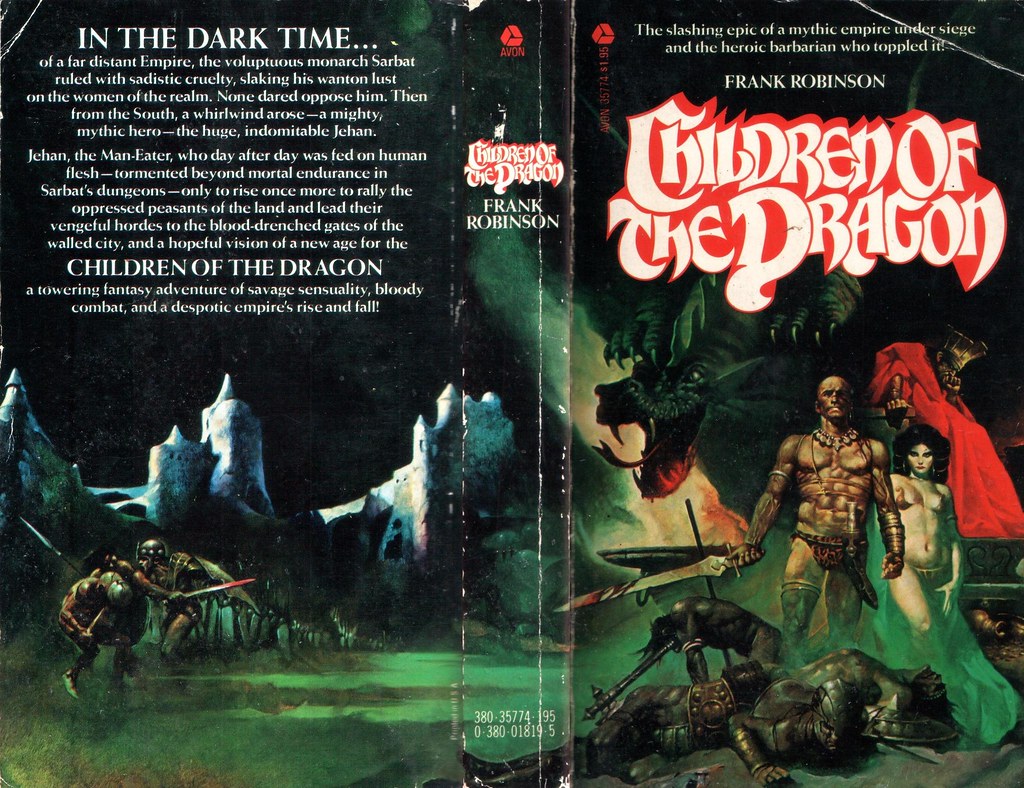
From my research, author Frank Robinson is a retired New York judge and an expert on coin values and collecting. He only authored one work of fiction in his short writing career. The book is Children of the Dragon, published in 1978 by Avon. Admittedly, a 450 page paperback isn't normally something I'm interested in reading, but the novel's cover art is extraordinary. It was painted by popular Spanish artist Manuel Perez Clemente, referred to as Sanjulian. His career work includes characters like Conan, Vampirella and magazines like Eerie, Creepy, and Famous Monsters of Filmland. In stereotypical fashion, I was totally prepared to judge a book by its cover. 

As a long fantasy novel, Robinson spends some time building the world the story exists in. It's a fictional place called Bergharran, similar to Robert E. Howard's Hyborian Age. There are regions (countries), dialects, languages, cultures, and so forth that are explained in great detail. But, overall I speculate that Robinson mirrored parts of the book after the Timurid Empire of the 15th century, what is known now as modern Iran, Iraq, Afghanistan, Pakistan and portions of North India and Turkey. Bergharran is experiencing an age similar to a post-Civil War. The Tnemghadi (the North) defeated the Urhemmedhi (the South) and they now rule with an iron fist as a tyrannical empire. The book's sprawling landscape fits the book's narrative, a storyline that encompasses 20ish years of Bergharran history. 

Over the course of time, the book examines several characters and their growth from poverty to royalty, most playing a supporting role to the chief protagonist, a man named Jehan Henghmani. He's married with two daughters, and in the opening pages it is explained that he had been captured by the Emperor of Tnemghadi. Jehan, a bandit by trade, is able to break his bonds and kill the executioner assigned to behead him. Because of this, and his inability to escape the dungeon, the Emperor imposes a strict punishment. He is to be tortured each day for the rest of his life. Any dungeon master that allows this prisoner to die under torture will receive the same punishment as Jehan. Further, he is fed only human flesh. These torture scenes, which is sometimes described in great detail, were extremely vile and disturbing. After years of abuse, Jehan's wife and kids are brought in and raped repeatedly in front of him. 

Eventually, Jehan is able to escape his Hell and begins to create a new group of roving bandits. But, instead of stealing from the Tnemghadi, he wants to destroy them. The next 300 pages are saturated with Jehan's creation of a large military force that collides with Tnemghadi's reign. There are large swaths of land and regions that are slowly devoured through calculated battles. In essence, Jehan rises to become a new leader through military tactics. This is where the problem lies - the book's focus on continental reformation.

Robinson's book is captivating at times, and feels epic – as it should. But, the narrative is bogged down with so much political strife and turmoil that I became exhausted. This isn't a fantasy novel, nor is it science-fiction or sword and sorcery. There is no dragons or magic and there isn't anything cosmic. This is purely a fictional middle-ages type of story with normal people displaying acts of barbarism, brutality, and violence on one another. At times, the torture sequences rivaled one of the most graphic novels I've ever read, Jack Ketchum's The Girl Next Door. This isn't for the squeamish. 

If political intrigue, royalty chess games, and the pursuit of power by ruthless, self-absorbed characters is your thing, then by all means reading this book should be a pleasant experience. Robinson is a great writer and the overall storyline is superb. But, at the end of the day, it's a lengthy book and requires some patience, and I simply don't have it.

Buy a copy of this book HERE.

Monday, January 23, 2023

The Temple

“The Temple” is a short story from Howard Phillips Lovecraft (1890-1937) that first appeared in the September 1925 issue of Weird Tales pulp magazine. The story has been compiled in countless collections and is available as a free Kindle download. 

The story presents itself as a found “letter in a bottle” manuscript written by a German submarine captain who just sank a British ship during WW1. A member of the German crew removes a mysterious amulet from the pocket of a dead enemy seaman, and things begin to get weird. 

The German crew begins experiencing mass nightmares, babbling, and visions of floating corpses in the sea. Things get worse for the cursed crew throughout the story as insanity leads to mutiny and murder. 

Eventually, the U-Boat settles upon the bottom of the sea where there is a great temple on a large campus recalling tales of the underwater City of Atlantis. Lovecraft does a great job of creating a spooky atmosphere as our unreliable narrator explores the city and slips deeper into madness. 

While not much actually happens in the story, it’s all about the vibe. Lovecraft was a master of creeping dread caused by circumstances and forces beyond our control. Taken in that context, “The Temple” is a worthy, short read.

Saturday, January 21, 2023

Conan - Wolves Beyond the Border

I questioned whether to place “Wolves Beyond the Border” in the Conan category. Technically, it's in the same fictional universe and mentions the hero, but Conan doesn't actually appear in the story. Yet, it first appeared in the 1967 Lancer paperback Conan the Usurper, alongside other Conan classics like “The Scarlet Citadel” and “The Phoenix on the Sword”. By association alone, it seems mandatory. In fact, Howard began the story in the 1930s, but it went unfinished and unpublished. It was located in 1965 by Glenn Lord and then passed to L. Sprague de Camp to finish writing the story based on Howard's notes and summaries.

“Wolves Beyond the Border” takes place along the Pictish border. For Hyborian Age rookies, the Picts are similar to the Native American tribes of the North American continent in the 1500-1800s. If you read early frontier novels by the likes of James Fenimore Cooper (Leatherstocking Tales) or later, traditional westerns by Zane Grey (his Border Trilogy for example), the narratives mostly consist of early settlers and pioneers struggling to live in the same territorial regions as Native American tribes. So, Robert E. Howard used this as a blueprint when creating Conan stories like “The Treasure of Tranicos” and “Wolves Beyond the Border”. The Pictish borders are similar to the surrounding areas of North America's early Ohio River Valley.

This story is told in first-person narrative by a border ranger. In the early pages, this ranger (unnamed and referred to as Gault Hagar's son) witnesses a bizarre ritual by the Picts, where they torture a man and then magically place him in the body of a snake. It is a disturbing, horrific passage that surpasses even the mad-scientist terrors lurking in “The Scarlet Citadel”. This ranger sees that an Aquilonian named Lord Valerian is conspiring to secretly ally with the Picts. This is important because the story is set during a time when Conan was attempting to overthrow Aquilonia's leaders and become the new king. An alliance of Picts and Aquilonian noblemen doesn't promise success for Conan. 

At nearly 60 paperback pages, the story becomes bogged down and convoluted in the middle. The ranger hero confronts Lord Valerian and Pictish leaders at a swamp cabin and there's a fight and a capture. The beginning and end are exciting skirmishes and chase sequences, but overall I found the story to be of middling quality. From what I understand, Howard wrote the story up to the cabin meeting, and then the reigns were handed to de Camp to complete the manuscript from there. 

In the big picture of the Conan mythos, “Wolves Beyond the Border” is like the Star Wars film Rogue One. It is a separate story without the major heroes like Skywalker and Solo, but adds to the trilogy that began with Star Wars. Same principle here. While Conan isn't around, this is a behind-the-scenes political/military strategy that contributes to the events leading to Conan capturing the Aqulonian throne. If that's your type of story or if you are a Conan collector, then I'm sure there is plenty of enjoyment to be found here. Otherwise, skip it.

Friday, January 20, 2023

M.I.A. Hunter #10 - Miami Warzone


M.I.A. Hunter was a series of men's action-adventure novels published by Jove in the 1980s and early 1990s. The series was created by Stephen Mertz (Cody's War, Kilroy) and featured his outlines and editing with a revolving door of authors including Joe Lansdale, Arthur Moore, and Mike Newton. Crime-fiction author and popular blogger Bill Crider (1941-2018) contributed as well with his series debut, Miami Warzone. It is the 10th installment, originally published in 1988 and existing today in digital format through Wolfpack Publishing

Miami Warzone is the first domestic appearance of Mark Stone, Terrence Loughlin, and Hog Wiley, the three-man retrieval team effectively known as “M.I.A. Hunter”. The series began with dangerous missions into Southeast Asia to rescue American prisoners held captive from the Vietnam War. Stone's team was working without permission from the U.S. Government, therefore their activities were highly illegal and placed them on a C.I.A. hitlist. But, the American government caught on to Stone's skills in the same way that they caught on to The Executioner. If you can't beat them, join them. So, a U.S. Senator (Harler I think?) in book seven liberates the three hunters and places them on the federal payroll working out of Fort Bragg. You're all caught up now.

In this 10th installment, Crider introduces readers to Jack Wofford, a former teammate of Stone's during the Vietnam War. He even helped to save Stone's life during a nasty firefight at a seemingly abandoned village. In a terrific backstory, Crider tells of how Wofford's brother succumbed to drug addiction and eventually died. To avenge his brother's loss, Wofford went vigilante and began running his own one-man vice-squad. Eventually, he had enough intel and dirt on some of America's most powerful drug dealers. The D.E.A. were impressed with Wofford's talents and placed him on the payroll, similar to what happened with Stone and the C.I.A. But, on a recent undercover buy, Wofford is caught and becomes imprisoned as collateral during a Cuban and Columbian drug war. 

Stone receives a call from Wofford's wife stating that the D.E.A. isn't doing enough to free her husband. The trio takes the job to track down Wofford's whereabouts while also attempting to destroy the drug importing operation devouring Miami. The narrative has a tremendously high body count as the locations include park battlefields, a wild Everglades romp, the ultimate barfight, a mansion blowout, and even a shootout at an airport. 

M.I.A. Hunter isn't Hemingway and never professed to be. Instead, it's a rip-roar, ass-kicking team commando series with explosive action and a slight dose of testosterone humor (Hog is a riot!). As much as I loved the old fashioned “bring 'em back alive” Vietnam rescue missions, the idea of Stone and company working domestically is a nice change of pace. The last two novel locations, the Soviet Union and Nicaragua, were both excellent choices to move this series into another dynamic. Crider's writing style is ultra-violent, but also balances out with a quality story laced with crime-fiction elements, sex, and a buddy cop camaraderie. In other words, this one is a series standout. 

Buy a copy of this book HERE.