Tuesday, December 28, 2021

World's Scariest Places #01 - Suicide Forest

Jeremy Bates is a Toronto horror-fiction author that has won both an Australian Shadows Award and a Canadian Arthur Ellis Award. He's published two very unique series titles – The World's Scariest Places and The World's Scariest Legends. With these books, Bates spins his own original stories based on popular myths and folklore. After reading his 2019 novels Mosquito Man and The Sleep Experiment, both of which are part of The World's Scariest Legends, I was anxious to try one of his World's Scariest Places entries. I borrowed a friend's copy of Suicide Forest, originally published in 2014 and now available in both audio, physical and digital versions.

Suicide Forest is based on the very real “suicide forest” in Aokigahara, Japan (also known as the Sea of Trees). Sadly, under this tranquil, dense canopy of trees, over 100 people take their own life each and every year. Bates uses this bizarre magnetism to construct this survival-horror novel. 

Ethan and his girlfriend Mel are American teachers working temporarily in Japan. After agreeing to hike Mt. Fuji, the couple is joined by Mel's high school friend John, a co-worker named Neil and Ethan's best friend Tomo. When the book begins, the group of friends is near the entrance of Aokigahara debating on a hiking /camping in the forest after heavy rains delay their climb. After meeting two Israelis, Ben and Nina, the whole group embarks on a hiking trip into the “suicide forest”. 

After a few hours, the group finds a corpse hanging from a tree, an old abandoned car, and a thick atmosphere of doom and gloom (obviously!). The group eventually camps and awakens to find Ben dead and hanging from a tree. Thinking he committed suicide, the friends attempt to hike back out of the forest to find the police. Soon they become lost and Neil develops a traumatic case of the runs. Lost, with a corpse and stacks of diarrhea, the friends begin hearing noises in the forest. After Tomo is found dead (another hanging corpse!) and John is nearly killed, Mel and Ethan discover that the “suicide forest” has quickly turned into the hills of homicide.

At 350-pages, Suicide Forest never really feels bloated or overextended. In some ways it reminded me of another tight survival thriller, The Ruins by Scott Smith. Ethan's jealousy of Mel and John's relationship, John's military experiences in Iraq, Tomo's Japanese humor and Nina's sexuality all play important roles in keeping the narrative interesting and propulsive. The forest killers (or supernatural entities) are truly scary and Bates walks the balance beam on revealing just enough to keep readers guessing on what is really happening in these dark woods. 

Like my prior experiences with Bates, his stories continue to have a unique flavor. With over 20 published horror novels, this author still maintains quality over quantity. He's really something special and I can't wait to read more of his work (translation: I'm going to raid more of my friend's Jeremy Bates collection). Buy a copy of the book HERE

Monday, December 27, 2021

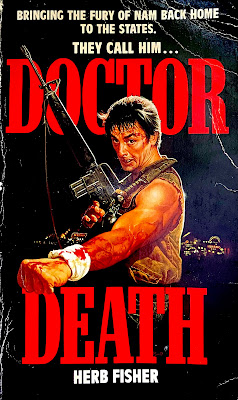
Doctor Death #01 - Doctor Death

Author Herb Fisher (1932-2001), a North Philadelphia native, began writing as a sports editor for his high school. On a football scholarship, Fisher attended Temple University and majored in journalism. Nicknamed Herbie or Fish, the author gained employment at Cherry Hill's East and West high schools as an English and Drama teacher while also coaching football. 

Beginning at age 55, Fisher had enjoyed writing so much that he wrote five screenplays, a novel and two television scripts. His agent suggested that one of the screenplays would be better suited as a book. The screenplay, Doctor Death, was whittled down to an epic novel. Eventually, that was trimmed and edited into a four book series of men's action-adventure paperbacks published by Berkley. The first novel, simply titled Doctor Death, was published in 1988 with misleading cover art and blurb. After reading it, I feel strongly that Herb Fisher deserved better treatment from his publisher.

Upon first glance, Doctor Death appears to be a late 80s cash grab targeting Mack Bolan fans. The concept of a Vietnam vet returning home to become a vigilante had become stale by the late 1970s. Dozens of movies and hundreds of books utilized the formula and most of them are all entertaining to a degree. But, after reading the first 100-pages of Herb Fisher's book, I began to understand that this isn't a cookie-cutter, “law in your own hands” styled action-adventure. It's much better than that.

The book's 18-page prologue takes place in the green jungles of the Mekong Delta in 1969. Army Special Forces (Green Beret) Sergeant Kyle Youngblood is fiercely defending an American camp as a large Vietcong battalion attack. As his fellow soldiers die, Kyle experiences a range of emotions from shock to raw, animalistic anger. Using grenades, mortars, wire, and guns, Kyle is able to hold the line while bleeding from a leg wound. When a backup platoon arrives, they find Kyle unconscious and nickname him “Doctor Death.”

The first chapter places the narrative in the present day where Kyle is now a farmer in Silver Lake, Nevada. He's living a happy, quiet small town existence with his wife and two young children. Everyone in town is fond of Kyle and considers him a hometown hero. In the opening chapters, readers are introduced to the Fallon family. They reside 25-miles west of Kyle and control a large portion of the Las Vegas underworld. In a backstory, it's explained that Marty Fallon was shot by rival mobsters and paralyzed from the waist down. He controls the action from a wheelchair in his posh, enormous mansion. His sons are screw ups, but they maintain a portion of the mob action. The youngest, Buddy, is Marty's pride and joy. But, Buddy is a wild man, sort of a juvenile delinquent right out of a 1950s crime-noir. He's a buck-wild drinker, gambler, and womanizer partying through life with his father's endless supply of money.

On Kyle's trip into town to purchase supplies, he makes a poor decision to stop in Andy's Place for a quick drink. Buddy is inside, backed by two enforcers, drinking and talking smack to anyone who will listen. Surprisingly, Kyle ignores all of it as a promise to his wife that he won't fight again. But, when Buddy's Lincoln and Kyle's beat-up pickup truck collide in the parking lot, all Hell breaks loose. Kyle is happy to swap insurance cards, but Buddy wants to swap fists. Provoked into the fight, Kyle ends up injuring the two enforcers and killing Buddy. The town sheriff is owned by the mob, so Kyle is jailed even though the fight was self-defense.

The court releases Kyle on bond, but he can't escape the trouble. When Marty learns that Buddy is dead, he places a hit on Kyle and his family. Several enforcers attempt to kill his family, but Kyle survives. In the book's third act, Kyle and his family are thrown to the wolves by the local law enforcement. They allow a mob army to descend on Kyle's farm to obliterate everything standing. The book's finale has Kyle defending the farm in the same manner as he did in Vietnam. But, instead of Army supplies, Kyle is left to make an unusual defense using farming tools and household items. The final battle is nothing short of spectacular. 

Herb Fisher gets everything right with Doctor Death. Kyle is an admirable protagonist and his willingness to sacrifice himself for his family transcends from the printed page to the beating heart. I cared about these characters and raced to the end just to learn of their fates. But, it's the little details that Fisher includes that make all of the difference.

So many books and films miss key moments to build small side-stories that will later become important events later. Fisher gets it. In the beginning, Kyle learns that the store owner doesn't have the ammo he needs. Instead, he has to settle on an undesirable caliber. This will play a large role in the book's finale. Or, something as simple as Kyle aiming a rifle, but placing extra shells between each of the fingers on his left hand for easy reloading. This reinforces battlefield experience. It's a statement that Kyle is a believable hero. Fisher even adds in the fact that the sheriff doesn't remove his hat when talking with Kyle, but the deputy does. It solidifies a good relationship, an alliance, between the deputy and Kyle. These little things are important. 

While I'm sure Fisher was delighted that his books were published by Berkley, the publisher misled the consumer. Kyle isn't the “M-16 vigilante of Vegas” like the cover suggests. I recently acquired the second and third books of the series and they have equally frustrating covers. While I enjoy The Vigilante, Sharpshooter, The Executioner, and so forth, Doctor Death isn't that type of debut. It's a different presentation and style, a screenplay to the extent that it fits into a novel. In other words, make an appointment with Doctor Death and take your damn medicine. 

Buy a copy of the brand new edition HERE

Friday, December 24, 2021

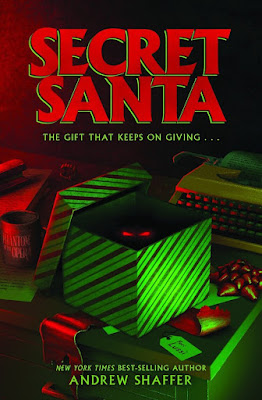
Secret Santa

Andrew Shaffer studied writing at Chicago's The Second City and is now a columnist for Huffington Post and RT Book Reviews. He created an atheist seasonal card company that was featured on The Colbert Report and co-owns the independent publisher 8th Circle Press. Shaffer became a NY Times bestselling author with humorous works like Fifty Shames of Earl Grey and How to Survive a Sharknado and Other Unnatural Disasters. I was searching for a holiday read and stumbled on his 2020 horror comedy Secret Santa. It was published by Quirk Books and is available in physical, digital, audio formats.

The novel takes place in 1980s New York and stars a spunky publishing editor named Lussi Meyer (and a hideous Nazi Devil Doll). Lussi's career has mostly consisted of publishing horror, but most recently she lost her editing job and has joined the ranks of the woefully unemployed. Desperate to pay the rent, Lussi's final attempt as an editor leads her to a prestigious publisher called Blackwood-Patterson. The building is old, the publisher has lost its way, and Lussi dreads working for this snooty “hardback” company. 

During the job interview, Lussi reminds the owner that Blackwood-Patterson hasn't produced a bestselling novel in over a decade. There's some banter back and forth on horror novels and the owner's idea that it's a distasteful genre. Rudely, she's asked to leave. But, before her departure, Lussi spots an old German doll (the hideous Nazi Devil Doll) in the owner's office. While handling the creepy toy, the owner has a heart attack and dies.

The owner's son has distanced himself from the publisher and isn't enthralled with the idea of running the company. After talking with Lussi, he requests that she work for him to reverse the publisher's declining sales performance. In doing so, Lussi introduces the concept of genre publishing and focuses on horror manuscripts that have been rejected. But, they haven't just been rejected. They have been placed in the building's dark and dusty basement to rot with rat feces and mildew. Needless to say, the publisher really hates genres (and would despise Paperback Warrior).

Lussi spends her time reading some good horror manuscripts and pissing off the charismatic chief editor nicknamed The Raven. But, at the annual office Christmas party, Lussi involuntarily takes part in a Secret Santa game where inebriated employees receive gifts from anonymous co-workers. Lussi's gift ends up being the creepy, disturbing Nazi Devil Doll from the former owner's office. Soon, Lussi realizes that her co-workers are being injured or killed based on the murderous magic of this ancient relic.

Secret Santa works as an average horror comedy. It's gross in all the right places and contains the obligatory funny dialogue to glue it together. I enjoyed the 1980s publishing lingo and Lussi's quest to find the next Stephen King, Dean Koontz or Peter Straub (the trinity of modern horror). Lussi is a lovable protagonist and the assembly of characters made it enjoyable. In terms of horror, I liken it to Grady Hendrix's Horrorstor - a new employee takes on a difficult assignment while battling workplace horror. If that's your thing, then Secret Santa is a wonderful gift. Buy a copy HERE

Thursday, December 23, 2021

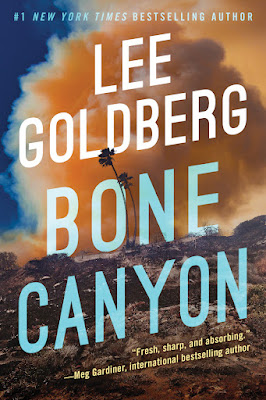
Eve Ronin #02 - Bone Canyon

Script writer and novelist Lee Goldberg rocketed into the New York Times Bestseller list with the successful series Fox & O'Hare, co-authored by Janet Evanovich (Stephanie Plum, Knight and Moon). Along with successful titles like Monk, Charlie Willis, and Ian Ludlow, Goldberg has recently concentrated his efforts on Eve Ronin, a crime-fiction title that began in 2019 with Lost Hills. I read and reviewed the novel and found it to be an exciting, high-quality start to the series. In 2021, the second Eve Ronin novel, Bone Canyon, was published. It's available in physical, digital, and audio editions.

In Lost Hills, Goldberg introduced Eve, a rookie homicide detective working for the Robbery-Homicide division of the Lost Hills Sheriff's station, a mid-sized city in South-Central California. Eve is despised by most of her fellow officers for short cutting the seniority climb. After an off-duty arrest of an intoxicated, disorderly celebrity, Eve discovered that the incident was captured on video and released to social media. The incident and footage made her the local hero and a political pawn utilized by the Los Angeles County Sheriff's office. Needing the positive image, they promoted Eve, a prior patrol cop, to homicide detective. In the debut novel, Eve solidifies her local hero status by valiantly solving a triple murder. 

What makes Eve a different type of hero is how much she avoids fame and fortune. After a second video becomes viral, her media status escalates. A Hollywood agent wants to sign her for a television deal, endless reporters want an exclusive, and her mother and sister both want her to look glamorous for her newfound spotlight. But Eve doesn't care about anything other than her job. She's resilient and steadfast in her mission to serve the people. She repeatedly declines TV deals and interviews and continues working cases with her soon-to-be retired partner Duncan “Doughnuts” Pavone. Eve is Duncan's mentor, a relationship that transcends from student and master to something more akin to a niece and uncle. 

In Bone Canyon, Eve and Duncan are called to investigate the remains of a human skull found in the Santa Monica Mountains. During the search for more bone fragments, Eve is introduced to a bookish, yet charismatic anthropologist named Daniel. The two immediately have a chemistry and Eve relies on Daniel's experience to piece together a fragmented skeleton. In doing so, Daniel locates more skeletal remains of another individual. This discovery expands the examination into two cases that are possibly unrelated. 

Through trials and tribulation, Eve and Duncan face physical and emotional adversity. There's political upheaval when the two detectives trace the clues back to a fraternity of officers within the Los Angeles Sheriff's Department. Eve's mental fortitude is put to the test when she carefully walks a balance beam of time-management, health, and her eroding camaraderie with her co-workers. In addition to the work stress, her family life continues to be a burden. Her mother, a comical whirlwind, remains persistent in belittling Eve's career choices. In an important side-story, Eve's sister introduces her to a physical therapist in hopes that it paves the way to romance. 

Bone Canyon is superb procedural fiction, complete with action, suspense, and an exhilarating pace. Every page means something. Aside from the twists and turns of the case, readers are thrust further into Eve's personal life, with a more dynamic awareness of her love life, personal attrition, media stardom, and her inevitable future without the veteran experience of Duncan. 

This novel is a real cornerstone of the series, one that places Eve at the proverbial crossroads – fight for the truth despite the deadly risk or find solace by gratifying the corruption. Her against-the-grain attitude and determination makes her one of the most independent characters in ages. Her decisions are hers alone to make, and even Lee Goldberg has no say in the matter. She's doing it her way, and her way is what readers will love. I can't wait for the next one.

Buy a copy of the book HERE

Wednesday, December 22, 2021

The Penetrator #02 - Blood on the Strip

With the success of The Executioner, Pinnacle began creating titles that captured the action-oriented, vigilante feel. In 1973, the publisher released The Target is H, the first novel of The Penetrator series. It ran a total of 53 installments under the house name of Lionel Derrick. The odd numbers were written by Mark K. Roberts and the even installments by Chet Cunningham. I enjoyed the series debut and wanted to revisit the character. The second entry, Blood on the Strip, was published in October, 1973.

Cunningham begins the novel with an eight-page prologue recapping the character's origin story and events from the first book. The series can be read in any order and features hero Mark Hardin as a Vietnam veteran fighting crime vigilante style. He's aided by two behind-the-scenes allies in Professor Hawkins and a Native American named Red Eagle. This opener explains that Hardin destroyed a California mob family and he's now prowling Las Vegas searching for his next mission.

The book's opening chapters has Hardin detonating charges at a talent agency called Starmaker. After, he heads to Professor Hawkins and Red Eagle to summarize events in Vegas. Thus, his recount to them makes up this entire novel and explains the sequence of events that led to Starmaker's fiery destruction. I like when books start with the conclusion and then map out how these events developed. It's like starting with the Oreo stuffing.

Hardin meets a young woman named Sally Johnson, an aspiring model and actress trying to earn a living in Vegas. At a restaurant bar, she advises Hardin that the talent agency she is using wants her to begin stripping and prostituting. When she refuses, they issue violent threats. When Hardin attempts to escort Johnson to her car, he's jumped by enforcers of the agency. Sally is cut to shreds and left to bleed out in the parking lot. Thankfully, she's rushed to the hospital and Hardin begins assembling a plan of attack. 

Cunningham's narrative keeps a steady pace as Hardin investigates the agency and its owner. In what will become a familiar formula, the investigation leads to some hit and run tactics destroying parts of this immense criminal empire. The villain behind the agency is like a knockoff female nemesis of James Bond. She keeps sex slaves locked in cages and eventually captures Sally to lead Hardin to her enforcers. Readers know how the story ends, but the ride is a lot of fun.

Since this was Cunningham's first Penetrator novel, I think this installment is a feeling out process. Hardin doesn't necessarily behave in the same manner in future novels and it becomes less elementary and neanderthal. Roberts had a better version of the hero in the debut, but Cunningham eventually finds a connection to the character and delivers equally enjoyable installments (so I've been told). If you love  the 1970s men's action-adventure genre, The Penetrator is in the upper echelon.

Tuesday, December 21, 2021

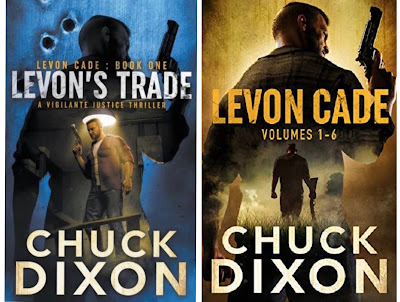
Levon Cade #01 - Levon's Trade

Chuck Dixon is a famous comic book writer whose work on Marvel’s Punisher series is regarded as a masterwork of the medium. Since then, he has been writing novels, including a popular vigilante series starring Levon Cade. The series debut from 2014, Levon’s Trade, has recently been reprinted by Wolfpack Publishing. 

The novel opens in a depressed Huntsville, Alabama. Levon Cade is lucky to have a gig as a graveyard shift security guard on a construction site. The novel wastes no time establishing that Levon is a no-joke badass as he disarms and dispatches two thugs shaking down a Guatemalan laborer at the site. 

We learn that Levon is a man with a particular set of skills learned during his shadowy time in the military. Joe Bob is Levon’s boss who does some homework and figures out that there’s more to his security guard than meets the eye. Joe Bob’s daughter is a college student in Tampa who has gone missing, and he hires Levon to find her. Levon’s got his own troubles involving an expensive custody battle over his daughter. Bottom line: he needs the money, and accepts the gig. 

Levon travels to Florida to investigate, and the reader is given further glimpses into our hero’s character and capabilities. He’s a quiet and stoic badass with an almost supernatural ability to appear, disappear, and fight - like a ninja in blue jeans. As he gets closer to the truth and his Russian prison gang adversaries come into greater focus, the author avoids the temptation of delivering a cartoonish or over-the-top action story, instead opting for gritty realism. 

Anyone who has ever read a Jack Reacher novel by Lee Child and wished it was written with the lean economy of a 200-page paperback from the 1970s will be very pleased with Levon’s Trade. Dixon writes in extremely short, punchy chapters with no irrelevant diversions. The characters are developed through their actions, not through the pages of introspective thought and inner monologues. Levon Cade is a Pinnacle Books action hero for the 21st Century. 

There appears to be nine books thus far in the Levon Cade series - all offered at affordable prices with attractive covers. If the other books maintain the same level of pace and quality as this debut, it may be the best contemporary men’s adventure series on the market. As large publishing houses demand bloated 400-page novels to sell at Walmart and airport magazine shops, it’s a breath of fresh air to read a series that remembers what made the genre great. Chuck Dixon is the real deal, and Levon Cade is the modern hero we deserve.

Buy a copy of the book HERE

Monday, December 20, 2021

Death Merchant #25 - The Enigma Project

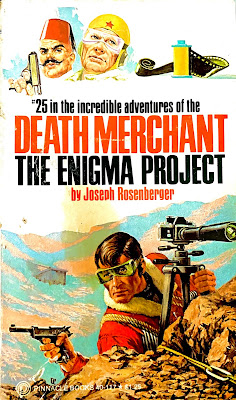
In November, 1977, Pinnacle published the 25th installment of Joseph Rosenberger's Death Merchant series. My reasonably intact paperback shows it is the second printing, a clue that this series was a big moneymaker for the publisher. Mostly, you can read the series in any order and the concept is really simple. Richard Camellion is a CIA agent, dubbed Death Merchant, that patrols the globe quelling international threats. Rosenberger thumbed through magazines like National Geographic to place his hero in exotic and dangerous locales to heighten the sense of adventure. In this case, it is the mountains of Ararat.

The Enigma Project begins with Camellion as an undercover mountain climber who has joined the Jasper Grundy Bible Institute. In the opening chapters, it's explained that this faux religious group was created by the CIA to use on a rainy day. The mission is for Camellion to climb to the heights of the Ararat mountains to place a specially designed, high resolution camera. This camera will quickly capture hundreds of photos that the CIA can analyze. The goal is to locate strategically placed satellite installations being utilized by the Soviet Union in Armenia. Or, something like that.

Camellion and two supporting agents join the study group under the intention of guiding them to a fabled position where Noah's Ark may rest. The group travel to Turkey on a helicopter, but unbeknownst to the passengers, the CIA has created a unique panel system that houses a small armory inside. This is unveiled to the passengers when they discover Camellion and others are packing heat for the climb. Camellion explains that mountain bandits and Armenians don't typically settle by just throwing rocks at unwanted guests. What he doesn't explain is that the group is expendable and their unfortunate deaths will be a sacrifice for the greater good.

Halfway up the snowy passage, the group encounter Soviet Armenians. In a series of exchanges, Camellion and his supporting agents fight the bad guys en route to the top. Problems include avalanches, harsh weather, Soviets, and a nagging religious scholar. Rosenberger writes the action sequences smoothly and places readers in the battle by describing who's on the flank, the perimeter defenses, and the combatants next moves. It's completely vivid and provides enough escapism for the average cubicle worker.

This series is fun in limited interactions. I prefer gritty team-combat novels, but in a pinch Death Merchant can provide some enjoyment. This installment is par for the course. Mileage may vary.