Monday, February 28, 2022

The Big Bounce

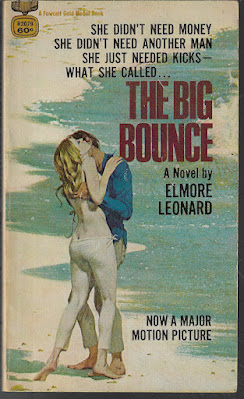
Between 1953 and 1961, Elmore Leonard (1925-2013) authored his first five career novels and all were westerns. Leonard played his first hand of crime-fiction in 1966 with a relatively unknown novel called The Big Bounce. He shopped it to a variety of publishers and they all declined. In 1969, Fawcett Gold Medal published the book simply because it had been adapted to film the same year starring Ryan O'Neal and Leigh Taylor-Young. The movie was a flop, so Hollywood tried again in 2004 with a cast including Owen Wilson, Morgan Freeman, and Charlie Sheen. It was such a disaster that Leonard described it as the “second-worst movie ever made”, alluding to the fact that the first one was the worst. Despite the publication and theatrical horror associated with The Big Bounce, I decided to read it. I wish I had those hours back.

The book begins with three men watching a video tape of migrant worker Jack Ryan (no relation to Tom Clancy) executing a home-run swing with a baseball bat on his crew leader's face. Readers later learn that Ryan was a former Baseball Player and has now spiraled down the labor ladder to the position of Seasonal Picker of Cucumbers in a lakeside region of Michigan. Ryan and acquaintances (he never had friends) rob a lake-house and steal $750 from wallets and purses. Ryan fears that the other guys will get caught simply because the box they placed the wallets and purses could be found.

After being fired from his job for smashing the foreman with the bat, Ryan is hired as a Handyman by a resort owner named Mr. Majestyk (oddly, no relation to the character Leonard created five years later). Ryan spends time in his new position avoiding an average-looking female guest who desperately wants to get lai....wants to have her window fixed. Ryan hooks up with Nancy instead, a young seductress who is banging two men, one of which is the owner of the cucumber farm. Ryan and Nancy run around shooting glass objects while planning to steal the payroll money from the farm.

I have no Earthly idea why anyone in Hollywood wanted to make a film from this novel. Or, why anyone would want to attempt it again. The book is mindless with its lack of plot structure and features one of the most uninteresting protagonists I've read. I nearly gave up reading it twice, but just kept pushing onward out of respect for Elmore Leonard. There isn't anything remotely compelling about the story, the character development, pace, or dialogue. If you must read everything Leonard wrote, then I guess you owe it to yourself to experience the good and the bad. Beyond that, avoid this book!

Buy a copy of the book HERE

Friday, February 25, 2022

Innocent Wanton (aka Young Nurse Desmond/Student Nurse)

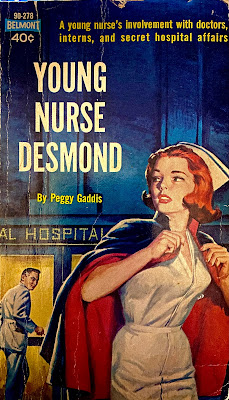
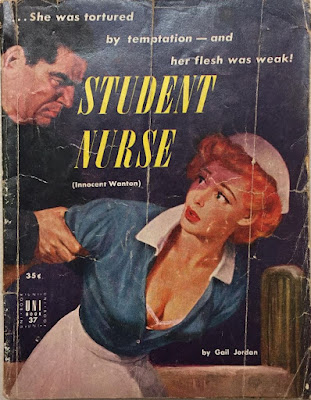
Peggy Gaddis Dern (Erolie Pearl Gaddis, 1895-1966) used pseudonyms like Georgia Craig, Joan Sherman, Perry Lindsay, and Peggy Gaddis to author romance novels and nurse fiction throughout the mid 20th century. Her first published work was erotic and racy novels printed by the lowly publisher Godwin in 1935. In the 1940s, she began to be published by Phoenix Press, Gramercy, and Arcadia. Prior to her death, Belmont and other publishers began reprinting her sexy romance novels to entice nurse-fiction fans. A great example is Young Nurse Desmond, published by Belmont in 1963. This novel was originally titled Innocent Wanton and published by Phoenix Press in 1950 under Dern's pseudonym, Gail Jordan. It was also printed under the title Student Nurse by Uni-Book as Digest Paperback #37.

Innocent Wanton is a sexy, juvenile delinquent style novel about a young girl named Martha that loses her virginity to a celebrity playwright named Jordan. Martha isn't a nurse, but works as a trainee in the Happy Valley Nursing Home. I'm not even sure the book discloses her last name as Desmond. After providing some pills to Jordan (who is there voluntarily), she learns that he is in this facility due to a drinking problem. Jordan immediately falls in love with Martha and desires to have her. After he begs Martha to have dinner with him, he is able to cajole her into the back seat where he takes her innocence on the cold vinyl seat. 

Later, Jordan proposes to Martha, she says yes, and the two move to a penthouse apartment in Manhattan. Martha quickly realizes that Jordan is a bit of a scumbag when she discovers that he has a girlfriend on the side. Risking the rewards of a robust alimony check, Martha bails on the marriage and rides a bus to the most overused locale in crime-noir history – the always reliable shore-front cottage in Small Town, Flordia. Her fierce independence doesn't last long when a man named Paul spots her bouncing out of the water. After “learning sex” from Jordan, Martha is determined to give her body to Paul in the most domineering way possible. However, Martha's problem is that Paul has a secret, a hidden connection to Jordan's past life. He is withholding information from her in hopes that she will be an easier lay. How can she escape these horny, secretive men and find true love?

The cover of Belmont's Young Nurse Desmond paperback, which again is the re-titled version of the earlier Innocent Wanton, states the book is about a young nurse's involvement with doctors, interns, and secret hospital affairs. The artwork clearly has the main character dressed as a nurse and leaving a general hospital. Does this sound like the same book? 

Unfortunately, Belmont and other publisher were notorious at cashing in on the hottest literary trends by reprinting prior novels. Dell probably made a great deal of money reprinting early mystery novels as Gothics in the 1960s and 1970s. In this case, Belmont is cashing in on nurse-fiction, a genre that Peggy Gaddis contributed to for 25+ years. By changing the author from Gail Jordan back to the marketable Peggy Gaddis name, and slapping a nurse on the cover, it probably swayed fans into believing this is a new release for the author.

This is my first experience with Peggy Dern and I mostly enjoyed the book. I have a tolerance for romance novels based on my love of Gothics and we've covered the romance-heavy slave Gothics (also known as plantation novels). The sex isn't graphic, but Martha was described in a voluptuous way that motivated me to learn more about her. Her torrid relationship with Jordan came to a satisfying conclusion and I genuinely enjoyed the rivalry between the lovers. I think if you enjoy juvenile delinquent-styled stories (Martha is 18-yrs of age) then you will probably find enough to like here. Innocent Wanton, aka Young Nurse Desmond, aka Student Nurse, is a lukewarm recommendation. 

Buy a copy of this book HERE

Thursday, February 24, 2022

Barr Breed #02 - The Body Beautiful

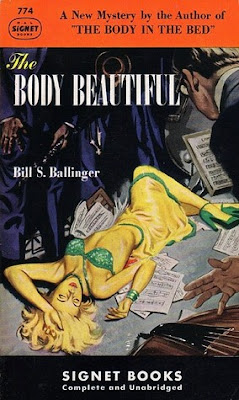
While writing over 150 teleplays, Bill S. Ballinger (1912-1980) still had the opportunity to author nearly 30 novels. His crime-noir and detective fiction is still held in high regard, including two novels he wrote about a Chicago private-detective named Barr Breed. I read the first of these novels, The Body in the Bed (1948), and really enjoyed it. It was only a matter of time until I tracked down the sequel, The Body Beautiful. It was originally published by Signet in 1949 and was reprinted several times through the mid-1960s. 

As described in the first novel, Breed is a private-investigator that runs a staffing agency featuring detectives. His agency is employed by stores, banks, railroads, and any business or individual attempting to retrieve or prevent an economic loss. Often, these investigations eventually lead to murder. In The Body Beautiful, trouble lays its bothersome load right on Breed's front steps.

Breed and his friend Benny stop by the Marlowe Theater to view a traveling performance called The Golden Girls. Mostly, it's scantily clad beauties dancing while suspended in bird cages. After the titillating performance, Benny introduces Breed to one of the show's star performers, a knock-out named Coffee Stearns. During the awkward date, and subsequent awkward dates, Breed can't penetrate Coffee's social walls. But, once she realizes he's a detective, she lowers her guard and bra straps. The two kindle a relationship, but it's short-lived. During a performance, Coffee falls from one of the cages and plunges into the crowd. The cause of death? A knife in the back. 

Breed is torn up over the murder and wants to investigate free of charge. Like most of these crime-noir detective novels, Breed's police ally is Sergeant Cheenan with the Homicide Division. The two have a bitter relationship due to Breed's reckless abandonment outside of the law. But, Cheenan knows Breed is a relentless gumshoe, so he allows him a long leash. Before Breed starts the investigation, he receives a phone call from a man wanting to hire Breed. The job is worth $1,000 if Breed can confirm that Coffee Stearns was really a woman named Betty Anne Beals. Intrigued by the offer, Breed takes the case.

Ballinger was a tremendous talent and The Body Beautiful is another fine testament to his storytelling skills. I love this Breed character and the two-sided personality he possesses. Sometimes he's Mike Hammer screaming at everyone in the room and at other times he's just a wisecracking predecessor to 1950's Shell Scott. Like the first novel, Breed displays a ferocious fighting spirit, but prefers to rely on others to make mistakes or provide tiny clues that eventually lead to the mystery's resolution. 

While mostly saddled in Chicago, the book takes a jaunt to New York briefly. Through a cross-section of suspicious performers, Breed must interview everyone involved in the production and its past performances. I found the characters intriguing and the plot's twist and turns fascinating. The book's grand finale is a suspenseful chase scene through the empty theater as Breed is forced to match wits with the mysterious killer. 

If you enjoy these mid 20th century detective novels, then you will love The Body Beautiful. It's clever, suspenseful, funny, and hard-hitting. Unfortunately, this was the second and last appearance of this dynamic detective and that's a real shame. I wish Ballinger could have found a steady and consistent paycheck writing a series of Barr Breed novels. But, we only have these two works as a small glimpse of what might have been. 

Get the book HERE

Wednesday, February 23, 2022

Barge Girl

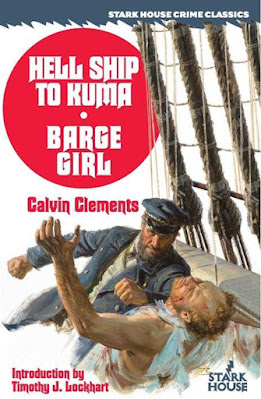
Stark House Press continues to reprint the original novels of New Jersey native Calvin Clements. During his life, Clements was in the Navy, served as a firefighter in New York City, and later perfected writing by contributing numerous scripts for television shows like Gunsmoke, How the West Was Won, and Dr. Kildare. Along with authoring short stories, he wrote four stand-alone paperbacks, two of which are paired together in a new Stark House two-in-one, Hell Ship to Kuma (1954) and Barge Girl (1953). I read and enjoyed Hell Ship to Kuma, as well as another of Clements' novels, Satan Takes the Helm (1952). Barge Girl was on my radar and thankfully has arrived in a gorgeous edition with an introduction by Timothy J. Lockhart (Smith, Pirates).

As a tugboat captain, Joe Baski tows barges around New York City. He's been on boats his whole life, including a sting as a quartermaster during WWII. But, his dream is to own a boat of his very own. Over the years, Baski has invested a few dollars every week to build what is ultimately a $50,000 boat. His next move is to quietly finish out his employment and then start his own charter business in the Florida Keys. Then came the “barge girl”, a married knockout named Stella.

When Joe first lays his eyes on Stella, he knows he must possess her. Stella's husband is much older, a weathered barge watchman that has become complacent with his boring existence. Stella wants more out of life, but feels an obligation to her husband. When she meets Joe, there is an instant attraction, a hot chemistry that refuses to burn out. Joe needs Stella for the next phase of his life and Stella wants to go, but is fighting an inner urge to be a devoted wife. 

Without spoiling your enjoyment, Clements successfully combines a love story with a suspenseful death, set against the backdrop of the 1950s shipping business. Like his prior novels, Clements still offers readers technical lessons on freighters and barges, but it doesn't distract from what amounts to be a thrilling narrative as Joe and Stella wade the waters of seduction and deceit. Fans of police procedural novels may enjoy the book's finale, complete with a pesky and thorough insurance investigator. 

Overall, Clements is simply masterful and remains one of the most frustrating authors of the mid 20th century. With only four novels to his name, readers deserved so much more than what he produced. Thankfully, I still have one more Clements novel to read, Dark Night of Love (1956) and at least 14 short-stories, all of which have been listed in the Clements bibliography at the back of Stark House's reprint. 

Buy a copy of the book HERE.

Tuesday, February 22, 2022

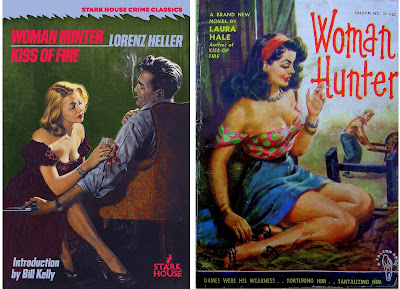
Woman Hunter

Lorenz Heller (1910-1965) wrote three books for a digest-size paperback house called Falcon Books using the pseudonym Laura Hale. Stark House Press has reprinted two of them, so I started with the 1952 dramatic heist novel, Woman Hunter.

Marty Doyle is a boxer who is hiding out in a fleabag apartment in Newark, New Jersey. A couple days earlier, he was supposed to take a dive in the ring but failed to do so. Now he has a pissed off mobster looking for his head, and the only thing that can make it square is to reimburse the mobster the $15,000 he lost betting on the fight.

Marty’s manager is an old-timer named Chuffy who knows a thing or two about both sides of the law. Chuffy wants to pay the mobster the fifteen grand to get Marty back in the ring and working toward a lucrative title shot. Chuffy doesn’t have many marketable skills, but he’s really, really good with guns.

Through his own underworld connections, Chuffy falls in with a heist crew looking to pull a big-money armored car job and lands Marty a gig as the getaway driver. The catch is that Chuffy and Marty need to hide out with the other crew members in a remote cabin before the job, so nothing goes sideways with any of the human resources.

As an author, Heller always puts a lot of energy into fully developing his characters. It was important to him that the reader understands everyone’s motivations. In a 180-page paperback, that can come at the expense of plot and action. That’s the problem with Woman Hunter. The set-up is super-interesting, but it quickly devolves into too much soapy romantic drama. A violent gun-filled conclusion was unable to save this snooze of a novel.

I stand by my assertion that Lorenz Heller is an unsung hero of crime fiction from the paperback-original era, but Woman Hunter isn’t the top-of-the-heap. Stark House is to be commended by bringing Heller’s work back to life, but this one can be safely skipped. 

Get the book HERE

Monday, February 21, 2022

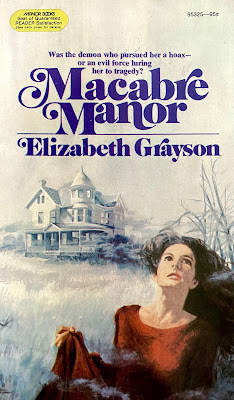
Macabre Manor

Based on a small sample size, the Gothics that I've read from the late 1960s through the mid-1970s have teased a supernatural element. The covers and taglines always suggest that the big mansion or castle contains a ghost or spirit haunting a beautiful woman. The finale fizzles out to be a scorned lover or disenchanted relative that suddenly becomes greedy and secretive. It was conventional style that is reminiscent of the shudder pulps of the early 20th century. At the beginning of the 1974 Manor book Macabre Manor, authored by Elizabeth Grayson, the protagonist appears to be tormented by a demon. Is the terrifying demon real or just a figment of her twisted imagination? Needing to resolve this important question, I jumped into this 190 page vintage paperback. 

Joyce has recently married Philip Hammond and moved into his family's mansion on the Caribbean island of  St Michael. After a walk on the beach, Joyce is visited by a demon calling himself a French man named Jean Pierre. He appears to Joyce as a “zombie” and slowly begins to demand things from her. After Joyce suffers a nervous breakdown, she is hospitalized and treated for anxiety. The Hammond family feels that Joyce isn't really interacting with a demon, instead she's suffering from fatigue and her new surroundings. When the demon asks Joyce to poison her father-in-law, the book begins to delve into a criminal conspiracy involving a bank and illegal gambling. 

Macabre Manor is merely an average Gothic novel with the traditional genre tropes – inheritance, wealthy family, supernatural sprinkles, and a vulnerable female embarking on a dark mental journey. According to Goodreads, Elizabeth Kary used the pseudonym Elizabeth Grayson to author a number of historical romance novels. However, based on my research, I can't verify if this author is the same one that wrote two other Gothic novels in the 1970s for Manor Books – By Demon's Possessed (1973) and Token of Evil (1974). Based on the quality of Macabre Manor, I'm in no hurry to find out. 

Buy a copy of this book HERE

Friday, February 18, 2022

Frisco Flat

According to Cutting Edge, author Stuart James grew up in rural Pennsylvania and at 15 went to work as a sports reporter for the Delaware Valley Advance. He sold his first story in 1951 to a pulp magazine and later became a staff writer for True and Popular Mechanics. While writing original paperbacks, James became an editor for Midwood Books, a subsidiary of Tower Publications that focused on adult romance novels with lurid covers. It was here that two of James' novels were published, The Devil's Workshop (org. title Bucks County Report (1961) and Judge Not My Sins (1961). Lee Goldberg's Cutting Edge has reprinted four Stuart James' novels including Frisco Flat, originally published in 1960 by Monarch. 

After a short career in boxing, Frankie Cargo receives a letter from a friend suggesting that he comes back home. Home is Frisco Flat, a fishing community off the California coast where Frankie grew up. Frankie learns that his father has died and a man named Sam Barlow now controls a majority of the town's industry. Frankie then discovers that his childhood home is now being occupied by a gorgeous squatter named Tosca, the girlfriend of the town's law-enforcement officer. Frankie gets in a fight with the officer and realizes coming home to Frisco Flat was a very poor decision.

Frankie's father left him a great fishing boat, but Barlow wants to buy it. By owning the boat, he will have a complete monopoly on the fishing industry. Frankie has other plans and borrows money to repair the boat and get it to sea. After days of hot, stinky fishing, Frankie's ton of fish should net him a solid profit to build the business back. But, someone working for Barlow shoots up Frankie's boat, thus sinking the vessel and Frankie's livelihood into the ocean depths. However, Barlow's men don't realize that Frankie grabbed something extremely valuable to them, a package worth a million dollars to the highest bidder.

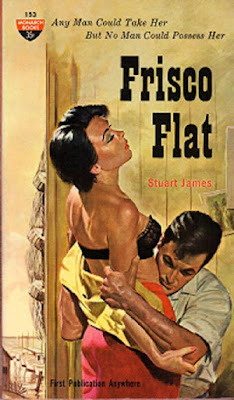
Based on the book's original cover art, I was expecting it to be a romance novel. Instead, it is a gritty, fast-paced crime-noir with lots of traditional genre tropes – criminal empire, the unlikely hero, beautiful women, a heist, and violence. Lots of violence. Frankie's transformation from the town pushover to the defiant hero was such a pleasure to read. I found that James storytelling presented itself like a good screenplay, which makes sense considering he spent a majority of his career in Hollywood on scripts and treatments. There are two hot romances for Frankie, but James doesn't dwell on it. Instead, he pushes the narrative into a crescendo of vengeance that was reminiscent of a western yarn.

However, Frisco Flat isn't terribly original. In fact, it bears a lot of similarity to Edward S. Aarons' 1953 novel The Net. In that story, Barney is a prizefighter that receives a letter from his brother asking him to return to his hometown. The town is a small coastal village where Barney's brother and father own a fishing business. Barney's father has been killed and a town bully named Hurd wants to buy out the family business. When Barney refuses, violence rises to the occasion. Sound familiar?

Obviously, James probably read Aarons' book that was published seven years earlier. But, despite the similarities and borrowed storyline, Frisco Flat was terrific. The romantic angle, character arc, and the surprises were worth the price of admission. If you enjoy great crime-noir literature of the mid 20th century, then you'll absolutely enjoy this book. Cutting Edge made a fine choice by adding Stuart James to their already impressive catalog of classic authors. Frisco Flat proves it in spades. 

Buy the book HERE