Monday, March 7, 2022

Shotgun

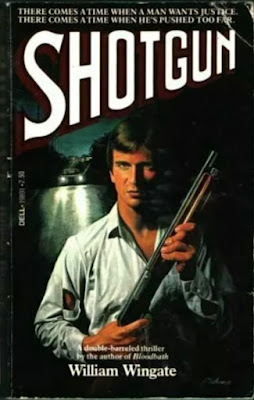
William Wingate (1939-2012) was a South African born author responsible for seven novels and a non-fiction book about winning poker. His 1980 paperback Shotgun was released as Hardacre’s Way in England and later adapted into the crappy movie Malone starring Burt Reynolds. It remains available as an affordable ebook.

Our hero is John Hardacre, a tough guy who drifts into the remote Tennessee mountain town of Baptist’s Fire. Hardacre is first encountered pushing his broken Volkswagen Beetle into the town’s service station employing the novel’s affable narrator, a 15 year-old named Lou. About halfway through the novel, the author reveals something about Lou that will knock your socks off. I’m still laughing about how clever this revelation was.

The service station is owned by Lou’s pa, and he’s receiving pressure to sell from a wealthy mobster-turned-boss hog who’s buying up the town. As pa turns down these cash offers, the pressure becomes more coercive thanks to the developer’s henchmen. All of the town’s leaders, including the corrupt and feckless sheriff, are in the back pocket of this local bossman whose lackeys are beyond justice.

As the novel progresses, we see bullies in action targeting Hardacre for harassment on the street and the spontaneous outbursts of violence increase Hardacre’s profile as a target for the town establishment’s revenge. Hardacre’s unwillingness to bend in the face of bullies puts his hosts, Lou and Pa, squarely within the blast radius for more violence.

What we have here is a fairly typical western plot transported to 1980 Appalachia. Other critics have compared Shotgun to Shane by Jack Schaefer, but the influence of David Morrell’s First Blood also shines brightly. It’s established early in the paperback that Hardacre travels with a sawed-off shotgun and you just know the weapon will be a turning point later in the book when the inevitable violence erupts.

Fans of 1980s men’s adventure paperbacks should regard Shotgun as required reading. The story of a drifter being pushed beyond his tolerable limits by bullying authorities is timeless, and the author delivers the bloodbath that genre fans will love. 

Get the ebook HERE.

Friday, March 4, 2022

The Hit

After authoring westerns for a decade, Brian Francis Wynne Garfield began writing crime-fiction in the 1970s. His pinnacle may have been 1972's Death Wish, but books like Relentless and The Three-Persons Hunt were stellar genre entries. Based on my research, 1970's The Hit may have been Garfield's first traditional crime-fiction novel. 

At the relatively young age of 30, Simon Crane spends his days as an amateur geologist in the desert. Before his complacent lifestyle, Crane was an Army Intelligence Lieutenant, a collegiate baseball player, a newspaper reporter and a cop. On the beat, Crane was “accidentally” shot by his partner during a hardware store holdup. After taking two .357 bullets in the thigh, Crane is now on early retirement and disability, allowing plenty of time for rockhounding.

Crane's life is turned upside down when his former love interest, Joanne, shows up at his door with an incredible tale. She is employed as a secretary for one of the front businesses ran by the Aiello-Madonna-DeAngelo mob. Along with playing with Aiello's files, she occasionally allowed him to bed her down in his downtime. Due to the intimacy, Joanne knew that Aiello had over three-million dollars in his secure safe as well as incriminating evidence on lawmakers, politicians, mob members, and even herself. When she arrived at work that morning, Aiello was missing and his safe was open and empty. 

Shortly after explaining to Crane that she doesn't know what to do about her situation, two mob enforcers appear and search Crane's house for any evidence that Joanne may be hiding. Doing the smart thing, Crane and Joanne go to DeAngelo and Madonna and explain that they had absolutely nothing to do with Aiello's murder. DeAngelo doesn't believe them and feels that Joanne sold out the mob and now she's been fed to them as the scapegoat. DeAngelo issues a deadly deadline: 48 hours to either bring the money back or prove that they didn't kill Aiello.

Garfield's short novel contains gambling, mobsters, double-crosses, car chases, and the obligatory “body buried at a road construction site”, all main ingredients of any great crime-fiction dish. The mystery aspect could be the fact that Crane is attempting to find the answer to save his own life. This is a genre trope of many 1940s and 1950s original paperbacks.

The Hit showcases Garfield re-creating the magic of crime-noir and makes both Crane and Joanne likable heroes throughout the propulsive plot. While there are a lot of characters to remember, the storyline and development isn't overly complicated or convoluted. Instead, this is just another good Brian Garfield novel with enough gritty violence and perplexing mystery to satisfy seasoned genre fans. 

Get the ebook HERE.

Thursday, March 3, 2022

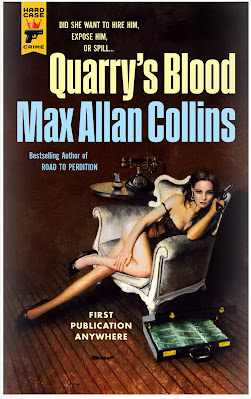
Quarry #16 - Quarry's Blood

Max Allan Collins’ Quarry series about a paid assassin is probably the best series (still) going today. The books blend action, mystery, sex and humor in a perfect combination, so I was excited to read the 2022 installment, Quarry’s Blood.

As the novel opens, it’s 1983 and Quarry (age 31) is at a strip club in Biloxi, Mississippi re-connecting with a stripper he once knew named Luann (stage name: Lolita). If this rings a bell, that’s because Quarry’s Blood begins as a sequel of sorts to 2015’s Quarry’s Choice, although Collins does a good job getting the reader up to speed if you’ve never read the other novel or forgotten the particulars. Mostly, Collins is just bringing back a beloved former character and consider yourself lucky as Luann is a fan-favorite love interest for Quarry.

Anyway, Quarry used to be a normal hitman, but now he’s a hitman who gets paid by intended victims to kill other hitmen before they can kill the targets. If possible, he also investigates the situation to figure out who hired the hitman in the first place — because if you don’t do that, why bother? The upshot is that Quarry returns to Luann because his 1983 investigation indicates that a hitman is targeting his former stripper friend for extinction.

We also join Quarry in 2021 (age 69) looking back on his life and greatest hits over the years. He’s content with his life of retired solitude when a visitor comes-a-knocking. The visitor isn’t carrying a gun, but rather a notebook. She’s an author of true crime novels, and she’s pieced together who Quarry is - or was - and wants to interview him for a book. She’s aware that Quarry has over 40 kills to his name and other things about him that I won’t spoil here.

Quarry is also facing a problem of someone trying to kill him. Does it have something to do with his prolifically murderous past? Or maybe it’s connected with this true-crime journalist poking about? This leads to a lot of revisiting historical hits to learn the one that triggered the violence of the present. There’s a meta-fiction aspect the whole endeavor that will also delight series stalwarts - you’ll know it when you read it. Of course, Collins ties the past and the present together in a tidy and well-construction manner forming one multi-generational tale.

Quarry’s Blood is another excellent installment in the series, but probably not a great entry point for a new reader since there are so many references to other Quarry adventures. This one’s for the fans. There’s an afterward by the author implying that this may truly be the last Quarry novel. I’m calling on Hard Case Crime publisher Charles Ardai to figure out a way to put the screws to Max Allan Collins to ensure there are more installments forthcoming. Whatever it takes… 

Buy a copy of the book HERE

Wednesday, March 2, 2022

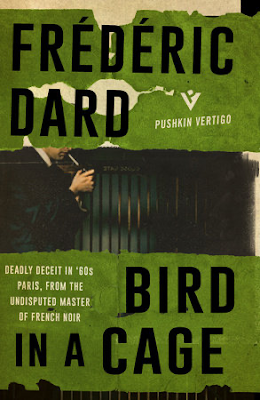
Bird in a Cage

Frederic Dard (1921-2000) has been called the Harry Whittington of France because he authored approximately 300 crime-noir paperbacks during the mid-20th century using his own name and a wide variety of pseudonyms. Readers may be familiar with his 175-installment San-Antonio police procedural series that received a sizable run of English translations. A London-based reprint publisher called Pushkin Vertigo has been reprinting many of Dard’s greatest hits with crisp, new translations for modern audiences, including his 1961 stand-alone paperback, Bird in a Cage (Le Monte-Charge).

Our narrator is Jerome and he has returned home to Paris on Christmas Eve after spending six years incarcerated for the murder of his girlfriend. Arriving at his childhood home is a melancholy experience since his mom died four years earlier when Jerome was in prison. Facing the crippling sadness of a Christmas alone, Jerome decides to treat himself to a nice dinner at a fancy restaurant.

At the restaurant, Jerome encounters a woman and follows her to a movie theater. He sits next to her and holds her hand in the dark providing the poor fellow with some much-needed human contact. After the show, they wander about Paris a bit and wind up at her place headed for a sexual encounter because they are French and that’s what the French do.

Just as Jerome is about to close the deal with this mysterious woman, they enter her parlor and lying underneath the tree is the girl’s estranged husband with his head blown off. Needless to say, this throws a monkey wrench in Jerome’s big plans to get laid after six years of forced celibacy. Moreover, Jerome is forced to disclose to this new widow that he’s a newly-released ex-con (and convicted murderer) and probably not her strongest alibi.

Jerome sets out to solve the murder, and seemingly impossible things begin to happen deepening the paperback’s mystery. The solution recalled the architectural misdirection often seen in a John Dickson Carr locked-room mystery in which a seemingly perfect crime is explained through elaborate planning and execution. As a mystery, the solution worked, but it didn’t make for a particularly edgy or hardboiled novel.

The writing (or rather the translation) was uniformly great making this an enjoyable 120-page quickie. The book’s final page was abrupt and confusing, but it didn’t impact the mystery itself. Overall, I enjoyed this foray into French noir and will probably come back for more. 

Buy a copy of the book HERE

Tuesday, March 1, 2022

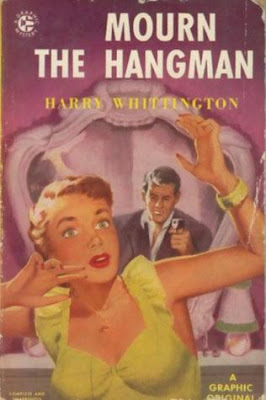
Mourn the Hangman

Harry Whittington's second contemporary novel was 1951's Murder is my Mistress, published by Graphic as #41. One year later, Whittington was featured again by the publisher with Mourn the Hangman, Graphic #46. The book was reprinted by Prologue in 2012 in paperback and digital editions.

Steven Blake and Bruce Bricker own Confidential Investigations, a private-eye business based in Gulf City, Florida. Their most recent job placed Blake undercover as a laborer for Arrenhower, a manufacturer with a government contract to produce airplane parts. Blake's job was to infiltrate the company to discover evidence that the company is a contract profiteer (using government money to buy supplies to make products for a competitor). After Blake locates proof, he drives back to Gulf City and reports it to his partner. When Blake returns home, he finds his wife has been murdered. Instead of calling the police, Blake runs smack-dab into another crime-noir plot of “innocent man on the run from the police after finding a corpse.”  

In this average Whittington novel, Blake is determined to locate his wife's murderer. The suspect list includes his partner, his wife's former lover, and Arrenhower's CEO. As Blake dodges the law, he becomes the primary target for a motivated police lieutenant. When the net tightens, Blake runs to Jacksonville to escape hired gunmen. Fast cars, a seductress, an ex-fighter, and corporate fraud all prove to be real highlights of Whittington's plot. The emotional, moral centric theme is personal loss and sworn vengeance. 

At 150 pages, the book's pace is just too quick to really allow readers to settle into the story. Cheers to Whittington for keeping it breezy, but I wanted to learn more about Blake's involvement with Arrenhower and his backstory as a former homicide detective.

Mourn the Hangman proves that Whittington was still perfecting his storytelling skills in the early 1950s. By 1955, Whittington had nearly 20 full-length, original novels on his resume, including many written under pseudonyms. His catalog varies and this novel is just another Whittington book, nothing more, nothing less. 

Buy a copy of this book HERE

Monday, February 28, 2022

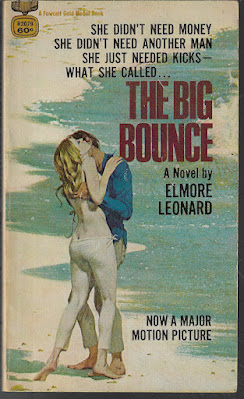
The Big Bounce

Between 1953 and 1961, Elmore Leonard (1925-2013) authored his first five career novels and all were westerns. Leonard played his first hand of crime-fiction in 1966 with a relatively unknown novel called The Big Bounce. He shopped it to a variety of publishers and they all declined. In 1969, Fawcett Gold Medal published the book simply because it had been adapted to film the same year starring Ryan O'Neal and Leigh Taylor-Young. The movie was a flop, so Hollywood tried again in 2004 with a cast including Owen Wilson, Morgan Freeman, and Charlie Sheen. It was such a disaster that Leonard described it as the “second-worst movie ever made”, alluding to the fact that the first one was the worst. Despite the publication and theatrical horror associated with The Big Bounce, I decided to read it. I wish I had those hours back.

The book begins with three men watching a video tape of migrant worker Jack Ryan (no relation to Tom Clancy) executing a home-run swing with a baseball bat on his crew leader's face. Readers later learn that Ryan was a former Baseball Player and has now spiraled down the labor ladder to the position of Seasonal Picker of Cucumbers in a lakeside region of Michigan. Ryan and acquaintances (he never had friends) rob a lake-house and steal $750 from wallets and purses. Ryan fears that the other guys will get caught simply because the box they placed the wallets and purses could be found.

After being fired from his job for smashing the foreman with the bat, Ryan is hired as a Handyman by a resort owner named Mr. Majestyk (oddly, no relation to the character Leonard created five years later). Ryan spends time in his new position avoiding an average-looking female guest who desperately wants to get lai....wants to have her window fixed. Ryan hooks up with Nancy instead, a young seductress who is banging two men, one of which is the owner of the cucumber farm. Ryan and Nancy run around shooting glass objects while planning to steal the payroll money from the farm.

I have no Earthly idea why anyone in Hollywood wanted to make a film from this novel. Or, why anyone would want to attempt it again. The book is mindless with its lack of plot structure and features one of the most uninteresting protagonists I've read. I nearly gave up reading it twice, but just kept pushing onward out of respect for Elmore Leonard. There isn't anything remotely compelling about the story, the character development, pace, or dialogue. If you must read everything Leonard wrote, then I guess you owe it to yourself to experience the good and the bad. Beyond that, avoid this book!

Buy a copy of the book HERE

Friday, February 25, 2022

Innocent Wanton (aka Young Nurse Desmond/Student Nurse)

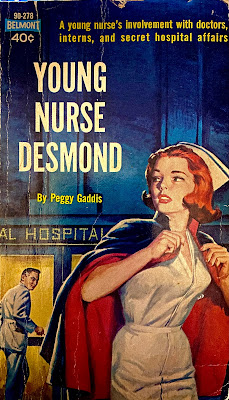
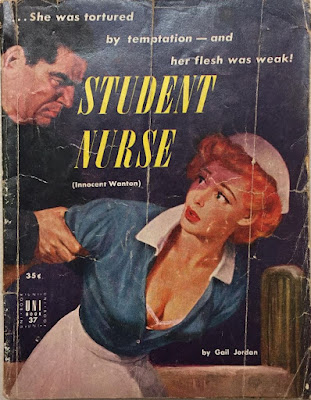
Peggy Gaddis Dern (Erolie Pearl Gaddis, 1895-1966) used pseudonyms like Georgia Craig, Joan Sherman, Perry Lindsay, and Peggy Gaddis to author romance novels and nurse fiction throughout the mid 20th century. Her first published work was erotic and racy novels printed by the lowly publisher Godwin in 1935. In the 1940s, she began to be published by Phoenix Press, Gramercy, and Arcadia. Prior to her death, Belmont and other publishers began reprinting her sexy romance novels to entice nurse-fiction fans. A great example is Young Nurse Desmond, published by Belmont in 1963. This novel was originally titled Innocent Wanton and published by Phoenix Press in 1950 under Dern's pseudonym, Gail Jordan. It was also printed under the title Student Nurse by Uni-Book as Digest Paperback #37.

Innocent Wanton is a sexy, juvenile delinquent style novel about a young girl named Martha that loses her virginity to a celebrity playwright named Jordan. Martha isn't a nurse, but works as a trainee in the Happy Valley Nursing Home. I'm not even sure the book discloses her last name as Desmond. After providing some pills to Jordan (who is there voluntarily), she learns that he is in this facility due to a drinking problem. Jordan immediately falls in love with Martha and desires to have her. After he begs Martha to have dinner with him, he is able to cajole her into the back seat where he takes her innocence on the cold vinyl seat. 

Later, Jordan proposes to Martha, she says yes, and the two move to a penthouse apartment in Manhattan. Martha quickly realizes that Jordan is a bit of a scumbag when she discovers that he has a girlfriend on the side. Risking the rewards of a robust alimony check, Martha bails on the marriage and rides a bus to the most overused locale in crime-noir history – the always reliable shore-front cottage in Small Town, Flordia. Her fierce independence doesn't last long when a man named Paul spots her bouncing out of the water. After “learning sex” from Jordan, Martha is determined to give her body to Paul in the most domineering way possible. However, Martha's problem is that Paul has a secret, a hidden connection to Jordan's past life. He is withholding information from her in hopes that she will be an easier lay. How can she escape these horny, secretive men and find true love?

The cover of Belmont's Young Nurse Desmond paperback, which again is the re-titled version of the earlier Innocent Wanton, states the book is about a young nurse's involvement with doctors, interns, and secret hospital affairs. The artwork clearly has the main character dressed as a nurse and leaving a general hospital. Does this sound like the same book? 

Unfortunately, Belmont and other publisher were notorious at cashing in on the hottest literary trends by reprinting prior novels. Dell probably made a great deal of money reprinting early mystery novels as Gothics in the 1960s and 1970s. In this case, Belmont is cashing in on nurse-fiction, a genre that Peggy Gaddis contributed to for 25+ years. By changing the author from Gail Jordan back to the marketable Peggy Gaddis name, and slapping a nurse on the cover, it probably swayed fans into believing this is a new release for the author.

This is my first experience with Peggy Dern and I mostly enjoyed the book. I have a tolerance for romance novels based on my love of Gothics and we've covered the romance-heavy slave Gothics (also known as plantation novels). The sex isn't graphic, but Martha was described in a voluptuous way that motivated me to learn more about her. Her torrid relationship with Jordan came to a satisfying conclusion and I genuinely enjoyed the rivalry between the lovers. I think if you enjoy juvenile delinquent-styled stories (Martha is 18-yrs of age) then you will probably find enough to like here. Innocent Wanton, aka Young Nurse Desmond, aka Student Nurse, is a lukewarm recommendation. 

Buy a copy of this book HERE