Tuesday, March 29, 2022

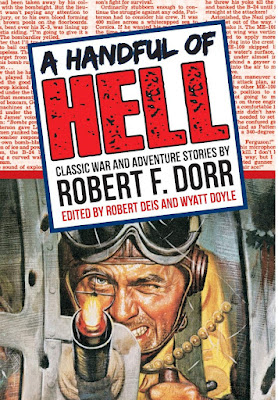
A Handful of Hell: Classic War and Adventure Stories by Robert F. Dorr

Back in 2016, Robert Deis and Wyatt Doyle teamed up for a book titled A Handful of Hell: Classic War and Adventure Stories by Robert F. Dorr. It is part of the duo's The Men's Adventure Library, published by New Texture. We've covered a number of these volumes, including I Watched Them Eat Me Alive, Barbarians on Bikes, and Cuba: Sugar, Sex, and Slaughter. Deis remains active with this project as well as his Men's Adventure Quarterly publication co-edited by Bill Cunningham. 

In A Handful of Hell's opening pages, Deis explains that he had received an email message from Dorr in November, 2009 concerning the recently-launched MensPulpMags.com blog. Dorr had explained, with exclamation, that he wrote hundreds of articles for the men's pulp adventure magazines and wasn't aware that there was still a large fan base for those vintage publications. Deis was aware of Dorr's work and the two struck up a friendship which led to the creation of this book.

The book includes a 20 page chapter written by Dorr titled “My Plan Was To Be a Writer and an Adventurer...” Dorr writes that he had two main interests since childhood, the Air Force and writing. His first paid publication was in Air Force Magazine's November, 1955 issue. Although he couldn't be an Air Force pilot due to a hearing impairment, Dorr still served in the military in a very unique role. He enrolled in Army Language School and studied the Korean language for 20 months. He was then sent to Korea to listen to North Korean radio communications between 1958-1960. 

After his military stint, Dorr actively pursued writing and sold “The Night Intruders” to Real for their April, 1962 publication. He states in the book that this was the first of what became several hundred men's pulp adventure stories. Thankfully, Deis and Doyle include the story in this volume. In fact, the duo collected 17 stories (by my count) that are written by Dorr and culled from vintage magazines like Stag, Man's, Bluebook, Male, Real, and Man's Illustrated. Handful of Hell also includes color scans of the magazine covers and interior artwork that accompanied these original stories. That in itself makes the book wildly entertaining, but I'm a reader and here are a few short reviews of included stories.

“5 Downed GIs Who Gutted Ambush Alley”

This story was featured in the June, 1967 issue of Men. The setting is South Vietnam's Ia Drang Valley, a hotbed of violence controlled by The People's Army of North Vietnam. San Diego native Sid Reeder and his crew plunge into the valley when their chopper is shot down. As the helicopter lies upside down, the soldiers inside formulate a plan. The enemy forces are descending from the hillside to destroy what's left of the downed chopper. They have to choose whether they want to call in support and risk another chopper being shot down or just call in the coordinates and go on killin' and dyin'. When Reeder thinks about the helicopter's two ground-to-air rockets, he comes up with a new plan. I loved the story and the frantic pace in which it is told. Dorr showcases a distinct understanding of helicopter aviation and protocols and is able to transport that to the printed page in a way that isn't technically jarring for the reader. This was such a great story.

“The POW General Who Tried to Kill Himself”

In the November, 1965 issue of Man's, Dorr tells this real-life account of U.S. Major General William F. Dean's harrowing ordeal as a prisoner-of-war in North Korea. Dorr explains to readers that Dean was on the run through the Korean countryside after narrowly escaping incoming enemy forces. Separated from his men, Dean's journey took him through jungles, fields, and villages desperately searching for food and medial supplies. Eventually, he's betrayed by a Korean and turned over to the North Korean People's Army. After months of starvation, dehydration, and lack of medical treatment, Dean reached the point of physical torture. After endless rounds of interrogation, for weeks and weeks, Dean is instructed that he will be tortured to gain information about American forces, locations, and strategies. Dean knows that he has reached a tipping point where he may divulge information under the harsh treatment. His only rescue is suicide. Honestly, this is really a tough story to read considering the levels of violence and torture. However, Dean's real life account is vividly told by Dorr as a tribute to his perseverance, patriotism, and internal fortitude. Dean is an American hero and I love that Dorr had the courage to write this. It's a true testament to human endurance and honor. Note - For more information, read Dean's autobiography titled General Dean’s Story.

“The Impossible Raid”

Stag, January 1966 featured this WW2 aviation story about a solo run by a lone B-17 bomber piloted by Captain Barry Helm. His mission is to utilize thick fog to make a daring bombing run on a German base. By targeting a large fuel supply, the bombing can create maximum damage to the Germans. But, in order to execute this nearly impossible assignment, the bomber must enter the airspace at tree level. This avoids field-swept radar that picks up higher elevation aircraft. Combining the low entry level with the thick fog makes it a valiant opportunity to strike a major blow to the German offense. This is just a classic, simple aviation tale that utilizes Dorr's descriptive storytelling. I liked the story's presentation from both the American forces as well as the Germans. In a short story, the narrative's presentation of events in the air and on the ground was just so epic and compelling.

You can buy this book and other collections HERE. Don't forget to check out Men's Adventure Quarterly for even more fantastic vintage stories and artwork.

Monday, March 28, 2022

Reprisal

Arthur Gordon (1913-2002) was a Yale graduate and Rhodes scholar that fought in WW2 and later became an editor for slick magazines like Good Housekeeping, Cosmopolitan, and Guidepost. His family has a rich lineage in Georgia. His aunt created the Girl Scouts organization and his great-grandfather started the Central of Georgia Railroad. His literary work includes the military-fiction novel Target Germany, A Song Called Hope, and an acclaimed biography about Norman Vincent Peale. 

My focus is on his only crime-fiction novel, Reprisal. It was originally published in 1950 as a hardcover by Simon & Schuster. Its success warranted a second printing by the publisher. In 1951, the novel was published in paperback by Pocket Book (#801) with a cover by Harvey Kidder (he painted the cover of another book we reviewed HERE).

The book's synopsis, printed on the back cover, peaked my interest. It says:

My name is Nathan Hamilton. I am black. My wife has been lynched! God knows what they did to her before they tied her to a tree and riddled her body with bullets. The killers were tried by jury. They were acquitted. Every white man in Hainesville knows that these men are guilty. But the town wants to forget. I can't forget. They lynched my wife because they know they could get away with it! They were sure nothing would happen! But something can happen. Something will happen! I'm starting for Hainesville tonight. There's a loaded gun in my valise with a bullet in it for each man who had a hand in the murder of my wife!

The book begins in a courtroom as the judge and counsel tensely await a jury's verdict. Three white men are on trial for the heinous murder of four African-Americans in the small, southern town of Hainesville. When the jury reconvenes, they find the men not guilty despite evidence that proves otherwise. The judge provides a verbal scolding to the courtroom and cautions the jury that he's ashamed of the justice system and the events that have unfolded to allow the men to walk free.

Gordon then begins introducing various characters and side stories that ultimately make up Hainesville. The main character is Melady, a brave reporter from the North that's covering the trial and its aftermath. He attempts to remain somewhat neutral early on, but by the book's end, he becomes heavily involved. Unity is another star, a receptionist who is involved in a relationship with a very bad man named Shep. Perhaps the most influential character is Yancy, an admirable African-American undertaker that tries to be the peacekeeper in the black section of town. Threading the characters is Nathan, a black man now living in New York after his wife was raped and murdered in Hainesville. Once he learns of the trial's outcome, he travels south with a gun.

There is way too much to unpack in one simple blog review. Reprisal is nearly 300-pages and has a character list that seemed a mile long. It's a lot to keep up with, almost like watching an entire season of Game of Thrones while running an org chart. There are affairs, attacks, backwoods justice, romantic relationships forming and ending, scandals, jobs, families, news-hounds, and so forth. It's daunting at times, but the investment is worth it. All of the stories tie together to present a turbulent era in the deep South. 

Surprisingly, Reprisal isn't as well known as Harper Lee's To Kill a Mocking Bird, predating it by 10 years. That could be due to the length, the complexity of the characters, or the amount of sheer violence that Reprisal possesses. The central theme is revenge, similar to a dusty western tale as the protagonist hunts the killers. There are no real heroes, only misfortune and death told in a doom 'n gloom style by Gordon. Shockingly, I found passages that I re-read numerous times due to their similarities to what we still experience today. Reprisal is a prophetic, iron-fist look at the heart-wrenching extremes humans seek to hurt one another. While never preachy or condescending, Gordon presents a fictional account of real-world violence, then and now, that leaves a distinct mark on the reader. It's a powerful novel.

Reprisal was adapted to film in 1956, but unfortunately it was poorly devised. The setting changed to the 1800s and the entire narrative was modified into a western revenge tale. Sadly, Reprisal has never been reprinted.

Note - The hardback version of the book shows the main character as a white man. It is evident that the cover is depicting Nathan as he is retrieving the pistol from his valise. I assume it was too controversial to put a black man with a gun on the hardcover? 

Buy a copy of this book HERE

Friday, March 25, 2022

Paperback Warrior Primer - Nick Carter: Killmaster

The character of Nick Carter (or Nicholas Carter) was created by Ormond G. Smith and John R. Coryell in 1886. Smith was heir to the New York City publisher Street & Smith, the early catalyst for dime novels and pulp fiction as far back as 1855. Smith wanted a private-eye or detective character similar to Old Sleuth or Old Cap Collier to star in various forms of media. The first Nick Carter literary appearance began in New York Weekly, September 18, 1886, in a story called "The Old Detective's Pupil" or "The Mysterious Crime of Madison Square." The serial ran 13 total installments with the setting mostly being Victorian-Edwardian New York.  

Carter is described as 5' 4" and having bronze-skin, gray eyes, dark hair and a square jaw. The character was trained by his father, Old Sim Carter, to fight criminals, essentially becoming the opponent of global evil. He's a genius that is inhumanly strong and a master of disguise. The character was so popular with readers that Street & Smith created the Nick Carter Weekly dime novel series. These stories would later be reprinted as stand-alone titles under New Magnet Library. 

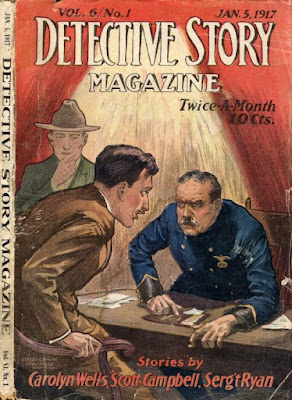
With its premier issue on October 15, 1915, the Nick Carter Weekly publication transitioned into Street & Smith's new Detective Story Magazine (just 10-cents twice a month!). The magazine ran 1,057 total issues, most of which concentrated on short crime-fiction with appearances from pulp heroes like The Shadow. The magazine's first 20 years featured covers by illustrator John A. Coughlin. In 1935, the magazine began suffering financial stress and officially stopped publishing in 1949.

Between 1924 and 1927, Street & Smith attempted a revival of the Nick Carter character in the pages of Detective Story Magazine. These stories also featured many of the same villains that Carter had faced in the prior Nick Carter Weekly publication (Dazaar the Arch-Fiend, Dr. Quartz, etc.). It seemed as if Carter's appearance in literature was over in 1927, but due to the success of The Shadow and Doc Savage, Street & Smith revived the character again. Between 1933 to 1936, the Nick Carter Detective Magazine was published. These stories introduced Carter as a more traditional hard-boiled detective. 

Beyond the page, two Nick Carter shows were featured on radio. Nick Carter, Master Detective radio show aired on Mutual Broadcasting System from 1943 to 1955. Nick Carter's son was the star of Chick Carter, Boy Detective from 1943 to 1945, followed by a film in 1946 under the title Chick Carter, Detective.

In 1908, the French film company Eclair ran a six-episode series starring Pierre Bressol as Nick Carter. Two French films were released, Nick Carter va tout casser (1964) and Nick Carter et le trefle rouge (1965). In Germany, four silent Nick Carter films were released: The Hotel in Chicago (1920), The Passenger in the Straitjacket (1922), Women Who Commit Adultry (1922), and Only One Night (1922). In the US, MGM released a trilogy of Nick Carter films: Nick Carter, Master Detective (1939), Phantom Riders (1940), and Sky Murder (1940). A television show called The Adventure of Nick Carter filmed one pilot, later released as an ABC movie.

The pulp version of Nick Carter continued in comic book form, with appearances in The Shadow, Army & Navy, and Doc Savage comics from 1940 through 1949. There was also a 1972 Italian comic strip and a Nick Carter comic book series from 1975. It lasted 12 issues and stars a character named Nick Carter that is a British soldier in WW2. However, it is not related to the Nick Carter spy series.

Little did fans know that a British secret-agent named James Bond would play a part in reviving the literary character 37 years later.

In the 1960s, Lyle Kenyon Engel began his plunge into paperback publishing. He was heir to his father's magazine publishing company, but sold that to become a publicity agent (supposedly one of his clients was the Today Show) and also a producer of children's records. To make an impact in publishing, he revived the familiar character of Nick Carter to capitalize on the 1960s spy fiction market. 

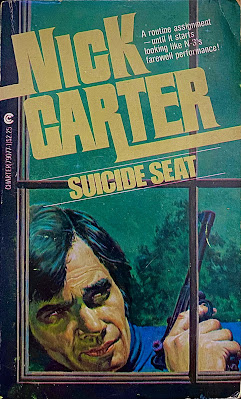
Nick Carter: Killmaster debuted in 1964 as a marketing attempt to cash-in on Ian Fleming's James Bond. The character was reinvented as a secret agent instead of a detective or private-eye. These novels were to be international adventures with a more robust approach compared to the serials, pulps and dime detective magazines. Basically, everything prior to 1964 was erased and this series was a complete reboot.

The general theme is that Nick Carter is an American secret-agent or spy working for an organization called Axe. The organization's leader is David Hawk. Axe and Hawk work closely with the American government and Hawk answers to "The Chief", presumably the U.S. President. Carter is referred to as N3 and we know there are other agents like him, also known as an N/number combination. In the first book, Run Spy Run, readers learn that Carter served in WW2 and also worked for OSS, the pre-cursor to what is now known as the CIA (like Matt Helm). Read our review of the book HERE.

One of the predominant characteristics of this version of Nick Carter is the three weapons he uses in the field. In the debut novel, it is explained that Carter took a Luger handgun from a German SS officer he killed in Munich during WW2. Carter named the gun Wilhelmina and it's included in nearly every novel. Hugo is the name for his Italian stiletto. He also carries a marble sized gas pellet that goes by the name Pierre. Carter can twist each half of the marble in separate directions and it will release a deadly toxin within 30-seconds, giving Carter enough time to flee the area. 

The Nick Carter: Killmaster series became immensely successful, running from 1964-1990 and offering 261 total novels. Each book on average sold 115,000 copies. Ironically, the series just lists Nick Carter as the author. The real authors aren't credited on the book's copyright page, a painful trademark of the series that frustrates readers, fans and collectors to no end. Engel typically split 50-50 with the authors he hired. He demanded lightning fast work, sometimes novels written in less than three weeks to meet furious deadlines. These books were released monthly, first by Avon and then later by Charter.

Notable author statistics:

- Valerie Moolman authored or co-wrote 11 novels between 1964 and 1967.

- Michael Avalone authored or co-authored 3 novels in 1964

-Manning Lee Stokes, of Richard Blade fame, wrote 18 novels

-Popular crime-fiction author Lionel White authored one Nick Carter book, the 18th installment from 1966. This was his second foray into spy fiction. He also wrote a stand-alone novel called Spykill under the name L.B. Blanco.

- Jon Messmann wrote 15 installments. Messman was a heavy contributor to action-adventure paperbacks. He was behind the popular adult western series The Trailsman along with the short-lived series titles Handyman: Jefferson Boone and The Revenger.

- George Snyder did 8 installments. He also wrote novels for the Grant Fowler series.

- Ralph Hayes authored 8 volumes in the series. He is known for his John Yard: Hunter series and Check Force among others.

- Martin Cruz Smith wrote 3 installments. Smith is primarily known for his Arkady Renko series that is still current to this day. The 1983 film Gorky Park was an adaptation of that series debut.

- Surprisingly, Chet Cunningham only wrote 1 book, # 72 Night of the Avenger, that was co-authored with Dan Streib

- Dennis Lynds authored 9 and his wife at the time, Gayle Lynds, wrote another 4. I've read one of Dennis Lynds' novels and I really enjoyed it. It was #211 Mercenary Mountain and it is reviewed HERE. Many will know Dennis Lynds as American author Michael Collins. He wrote the popular Dan Fortune series before his death in 2005.

- Saul Wernick wrote 5. Many remember him as writing the first Mack Bolan novel after Don Pendleton sold the series to Gold Eagle. 

- David Hagbert authored 25 books. He is primarily known for his CIA series starring Kirk McGarvey

- Death Merchant creator Joseph Rosenberger wrote 1.

- Jack Canon is the heaviest contributor with over 30 installments. I lost count, but I think it was 35. Not to be confused with Nelson Demille pseudonym Jack Cannon. 

- Robert Randisi authored 6 in the series. He's a respected western writer who also wrote 3 Destroyer books as well.

- Joseph Gilmore wrote 8.

- There are numerous authors that authored three or less that I haven't mentioned, but you can find a detailed list on spysandgals.com or Wikipedia.

- There is yet another Nick Carter series that ran from 2011-2019 called Project. It's written by Alex Lukeman and again features a starring character named Nick Carter that is an anti-terrorist sort of hero. Again, not related to the Nick Carter spy series.

Lyle Kenyon Engel would go on to create Book Creations in the 1970s. Ultimately, it was a cash cow and a rather unique company. Engel would create a series, imagine the story, hire authors to write it and even create book cover art. Then he sold these to various publishers. He was the paperback king and died a multi-millionaire in 1986. 

You can listen to the Paperback Warrior Podcast episode dedicated to Nick Carter HERE and the episode spotlighting Lyle Kenyon Engel HERE.

Thursday, March 24, 2022

Singer Batts #01 - Hue and Cry (aka Room for Murder/The Murder of Marion Mason)

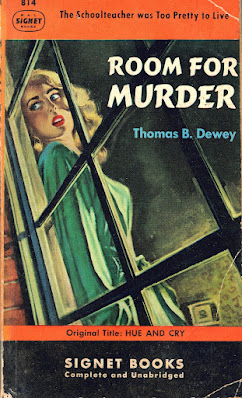
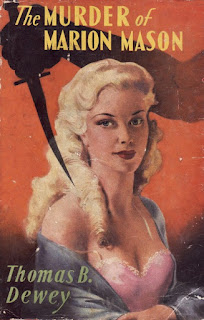
Thomas B. Dewey originally worked in Hollywood at a correspondence school called Storycraft. In 1942, he moved to Washington, D.C. to be an editorial assistant for the U.S. State Department during WW2. As a side hustle, Dewey began writing paperback original novels. Along with stand-alone titles, Dewey created three series titles – Mac, Pete Schoefield, and Singer Batts. In fact, his very first novel introduced the character of Singer Batts, a hotel owner in a small Ohio town that solves mysteries. It was called Hue and Cry in the U.S. and The Murder of Marion Mason in the U.K. Later, it was reprinted under the title Room for Murder. The book now exists in a bundle through Wildside Press with the other three series installments. 

Dewey uses Rex Stout's strategy, and authors before him, to create a narrator that tells the tale of the formidable hero. Like Archie Goodwin's narration in Stout's Nero Wolfe detective series, Dewey uses a  character named Joe Spinder to narrate the story starring Singer Batts. The setup is quite simple: 

Batts is a thirty-something scholarly fellow that has recently inherited the Hotel Preston from his late father Emory. The hotel is in the sleepy mid-western town of Preston, Ohio. The town's goofy marshal is Pete Haley, a friend of the hotel's staff. Batts resides at the hotel and leaves all of the heavy lifting to the hotel's manager and story narrator, Joe Spinder. The staff includes capable night clerk Jack Pritchard, sleepy day clerk Old Harry Baird, and janitorial laborer Nancy Wheeler. 

Before all of the murdering, sleuthing, and solving, Spinder describes Batts in the opening pages: “Never wait for Singer Batts to ask a personal question. He doesn't operate that way. You live your life, he'll live his. It's only when there's something he thinks he's got a right to know that he'll ask questions. Then he'll ask plenty. Questions to drive you crazy.”

The book begins with two drunk young men being wrangled into the hotel by Pete. These are good 'ole boys that tipped a few too many bottles and Pete doesn't want to lock them up and ruin their family's good graces. Instead, he wakes up Joe and Batts and works out an arrangement for the boys to sleep it off in the hotel. The night gives way to the day and Joe leaves for errands in town. When he returns, there is a mob of people outside of the hotel and a corpse inside. A young woman named Marion Mason has been stabbed to death in her room.

Batts has the armchair detective tendencies, but isn't intimidated enough to just stay seated. When three lawmen from the state arrive, including the District Attorney, Joe goes into overdrive explaining the prior night's activities, the short list of guests, and that Marion Mason is new in town and a school teacher. But, Dewey paints the lawmen and the D.A. as the bad guys. They point fingers at Joe and things escalate into a physical brawl. The author doesn't beat around the bush and places a deadline on the novel: 24-hours to find the real killer or Joe is taking the fall. 

Joe mentions other cases that Batts has solved, including one or two that foiled the same D.A. But, Batts doesn't want to solve crimes. He's content living in his small bedroom and just gazing through the window. Joe eventually talks him into action and the two start the investigation by interviewing various town citizens, including two specific men that Marion slept around with. 

The case takes the mandatory twists and turns by leading readers out of Preston and into some seedy places out of town. The action and violence was a step up from what I expected and I really enjoyed Joe's wisecracking demeanor as the storyteller (he's really the show's star). He reminds me of Al Wheeler in the Carter Brown mysteries. Also, the language was surprisingly profane considering this is a 1944 novel. 

Managing my expectations, I went into Dewey's first novel thinking it may be a quirky small town hotel mystery. It is, but it's written very well as Dewey proved he could write crime-fiction with the best of them. I really enjoyed this first Singer Batts novel and I'll check in at the front desk for three more nights: As Good as Dead (1946), Mourning After (1950), and Handle with Fear (1951). 

Get the ebook HERE.

Wednesday, March 23, 2022

Borealis

Horror author Ronald Malfi seems to have made his way into the mainstream. I recently found a copy of his haunted house novel Little Girls sitting on an end cap at Target. I remember singing the author's praises in the 2000s and I'm happy his literary career is beginning to take off. In the early days, Malfi was published by the likes of Dark Fuse and Samhain Publishing. I had been saving Borealis for a rainy day. It's an 80ish page novella originally published in 2009 by Samhain and the weatherman says we are in for a storm. The time has come.

The book begins with a man named Bodine urgently driving a young girl to a rundown Las Vegas motel. Immediately, something is amiss with this bizarre child. She tells Bodine she doesn't have a name and doesn't have any parents. She's giddy, mischievous, and just downright scary. Shockingly, Bodine retrieves a handgun from his waistband with the intention of murdering the girl. The scene then transforms into the morning after with the town's sheriff finding Bodine's brains on the bathroom wall in an apparent suicide. The girl is gone and that was twelve years ago.

Present day, protagonist Charlie Mears is smelling the diesel fumes of a fishing trawler. He's been on board the Borealis for seven days pulling cages of crabs from the seabed. It's a hard blue-collar life made even harder by the harsh landscape. The crew is in the icy Bering Sea, hundreds of miles from the coasts of Alaska. After a long day of trawling, Charlie looks out into the glaciers and spots a young naked woman running on the ice. The crew stops to make the rescue.

On board, fed, warmed, and clothed, the crew provides her the Captain's quarters. But one crew member says something isn't right about her, that he has a bad feeling in her presence. When they ask the woman what her name is, she coldly explains she doesn't have one. She also can't explain where she came from. When one of the crewmen is found dead, the story takes a darker turn. Who is this woman? Or, better yet, what is this thing?

I've always loved cold weather stories that include nautical adventure or survival. That also includes atmospheric horror novels or movies set in frosty locations. As a fan of John Carpenter's film The Thing (based on a movie that was based on a short story), I found that Malfi's storytelling skills possess that same tone – the isolation, cold fear, and survival element. This little girl – young woman -  is just so damn creepy and it gave me chills when she tells Charlie things about his life that she has no way of knowing. The story also reminded me of Stephen King's great screenplay Storm of the Century. Malfi's escalating tension into total panic works on so many levels. It's visceral violence, psychological horror, and haunting suspense all aboard a stationary broken boat. The perfect nightmare.

I wish Borealis was still available for purchase. At the time of this review, the novella remains out of print. Wolfpack Publishing, Brash Books, Stark House...here's your chance! This story deserves an audience.

Tuesday, March 22, 2022

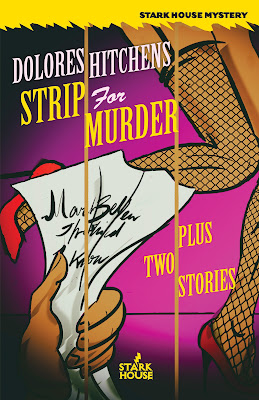
Strip for Murder

Dolores Hitchens was born as Julia Clara Catherine Dolores Robbins (1907-1973) in San Antonio, TX. After graduating from the University of California, Hitchens worked as a nurse and a teacher before turning to writing. She authored two novels starring Lt. Stephen Mayhew and 12 novels starring sleuth Rachel Murdock under the pseudonym D.B. Olsen. She also wrote under the pseudonyms Noel Burke, and Dolan Birkley. Her railroad detective fiction, co-authored with her husband Bert Hitchens, is highly respected, but using her own name, she had a remarkable career writing stand-alone mystery-suspense novels from 1951 through 1973. My first experience with Hitchens is Strip for Murder, a 130 page novella originally published in Mercury Mystery Magazine in 1958. Stark House Press has reprinted the novella along with two shorts originally appearing in Ellery Queen Mystery Magazine

Mark Bellew is employed as a Theatrical Representative. It sounds like a respectable job title, but in essence it's the “pimp” level on the corporate ladder. Bellew markets a variety of strippers, or exotic dancers, for various parties and social functions. If you are hosting a post-golf tournament men's party (in the 1950s) at the lodge, Bellew service's may be enjoyable. There's no hanky panky hi-jinks because Bellew keeps it on the up and up - quality T&A from entertainment veterans. At least until someone is raped and murdered.

Hitchens' protagonist is an Army veteran and prior boxer named Warne that works as an insurance detective. His office is conveniently next door to Bellew's and the two are acquaintances. One day, in a panic, Bellew confesses to Warne that he is receiving anonymous, threatening letters reminding him of an unfortunate incident from 20 years ago. Bellew explains that the incident occurred when he hired a young woman for a men's party. The woman advised Bellew that she was a professional stripper and could take care of herself, but after her performance, she stayed around a little too long and was raped by one of the men. A few days later she committed suicide by jumping out of a high-rise building. The ominous letters prophetically state that the same thing will happen again.

Warne takes the case and looks into the young woman's family history and what her life was like before her suicide. The woman's father is now filthy rich and his adopted son is an arrogant macho-man with a fast car and hot wife. The son makes for a great villain and the perfect adversary for the wise, tougher, and much older Warne. But, the real investigation begins when the letter-writer's prophecy comes to fruition. Bellew's most recent booking leads to a professional stripper named Candy jumping to her death from an apartment building. Is Bellew somehow behind the two deaths? Or, do the two girls have some criminal relationship that's separated by 20 years? 

Hitchens uses Warne as the hero, but she also presents separate events featuring Bellew and a determined reporter named Robinson. The mystery shapes up nicely and offers some enjoyable, yet perplexing questions. I loved the twists and turns of the plot and was slightly surprised when the killer was revealed. I also really enjoyed Warne's budding relationship with Bellew's adorable secretary. 

Dolores Hitchens was the real deal and Strip for Murder is another testament that mid 20th century women mystery writers were just as talented and brilliant as their male counterparts. Hitchens creates a riveting murder mystery complete with shady ladies, fast cars, and an admirable, competent hero to uncover the hidden truth. The storytelling is violent, fast-paced and brimming with conspicuous characters that make it a memorable and pleasurable reading experience. 

Get the book HERE.

Monday, March 21, 2022

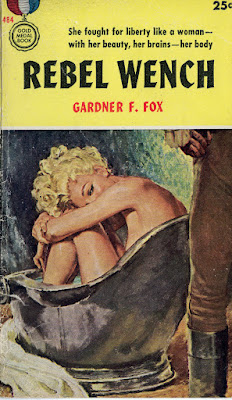
Rebel Wench

Gardner F. Fox (1911-1986) began writing for the comic book industry in 1937. Throughout his prolific literary career, Fox authored over 4,000 comic books and helped create characters like Hawkman and Flash. While reaching an iconic level within comics, Fox also wrote over 150 paperback originals encompassing genres like science-fiction, fantasy, western, and romance. I recently purchased a Historical Fiction ebook bundle from the Gardner Francis Fox Library. Included was Rebel Wench, originally published by Fawcett Gold Medal in 1955. The book is also available as a paperback reprint and also exists in digital through Wildside Press.

Despite the book's cover, the protagonist of Rebel Wench is Billy Joe Stafford, a plantation owner embroiled in the American Revolutionary War in 1781. In the character's history, readers learn that he is a third generation farmer that was taught to hunt and survive at an early age by a Native American. Stafford is respected by the slaves, including his lifelong servant and friend, Old Gem. His marriage to Laura Lee developed a large rift in 1777 – Stafford joined the Continental Army to fight for independence and Laura became a Tory in support of Great Britain. 

The “rebel wench” of Fox's story is Deborah Treat, a beautiful spy working with the rebels under Brigadier General Daniel Morgan. In the opening chapters, Stafford rescues Deborah from the clutches of an evil brawler, a villain that appears repeatedly throughout the narrative. After dismissing Deborah as a prostitute, he soon learns that she is a sharpshooter, a cunning strategist, and a fierce lover. As an aid to Morgan's Rifles, Stafford and Deborah team up to infiltrate British forces controlled by Cornwallis. 

Central to the plot is a striking love-hate relationship between Stafford and his wife Laura. Stafford wants Laura to join the rebellion, but she's in love with a British Colonel who hopes to take over the plantation once Stafford is killed. There's a bit of heated intrigue surrounding a lavish party where Stafford and Deborah pose as siblings to expose plans created by Cornwallis. In sultry style, Fox seduces readers with a few tepid sex scenes, most of which concern Laura's bedroom romps with both Stafford and the Colonel. My interest was the historical aspect and, for the most part, Fox fills the gaps with a great history lesson on battles and guerilla fighting between armies and divisions up and down America's Eastern Coast. 

Rebel Wench would have easily appealed to the 16 year old boy in the 1950s or American soldiers serving abroad. With plenty of gunfights, fisticuffs, beautiful women, and galloping horses, Gardner Fox absolutely knew his storytelling strengths and what his fans were expecting. If you control your own expectations, there's nothing to dislike about this fun adventure. Recommended.

Buy a copy of this book HERE.