Tuesday, December 21, 2021

Levon Cade #01 - Levon's Trade

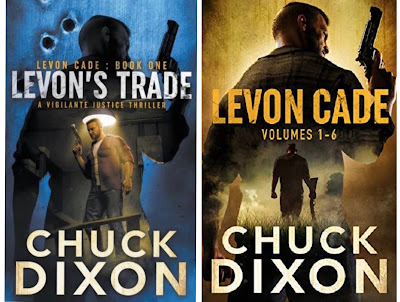
Chuck Dixon is a famous comic book writer whose work on Marvel’s Punisher series is regarded as a masterwork of the medium. Since then, he has been writing novels, including a popular vigilante series starring Levon Cade. The series debut from 2014, Levon’s Trade, has recently been reprinted by Wolfpack Publishing. 

The novel opens in a depressed Huntsville, Alabama. Levon Cade is lucky to have a gig as a graveyard shift security guard on a construction site. The novel wastes no time establishing that Levon is a no-joke badass as he disarms and dispatches two thugs shaking down a Guatemalan laborer at the site. 

We learn that Levon is a man with a particular set of skills learned during his shadowy time in the military. Joe Bob is Levon’s boss who does some homework and figures out that there’s more to his security guard than meets the eye. Joe Bob’s daughter is a college student in Tampa who has gone missing, and he hires Levon to find her. Levon’s got his own troubles involving an expensive custody battle over his daughter. Bottom line: he needs the money, and accepts the gig. 

Levon travels to Florida to investigate, and the reader is given further glimpses into our hero’s character and capabilities. He’s a quiet and stoic badass with an almost supernatural ability to appear, disappear, and fight - like a ninja in blue jeans. As he gets closer to the truth and his Russian prison gang adversaries come into greater focus, the author avoids the temptation of delivering a cartoonish or over-the-top action story, instead opting for gritty realism. 

Anyone who has ever read a Jack Reacher novel by Lee Child and wished it was written with the lean economy of a 200-page paperback from the 1970s will be very pleased with Levon’s Trade. Dixon writes in extremely short, punchy chapters with no irrelevant diversions. The characters are developed through their actions, not through the pages of introspective thought and inner monologues. Levon Cade is a Pinnacle Books action hero for the 21st Century. 

There appears to be nine books thus far in the Levon Cade series - all offered at affordable prices with attractive covers. If the other books maintain the same level of pace and quality as this debut, it may be the best contemporary men’s adventure series on the market. As large publishing houses demand bloated 400-page novels to sell at Walmart and airport magazine shops, it’s a breath of fresh air to read a series that remembers what made the genre great. Chuck Dixon is the real deal, and Levon Cade is the modern hero we deserve.

Buy a copy of the book HERE

Monday, December 20, 2021

Death Merchant #25 - The Enigma Project

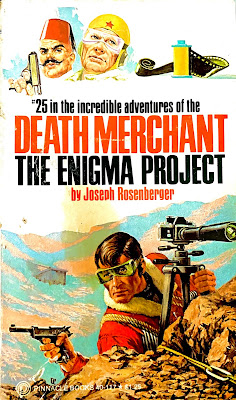
In November, 1977, Pinnacle published the 25th installment of Joseph Rosenberger's Death Merchant series. My reasonably intact paperback shows it is the second printing, a clue that this series was a big moneymaker for the publisher. Mostly, you can read the series in any order and the concept is really simple. Richard Camellion is a CIA agent, dubbed Death Merchant, that patrols the globe quelling international threats. Rosenberger thumbed through magazines like National Geographic to place his hero in exotic and dangerous locales to heighten the sense of adventure. In this case, it is the mountains of Ararat.

The Enigma Project begins with Camellion as an undercover mountain climber who has joined the Jasper Grundy Bible Institute. In the opening chapters, it's explained that this faux religious group was created by the CIA to use on a rainy day. The mission is for Camellion to climb to the heights of the Ararat mountains to place a specially designed, high resolution camera. This camera will quickly capture hundreds of photos that the CIA can analyze. The goal is to locate strategically placed satellite installations being utilized by the Soviet Union in Armenia. Or, something like that.

Camellion and two supporting agents join the study group under the intention of guiding them to a fabled position where Noah's Ark may rest. The group travel to Turkey on a helicopter, but unbeknownst to the passengers, the CIA has created a unique panel system that houses a small armory inside. This is unveiled to the passengers when they discover Camellion and others are packing heat for the climb. Camellion explains that mountain bandits and Armenians don't typically settle by just throwing rocks at unwanted guests. What he doesn't explain is that the group is expendable and their unfortunate deaths will be a sacrifice for the greater good.

Halfway up the snowy passage, the group encounter Soviet Armenians. In a series of exchanges, Camellion and his supporting agents fight the bad guys en route to the top. Problems include avalanches, harsh weather, Soviets, and a nagging religious scholar. Rosenberger writes the action sequences smoothly and places readers in the battle by describing who's on the flank, the perimeter defenses, and the combatants next moves. It's completely vivid and provides enough escapism for the average cubicle worker.

This series is fun in limited interactions. I prefer gritty team-combat novels, but in a pinch Death Merchant can provide some enjoyment. This installment is par for the course. Mileage may vary.

Friday, December 17, 2021

The Institute

Master storyteller Stephen King has honed in on a horror sub-genre – kids with psychic abilities on the run from a shadowy organization. He first utilized the concept with 1981's Firestarter, featuring telepath Charlene McGee on the run from a government agency called The Shop. His novel Doctor Sleep features an organization called True Knot hunting down kids and adults with “the shining.” King serves this platter with his 2019 novel The Institute. It was published by Scribner and exists in multiple formats. Based on King's prior works, I would imagine a streaming show, graphic novel series, or the movie is already in the works.

My paperback version weighs in at 650 pages, so there's a lot to unpack. The novel's first 50 pages is like the first act of a 1950s crime-noir (or John Ball's Tallon series) as readers are introduced to the former Florida police officer Tim Jamieson. Tim is paid to relinquish his seat on a commercial airliner to make room for a government employee. After deciding to pocket the refund and extra money, Tim hitchhikes up I-95 from Florida to New York. But, he ends up in the cozy town of Du Pray, South Carolina and immediately falls in love with its Mayberry-like charm. He takes a night security post with the small, local police department and slowly becomes ingrained into Du Pray's lovable population. He then disappears from the narrative for the next 400 pages.

Protagonist Luke Ellis is introduced as a likable 12-year old genius that possesses telekinetic abilities. In the middle of the night, masked individuals break into Luke's Minneapolis home and kill his parents. The intruders drug Luke and he awakens in The Institute, a secret facility in a rural stretch of Maine forest. He quickly meets other kidnapped children, who form a sort of “loser's club” to overcome their scary predicament. The children earn tokens for being good, which they can use to purchase extra goodies like alcohol, marijuana, and cigarettes. The staff is led by Mrs. Sigsby, who oversees experiments on the children to heighten their telekinetic powers.

The book's first half focuses on Luke and his friends stay in a section called the “Front Half”, a safer portion of the facility where the staff is mostly nice and the experiments aren't excessively painful. Luke is asked to stare at lights and dots while subjected to daily doses of injections. The torment of Front Half is that these kids don't know what became of their prior lives. Luke wonders what happened to his parents and what his role is with the institute. Sigsby motivates the kids by advising them they will wake up in their own homes with their memories erased of everything that transpired there. As time goes on, Luke's friends are individually chosen, against their will, to relocate to Back Half. It's here that he learns that the kids are subjected to horrific torture and most don't survive the ordeal. To avoid being taken to Back Half, Luke must escape the institute.

Needless to say, there's a lot more to the novel than simply imprisonment and escape. Luke befriends a staff member and she has her own backstory. The novel tiptoes to the grand reveal, which is the purpose and use of the institute. There's the inevitable meeting between Tim and Luke, and at that point King transforms the novel from horror to action-thriller. All of these elements build to a giant crescendo, but like King's historic flaw, the ending leaves a lot to be desired.

My biggest issue with King's modern work is that he injects plenty of commentary on the political landscape (of course he jabs Donald Trump) and has a lot to say about debt. There's a centerpiece about credit cards and revolving bills that plague our society. Why King feels as if he knows anything about the average American is beyond me. He is worth a half-billion, earns $20-million per year and has had the right to call himself a millionaire for 40+ years. It's this sort of thing that dampens The Institute.

For example, King says that Tim is paid just $100 per week to work for the police force. He also has Tim pay an Uber driver with physical cash that the airline provided to him as a refund. The real world doesn't work this way. It's as if King is so far removed from everyday life that his stories lose some plausibility. The Institute really didn't need the uneducated social commentary and the obvious disconnect removed me from some aspects of the story.

Nevertheless, I mostly liked The Institute and found Tim and Luke's story enthralling. King hasn't lost any of his storytelling abilities, but he has started to blur the lines between his abstract horror creations and all-out action-thrillers. If you can appreciate the modern day version of Stephen King, you'll love The Institute.

Get the book HERE

Thursday, December 16, 2021

Narc #02 - Death of a Courier

Marc Olden (1933-2003) is a familiar name for crime-fiction fans. He authored series titles like Black Samurai, Narc (as Robert Hawkes), and The Harker File. In addition to series titles, Olden penned 17 stand-alone novels and two works of non-fiction. We've covered both Black Samurai and Narc and I was anxious to read more of his work. After enjoying his Narc debut, I wanted to revisit the character with the second installment, Death of a Courier. It was published by Signet in 1974.

You can read the series in any order. The gist is that John Bolt is a seasoned narcotics agent working for a government agency called D-3. The agency has ten regional setups covering all 50 states. Nine of these operations cover 49 states, the tenth covers New York City, where Bolt has worked for over a decade. He reports to Sam Rand, who then reports to a guy named Craven, D-3's head honcho. 

Death of a Courier lives up to its name. The novel's premise is that drug couriers for Vincent DeTorres, a Cuban mob, are being murdered by enforcers working for a New York mobster named Don Rummo. Bolt's entrance into this drug war begins in Central Park when a courier he is tailing is shot and killed by hired guns. Reporting the incident, Bolt then learns that couriers in big cities are being killed. He then gains the assignment of digging into the details, and this is where Olden shines.

Undercover, Bolt infiltrates DeTorres' mob by partnering with an enforcer named Ortega. There are numerous firefights, but the most memorable one entails 20-pages. In it, Bolt and Ortega find themselves in a Detroit airport to receive a large shipment of heroin. Thankfully, the deal falls apart and the scene explodes as these warring factions shoot it out in close quarters. Bolt's use of a .45 Colt and shotgun reminded me of the intensity of the opening scene in the series debut. Olden describes these action scenes with so much detail that readers can almost smell the cordite. 

While the war between rival mobs is really interesting, Olden introduces another exciting addition to the plot. There is an included backstory of Bolt's former partner, Paris, being brutally beaten by racists. In rehabilitation, Paris feels that the agency failed him. Months later, Paris kills the racists and enters a life of criminality. Bolt learns that Paris has re-emerged as an enforcer for Don Rummo and that he has vowed to kill seven Narc agents, one for each year that he served the agency.

Needless to say, Death of a Courier was simply awesome. Olden is a great storyteller and I felt that the narrative was soaked with realism. A year before this novel, the author wrote a non-fiction book titled Cocaine, a deep dive into New York's drug trade. Partially due to this, the Narc series doesn't seem terribly far-fetched like a Butcher or Death Merchant entry. Further, Olden's martial-arts studies lends credit to some of the fight scenes. 

If you are bored with the superhuman vigilante stuff, Narc is a must read title. These books are becoming more and more pricey, so I encourage you to get them now. Remember to search under Olden's pseudonym of Robert Hawkes. You'll thank me later.

Wednesday, December 15, 2021

Walking Wounded

According to his Amazon author page, Robert S. Stokes majored in journalism at the University of North Carolina. In the early 1960s, Stokes served in the U.S. Army in Europe before becoming a full-time freelance writer for various magazines including Newsweek and Life. His career led him to Saigon to cover the Vietnam War, an experience that aided him in writing his first novel, Walking Wounded. It was originally published by Dell in 1980, and I can't locate any information to suggest it was ever reprinted.

The novel begins by introducing readers to Jim Bonner, a former Vietnam veteran that now works as a hitman for the C.I.A. After numerous years of death and violence, Bonner is beginning to crack up. During an assignment to physically assault a target in Manhattan, Bonner snaps and fatally shoots the man. Fearing that he's now on a C.I.A. hit list, Bonner flees to Las Vegas to consult with a former military buddy named Cobb.

In the deserts of Nevada, Bonner hightails it in a van loaded with weapons. He knows the agency has targeted him, but he plans to stay alive as long as possible. On a rural stretch of blacktop, Bonner finds a woman named Karen stranded with her young son. Granting them a lift, Bonner discovers that Karen is a druggie that's been booted from her apartment. She has nowhere to go, so she's in for the Hellish ride with Bonner.

The narrative settles in as Bonner, Karen and her son make the long road trip to destinations unknown. Along the way, Bonner stops in to see old war buddies and friends he's made throughout his career with the agency. On cue, Bonner's boss sends a veteran named Gereke to locate, and eliminate, Bonner. Thus, the narrative builds to the inevitable confrontation between the experienced government assassins. 

Walking Wounded is the perfect title for the novel because it describes Bonner's inability to cope with his responsibilities. He's in continuous pain from horrific burns he experienced during a napalm drop (which makes me wonder how he even gained the agency gig). He's on a steady stream of heavy narcotics that have really spaced him out. He's also suffering from severe PTSD and finds it hard to decipher reality from war-torn Southeast Asia. 

Stokes' validates Bonner's condition with numerous flashbacks to Bonner's war experience. These scenes range from drug use in the jungles and barracks to firefights with Vietcong. In a unique parallel, Bonner recounts memories of his father and the mental anguish he endured from World War 2. The author has a lot to say about the poor state of Veteran Affairs in the 1980s, the cyclical nature of violence, and America's dependence on narcotics (a timeless statement). It's clever that Bonner replaces his father in war, and Gereke replaces Bonner in post-war operations. It all ties in as a Yin-Yang concept.

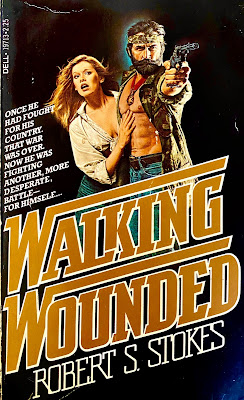
Despite the book's cover, Walking Wounded isn't really what I would consider a strong candidate for a 1980s men's action-adventure novel. This is more of a thriller with action sequences mostly replaced with social commentary and drug use. In that regard, Dell performed a disservice to Stokes. It's never a boring novel, but the cover suggests a Rolling Thunder sort of premise with a more traditional hero fighting some sort of stereotypical bad guy. Stokes' is delivering much more, with heroes and villains that aren't as easily defined. If you want something remarkably different, Walking Wounded may be worth the investment.

Tuesday, December 14, 2021

The Revenger #02 - Fire in the Streets

Paperback Warrior continues to devour the literature of Jon Messmann. We've covered his series titles like The Trailsman, Handyman, Canyon 'O Grady, The Revenger, and even his gothic stand-alone novels under various pseudonyms like Claudette Nicole. My first experience with the author was the debut novel in The Revenger series. Inspired by Don Pendleton's The Executioner, the Signet series began in 1973 and ran six total volumes. The entire series has been reprinted in new editions by Brash Books with an introduction by yours truly. 

The book begins with some flashbacks to the events that occurred in the series debut. The quick story is that New Yorker Ben Martin is a Vietnam veteran who experienced the death of his son by mobsters. Avenging his son's murder, Martin became a one-man army and destroyed the local mob. At the end of that novel, he left his wife to pursue an indiscreet lifestyle using the new name of Ben Markham (Messman had never intended the series to continue). 

Now, it's explained to readers that Ben has lived in the Chicago suburbs for a year. He began working for Alwyn Beef Products and worked his way up to a senior manager due to his experiences as a grocery shop owner. But, Ben is attacked one evening at work by enforcers working for mobster Nick Carboni. After killing the attackers, Ben returns home and starts to question his life. In his own headspace, Ben realizes that he has always wanted to kill again, to right the wrongs, and fight evil. But, in a reversal, he also wants to live a normal existence that isn't smeared in blood. 

What makes The Revenger so great is that Messmann doesn't deliberately set out to create a hero for readers. It's never just a good guy with a gun. Like the debut, he slowly has unfortunate events consume Ben's life. It is like an erosion of sanity that reveals Ben's hard-hitting talents. He's meant to kill the bad guys, and he has the skills and talents based on his experiences in Vietnam, but he is hesitant. Slowly, Ben is pulled into this mystery and must fight again.

Ben's employer is a friend, but he's also a terrible gambler. After losing a great deal of money in the gambling rackets, Carboni has struck a deal with him. The mob will infiltrate his business and in return, Carboni wipes the IOUs off the table. Once Ben learns the reasons for the attack, he puts together an elaborate plan to wipe out the mob at strategic locations. From rooftops, he begins assassinating key personnel with different European rifles, weapons he leaves at the scene to confuse Carboni. But Messmann also has Ben fistfighting with mobsters as well as a fiery car chase on the highway. 

What makes this story unique is that it involves three separate women that are experiencing individual struggles directly related to Ben's mission. Carboni's wife is resistant to her husband's criminal behavior and wants out. When Ben's friend and co-worker is killed, he falls into a friendly relationship with the man's widow. But, Ben's love interest in the story is his employer's wife, a defiant woman that knows her husband is a gambling junkie. These three women are liberally featured throughout the 135-page narrative. 

Fire in the Streets is just as good, or better, than its predecessor and rivals some of Pendleton's best single-digit efforts on The Executioner. Imitation is the best form of flattery and Messmann clones a Mack Bolan styled story while also injecting a great deal of emotional drama. It's violent when it needs to be, and Ben proves to be a capable hero when the gunfire begins. The end result makes The Revenger simply fantastic.

Get the new edition HERE

Monday, December 13, 2021

To the River's End

Rant - Kensington continues to swindle their fan base by suggesting that William W. Johnstone, who died in 2004, is still alive. On the back inside cover of the publisher's recent release, To the River's End, it states, “William W. Johnstone IS the New York Times and USA Today bestselling author of over 300 books...” Further, it states that he authored titles like Flintlock and Will Tanner: Deputy U.S. Marshal. The fact of the matter is that Mr. Johnstone had been dead over 10-years by the time those books were actually authored by ghost writers. Additionally, it states J.A. Johnstone is the co-writer of this book and that she had a hand in writing a number of prior titles. The reality is that she is Johnstone's niece, heir to the empire, and she hasn't written a published word. The back cover proclaims to readers that William and J.A. “...are the greatest western writers of the 21st century.” Hell, it even states you can email Mr. Johnstone at dogcia.two@gmail.com. If he responds, then I'll tap-dance on water and turn your milk into moonshine. 

ReviewTo the River's End hit store shelves in October, 2021 and is only the second trade paperback to emerge from the William W. Johnstone camp. Unlike prior Mass Market Paperbacks, this one has a different color scheme, texture, art design and feel. The only other trade paperback that I'm aware of being the Target exclusive, Go West Young Man, from May, 2021. As I stated above, the cover states this is authored by William W. Johnstone and J.A. Johnstone but in reality it is written by one of a handful of revolving ghost writers – some great, some mediocre and some just plain 'ole bad. 

The book is about two trappers, Luke Ransom and Jug Sartain, that partner up to independently capture beaver pelts in the fertile Rocky Mountains. Luke is the weapons expert and fighting man while Jug provides the comedy and tasty biscuits. While the two are skilled trappers, their fierce independence makes them a vulnerable target for the Blackfoot tribe. Without the support of the American Fur company or Hudson Valley, their presence alone infuriates the Blackfoot tribe. This rivalry is the premise of the book.

Like an assembly line, Luke kills the approaching Blackfoot throughout the long winter. But, not just fighting and killing them. It's a slaughterhouse so thick that the main problem isn’t the amount of Blackfoot warriors. Instead, Luke's biggest issues are A) Where to dump all of these bodies and B) What to do with all of the horses he acquires after mowing down these presumably inexperienced, incompetent Native Americans. Jug plays second fiddle and exists just to be shot twice and then nursed back to health. 

To the River's End would be a gripping cold-weather survival tale ripe with action if the protagonists actually faced stiff opposition. Instead, it's like a Friday the 13th film where the immortal Luke elevates the body count using knives, arrows and lead. Readers, you deserve better than this. Author, whoever you are, I'm glad you are working and being paid to write. Everyone deserves the right to make a living with the talents they possess. However, I wish you had more time to write quality books instead of meeting deadlines for this sketchy western brand.

Get the book HERE