Wednesday, February 2, 2022

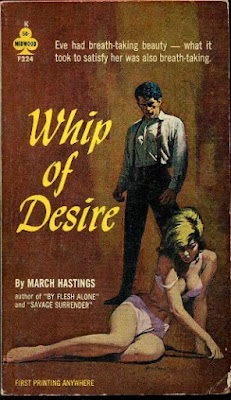
Whip of Desire

March Hastings was one of a number of pseudonyms used by author Sally Singer (b. 1930). The New York native specialized in erotic fiction and wrote over 20 novels between 1958 to 1976. These vintage paperbacks have become collector's items and often fetch prices over $100. Thankfully, Cutting Edge has been reprinting Singer's work as affordable paperbacks and ebooks. I read her 1961 lesbian novel The Outcasts and found it enjoyable enough to warrant a revisit of the author's work. I chose the Cutting Edge reprint of Whip of Desire. It was originally published by Midwood in 1962.

The book stars Fred Boyer, a 28 year old man originally from Alaska. He now lives in New York, plays the piano and has a pregnant wife named Mindy. In the opening chapter, Fred is at an employment agency hoping to find work. He's provided instructions to a theater ran by a gorgeous woman named Eve. Instantly, Fred and Eve connect and in a matter of days they establish a business that's funded by Eve's wealthy father. Fred will compose and perform music and Eve will put together a stage act. 

Later, readers learn that Eve's father crashed the family plane years ago, an accident that killed Eve's sister and injured her. Eve feels she is somehow responsible for her sister's death and harms herself frequently – pain as her penance for surviving. As Fred soon realizes, Eve craves rough sex and demands to be dominated. Eventually, Fred's heated desires for Eve erupts in a frenzy of pleasure and pain. He's liberated from the financial stress of being a husband and an expectant father by forcefully taking Eve. She pleasurably gains the abuse she feels she deserves while he is freed from life's cumbersome shackles by becoming her lover. But, Fred learns there is another man in Eve's life, a man so abusive that he leaves Eve broken, bloody, and nearly dead.

As an intriguing romance novel of the 1960s, Whip of Desire introduces some surprising elements. Both Fred and Eve were dynamic characters and the story was serviceable enough. I think Singer is a terrific writer, but she really finds her element in the sex scenes. Her descriptions are never graphic, but really convey the emotions and physical collision between these lovers. Mindy's mistrust in Fred, Eve's backstory, the business venture, and Eve's domineering “other man” made for a propulsive, fully developed story that I found entertaining. 

If you enjoy heated, erotic mid-20th century romance novels, then Whip of Desire will surely be a real pleasure to read. Recommended. Buy a copy HERE.

Tuesday, February 1, 2022

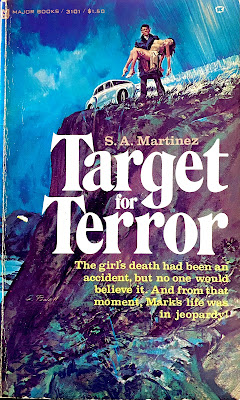
Target of Terror

Gerry Powell was a popular pulp and paperback artist that created covers for the likes of Signet, Fawcett Gold Medal, Dell, and Pyramid. It was striking cover art that led me to one of his paperback covers at a local used bookstore. The novel is Target for Terror, authored by S.A. Martinez and published by Major Books in 1976. I could find nothing online that identified the author, so that information remains a mystery. But, the contents of this old paperback are what truly matters. Intrigued by the book's premise, I dove in.

Mark and his wife Claire live in an older, three-level house on the shoreline cliffs of Malibu, California. Mark is a writer, Claire is an actress, and their marriage is falling apart. Through an employment agency, Claire has hired a new house cleaner named Leyla. While she's in New York, she notifies Mark that Leyla should be arriving in the coming days. Mark, despondent over his recent writing failures, droops around the house and spends time talking to his chatty, snooty friend Jamie.

In the opening chapters, young Leyla hitchhikes to Mark's house and arrives on a rainy, stormy night two days ahead of schedule. Readers will immediately realize that something is amiss with Leyla. She is paranoid someone is following her and she's carrying a small canvas bag and a tambourine. To his surprise, Mark finds Leyla on his doorstep in the middle of the night and ushers her inside. Anyone who has read a Gil Brewer novel knows where this is headed. 

Lonely and horny, Mark chases Leyla around the mansion hoping to get laid. Leyla just wants shelter from the night and the ability to hide from whatever deep and dark past is chasing her. After Mark becomes physical, Leyla runs up the stairs to escape. Backing away from her attacker, Leyla falls from the crumbling balcony and dies. 

The book's first 50 pages is Mark's hurried efforts to clean the crime scene – dispose of her clothes, conceal his scratch marks, eliminate her presence from the house. Thinking that her body would wash up on a northern shore, he is shocked to find her body below his house the next morning. The book's narrative then focuses on his efforts to relocate the corpse somewhere else. But, Target of Terror isn't just a tale of murder. Mark finds that he is now the target of whoever was hunting Leyla. They think he killed Leyla to obtain the valuable thing they want. When detectives, Claire, and Jamie become involved, the whole narrative twists and turns into a cat and mouse chase over Leyla's secret treasure.

You have to realize, this novel was published by Major Books. They were a lowly 1970s publisher with terrible editing and equally terrible books. Due to the publisher, Target for Terror reads like a play or a rough draft. The dialogue isn't natural, the pacing is a little off, and the characters are mostly one-dimensional. The main villain is stereotypical and there's very little backstory that suggests Mark is capable of rape and murder. But, despite the abysmal editing job, I can say I enjoyed the book. Martinez's writing is serviceable enough and I had the foresight to realize the finished product would be a hack job. In the hands of a capable editor, the book would have been a real treat. Unfortunately, what's left here is just another average paperback collecting dust bunnies in a basement zoo.

Monday, January 31, 2022

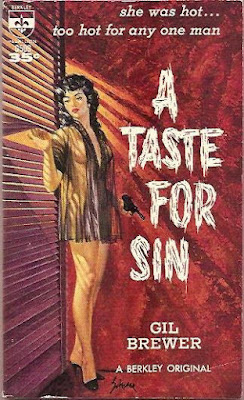
A Taste for Sin

Gil Brewer (1922-1983) was a prolific author of paperback original crime novels in the mid-20th century before his life was consumed with alcohol and personal demons. He was at the top of his game in 1961 when he wrote A Taste for Sin, a novel that’s been reprinted by Stark House Press

Our narrator is Jim Phalen, an employee at the Happytime Liquor Store.  As the novel opens, he’s been invited to the house of a horny local housewife for some afternoon delight. Her name is Felice, and her unwitting husband works at the local bank. She’s a conniving and kinky bitch — more on that later. 

Phalen is not a good and honorable person either. He rents a room in a dilapidated lodge with a toilet that barely functions, and he can barely afford those spartan accommodations on his meager salary. He recounts his brutally-violent past, and, man, it’s something else. Brace yourself for some insane violence throughout this book. Anyway, it’s clear that Phalen’s intention is to somehow leverage the rich, married lady he’s banging to change the direction of his life.

Meanwhile, Phalen is dealing with the fallout of a petty crime he committed that spun out of control. He needs to be deceptively clever to avoid getting caught. Felice learns about Phalen’s money troubles and pressures him into a scheme to rip off the bank and kill her husband. 

What we have here is a femme fatale heist novel and a rather excellent one at that. A Taste for Sin showcases some of the best actual prose writing I’ve ever read from Brewer. The sex scenes are more graphic than usual for 1961, and the action scenes are a genuine bloodbath. I’ve always cited The Vengeful Virgin and 13 French Street as Brewer’s masterworks, but A Taste For Sin is the new top-of-the-heap. Highest recommendation. 

Friday, January 28, 2022

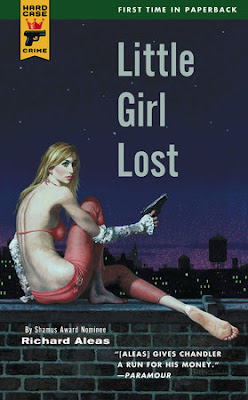
John Blake #01 - Little Girl Lost

Charles Ardai is the founder and publisher of the Hard Case Crime paperback imprint. Using the pseudonym Richard Aleas, he wrote two original, contemporary mystery novels starring a New York private eye named John Blake for Hard Case Crime. The first Blake novel, Little Girl Lost (2004), was nominated for an Edgar Award and remains available today in all formats.

The paperback opens with Blake remembering Miranda Sugarman, the sweet neighborhood girl who took his virginity years ago. She left Blake behind after high school to attend a university with a goal to become a doctor. Blake learns of her death from an exploitive newspaper headline reading, “Stripper Murdered.” Without a client, he decided to investigate her death and gain a better understanding of his former friend’s life and death.

One of my favorite elements of the set-up is Blake’s boss in the PI firm, a much older ex-cop named Leo, who plucked Blake out of college and mentored him in the investigation racket. He’s the perfect, world-weary antithesis to Blake’s youthful idealism and quest for justice. He’s also well-connected within the NYPD and a great asset to Blake’s side.

The trail to the truth takes Blake into the behind-the-scenes world of seedy NYC strip clubs. It’s a fascinating look behind the curtain as Blake encounters a conspiracy of dope, missing college girls and much more. Blake is a fallible hero who takes more than a few beatings, but is always smart, capable and upbeat. His narration moves the plot forward at a good pace and is never boring.

Ardai is a much better writer than I was expecting, and Little Girl Lost was a solid, workmanlike private eye mystery with plenty of twists leading to the satisfying solution. It’s an easy recommendation, and I look forward to reading the sequel, Songs of Innocence, from 2011.

Thursday, January 27, 2022

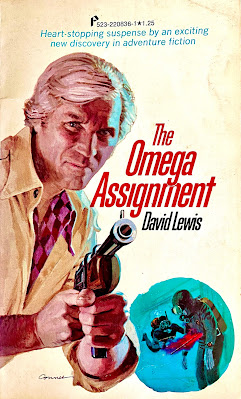
Steve Savage #02 - The Omega Assignment

David Lewis, real name Patton D. Lewis, authored a two book series of spy novels for Pinnacle in 1976. In my research, I couldn't locate anything about Lewis other than a lot of Google hits on the western writer Lewis B. Patten. The series stars part-time British Secret Intelligence Agent Steve Savage. The first novel is The Andromeda Assignment and the follow-up is The Omega Assignment. In working backwards, I'm reading and reviewing The Omega Assignment

Savage's origin tale, printed on the back of each novel, advises readers that he joined a freighter at the age of 14. He was later degraded by the Captain and beaten for six straight weeks. He managed to escape into Hong Kong and learned martial arts in exchange for cleaning a gym. He then returned to London and trained as a photographer. He has covered war and fighting throughout the world, including Vietnam, the Middle East and Belfast. His agent, Gregor de Freitas, operates as an SIS frontman after escaping the Soviet Union. Savage's capabilities to enter communist countries as a photographer allows him to work part-time as a secret agent under Freitas' guidance. Lewis warns readers that “This man is dangerous!”

In The Omega Assignment, a multi-millionaire German man named Braeder frequently entertains politicians and members of NATO on an ocean liner called Clytherea. On board, Braeder provides sadistic thrills that includes various types of sex, S&M, rape, and torture. Braeder “liberates” these sick leaders and allows them to engage in their wildest fantasies. But, he records all of this on video tape in an elaborate ruse. Here's how it works:

Braeder sinks Clytherea and uses the recorded tape as blackmail to obtain a small hydrogen bomb that fits into a suitcase. He then trades this bomb to Middle East fanatics for an extremely large supply of heroin. He then makes connections with the largest mafia families in America to become their chief supplier. With a surplus of heroin, he slowly begins to reduce the supply to the mob. To free up the supply chain, Braeder demands more money for the drug. Thus, Braeder begins raking in the dough and makes himself...king of the world?

While I don't know exactly what Braeder hopes to accomplish with all of his money, the narrative outlining all of this was a real pleasure to read. Savage becomes involved as an underwater photographer gaining footage exploring the sunken Clytherea. Lewis writes the underwater exploration portion so well. He thrusts the reader into these gloomy, dark hallways and rooms as Savage explores the ship. There are floating corpses and a plethora of art and jewels to photograph, but Savage is placed in peril when his diving partner is killed by a booby trap inside the ship.

Without ruining the fun, Savage teams up with an American female narcotics agent named Destiny, while assisting the CIA and British intelligence. The explosive narrative has Savage facing a variety of criminals on land, air and sea. Most of the plot develops in Cyprus and culminates in Destiny being captured and taken to Braeder's enormous beach-side fortress. Savage purposefully becomes captured in an effort to free her from the inside. He also teams up with an older Greek paramilitary unit known as EOKA for the finale. 

I felt that the first two acts of The Omega Assignment was a lot of fun and read like a B version of a Jack Higgins novel. The last act was really over the top with Savage forced to fight in the nude gladiator style against Braeder's “strong guy.” I thought that this final battle was more like a Richard Blade adventure complete with zany antics that made the conclusion a bit cartoonish. If you love action-packed adventure and espionage, then The Omega Assignment is an entertaining read. I liked it enough to search for the first book online. To my knowledge, these books have never been reprinted, but remain fairly affordable as used paperbacks.

Note: Thanks to Spy, Guys, and Gals for additional information about this series.

Wednesday, January 26, 2022

Vee Brown - The Complete Cases #01

Vee Brown starred in 18 violent mini-novels between 1932 and 1936 in the pages of Dime Detective Magazine. The stories were authored by Carroll John Daly, the inventor of hardboiled crime fiction and his popular Race Williams character. Steeger Books has released two volumes of Vee Brown novellas comprising the entire series run. I sampled two of the stories from the first compilation to get a taste for the character. 

Vee is a violent gun-toting police detective who is also a mild-mannered and educated Tin-Pan Alley songwriter of sentimental tunes — a secret side-hustle that brings the supercop tremendous wealth. Think Cole Porter or George Gershwin with a taste for justice and criminal blood. The Vee Brown stories are narrated by a newspaper reporter named Dean Condon who shadows Vee on the job and writes about his adventures for the paper.  

“The Crime Machine”

I started at the beginning with the first Vee Brown adventure - a short story called “The Crime Machine” from 1932. 

As the novella opens, reporter Dean Condon is preparing to meet Vee and ride-along with him for a newspaper article. Condon is nervous because Vee has earned a reputation as the most relentless hunter and killer of criminals on the police force. When Vee and Condon meet face-to-face, they make the connection that the two knew one another back in college as passing acquaintances. 

Because “The Crime Machine” is the series intro, it exists to establish the Holmes-Watson relationship between the crime-fighter and his sidekick documentarian - a dynamic that persists throughout the entire series. As such, the plot is rather thin - like a TV series pilot episode. 

On their first outing together, they are hunting Killer Regan, who shot up a theater during a robbery murdering a female cashier. Vee’s orders from the District Attorney’s office is to produce Regan dead or alive. On the prowl, Vee is stealthy as The Shadow — seeming to disappear while infiltrating the criminal’s lair with a perpetually-amazed Condon in-tow. 

There’s plenty of tough talk and violent pulpy action to enjoy - as well as the big reveal where Condon learns that the deadly hero is also “The Master of Melody” who publishes popular sheet music under his given name of Vivian. Despite the simplicity of the plot, the short-story was a total blast and left the reader hungry for more. 

“The Price of Silence”

The ninth Vee Brown adventure is “The Price of Silence", the final story in Volume One of the Steeger Books collection. It’s a 50-page novella from 1933 published when Daly had hit his stride with the series. 

The story opens with the crime scene investigation of a wealthy woman stabbed in the chest in her own home while her husband slept upstairs. Because it’s 1933, a police inspector comments that such things are to be expected in the city’s Italian neighborhood, but not in the victim’s upscale community. 

Fortunately, the killer left behind a calling card identifying himself as “The Black Death” which seems like a decent lead for Vee to launch his investigation. He quickly deduces that the victim was likely a blackmail victim who failed to pay off her tormenter resulting in death. 

Vee quickly identifies a suspect for the murder - a society dandy behind a gang of racketeers handling the dirty work of shaking down the blackmail victims. Vee’s plan is to squeeze the henchmen with death threats until they identify their boss. 

As the narrator, Condon finds himself at the center of the action when he is held captive by the thugs awaiting Vee’s return. When they reunite, Vee and Condon follow leads through a rather convoluted mystery plot leading to the exciting confrontation you always knew was coming. 

I enjoyed these two Vee Brown stories enough to continue with the series in the future. Steeger Books have released a second volume compiling the final nine novellas. I’m looking forward to checking them out. Recommended. Get your copy HERE.

Tuesday, January 25, 2022

Arrow #01 - Wine, Women...and Death

According to his website, Walter Deptula Jr. graduated from Columbia University and became both a Naval Aviator and an educator at California community colleges. Along with acting, writing, and producing community theater, Deptula also authored a six book series of men's action-adventure novels in the 1970s. The Arrow series stars Franco Arronelli, known as Frank Arrow, as a professional thief living in Hawaii. The debut, Wine, Women...and Death was published by Curtis Books (a subsidiary of CBS) in 1974. 

As a young man, Arrow worked the beat in Staten Island as a patrol officer. During a bank heist, Arrow is shot in the leg while fatally shooting the thief. During the struggle, Arrow swiped $4,000 from the bank drawer. Being wet behind the ears, Arrow buys a new car and is eventually kicked from the force. Arrow then develops a long career as a self-employed thief. He is paid by clients and insurance companies to steal back stolen goods – a thief of thieves. 

In the backstory, readers learn of Arrow's most recent undertaking, but it's only later in the novel that the events are explained in detail. A criminal named Serranto, possibly working for someone, robs a prominent jewelry store. After the successful heist, Serranto hides the jewels in a tomb on a large New York estate. The insurance company hires Arrow to find the jewels and agrees to his 25% commission fee. But, Arrow learns that some of the jewels are ancient relics traced back to an early English empire. If he can retrieve the jewels, his commission will be an extremely lucrative payout. 

Deptula's middle chapters are dedicated to Arrow's preparation and planning to retrieve the stolen jewels. These chapters were written so well and reminded me of great mid-20th century heist fiction by the likes of Dan Marlowe and Lionel White. In these chapters, Deptula absolutely shines. I loved the setup, planning, disguises, team players, and ultimately the execution. It's not imitation, but clearly the author was influenced by the crime-noir masters.

Surprisingly, Wine, Women...and Death isn't just a heist novel. Instead, the events of the heist lead Arrow into an underworld of bloody violence. Someone on Arrow's team sells him out to Serranto and his fiance is murdered. In a desperate bid for revenge, Arrow must not only find and kill Serranto, but also discover who the real mastermind is. It's this part of the book that is simply a product of its time. This is straight-laced, 1970s gritty action that is probably spawned by Mack Bolan and countless other paperback vigilantes of the era. 

I loved all of the little nuances that are associated with the character. Arrow lives in a beach-side mansion and possesses all of the luxuries one would expect – private plane, helicopter, employees, a compound and a pet shark (which plays into the book's finale). While not completely over the top with gunplay, the book still packs a serious punch in terms of action-oriented fight scenes. The author's presentation of Arrow and his fiance was really important and added a personal investment for me. I wanted Arrow to kill the SOBs that tortured and killed his lover. The book made me feel something, and that's always an important factor.

While this series mostly receives lukewarm reviews online, I can honestly say I thoroughly enjoyed the debut. I hope to borrow or buy the final installments. In reading the author's online comments about the series, I learned that six total books were written, but CBS shut down Curtis Books after Arrow #3 was published. The remaining books are now manuscripts that I'm sure Deptula is still hoping to publish someday. Anyone interested in releasing this trio of original novels, plus three unpublished works?