Friday, March 18, 2022

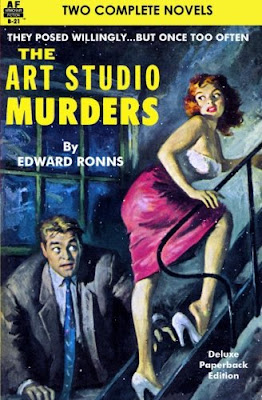
The Art Studio Murders (aka Dark Memory)

Philadelphia native Edward S. Aarons was a graduate of Columbia University, a WW2 veteran, and successful author. He wrote nearly 100 short stories between 1930 through the 1950s, but he's recognized for the two phases of his career. The first is his early crime-fiction, 20 novels published by the likes of Graphic, Avon, Fawcett Gold Medal, and Phoenix. The second phase is the Assignment series starring CIA operative Sam Durrell. I've been steadily plowing through Aarons' crime-fiction novels, mostly written as Edward Ronns, which brings me to his 1950 original paperback The Art Studio Murders. It was also published with various cover art as Dark Memory.

Henry Dana is a painter living in an art studio in New York City. After attempting to take the subway back home, Dana plunges from the platform and is nearly killed. When he wakes, Dana feels like this was no accident and believes someone is trying to kill him. Later, he discovers that his paintings have been slashed and he's attacked by an unseen intruder in his studio. An acquaintance named Lori calls Dana one evening and tells him she knows the identity of his attacker. But, in a familiar genre trope, she dies before Dana can gain the name.

Like Aarons' own career, the book has two very different stages. The first act takes place in New York with Dana avoiding death while also acquiring a lower commission for a painting. These scenes involve Dana's agent and friends, and introduces a “fatal attraction” scenario where his married friend Kay tries to seduce him. There's the typical police angle where they think Dana is under a lot of mental stress and his paranoia is wreaking havoc on his social existence. 

The second stage is something I've talked about in numerous reviews of the author's work. This is all about location. In the second act, Dana decides to leave the city and head to Kettle Island, Connecticut to rekindle an old love affair with a recently divorced woman named Sarah. But, Dana's friends follow him to the island to enjoy a short vacation. Dana effectively brings his killer with him to the island. The author uses a harrowing thunderstorm to trap the characters on the island. Like most of his crime-noir novels,  Aarons' uses a waterfront setting as an integral part of the story – an abandoned lighthouse, windswept beaches, shoreline cottages. 

The Art Studio Murders works as a suspenseful stalker novel. In the city, Dana's experiences with the killer in the darkened studio was like a horror movie scene. Aarons ups the ante by recreating that suspense in the second act, only making it more atmospheric and frenzied. The only real issue I had with the book is there are too many characters. In the early chapters, there are eight characters to contend with. Thankfully, the book has been reprinted by Armchair Fiction and the publisher has a handy checklist with short descriptions of each character. 

The Armchair Fiction reprint is a twofer including The Art Studio Murders and an absolute gem by Mary Roberts Rinehart called The Case of Jennie Brice. I reviewed the latter work for Paperback Warrior HERE. There's no reason not to buy the reprint considering it's two great novels in one. At the time of this writing you can buy the reprint for $13 HERE

Thursday, March 17, 2022

Champions Wear Purple

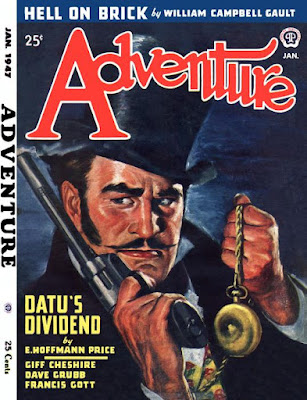
Oklahoma native Clifton Adams authored over 50 full-length novels and around 125 short stories for the magazines and digests. His first professional sale was the short story “Champions Wear Purple”, published in Adventure in January, 1947. Being a huge fan, I tracked down a copy of the magazine online and was surprised to find that it is an Oklahoma Wildcatter boxing story. Loving both boxing and Clifton Adams, it was a match made in Heaven.

In the story, an unnamed narrator tells the reader that he's an oil-rig worker on the Woodard Wildcat. With his throat as “dry as an Arizona test hole”, he strolls into Bert Harrison's Beer Hall to tip a few pints with his co-workers. While there, a young man walks into the bar carrying an Army duffel-bag. When he orders a glass of water, the narrator steps in and offers him a drink. But, the kid says he doesn't drink, but would like to locate a man named Winters.

The narrator takes a moment to explain to “The Kid” that Winters is the old guy sitting by himself at the bar reading an out of town newspaper. The narrator explains to the reader that Winters has never been known to say a nice thing and the only time he opens his mouth is to curse at someone. The Kid walks over to Winters and introduces himself as Lee Robertson. He explains to the old man that he was in France fighting the Germans with a guy named Pete. Before he died, Pete told Robertson to find Winters because he could make a fighter out of him. Winters, shocked and dismayed to learn that Pete was killed, yells at Robertson and told him to get out. 

The narrator, feeling sorry for Robertson, chases him down in the street and offers him a job on the oil-rig. While Roberson contemplates joining the crew, the narrator advises readers that Winters and Pete were like father and son, and that Winters was Pete's boxing trainer. Upon the verge of becoming the light-heavyweight champion of the world, the war came along and took Pete away. Now, Pete is dead and Winters is left to ponder what might have been. Robertson agrees to join the oil-rig crew, but also takes an offer to fight in the town's arena. 

Robertson becomes the local boxing hero and a real friend for the wildcatters. They make Robertson their new hero and he earns their accolades by knocking out the competition on regular Wednesday night fight cards. Winters on the other hand despises Robertson and won't offer a single word of encouragement to the young man. At the bar one night, the bets begin rolling when Winters finally says, “There's a man in Hobartsville he can't beat.” Winters bets all of them that Robertson will lose to the fighter. The match is then set and Robertson discovers that the Hobartsville fighter is a former pro that almost became a world champion. With his respect and fistfuls of cash on the line, will Robertson beat this seasoned, experienced opponent?

There was so much to enjoy about this story and I love how it all ties into a purple ring robe. In just a few pages, Adams forces the reader to care about these characters. There are a number of underlying elements that make this story exceptional. First and foremost, the idea that Winters only hates Robertson due to Pete dying. He nearly begs for it to have occurred the other way around with Pete living and Roberson dying. Second, I love that Robertson, despite being floored by Winters' disrespect, still soldiers on and continues his dream. The in-ring action was superb with a number of rounds described in great detail. If you love boxing, you will appreciate these swift scenes. 

From the narrator's cool, laid-back presentation to Robertson's fighting skills, "Champions Wear Purple" is a real treat. Despite it being his first published work, it is easy to spot Adams' storytelling talents. He was destined for greatness and this story is just a small preview of what was to come. You can read the entire Adventure issue, including this story, for free: 

Wednesday, March 16, 2022

Paperback Warrior Primer - Thomas B. Dewey

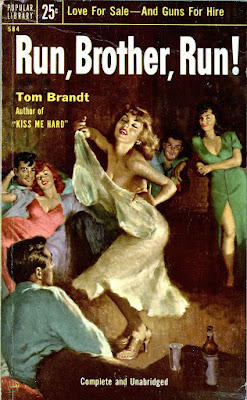
Paperback Confidential by Brian Ritt is my favorite reference book about vintage crime-fiction. In browsing the book (published by our good friends at Stark House Press), I was able to locate a lot of information about an underrated author named Thomas B. Dewey. He authored 36 novels and a handful of short stories between 1944 and 1969. He also wrote a number of stand-alone novels using the pseudonyms Thomas Brandt and Cord Wainer. For this Primer, I'm using the information I discovered in Ritt's book, so all credit goes to him.

Thomas B. Dewey was born in Ekhart, Indiana in 1915. Dewey graduated from Kansas State Teachers College in 1936 and attended grad school at the University of Iowa. After grad school, he moved to Hollywood to find his fortune working for a correspondence school called Storycraft. In 1942, he moved to Washington, DC to be an editorial assistant for the U.S. State Department during World War 2. While working as a writer and editor for the State Department, he began writing novels as a side hustle. 

Dewey's first published novel, Hue and Cry, was published in 1944. It was also released under the titles Room for Murder and The Murder of Marion Mason. The protagonist was a character named Singer Batts, a hotel owner and Skakespeare fan living in Preston, Ohio. He partners with his hotel manager, Joe Spinder, to solve the book's mystery. Dewey (or readers) liked the character so much that he wrote three other novels starring him - As Good As Dead (1946), Mourning After (1950), and Handle With Fear (1951). The books and character are similar to that of Rex Stout's Nero Wolfe series with Spinder serving as the narrator like Archie Goodwin's role in the Nero Wolfe books. You can obtain the four Singer Batts books through Wildside Press HERE

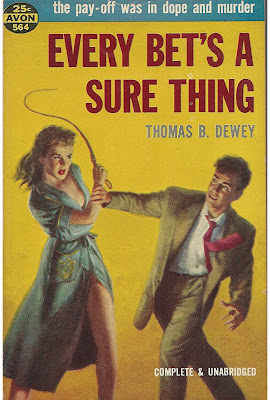
In 1945, Dewey leaves the State Department to go back to Los Angeles to work in advertising. It’s there that he marries his first wife, Maxine Morley Sorensen, in 1951. It was during his advertising years that he launched his most popular series starring a Chicago private eye named Mac – the reader never gets to know his full name. The first Mac book, Draw the Curtain Close, was published in 1947. It took Dewey six years before the second Mac installment was published, Every Bet's a Sure Thing. Our review of the book is HERE. Remarkably, the Mac series continued for 17 novels with the last installment being The Taurus Trap in 1970. 

Mac is often described as “The Compassionate Private Eye”, a true statement that also understates that Mac can, and does, kick some serious ass when called upon to do so. His compassion as a character really humanizes him in the body of his first person narration. But these books shouldn’t be confused with soft-boiled cozy mysteries. They are top-notch private eye stories. I’ll be reading and reviewing more Mac books here at Paperback Warrior, and he may turn out to be my favorite private-eye series. Wildside Press has reprinted most of these for $5 or less per book HERE.

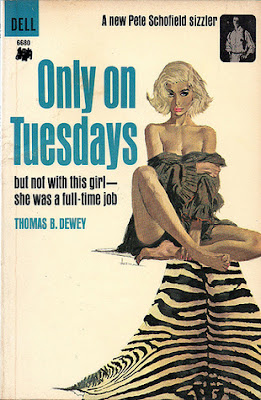
Dewey quit his job in advertising to write full time in 1952, a steady gig he continued until 1971. In 1957, Dewey launched his third series character, a San Fernando Valley private-eye named Pete Schofield. The first book in the series was And Where She Stops (1957). That series continued for nine total installments through 1965’s Nude in Nevada.  The gist of the series is that Schoefield solves crimes with his adorable redhead wife Jeanne. Once again, Wildside Press has these available as well HERE

The usual trajectory of an author of this era is to write a lot of stand-alone novels, hone their craft, and then launch what they hope will be a successful series. Dewey did it backwards launching three successful series titles right out of the gate and keeping Mac and Pete Schofield alive at the same time.

He did write a handful of stand-alone novels – a couple under his own name - but he also deployed two pseudonyms in the 1950s. This was a pretty common way either to get some extra work on the side without your publisher knowing or to ensure that you aren’t flooding the market and hurting your own brand.

Dewey’s last novel was published in 1969, and then it appears he retired from writing fiction at the age of 54. In 1971, he became a professor of English at Arizona State university, where he taught writing. In 1972, he married his second wife Doris L. Smith, and the author died nine years later in 1981 at age 66.

Hollywood never adapted his work for the big screen, but two of his novels were made into TV episodes:

Bob Hope Presents The Chrysler Theatre
"Runaway" (1964)
Based on “A Sad Song Singing” 

Cannon
"Death's a Double-Cross" (1971).
Based on the novel Every Bet's a Sure Thing

Tuesday, March 15, 2022

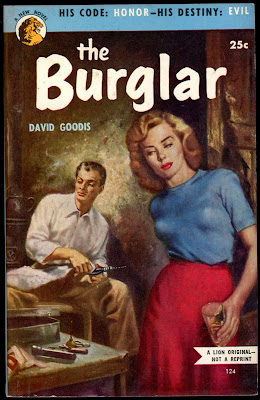
The Burglar

As a career midpoint, The Burglar exemplifies everything we've grown to appreciate and admire about David Goodis. It was originally published as a paperback original by Lion Books and later reprinted by Black Lizard, Simon & Schuster, and a host of others. Goodis wrote the screenplay for the film adaptation, making it Goodis' only solo authored screenplay to actually be produced. The film was released in 1957 and starred Dan Duryea and Jayne Mansfield. In 1971, the French continued their fascination with the author by remaking the film with Omar Sharif and Jean-Paul Belmondo in starring roles. 

In flashback sequences, readers learn that Harbin experienced a poverty-ridden childhood. After his mother and father both die, Harbin hits the road and is picked up by a professional thief named Gerald. Harbin learns to become a skilled burglar under Gerald's tutelage. After Gerald is killed, Harbin is left to raise Gerald's young daughter Gladden. Over 18 years, Hardin's role transforms from Gladden's older brother to father, bringing the novel to the present with Hardin at age 34 and Gladden now 24. 

The opening chapters is a suspenseful heist as Harbin and his crew (two men and Gladden) rob a large mansion on Philadelphia's Main Line. The take is a whopping $100K in emeralds. But, the robbery didn't go as planned due to Harbin being interviewed by police outside of the mansion. Harbin miraculously explains his way out of the situation, but the police take note of his whereabouts. 

Back at the crew's “home”, a place deemed The Spot, Harbin makes the decision to send Gladden to Atlantic City for a few days while their hot status cools down a bit. While wasting the days, Harbin strolls around Philly with no real destination in mind. He contemplates the next move and his relationship with Gladden. But, a knockout named Della approaches Harbin at a bar and the two immediately hit it off. 

After a few chapters, Harbin and Della are in love and have the proverbial “white picket fence” lifestyle planned in the Pennsylvania countryside. The problem is multifaceted – Harbin has a criminal background that he needs to share with Della, he has a complicated relationship with Gladden that needs unraveling, and he has to leave the burglary business and his crew. The first one is easy, the second is an emotional implosion and the third becomes central to the book's propulsive plot.

As always, Goodis is one of the masters of crime-noir storytelling (arguably the very best) and The Burglar is about as good as it gets. The characters are dynamic, with each one facing extreme adversity while carrying heavy burdens. Both Della and Gladden are in love with Harbin, but his decision to choose one not only has a lasting impact on his own life, it controls the fate of the heist crew. There is the obligatory “running from the law” plot threads that keep the narrative at a brisk pace.

I like the author's subtext that theft is like a drug. It brings these characters emotional peaks and valleys while insuring they avoid the rat-race of a 9-to-5 job. At one point Harbin admits he has nothing he wants or even desires. He can't locate any material objects to buy with his $7K in walk-around money. Much less, where to spend his share of $25K from the most recent heist. It's not about the money, it's the adrenaline rush. 

If you just love a great story, The Burglar is absolutely fantastic. As a mid 20th century crime-noir, it's sheer perfection. Tangled love, the burden of criminality, greed's fascinating tug-of-war, flawed justice, the price of happiness, these compelling, prevalent plot-points just go on and on. Excellent books create meaningful discussion and The Burglar does just that. Highest recommendation. 

Get the book HERE.

Monday, March 14, 2022

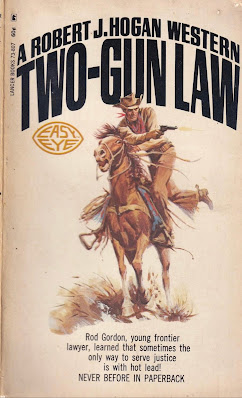
Two-Gun Law

Robert J. Hogan (1897-1963) is mostly associated with his creation of the pulp-aviation series G-8 and his Battle Aces. After serving in WWI, Hogan worked in the aviation industry while writing for the pulps from 1930 through 1957. It's hard to locate information about Hogan's work beyond G-8 or his Smoke Wade creation. But, Hogan wrote a number of original western paperbacks like Brand of Cain, Renegade Guns, and Two-Gun Law. Pageturner's Buckskin Editions imprint have reprinted six of Hogan's western novels as affordable ebooks including Two-Gun Law. It was originally released as Law for La Mesa, a complete novel featured in Giant Western October, 1950. Lancer later reprinted it in paperback as Two-Gun Law

Rod Gordon was born and raised in the southwestern frontier town of La Mesa. Growing into an adult, Gordon had become a fast gunman and a reckless youth. To stop Gordon's inevitable criminal path, his father sent him back east to study law. Maturing, and learning the mantra that “every man is innocent until proven guilty”, Gordon returns to La Mesa to begin his law practice. His first client is an elderly man named Blue Harmon.

Harmon explains to Gordon that his ranch is being seized by the town bank, specifically a man named Colonel Ball. Harmon has paid taxes and has the official rights to keep his ranch, but due to some crooked politics Ball has proven the tax receipts are missing, thus the delinquency. Harmon is now dispossessed of the ranch so Gordon takes the case pro bono. After talking with Ball, Gordon explains that Harmon simply misplaced the receipts and needs more time. Before Gordon is able to elevate the case, Harmon's foreclosure leads to a shootout. Harmon is killed and Gordon is furious.

As Gordon begins to dig into the town's most recent history, he learns that Ball has repossessed many of the ranches and farms. La Mesa's citizens have been misled, cheated, bullied, and forced into poverty due to Colonel Ball's criminality. But, Ball wants to work with Gordon and explain that the whole business is on the up and up. Further, Ball wants his beautiful daughter Maxine to marry a civilized, noble professional like an attorney. While Ball plays matchmaker for Gordon and Maxine, the town turns on Gordon. They think Gordon has sold out to Ball and is now a part of an evil criminal alliance.

Hogan's western falls into the genre's trope of “land baron takes over the town.” Hundreds of stories and books fall into this category, but Hogan's writing style is exceptional because he molds it into a compelling crime-noir. Two-Gun Law reads like a Clifton Adams novel (oddly Adams also has a western with the same title) with the traditional western formula laced with crime-fiction elements. There are some footprints of Hogan's pulp writing as the characters display a seemingly supernatural ability to shoot precisely. But, it never really interferes with the story. I love the little nuances that the author includes. 

When Gordon finds the corpse inside Harmon's house, a nearby neighbor named Loony is playing a mouth harp and singing "The Dying Cowboy" (also known as "Cowboy's Lament"). Readers immediately think the song represents Harmon's death. But, in brilliant foreshadowing, the song is really a prophetic tune for Loony himself. I also really liked that Gordon, the wild-and-woolly gunman turned attorney, hangs his six-guns on his office wall. As the town turmoil increases, Gordon retrieves the guns from the wall and reflects how heavy they seem now. It's a parallel to Gordon's heavy burden as town savior. 

If you have a Kindle, $3 is well worth the price of admission for Two-Gun Law. If you want paper, affordable copies of the Lancer version are still out there. As an introduction to Hogan's writing, I was really impressed with the book and I'm looking forward to reading more of these Buckskin Edition reprints. 

Buy the ebook HERE.

Friday, March 11, 2022

Men's Adventure Quarterly #04

Robert Deis and Bill  Cunningham have been doing God's work with their Men's Adventure Quarterly publication. It's an old-school throwback to the men's action-adventure magazines (MAMs) of the early to mid 20th century. The magazine's debut was in 2021 and featured westerns as the theme. The second issue focused on espionage and the third installment contained stories around vigilantes. This fourth installment is “The Jungle Girls Issue!” 

In the opening pages, Deis authors “It's a Jungle Girl Out There!”, a great article examining the origins of the “jungle girl” stories in fiction, magazines, and comics. Deis cites two of the genre's earliest works, H. Rider Haggard's 1886 novel She and William Henry Hudson's 1904 novel Green Mansions. I enjoyed the timeline Deis presents from these novels, including Edgar Rice Burroughs' Jungle Girl in 1932 and the 1940s/1950s movie serials and comics starring Nyoka the Jungle Girl. The introduction expands into the variations and eras of Sheena, Queen of the Jungle. It was a real education for me learning the concept of “jungle girl” and its place in literature and pop-culture.

The magazine dedicates 50+ pages to model, author, traveler, and icon, Jane Dolinger. Deis interviews Lawrence Abbott, author of the book Jane Dolinger: The Adventurous Life of an American Travel Writer. Throughout the interview, Abbott provides Dolinger's history from pin-up model to her books like The Head with the long Yellow Hair (1968) and Jaguar Princess (1964). It was interesting to learn her backstory, the travels, and about her marriage. Many of her articles and columns are reprinted, including "I Helped Shrink a Human Head" (Champion 09/1959), "I Found the Jaguar Princess" (Adventure 04/1965), and "The Jungle Killers Who Fight for Women" (All Man 05/1963). I found "Around the World with Jane and Camera" (Wildcat 07/1966) as a terrific insight into her traveling experiences in rural locations and hostile jungles. She led an incredible life and the magazine is loaded with gorgeous photos of her (NSFW).

Like prior issues, this issue is saturated with reprinted stories and art from vintage men's action-adventure magazines. First off is “The She-Wolf of Halmahera” (Spur 09/1959), a first-person account by Leonard Kelcey (not a real guy) who explains to readers his harrowing experiences in Indonesia tracking down a she-wolf/vampire seductress. “Yank Explorer Who Ruled Guatamala's Taboo Tribe” (For Men Only 08/1959) features cover art by the talented Mort Kunstler, which in itself is worth the price of admission, and interior art by one of my favorites, Gil Cohen. The story is written by Donald Honig, an author that Deis spotlights in the story's introduction page. Other stories include “Borneo's Topless Army” (True Adventures 10/1966, art by Vic Prezio and Basil Gogos) and “Forbidden Amazon Female Compound” (Stag 04/1968, art by Mort Kunstler).

The book includes pages upon pages of vintage MAM artwork, including a variety of stunning models from the era. There is also an article on Marion Michael, a German model and actress that starred in films like Liane, Jungle Goddess and Native Girl and the Slaver. The editors include lobby card and movie poster artwork featuring Michael as well as a number of photos. 

Men's Adventure Quarterly #04 looks absolutely fantastic on paper (wink wink). As an educational tool, Deis and Cunningham provide an academic approach to this genre and I learned a great deal more about the MAM industry and culture. Each issue of MAQ continues to improve and expand while also rekindling the same fires stoked by the legions of creators, artists, writers, publishers, and fans that came before it. Deis and Cunningham's collaboration is pure dedication to the spirit and heart of MAMs and I absolutely applaud their efforts. 

Get the book HERE.

Thursday, March 10, 2022

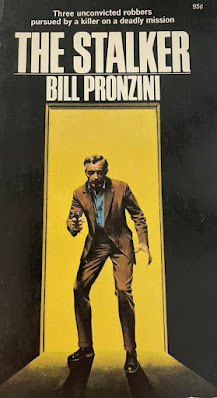
The Stalker

In 1971, author Bill Pronzini's first two novels were published, The Snatch and The Stalker. The former was the first of Pronzini's successful and respected Nameless Detective series. The Stalker was the first of over 30 original, stand-alone novels. After positive Paperback Warrior reviews for Panic (1972) and Snowbound (1974), I was excited to re-enter Pronzini's early 1970s era of crime-fiction. I decided to retrace his steps and begin with The Stalker

The book begins in Granite City, Illinois in March of 1959. Six men successfully rob a Smithfield armored car transporting $750K in money from Mannerling Chemical. Aside from punching a guard, the heist is executed flawlessly and these six men become financially stable in less than 10-minutes. Readers are advised that the investigation into the robbery was unsuccessful in locating the men or the stolen money.

The next chapters feature newspaper articles from 1970 detailing the grisly deaths of three, seemingly unrelated men. These deaths appear to be random accidents, but in the book's compelling middle chapters, readers discover that these men were half of the 1959 heist crew. It's explained that three Army buddies – Conradin, Drexel, and the book's protagonist, Kilduf – planned the heist and are now the remaining members of a mysterious kill-list. 

Pronzini's plot development is exceptional as he leads readers into a dramatic mystery as these three men attempt to identify their stalker. Considering the heist was perfect with no fatalities, and that law-enforcement never located a single clue, the idea that someone has found them seems impossible. But, three of their crew is dead and the list has shortened. There is a tremendous amount of urgency, which Pronzini successfully balances with the slower pace of suspense and mystery. I won't ruin the surprise, but there is another character in the novel that adds some insight to the puzzle.

The Stalker is a short novel, but Pronzini is able to develop the characters at a quick pace that doesn't detract from the story's impact. I loved the relationships between Kilduf and his frustrated spouse, as well as the summarized backstory of these three characters and the wealth they spent or invested. Pronzini is able to create this mental anguish as the characters learn of their potential fates and how their criminal pasts may now extinguish their future. Was the money worth the guilt? Was the fortune worth the mental sacrifice? I love these questions as Pronzini violently shortens the kill-list one by one.

As either a murder mystery, a psychological suspense novel, or as crime-fiction, The Stalker is absolutely fantastic. Pronzini crafts a believable heist tale, but manages to reshape it into a thrill-ride. The end result makes it a mandatory read. Highly recommended! 

Buy a copy of this book HERE