Thursday, April 7, 2022

Cage of Ice

Duncan Kyle is the name printed on a number of 1970s and 1980s high-adventure novels. In reality, this is John Franklin Broxholme (1930-2000) using Kyle as a pseudonym. I really enjoyed my first sampling of the author's work, the action-packed 1976 novel In Deep (aka Whiteout!). I wanted to try another, so I randomly chose Cage of Ice from my bookshelf. It was the author's first published novel, originally appearing in hardcover in 1970 (Harper Collins) and later reprinted numerous times in paperback. Pictured is my 1987 Fontana edition, which has the best cover -  in my opinion - of the reprints I've seen.

In Cage of Ice, protagonist Dr. John Edwards is a British surgeon and teacher residing in New York. In a unique plot set-up, Edwards receives an envelope addressed to Professor John Edwards, which isn't him. Once he receives the envelope, he is nearly killed on the highway by a motorist and his apartment is ransacked and the doorman assaulted. Whatever was in the envelope is then stolen by these mysterious men. Edwards, desperate to learn why he has been targeted by killers, tracks down the envelope's origin and discovers it was supposed to go to Professor Ed Ward....not John Edwards. Get it? 

Edwards finds Professor Ward's residence, but when he arrives, he finds the man murdered. After surviving another round of killers, Edwards is then arrested on suspicion of murder and bailed out of jail by the CIA, who then safely ushers him to their headquarters in Washington D.C. What the heck is happening in this high-adventure-missing-high-adventure narrative? 

Here's what amounts to be the most absurd plot I've discovered yet in a men's action-adventure novel:

The Soviets need more shipping alternatives and routes to contend with the West. To do this, they need sea ports on their northern coastline. But, the area remains frozen nearly year round, so the region is mostly useless. The Soviet Union needs the sea level to rise so they can build a giant dam to allow warmer water onto their coasts while also funneling cold water to Japan, annihilating that country's climate (along with submerging most of Northern America's coastline). To force sea levels to rise, they need the Arctic Ice Caps to melt. Anyone knows that the sunlight bounces off the gleaming white snow and ice, thus it stays frozen. But, the Russians create a carbon that they can release from aircraft that turns the Ice Caps the color of dark ash. Now, the sun can become the Soviet Union's ally by melting the ice and raising the sea level. It is so ridiculous, yet somehow remarkably brilliant! 

A Russian scientist has created this whole process, but he wants out of the Soviet Union so he can spill his secrets to the U.S. and avoid a global catastrophe. But, the U.S. already knows the secrets based on correspondence this Russian scientist had with Professor Ward, who has been killed by Soviet assassins already. The Russian scientist is being held at a secret facility in a frozen wasteland off of Russia's northern coast. The CIA then recruits operatives from Japan, Scotland, England, and the U.S. to make the impossible journey, through the ice and snow, to retrieve the scientist (for some reason). But, because Edwards is a doctor, he's recruited as well because most British surgeons know how to climb icy mountains, navigate specialized snow vehicles, shoot straight, and survive under Earth's harshest elements. 

As insane as all of this sounds, Cage of Ice is a fantastic adventure if you just dismiss the destination and enjoy the ride. Duncan Kyle is writing to entertain readers and this is just pure popcorn fun. The author creates dramatic, harrowing situations for this team to endure and overcome. The survival elements are there, but they don't consume the action. Instead, it is endurance, skiing, breaking into the installation, catastrophe, and creating a backup plan on the run that keeps the pages turning. The book's finale has an awesome firefight with helicopters and a nearly apocalyptic showdown with a nuclear submarine.

If you suspend disbelief to concentrate on the overall action and adventure, then Cage of Ice is an absolute winner. It's similar to the greats like Hammond Innes and Alistair MacLean in terms of the faster pace and death-defying sequences. It's just tissue thin on plot, so your mileage may vary. I recommend it, and I rarely steer you wrong. 

Buy a copy of this book HERE

Wednesday, April 6, 2022

Paperback Warrior Primer - Jack Pearl

The first thing to know about Jack Pearl is that the name is a pseudonym of Jacques Bain Pearl. Pearl was born in Richmond Hill, New York in 1923. After obtaining his Master's at Columbia, Pearl spent nearly three years in the U.S. Army's Military Police throughout Africa, Sicily and Italy during World War 2

After the war, Pearl began a short career as an engineer, but quickly his goal of becoming a full-time writer took control of his life. In 1952, Pearl was able to get his feet wet by writing for a short-lived crime-drama television show called Gang Busters. He also began contributing short stories to the Men's Adventure Magazines. His earliest short story may have been "Submerge!", published by Saga in September 1953. He would go on to contribute short stories to Man, Climax, Impact and Boys Life. After a stint as an advertising copywriter, Pearl worked his way into a managing editor role at Saga and Climax

In 1961, Pearl began writing military non-fiction novels. The first was simply called General Douglas MacArthur, a life story of the man published by Monarch, which was followed by Blood-and-Guts, a life story of General Patton also published by Monarch. These two books instantly became hot sellers and Pearl was off to the races as a full-time novelist. A year later he wrote another one about Navy legend Admiral Bull Halsey and Famous Aerial Dogfights of World War 2.

The earliest work I've read by Pearl is his 1962 movie novelization Ambush Bay. This was a film released by United Artists and Pearl mostly sticks to the film's screenplay but has a few variations. I read the novel and it's set during World War 2 in the Philippines. Nine battle-scarred U.S. Marines and an Air Force radio man are attempting to penetrate a Japanese occupied region to rescue a U.S. Intelligence officer. I really liked it a lot and reviewed the novel HERE.

Pearl wrote a young adult, air force cadet series called The Young Falcons in 1962. The first was The Young Falcons, the second was Bruce Larkin – Air Force Cadet

In 1963, Pearl was still writing for magazines like Saga. In fact, Pearl started dabbling in Cryptozoology with some of his stories. 1964 proved to be a very productive year for the author. He wrote a non-fiction book called Battleground World War 1 as well as the movie novelization for Robin and the 7 Hoods. This was an all-star film showcasing Frank Sinatra, Dean Martin, Sammy Davis Jr., and Bing Crosby. That same year, Pearl rose to prominence with his book about historical assassinations called The Dangerous Assassins. In 1965, he also authored the movie novelizations for The Yellow Rolls-Royce and Our Man Flint, as well as a prison novel called Stockade, which was published by Pocket Books. 

One of Pearl's most popular novels was published in 1966. It was called The Crucifixion of Pete McCabe and it is about a man convicted of rape and murder that must prove his innocence. In 1967, Pearl authored a television tie in novel to the sci-fi TV series The Invaders called Dam of Death. That same year he also authored the first of a two book series of young adult science fiction called Space Eagle, which is loosely based on the Lone Ranger concept. Also in 1967, Pearl authored two books as television tie-in novels to the show Garrison's Guerillas. One was a young adult novel called Garrison's Guerillas and the Fear Formula. The other was simply titled Garrison's Guerillas, a paperback published by Dell that serves as a traditional WW2 men's action-adventure novel. I read and reviewed the book HERE.

In 1968, Pearl authored the movie novelization of Funny Girl. By the 1970s, Jack Pearl started to author books in a gritty, more violent tone that fits snugly with men's action-adventure of the time. This era of his writing begins with 1971's A Time to Kill, A Time to Die. It's about a reunion of old friends from World War 2 at an Aspen Ski Lodge. But within a half-hour, five are fatally shot by a sniper and it's up to the local police and a psychiatrist to close in on the killer and learn his/her motives. His 1973 book Victims is about a terrorist bombing attempt in New York City on Christmas Eve. 

Pearl wrote The Plot to Kill the President in 1972 and it was published by Pinnacle. This is a book that was inspired by the Kennedy Assassination. Pearl continued doing television and movie novelizations in the 1970s with a book called Nancy, a mob-themed one called Lepke. He also started tinkering with romance novels in the 1970s with books like Callie Knight.

Real life Newark Detective David Toma co-authored a handful of novels with Pearl based on his career in law enforcement. The first was co-written with Michael Brett (the same one that wrote Diecast) and two were written with Jack Pearl – The Affair of the Unhappy Hooker and also The Airport Affair

From 1977 through the late 1980s, Pearl teamed up with his cousin Donald Bain (author of the Murder, She Wrote series) to write mass-market romance novels under the name Stephanie Blake. This is what Pearl finished his career doing. He would pass away in Nassau County, New York in 1992. 

You can check out our Jack Pearl page HERE as well as listen to our podcast episode about the author HERE.

Tuesday, April 5, 2022

X-Files - Goblins

I'm an X-Files fan, one of those weird X-Phile nuts. To prove it, I have an old trunk filled with show toys, coffee mugs, calendars, books, action-figures, autographs, and various magazines like TV Guide. I even have VHS recordings of various episodes as they originally aired on Friday nights. I've read the graphic novels, fan-fiction, and some of the books. I've had Goblins for a long time and recently decided to listen to the audio version while earning my keep performing honey do chores. It was originally published in paperback by Harper in 1994 and authored by Charles Grant, a prolific writer that specialized in horror.

In a small town in Louisiana, two retired U.S. Military officers are slashed to death. However, eyewitnesses claim a hand came from out of nowhere, as if it was nearly invisible when making the killing stroke. One of the men was to marry the cousin of a sportswriter that Mulder knows. The sportswriter comes to Mulder with the murder mystery, but he's already on it. The F.B.I. has already been called to perform the investigation quietly, thus Scully and Mulder are brought up from the basement to handle what may, or may not be, a legitimate X-Files case.

The problem that the F.B.I. agents face (and readers for that matter), is that there are too many cooks in the kitchen. Grant doesn't leave well enough alone and partners two rookie agents to accompany Scully and Mulder on the case. Thus, there's multiple investigations with different pairings of the agents. Also, the sportswriter comes to town as well to conduct his own investigation, which just complicates the narrative more.

I'm not sure if Grant had actually watched an X-Files episode when he was hired to write this sort of television tie-in literature. Mulder's characterization is off, behaving in ways that doesn't really match his television persona. In this book, Mulder isn't as sarcastic with his responses or as serious as the TV character, and does the investigation in ways that has no real purpose or flow. I also didn't sense any of the guilt ridden emotion that wrecks Mulder on screen, although Grant does include a flashback scene of Samantha disappearing (Mulder's sister and major series story arc). He's also overly happy about things beyond the paranormal, which is unusual. The idea is that Mulder only becomes enthusiastic when researching X-Files-type cases. 

My main issue with Goblins is that it's just boring. Nothing really happens, the agents spin their wheels, and I figured out the whole “goblin” mystery in the book's first few chapters. The bumpy narrative was a struggle to get through and I was left thoroughly disappointed that I've hung on to this paperback for nearly 30 years only to find out it isn't very good. 

There are numerous paperbacks available, including a couple that retcon Scully and Mulder's teen years. I'll continue reading X-Files related stories and books, but there's no reason for you to read Goblins

Get the ebook HERE.

Monday, April 4, 2022

Hugh North 18 - Two Tickets for Tangier

Francis Van Wyck Mason (1901-1978) was a renowned international traveler and author with 78 books to his credit. He began his career writing stories for the pulps where he developed his signature character, U.S. Army Intelligence Colonel Hugh North (7 stories, 25 novels) in 1930. The stories began as mysteries, but shifted into spy adventures with the advent of paperback original novels. My first taste was the character’s 18th novel, Two Tickets for Tangier, from 1955. 

North, who works for a U.S. spy agency called G-2, is on vacation in London romancing a sexy babe named Lady Angela Forester. He’s known Angela for awhile, but he’s not initially aware that she’s a British MI-2 spy. Their romantic time together is cut short when North is summoned into his boss’ office in London, and Angela has to fly to Tangier for something or other. 

Don’t be embarrassed if you know nothing about Tangier. I’m here for you. It’s a port city located in Morocco on the northern coast of Africa — across from the Strait of Gibraltar from the southern tip of Spain. In 1955, Tangier was still an international city largely operating independently as a free trade zone beyond the control of much oversight from Morocco. As a result, Tangier was a multi-cultural, freewheeling city — an “anything goes” kinda place. 

As luck would have it — the paperback’s title gives it away — North’s new assignment is also to Tangier. The mission involves a gas called Thulium-X that creates intense cold temperatures similar to those of outer space. The gas was perfected by a former Nazi scientist named Dr. Vogel, who had been enslaved by the Ruskies since 1945. Somehow the scientist escaped and is hiding in Tangier. North needs to find him and buy the formula before the Soviets can make the grab. 

The plotting in Two Tickets to Tangier was good, but not remarkable. The writing, however, was a slog. The author went to such pains to portray North as a debonair man of the world that he really came off as a foppish snob. He peppers his language with French phrases and seems like the last guy I’d ever send into a critical mission. Painstaking descriptions of locations abound and offhand references to obscure characters from previous novels litter every scene. 

I was really optimistic about this series, but this first foray into the world of The Man From G-2 really left me cold. If there’s a good installment in this series, please hit me up. I assure you that Two Tickets to Tangier isn’t the one. 

Buy a copy of this book HERE 
Friday, April 1, 2022

The Many

The Many (2016) is the first book in a trilogy of psychological horror thrillers by American author Nathan Field. I sampled the first chapter on my Kindle and was sufficiently creeped out to continue reading.

The novel begins with a blind date in Portland, Oregon, where Stacey quickly becomes charmed by a British doctor named Adam, whom she originally met on a dating app. The wine and dinner portion of the date went swimmingly well, but things get seriously weird in the car ride back to Adam’s place to consummate the good night.

The third-person perspective changes to Karl Morgan. He’s Stacey’s brother and he is super-concerned about Stacey’s well-being. Karl is flopping on his sister’s couch, and Stacey has been acting seriously weird since her date with the doctor. The change in Stacey’s behavior triggers Karl to leave Stacy’s place and set off on his own. Maybe some time apart will be good for the siblings.

When Karl reconnects with his sister, her weirdness and creepy behavior only increases. The central mystery of the novel’s first act: “What the hell is going on with Stacy?” No one spoiled the book for me, so I was wavering between demonic possession and an alien body-snatching. There were some legit terrifying scenes depicting Stacey’s descent into weirdness or madness or however you want to characterize her changes. Fans of horror fiction will be super-pleased. Leave it at that.

The initial solution to the mystery is revealed halfway through the novel, and the book then slides into straight-up thriller territory. Two characters pair up to solve the mystery, and their relationship follows the beats of a young adult novel. A late-novel plot twist turns everything you’ve read on its head, making the reader want to know more about the conspiracy of The Many promised in the title.

Beyond that, there’s not much I can say about the plot that won’t spoil the fun for you. My only complaint is that the paperback is part one in a trilogy, and not much is resolved in The Many. To the publisher’s credit, all three installments have been released in one 900-page volume, which I’ll need to tackle one day to find out what the Hell happens.

Bottom line, The Many - at least the first installment - is inventive, periodically terrifying, and often hard to put down. It’s a puzzle-box mystery with an intriguing solution that kept the pages turning. If this sounds like your kind of thing, it probably is. You won’t be disappointed. 

Get the ebook HERE.

Thursday, March 31, 2022

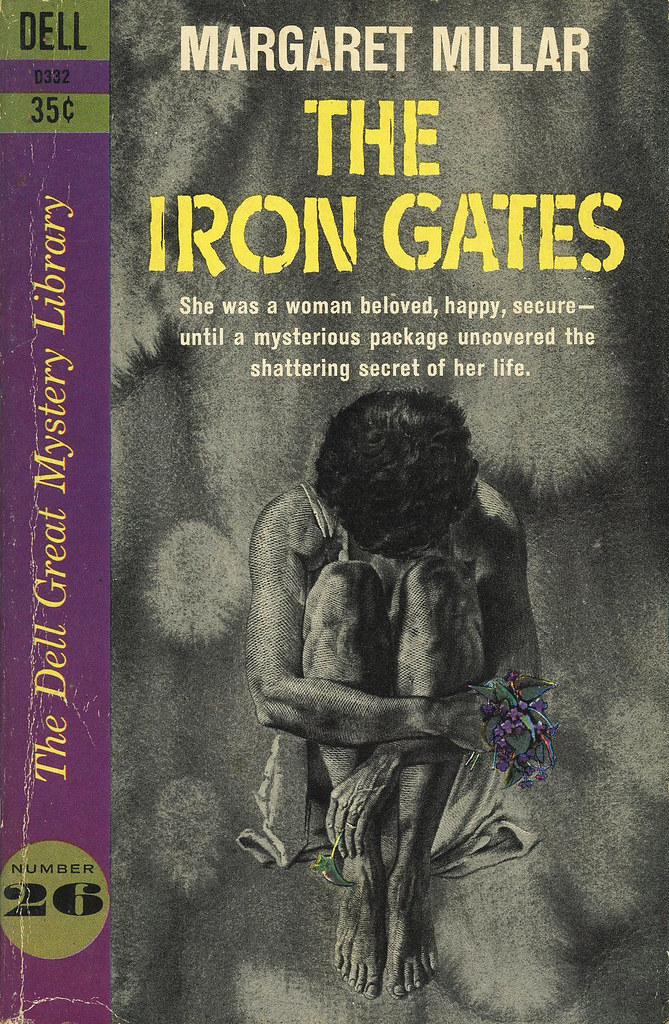
Inspector Sands #02 - The Iron Gates

Along with her contemporaries like Dorothy B. Hughes, Charlotte Armstrong, Dolores Hitchens and Helen Nielsen, California native Margaret Millar helped solidify the presence of talented female mystery authors in the 1940s and 1950s. She wrote over 25 original novels, mostly as stand-alone works. However, her first three novels starred a Canadian sleuth named Dr. Paul Prye and she repeated that creation with another Canadian detective, Inspector Sands. 

The Toronto homicide detective starred in Wall of Eyes (1943) and The Iron Gates (1945), as well as a short story called "The Neighbors Next Door" in a 1954 issue of Ellery Queen Mystery Magazine. I chose to read the latter novel based on an article by Curtis Evans (via Stark House Press) praising the book. It has been reprinted multiple times in hardcover, paperback, and most recently as an audio book. It was also printed in the U.K. as Taste of Fears.

In The Iron Gates, Millar's prose is pure psychological suspense. In the book's opening chapters, Lucille Morrow is mourning the unusual death of her friend Mildred. These scenes are beautifully written and drape the imagery in a white pane of frosted glass reflecting Lucille's loss and mental anguish. It's a hazy precursor to what eventually occurs later in the book as a historical flashback or retelling. 

Later, readers learn that Lucille is now married to a retired physician named Andrew, Mildred's previous husband. She is the stepmother of his two adult, but childish, kids and the in-law to his worrisome sister, all of which reside in the same house. Due to the death of Mildred, and Andrew's replacement of her with Lucille, there are strict dividing lines in the household based on suspicions and shifting judgments. These alliances and strategic family placements play into the novel's central themes of jealousy and lust.

Inspector Sands becomes involved in the narrative when Lucille goes missing. There's early discussion between characters about a nearby park where a grisly murder took place. There's a cautionary tale told about a wandering ax-man preying on park guests. The idea that Lucille is missing, the nearby murder, Mildred's prior death and this strange ax-man all play into the mystery. Sands doesn't know what to believe and finds the family obtuse about Lucille's whereabouts. Only Andrew seems genuinely concerned about her well-being, opening up a string of guesses on which family member committed murder.

The book takes an interesting twist for the second half. Without spoiling the plot development, a major character ends up in a mental asylum behind “iron gates”. Her reason for being there is cloudy, leaving Sands and a detective to investigate the events surrounding her confinement in the asylum. Most of the book's second half does take place in the asylum as the character interacts with other mental patients and the hospital's staff. I enjoyed these parts of the story, but felt it was a little distracting at times. The behavior of the patients and their involvement in the main character's psyche definitely contributes to the story's development, but it's a marathon. 

As a psychological suspense novel, Millar conveys a lot of emotion in her writing. I enjoy the shading she provides as she draws out each character for the reader to suspect. As I learn more and more about female mystery authors of the 20th century, my research always leads to Millar. She was a a real talent and sadly isn't as relevant now. Her work is mostly forgotten aside from a few reprint houses still preserving her novels. Her spouse, Ross MacDonald, the creator of the California detective Archer, is in more abundance, but honestly Millar may have been the one to read all along. 

The Iron Gates was optioned for film to Warner Brothers and allegedly Millar wrote the screenplay. It was to star either Bette Davis or Barbara Stanwyck, but the film never came to fruition. This novel remains rather timeless and would make for a great modern film with it's real world complexity. My vote is for director David Bruckner (The Night House, The Ritual). Anyone have his number? 

Buy a copy of this book HERE

Wednesday, March 30, 2022

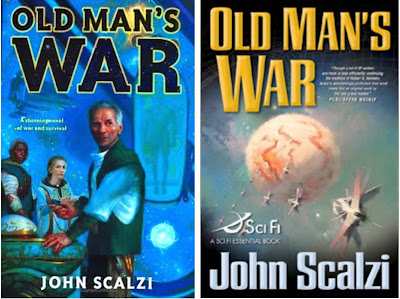
Old Man's War

Old Man’s War by California author John Scalzi is one of those books that often appears on lists of the "Greatest Science-Fiction Books of All Time." The novel was first published as a serial and released as a book in 2005. The novel was nominated for a Hugo Award and inspired multiple sequels.

Here’s the set-up:

It’s about 200+ years in the future, and Earth is engaged in a forever war with several alien races in colonized interstellar space. However, Earth’s military doesn’t want strong, young soldiers. Instead, they want senior citizens for reasons the novel will make clear to you when you read it. If a volunteer oldster serves in combat for two years and survives, the senior is awarded a sizable plot of land on one of the many colonized planets. They also get some life-extending medical procedures, so they don’t keel over on the battlefield. Extending life in exchange for dangerous combat is a good deal for the elderly looking into the Great Beyond.

Enter John Perry, our narrator. He is a 75 year old widow living in Ohio that is now joining the military. The idea of extending his life and leaving Earth behind forever seems like a good idea. The catch is that you can never return, nor can you have any contact with the people you leave behind. As a result, information about combat as part of the Colonial Defense Force is spotty. You need to sign on in a leap of faith to learn the whole scoop.

The geopolitics of Earth’s space colonies are pretty fascinating and also best left explained in the novel. Same for the inventive physics devised by the author to catapult senior citizens into the far reaches of space. I also wasn’t expecting how funny the book would be. The narrative voice of John Perry reminded me of Andy Weir’s novels The Martian and Hail Mary. It’s the kind of science-fiction that doesn’t ask too much of the reader as the world-building is so smooth and effortless to read.

The Colonial Defense Force has many of the hallmarks of our own military culture with intensive training by intense drill sergeants. It’s only when the oldster soldiers are briefed on their mission and the enemies they will be encountering that it becomes clear that this isn’t going to be a walk in the park. By the time you actually get to combat battles, you’re in for a real treat (think of the film Starship Troopers).

The many battle scenes will please action-adventure paperback fans, and this is a perfect novel for people curious about science-fiction who don’t know where to begin. Overall, Old Man’s War is an absolute winner and I look forward to exploring the sequels. 

Get the book HERE.