Wednesday, May 11, 2022

World's Scariest Places #03 - Helltown

After enjoying horror novels like Suicide Forest, The Mosquito Man, and The Sleep Experiment, I was anxious to read another book by Jeremy Bates. The Canadian-Australian author has two unique series titles – World's Scariest Legends and World's Scariest Places. The idea is that Bates uses some sort of urban legend or supposedly haunted place as the main element of these stand-alone novels. His 2015 novel Helltown is set in the abandoned town of Boston Mills, OH. 

The actual urban legends concerning the small town of Boston Mills, OH are pretty darn creepy. The real town, simply called Boston, was closed by the U.S. Forestry Department in 1974. The reasoning was the need to preserve forests in Summit County. The inhabitants were paid to leave and what remains is an abandoned town, complete with old buildings, rural roads, barricaded bridges, and some really wild legends. The white church in town looks to have upside-down crosses on its exterior. There's an abandoned school bus in the forest said to be haunted. Supposedly, a clan of wild cannibals resides in the town and prey on visitors. Toxic gas, disease, and rumors of giant pythons make it sound appealing enough for the occasional tourist to quench their thirst for adventure and mystery. Over the years, Boston is now deemed Helltown.

Bates uses a lot of these myths and legends in his horror narrative. The book is set in 1987 and features Boston Mills as a small community of rednecks that are still living in the town despite the fact that most of the population left 13 years earlier. These rednecks kill rabbits with dynamite, watch a lot of television, drink cases of beer daily, hang out a local bar, and worship Satan. That's right. Satan. 

Like a classic 80s horror flick, a group of kids are heading into Boston Mills on Halloween night, hoping to discover ghosts or chainsaw-wielding maniacs. Their car is run off the road by a hearse and the survivors find themselves on the run from crazed rednecks looking for rape, violence, and satanic sacrifice. The book's main characters are two good hearted girls, an ex-Army vet struggling with PTSD, an urban explorer and the whacked-out doctor that's behind the murder and mayhem. Bates uses the church, school bus, rural location, pythons, and crazy cannibal elements of the town's dark mythology to create his nightmarish horror novel. 

I think Jeremy Bates has a great thing going. These two series titles are just so much fun and have enough sex, violence, and gore to satisfy fans of Edward Lee and Bryan Smith without going full-blown splatterpunk. Bates' writing is provocative and deeply disturbing, but it isn't unreadable. He has a real talent to skirt the boundaries of absolute madness without pushing the reader over the edge. Recommended. 

Buy a copy of the book HERE.

Tuesday, May 10, 2022

Kim

With 17 novels and dozens of short stories to his name, Robert Colby remains one of my favorite authors of the paperback original era. Kim was a 1962 hardboiled private-eye mystery mispackaged as a sex novel by Monarch Books. It remains available today from two separate reprint publishers - Wildside Press and Prologue Books.

The narrator is Miami private detective Rod Striker whose practice involves helping wealthy clients with personal problems. His latest client is rich Aunt Martha, who is concerned about her 22 year-old niece, Kim. She’s engaged to a nice boy, but she had a fling with a local strip club pimp named Eddie Tarino who runs a sex-for-pay boat between Miami and the Bahamas. Tarino wants Kim on board as his personal escort and is threatening her fiancĂ© and aunt with physical harm if Kim doesn’t comply. Aunt Martha wants Striker to drag Tarino into a dark alley and beat him until he begs for mercy and promises to stay away from Kim. 

Rather than beginning the assignment with violence, Striker decides to visit Tarino and talk some sense to the pimp. The meeting of these two Alpha Males is really something special, and Striker discovers that there’s way more to the story than his client initially understood. He also follows up with Kim, who —as expected — is a dish to end all dishes The author’s description of her cans will stay with me forever.

Striker has a partner at his PI agency named Myra. She’s a beautiful 29 year-old ex-cop from Los Angeles. The author does a great job describing her to make every man reading the novel fall in love with her. Striker and Myra are occasionally romantically involved, although the relationship is mostly business. Much later in the novel, the first-person narration switches from Striker to Myra. I normally hate that crap, but it worked this time because they’re both awesome characters. 

A mystery arises for Striker and Myra to solve:  Who is pulling the strings behind this manipulation of Kim? There are sex scenes along the way, and they’re white-hot in a 1962 kinda way. To be clear, this is a first-class hardboiled mystery with two great leads. The paperback had some pacing problems in the second half, but the twisty conclusion was straight aces. 

Bottom Line: Another winner from Robert Colby. Go ahead and add this one to your reading queue. 

Buy a copy of this book HERE.

Monday, May 9, 2022

Burnt Offerings

Horror luminaries Stephen King and Bentley Little have both acknowledged Burnt Offerings as an influence on their writing. The novel, authored by Robert Marasco, was originally published in 1973 and adapted into an MGM film in 1976. The book is available now as a reprint through Valancourt Books with an introduction by Stephen Graham Jones. 

In the book, Ben and Marian Rolfe live in the crowded city of Queens, New York and are barely surviving the day to day hustle and bustle of work, marriage, and parenthood. The city is consuming them, eating away their existence and crushing their dreams and aspirations. Ben realizes this isn't a place to raise their young son David. In hopes of a fantastic family summer, Marian begins searching the classified ads for a summer place they can rent with their meager budget. Ben works as a professor, so Memorial Day through Labor Day affords them the opportunity to get away from it all. 

Marian locates an advertisement for a summer house in upstate New York. It's an appealing invitation of private beach, pool, dock, magnificent views, and the price, while not disclosed, suggests it might be affordable. The three drive up for the weekend to visit the place and negotiate with the owners. Their arrival proves to be disappointing. 

The house, which is a 30-room mansion, is in disarray. The once lush landscape is now dead, the exterior is crumbling, and the inside is dusty, ancient, and clearly neglected. But, it has potential and could be a great way to spend a summer vacation. The house is owned by Mrs. Allardyce and her elderly son and daughter. The deal works out to just $900 for the whole summer - a bargain if there ever was one. The only catch is that the Rolfes will be sharing the house with Mrs. Allardyce, a frail, sickly woman that lives in the west wing of the house. Her children explain that she doesn't leave her room and rarely makes an appearance. The Rolfes just need to leave a tray of food for her three times per day. This burden isn't that heavy.

Once the Rolfes settle into the house for the summer, their family ties begin to deteriorate. Marian begins to spend more and more time on the west wing cleaning. Ben begins a descent into madness, peaking as he attempts to drown David in the pool. Marian and Ben's relationship unravels, but oddly, the house begins to come alive with new paint and landscaping. The house is growing as the Rolfes sacrifice their happiness and love. Who's the master and servant? Is the house haunted? Is Mrs. Allardyce even real? These are the questions that arise throughout the book's haunting narrative.

American Nightmares: The Haunted House Formula in American Popular Fiction, by Dale Bailey, compares Burnt Offerings with a later novel, Anne River's Siddon's The House Next Door and of course, the staple of 1970s haunted house fiction, Jay Anson's The Amityville Horror. I've now read all three, and while I still prefer Anson's dark and twisted narrative, Marasco's work is much grimmer and intelligent, dwelling on a biblical emphasis of sacrifice and loyalty. There's a deep social subtext to Marasco's storytelling – the price of happiness, humanity's lust for material things, the financial burdens of average Americans, the limits of sacrifice, and the strains of the family dynamic in modern culture. 

The family's descent into despair is a heart-wrenching spectacle for readers, especially considering these characters are so easily likable in the book's opening chapters. The mystery involving the west wing was captivating, leading me to question whether some of the events happening were real or just a malevolent facade. Mrs. Allardyce's identity was like a dangling carrot, suspended for readers to finally uncover in the book's closing pages. The house, a character unto itself, was remarkably detailed to enhance the transformation from ruin to prosperity. 

Stephen King, as he acknowledged, probably owes a great deal to Marasco for the success of his 1977 novel The Shining, published just four years after Burnt Offerings. Like Marasco's plot, King replaces the Rolfes with the Torrance family, equally introduced as a strained married couple raising their young son. King transfers the location of a 30-room mansion in upstate New York to the empty Overlook Hotel in Colorado. Ben Rolfe is struggling with a text, like Jack Torrance's frustrated efforts to finish writing a manuscript. Marasco utilizes a deep swimming pool as an eventful place where young David faces death. King uses the mysterious hotel room 217 to captivate Danny Torrance (and a bathtub to be technical). Alternatively, Marian's fascination with the door to Mrs. Allardyce's room is similar to Danny often approaching 217's door. In other words, I hope King cut Marasco a check. 

Burnt Offerings is an abstract horror novel, working on a psychological level that is crafted with expertise. As an entry in the overpopulated “haunted dwelling” sub-genre, it is easily in the upper echelon of mandatory reads along with the aforementioned The Amityville Horror, The House Next Door and pioneering efforts like Richard Matheson's Hell House, Shirley Jackson's The Haunting of Hill House, and Henry James' The Turn of the Screw. Unfortunately, Marasco didn't pursue another horror novel that I'm aware of. To quote John Carpenter, “I guess everyone's entitled to one good scare.” 

Buy a copy of this book HERE

Friday, May 6, 2022

Sea Vengeance

British author Robert Leader (b. 1938) had worked as a Merchant Marine, bartender, and a factory worker before becoming a full-time novelist. He wrote over 200 short stories and sold them to magazines like Reveille, Titbits, London Evening News and London Mystery. He found success authoring a series of 10 espionage thrillers starring British agent Simon Larren. Collectively, British publisher Robert Hale published over 40 of his novels, most authored under his real name or pseudonyms like Robert Charles or Robert Brandon. Some were exported to the U.S. by Pinnacle. My first experience with the author is his 1974 novel Sea Vengeance. It was published in the U.S. by Pinnacle with a cover by Phil Marini.

The first few chapters of Sea Vengeance plays out like the exciting 1992 Steven Seagal action film Under Siege.  Chief Officer John Steele, a Korean War veteran, is working on board the Shantung as it departs embattled Saigon en route to peaceful Singapore. The large ship features eight cabins, each containing a diverse variety of passengers. Within a few hours, Steele and the crew discover that the group of Buddhist monks on board are actually Viet Cong hijackers. They kill a few of the Shantung crew and severely injure its Captain.  

With the ship under command of a Viet Cong leader named Thang, Steele works in stealth to capture weapons and free passengers. His betrayal comes from an unlikely suspect, a lover he has met on board named Lin Chi. Together, Chi, Thang, and the Viet Cong have plans to use the ship to rescue a number of their allies from a small prison camp off the coast of  battle-torn Vietnam.

At 182 pages, Sea Vengeance is brimming over with exciting danger and intrigue. Steele proves to be the capable hero – admirable, courageous, and willing to sacrifice his life for others. As a propulsive action yarn, the scenes with Steele secretly working “behind the enemy” to secure the ship was really engaging. With the author's vast experience on merchant ships, I found some of these scenes had a sense of realism. While Steele's struggles with the Viet Cong on the ship were effective, page turning events, I applaud the author's introspective commentary. 

The combatants in the Vietnam War are presented positively by the author, both condemnation and worthy appraisal provided through a philosophical look at war and its aftermath. This isn't a stretch from Leader's wheelhouse considering he has written a number of non-fiction books on religion, philosophy, and his travel experiences. He certainly has the credentials and education to provide thought-provoking dialogue between these volatile characters. I found that to be one of the biggest highlights. 

If you enjoy Vietnam military history, or love a great nautical or war story, then Sea Vengeance is highly recommended. I found it to be similar to Australian author James Edmond Macdonnell's series of World War 2 novels starring Captain Walt Kenyon. Just don't be surprised with some of the heavy dialogue sequences. While it doesn't bog the narrative down, it may slow the excitement for those of you looking for just head-on carnage. 

Buy a copy of this book HERE

Thursday, May 5, 2022

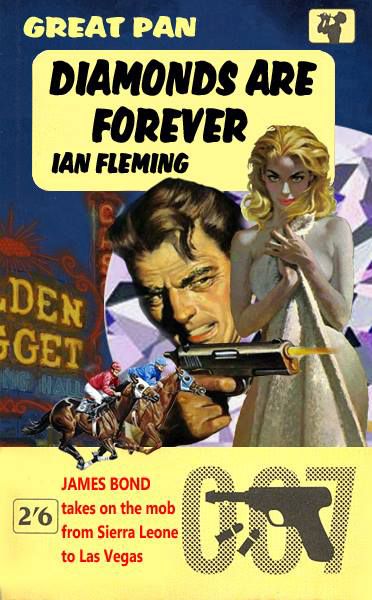
James Bond #04 - Diamonds Are Forever

Diamonds Are Forever is the fourth installment of Ian Fleming's wildly successful James Bond series of spy-thrillers. It was originally published by Jonathan Cape in the U.K. in 1956. The novel's central theme is diamond smuggling, a criminal operation that intrigued Fleming enough to not only use it as a plot, but also a non-fiction book he wrote in 1957, The Dimaond Smugglers. In 1971, the novel was adapted into the seventh James Bond film. 

In the book's opening chapters, Bond and his superior M engage in a deep discussion about the diamond industry. At the time, England was importing diamonds from Africa and then selling large amounts to various international companies and countries. It made up a large percentage of the country's income and represented what would ultimately be one of the largest diamond exporting operations. One of the largest buyers, House of Diamonds, has reduced their purchases of English diamonds, creating a financial gap in the Brits lucrative business. 

It's explained that House of Diamonds is a legitimate business owned and controlled by an American mob family named The Spangs. M, and the Special Branch, suspect that a criminal element has been introduced which is creating the rift. House of Diamonds surely must be obtaining their diamonds by smuggling them in at a cheaper price. M wants Bond to investigate the operation by infiltrating the smuggling ring into New York and Las Vegas under the disguise of a common burglar named Peter Franks. He wants Bond to engage in the job and then converse with a woman named Tiffany Case, one of the gang members involved in the smuggling.  

Bond's journey is quite epic, first beginning in New York to retrieve the smuggling money owed on the latest smuggle. His payer is a gang leader named Shady Tree. He explains that their operation doesn't just pay out the full payment for security reasons. To fulfill his payout to Bond, aka Peter Franks, he orchestrates a number of rigged gambling ventures that will produce fragmented payments. The first payout is an exciting stretch at a rigged horse race in Saratoga. Then, a rigged blackjack game in Las Vegas dealt by Tiffany. But, Bond flips the score and pays off the jockey to disrupt the payoff and then wins too much money at blackjack.

If I provide anything else pertaining to the story, it's going to provoke you to skip Ian Fleming and just read me. I'd never forgive myself. Here's the thing, read Diamonds Are Forever if you want to see Bond deeply entrenched in hardboiled danger. Fleming throws everything but the kitchen sink at readers: intrigue on a ship, danger in the desert, a train-car chase, torture, romance, and gunplay. The chemistry between Tiffany and Bond was perfect with both needing something from each other. Former American CIA agent Felix Leiter returns to this book and I found his addition to the story effective. My only real complaint is the “cowboy” appearance of one of the Spangs and the longer than necessary ending. Otherwise, Bond absolutely wins again. Recommended. 

Buy the book HERE.

Wednesday, May 4, 2022

The Freakshow

According to his Goodreads profile, Bryan Smith has authored more than thirty horror and crime novels and novellas. His crime-fiction book 68 Kill was adapted into a critically-acclaimed film in 2017. Smith also co-scripted an original Harley Quinn (Batman) story for DC Comics' House of Horrors anthology. I first discovered the author in the mid-2000s by reading his mass-market horror paperbacks like House of Blood and Deathbringer. His 2007 horror novel The Freakshow was originally published by Leisure and has now been reprinted by Grindhouse Press in multiple formats. 

The Freakshow is splatterpunk with the obligatory copious amounts of sex (mostly rape), gore, and violence prevalent over the science-fiction and dark fantasy elements. The novel's concept is that supernatural beings from a netherworld are playing a game where they control humans to do just about anything imaginable. These “things” are losing their home world, so they want ours. By conquering humans through assimilation, they can move from the netherworld into ours. 

These beings are sort of like Clive Barker's Cenobites from his novella The Hellbound Heart and the franchise of films. They have a variety of appearances and abilities and aren't necessarily good or evil, thus the “angels to some, demons to others” sentiment of Barker's stories is the theme of The Freakshow. Because of the variation, Smith's imagination runs wild. There's a two-headed succubus leader, a robotic clown, sexually depraved humans (if you can call them that), rolling heads that chomp flesh, you get the general consensus.

It's hard to find any characters to really cheer other than Heather, a young woman in an abusive relationship with her boyfriend and dealing with an ailing mother. She is the main character, but that's a loose term considering the book has a dozen or more characters. Mostly these characters are disposable and make for rape and torture targets. The story presents characters that are fighting the freakshow invaders or working for these supernatural beings. Mostly, the characters just dwell on perverse sex and creative ways to kill or maim each other. There's no respect for any higher authority beyond their own self-interest 

Overall, I found the book to be slightly better than average. With Smith's literary work, I manage my expectations, knowing that his narratives are saturated in over-the-top violence and gore. There's nothing wrong with that, but I normally like my horror to be more psychological than physical. If a unique, violent bloodbath is your thing, then The Freakshow will surely please you.

Note – Brian Keene's Urban Gothic and this book tie-in to a novel called Suburban Gothic, authored by both Keene and Smith. 

Buy a copy of the book HERE.

Tuesday, May 3, 2022

The Brat

The Brat, published in 1957 by Fawcett Gold Medal, was Gil Brewer's 12th career effort, a mid-era crime-noir that is misrepresented by the book's sultry cover. Fans of Brewer's sexier femme fatale novels, like The Vengeful Virgin (1958) or The Tease (1967) may be led to believe that The Brat possesses that same energy level. It includes all of the potent ingredients to make the narrative seemingly explode – wild women, lust, greed, criminality, and average men pushed from their suburban threshold into a world of madness. Like Orrie Hitt, Brewer loved this type of storytelling experience - the sexy seductress weaving a master-plan. But, The Brat doesn't utilize these ingredients to create anything magical. 

In this novel, Brewer mimics Day Keene's more simplistic approach. It makes sense considering the two were friends and even collaborated together. If I didn't know better, I would have pegged The Brat as a Keene novel. The narrative is saturated in genre tropes that are familiar to any seasoned crime-noir fan. The narrative's central element is identical to the “man awakens to find a corpse and flees from the law to prove his own innocence” concept. Only, Brewer exchanges the swanky apartment, soft bed, or suburban house with a bank.

Lee is a fairly wealthy guy before his trip into Florida swampland. It's in the sweltering jungle that he finds the sexy Evis, a backwoods tramp that he can't resist. Her family is redneck loonies, so Evis is rescued by Lee and soon the two ring the wedding bells. But, Evis’ domestication is ripe with greed and self-interest. She carves through Lee's savings, leaving the two almost destitute just a short time later. Evis, who conveniently works at the local bank, pitches Lee a heist plan. She can easily steal money from the bank's vault during her closing shift. Lee slightly agrees, but doesn't want to commit to steering into that lane yet.

Lee arrives from work one evening to find that Evis is working at the bank and she needs him to pick her up. When he arrives at the bank, there's a corpse, missing money, missing spouse, and enough evidence that suggests he collaborated with Evis to commit this criminal act. Terrified of being fried for murder, Lee hits the road to pursuit Evis. Along the way, he is tracked by a greedy sheriff that wants the money all to himself. There's also Lee's best friend that may have been Evis's side hustle to seduce into a joint heist. Lee must avoid the police, find Evis and the missing cash, and prove he is innocent. 

Brewer's novel  is one long road trip as Lee hops from destination to destination searching for clues. The pacing and plot structure never allows the narrative to breathe, making the characters one-dimensional and over-obsessive. This is Day Keene's wheelhouse and he excels at it far better than Brewer. The Brat is similar to Brewer's Sin for Me (1967) novel with its western feel and seemingly endless manhunt. If you must read everything Brewer has written, then you aren't skipping The Brat. Otherwise, there's no need to spend any time reading this less than satisfactory novel.

Buy a copy of this book HERE