Sunday, June 5, 2022

House of Stairs

William Sleator (1945-2011) was a Harvard graduate that authored science-fiction and young adult novels from 1970 through 2011. I wasn't aware of his literary work, but was happy to discover House of Stairs at a local used bookstore. It was originally published by Avon in 1974 and has since been reprinted numerous times in multiple formats.

The book consists of five sixteen-year old kids being taken from various orphanages and state institutions and placed in a seemingly endless world of stairs. There are no walls or rails, just platforms connected by stairs that lead in different directions to more stairs. The first to arrive is Peter, blindfolded and shoved from an elevator into this stairway nightmare. Inside the maze, he finds a girl named Lola. Together, the duo stumbles upon another stairway resident, a girl named Blossom. She has found a small, disc-shaped machine that releases a small food pellet each time she sticks out her tongue.

The three are later joined by Abigail and Oliver, and collectively the five of them share a small backstory of how they came to arrive in the maze. Like any novel that places ordinary people in extraordinary circumstances, alliances are formed and enemies are made. In this case, Lola and Peter form a partnership and attempt to exist “upstairs” away from the others. The motivation for alienation is that the food machine changes its preferences on when to deliver the pellets. As the hours morph into days, the group soon becomes starved and forced to abuse each other in order for the food pellets to be delivered. You see, physical and verbal abuse awards the group with food while kindness and generosity produces starvation. The horror!

At 156 pages, House of Stairs is a brisk, macabre little novel that says so much about humanity's will to survive. It was interesting to watch the deterioration of human kindness when pushed to the breaking point physically and emotionally. With the idea that time isn't a factor, a rescue isn't feasible, and escape is impossible, these kids spiral into madness and depravity. It's a young adult novel, but there are some violent scenes and sadistic overtones.

I enjoyed this book a lot and found the central mystery as a propulsive, consistent plot development. I will say it is a bit dated with some situations and the ending left me a bit underwhelmed. If you love survival horror like The Mist or The Ruins, then House of Stairs should provide just enough literary terror to quench your thirst. Recommended. 

Buy a copy of the book HERE.

Friday, June 3, 2022

Cody's War #01 - Dragonfire!

Between 1982 and 1986, Stephen Mertz authored a number of gritty Mack Bolan installments that are considered some of the best of the series. He also created and authored installments of the M.I.A. Hunter series as well as the Kilroy mysteries and music-based novels like Hank and Muddy and Jimi After Dark. Recently, he launched a brand new action-adventure title called Cody's War. I'm always up for a rip-roaring, Mertz mule-kicker, so I chose to read the series debut, Dragonfire!. It's out now through Wolfpack Publishing.

Readers learn through backstory that CIA Agent Jack Cody experienced a personal tragedy when his family was killed by a terrorist bomb. Now, Cody seeks out the most perilous jobs in a quest to kill himself in the line of duty. Thus, his unconventional methods have earned him the nickname “Suicide Cody”.

In the book's opening chapters, Mertz introduces readers to his newest paperback warrior by placing Cody on a small, U.S. submarine en route to the Ocean Song, a recreational yacht containing a wanted Islamic terrorist named Hadi Abu. As Cody emerges from the tiny craft, there is a prophetic message in one simple line of text: “Cody lifted himself through the hatch, into the storm.” It kicks off the novel, the character's mission, this series debut, and puts readers in the harness seat as the author thrusts readers into the action.

On the Ocean Song, Cody disposes of the baddies, captures a valuable female accomplice, and faces off with one of the early Final Bosses. Abu, refusing to go quietly into submission, gets the 'ole one-two punch - a shotgun amputation and decapitation. Cody then thrusts the captive over his shoulder to ascend a swinging ladder to a helicopter spewing out M60 rounds into the Ocean Song's violent, but foolish crew. Wham! Bam! Thank you Uncle Sam.

After the fast-paced opening scene, Dragonfire! settles into a brisk pace as the next mission unfolds. A Chinese scientist is attempting to defect to America and is receiving assistance from a covert CIA agent. As one can imagine, the defection requires stealth support from resistance cells within Red China, an underground pathway that has already smuggled out the scientist's wife. This resistance cell, oddly enough, is backed by the Triad, China's version of the Mob. 

The exchange is set that will place the scientist on a road to freedom. However, when the final deal goes down, the CIA man is killed and the scientist is taken captive by a Major Zhao. It turns out, Zhao is working on a coup attempt from within the Chinese military. He will use Dragonfire, the scientist's deadly weapon, to shift the momentum and overthrow the Chinese government in a quest for world dominance. It's a pulp-fiction “take over the world with the biggest bomb” strategy that isn't far removed from an Ian Fleming (James Bond) or Michael Avallone (Nick Carter, Ed Noon) styled plot. 

U.S. President Harwood informs his close cabinet that Cody is The President's Man and has been for the three predecessors before him. Harwood elaborates, “He's as well-known in this office as he's unknown to the general public.” So, Harwood gives the orders to Cody's CIA controller and possible love interest, Sara Durell (an obvious ode to Mertz's favorite spy hero in Sam Durell). She meets with Cody, provides the rundown, and hooks him up with an embassy handler named Beth in Hong Kong. The mission is to locate the scientist while investigating the disappearances of an American fighter-jet and submarine, which readers already know were targeted, zapped, fried, and vaporized by Dragonfire. Cody's ultimate goal is to prevent Earth from falling under the bombastic spell of an even viler Chinese dictator.

Needless to say, Mertz is in full rock 'n roll mode with Cody's War. Dragonfire!, while being a modern, sophisticated shoot 'em up, is a throwback to the two-fisted, barrel-chested, bullet-belted heroes of the 1970s through the 1990s. Cody isn't completely exposed in this book, leaving a lot of his past in the dark. But, I love the madness to his motive and the idea that he is longing for his own death while fighting to save the lives of others. There's very little humor (if any) as Cody drills down to the bone marrow to find and eliminate targets. This keeps the book on the rails and moving towards a destination. Readers know the stops. I also love literary-longevity. Mertz has created a durable series hero that he can simply drop into the endless abundance of current Earthly war-zones. Plus, there's the whole “Sara 'n Cody” romance that can build up over time. 

In the introduction to Conan of the Isles, L. Sprague de Camp wrote about a lecture he attended on writers. I think this sort of sentiment describes talented authors like Stephen Mertz:

“A lecturer lately has said that, if a fiction writer wants sales, he should write exclusively either about politics or sex. A novel like The President's Boyfriend ought to be a lead-pipe cinch. There are still, however, many readers who read, not to be enlightened, improved, uplifted, reformed, baffled by the writer's obscurity, amazed by his cleverness, nauseated by his scatology, or reduced to tears by the plight of some mistreated person, class, or caste, but to be entertained.”

Whether he's throwing rounds downrange with a literary creation or blowin' the blues harp in a smoky dive, Mertz is an entertainer. With his newest fictional hero, this remarkable scribe ventures down another pathway to offer up another enjoyable, rock-solid good guy during a time when humanity needs more good guys. Jack Cody is that guy.

Cody's War Checklist

1 Dragonfire!
2 Camp David Has Fallen!
3 The Fires of Allah
4 Day of Reckoning
5 The Last Refuge
6 Cody's Return
7 Lethal Assault
8 Final Strike
9 Afghanistan Payback
10 Hellfire in Syria 

Buy a copy of this book HERE.

Thursday, June 2, 2022

Tightrope Men, The

British resident Giles Denison awakens in an unfamiliar place with vague memories of his past. When he stumbles into the bathroom, he is shocked to see the face staring back at him is not his own. The mirror's reflection, and wallet, prove that Denison is a doctor named Harold Meyrick. Upon further inspection, Denison discovers that he is in a hotel room in Oslo, Norway. Going with the flow, and hoping sanity returns, Denison heads to the front desk and learns that he's been a guest of the hotel for three weeks. Finding his car, Denison is further perplexed when he finds a small doll inside with an invitation for a meeting at a nearby popular tourist spot.

When Denison arrives at the rural, forested attraction, he's immediately attacked by three men. Barely surviving the encounter, Denison escapes with his life and is soon arrested by the Norwegian police. Thankfully, Denison finds some solace when men from the British embassy arrive to spring him from jail. They attempt to explain the bizarre circumstances surrounding Denison's newfound identity. It turns out that Dr. Meyrick was assisting British intelligence in locating hidden papers regarding a top-secret weapon. Some red agency captured Meyrick and the perfectly pedestrian Denison. Meyrick is either dead or undergoing torture, while Denison has been brain-scooped and surgically rendered to resemble Meyrick. 

Desmond Bagley's The Tightrope Men (1973) is a clever, high-speed espionage thriller with the obligatory suit 'n tie good guys fighting global terror with an unlikely hero. Denison's transformation from unwilling, shocked suburbanite into the willing and capable spy was really enjoyable. The author injects some humor and a lot of fun banter with Denison, as Meyrick, forced to engage in relationships with Meyrick's friends and a beautiful daughter. The latter becomes a real mess for Denison as he is falling in love with the woman that is supposed to be his daughter. There's reader speculation on who's in the know and who isn't when it comes to Denison's facade as Meyrick, which made for a great mystery. Of course, there's gunplay and action-adventure in the deep, rural wilderness of Finland (similar to Bagley's Running Blind taking place in the remote wilds of Iceland).    

Needless to say, Bagley rarely disappoints. The Tightrope Men is a well-crafted, superb spy-thriller with danger, intrigue, and romance at the forefront. If you love Ian Fleming, Hammond Innes, and Alistair MacLean, then you are probably already familiar with Desmond Bagley. If not, this is a perfect representation of his work. Highly, highly recommended.

Fun Fact about Paperback Warrior – I'm a bit of a Finland history buff and Bagley provides an excellent, digestible history on Finland's relationship with Russia. There's also passages regarding the Karelian Isthmus, an area in northwestern Russia, where the Finnish population was seemingly replaced with Russian. In particular, I've read poems and stories associated with Finland's National epic Kalevala. There's a great Finnish band called Amorphis that writes and performs songs associated with Finnish history and the Kalevala poems. 

Buy a copy of this book HERE.

Wednesday, June 1, 2022

Atlantic Fury

Author Hammond Innes would spend months researching and visiting obscure parts of the world in preparation for his adventure novels. Typically, Innes likes to keep things frosty, evident with his novels The White South, The Land God Gave to Cain, and Fire in the Snow. Thus, the northern hemisphere was a popular destination, including the rocky Outer Hebrides islands, positioned off the west coast of mainland Scotland. This rugged, rural terrain is the backdrop for Atlantic Fury, a mid-career novel originally published by Collins in 1962. 

The first thing you need to realize about Atlantic Fury is that the book's ending is revealed in the novel's first few pages. The account is written in first-person perspective by Donald Ross, an artist and former seaman who explains that a major military disaster occurred at sea and courtroom drama transpired. Ross's narrative reveals the results of his investigation into the wreck and what prompted his participation.

In the novel's first act, Ross is unexpectedly visited by a Canadian gentleman named Lane. He explains that his wife is running in second-place to inherit a ton of money from a deceased relative. The current leader is a guy named Major Braddock, but all attempts to reach him have been met with cold silence. It appears that Braddock just isn't that interested in the will, but can't be excluded without proof of death. Interestingly enough, Lane explains to Ross that he has evidence that proves that the real Braddock actually died years ago in a boating disaster. The man pretending to be Braddock now is Ross's brother Iain. That's a real pitch, but what makes it a curveball is that Ross's brother died years ago. Did Iain fake his own death and become the deceased Braddock to fool authorities?

I would imagine that this type of story has been told before, the one where the guy condemned to the gallows figures out a way to swap identities. However, Innes does what he does best by incorporating all of the harrowing elements to create the perfect escapism – roaring storms, nautical disaster, brutal survival, and the obligatory harsh and unforgiving landscape. Innes understood his audience and what was needed to delight his loyal fan base. It's like Lionel White providing thieves and bank jobs to please the readers of his riveting heist novels. But, Innes captures a certain lonely and tragic essence with the characters he creates.

Ross exhibits a deep longing for the fictional Laerg, an island making up a part of the Outer Hebrides chain. His attempts to reach it is either counter or parallel to his minimalist lifestyle depending on perspective. Ross is a single starving artist living in a small apartment, yet longs for Laerg's isolated, uninhabitable landscape of perilous rocks and beaches. It's also a trip into his past to determine his brother's connection to the island. If Laerg is a solitary confinement, then Ross is just bringing his sheltered lifestyle to another place. Or, does the island represent some sort of artistic freedom, liberating Ross from his confined space? Examining the other novel's strengths may reveal certain characters that would rob you of reading pleasure. 

Atlantic Fury isn't top shelf Innes, but for any other high-adventure author it probably is. Innes was simply that good and proves it with a stellar catalog. There's plenty to like about the novel considering the central mystery, as revealed as it is, and the abstract, unique adventurers. Recommended. 

Buy the book HERE.

Tuesday, May 31, 2022

Larry Kent #751 - Spanish Harlem

Larry Kent was a hardboiled New York private detective in a long-running series first published in Australia. Many of the novels were written by an American immigrant to Australia named Don Haring, including #751 Spanish Harlem from 1974 currently available from reprint publishers Bold Venture Press (paper) and Piccadilly Press (ebook).

The novel begins with PI Larry Kent being forcibly brought to see a gangster who runs the numbers game in Spanish Harlem. The racketeer’s teenage son has disappeared from a military academy in Georgia, and he needs Larry to find the boy. Kidnapping? Murder? Mob feud? No one knows.

Larry travels down to Dixieville, Georgia, where Greystones Military Academy stands. The missing boy - his name is Phillip - is the “best pass catcher” on the Academy’s football team, so the school is anxious to have him back in pads. Based on the description of the boy’s field position, I gather the author wasn’t much of a football fan himself. It doesn’t take long before Larry is being menaced by a parade of walking southern stereotypes who try to beat him and call him a “nigra lover.”

All roads lead to a racist domestic extremist group called the Sons of the South, who wear white sheets, engage in arson, advocate for sterilization of blacks, etc., etc., etc. Of course they have the local sheriff in their back pocket. Rescuing the missing boy is more complicated than you’d expect and plunges Larry into organized criminal politics among Black Harlem, Spanish Harlem and The Syndicate.

This is a middle-of-the-road Larry Kent novel. It’s not one of the great ones or one of the incomprehensible ones. It’s a bit generic and reminded me of a Mike Shayne mystery without much sex or action. The whole novel is pretty weighted down in racial politics, which became pretty tiresome given today’s never-ending discussions of race. By now, you know if this is your thing or not. 

Buy a copy of this book HERE.

Monday, May 30, 2022

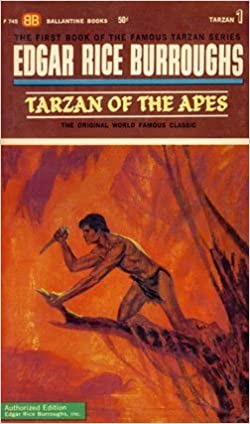
Tarzan #01 - Tarzan of the Apes

Many of the classic, more mainstream series titles or novels we discuss here at Paperback Warrior are presented from the perspective of a brand new reader. Novels from the likes of Ian Fleming, Jack London, Robert E. Howard, etc. have been devoured by millions of readers through many generations. However, for the most part they remain brand new to us. Aside from various media – comics, movies, television, non-fiction analysis – these classic literary works are a paradise of undiscovered gems. Slowly, we pull these classics from the rainy day stash to read and review. Thus, I've now arrived at Edgar Rice Burroughs' acclaimed 24 book series of novels starring the iconic Tarzan.

Tarzan of the Apes originally appeared in magazine format in the October, 1912 issue of All-Story. It was first published as a hardcover in 1914 and then later as a paperback by Ballantine in 1963 (with a cover painting by Dick Powers). It's a rather long novel at 220 pages of smaller paperback font size, making it a thorough and comprehensive origin story to kick off the series. 

The book begins with explanations that John Clayton (known as Lord Greystoke or Viscount Greystoke) is a British Lord that has accepted an assignment by the British Colonial Office to investigate racial relations in West Africa. While excited for his new career boost, Clayton also feels dismayed that he must bring his pregnant wife Alice to a harsh landscape. En route to their destination, the crew of their passenger ship overthrows the Captain and nearly kill Clayton and his wife. Thanks to crew leader Black Michael, the couple is spared. Instead of being thrown overboard, Black Michael leaves them on the shores of a dense coastal jungle. In essence, the Claytons are marooned on a dangerous, unfamiliar island in the middle of nowhere. Death seems inevitable.

Through the book's first chapters, the narrative highlights the Claytons early determination to beat the odds. As the months go by, and a rescue seems unlikely, the hopes and determination begin to fade. Enclosing their meager existence is the menacing jungle wildlife, complete with roaring lions, ferocious apes, and other predatory animals. After Alice is nearly killed by an ape, she becomes emotionally unhinged. One year after giving birth to the couple's son, she dies from emotional distress. With great difficulty carrying the immense, lonely burden, Clayton simply gives up and is soon killed by a tribal king ape named Kerchak. A motherly ape named Kala, who just lost her own child, rescues the baby boy and raises him as her own. Thus, his name becomes Tarzan, which means “White Skin” in  the ape language. 

As one would expect, the middle chapters are the proverbial coming-of-age narrative concerning Tarzan's childhood and transformation from the tribe's weakling to the savage “King of the Apes”. It's action-adventure focused as Tarzan becomes a skilled hunter, fighter, and leader of the tribe through various battles with other apes and wildlife. Tarzan spends his calm moments at his parents' small, makeshift cottage going through various trinkets and books, learning more about his own race and why he is different than the apes. He teaches himself to read and write based on the numerous baby books the Claytons had packed for their trip. Through these quiet moments, Tarzan takes the necessary steps to slowly evolve into a civilized man.

A couple of decades pass and then a new crew finds themselves marooned on this same island. This is how Tarzan meets young Jane Porter, his love interest and future wife. Ironically, Tarzan's cousin is one of the members of the party, William Clayton, son of Lord Greystoke (Tarzan's uncle). This portion of the narrative was really fragmented and uneven, with a number of characters involved in events in different locations on the island. Eventually, Jane is rescued by Tarzan after discovering his parents' cottage. She falls in love with him, but realizes he isn't civilized enough and would be unhappy anywhere other than the jungle. The book's finale concludes with Tarzan learning a modern way of existence through a French soldier named D'Arnot. The story's ending is a bit of a cliffhanger as Tarzan learns of his Clayton/Greystoke heritage, but withholds the information in an effort to allow Jane to marry William without complications.

Overall, Tarzan of the Apes was a fun reading experience, but I would be remiss if I didn't express that I was a little underwhelmed. After the lofty literary praise I've read about the book in my lifetime, I felt that the narrative was unnecessarily dense in spots. Further, there were way too many characters in the book's third act to enforce any sort of isolation or loneliness within the tight narrative. The action-adventure aspect was still intact, but only marginally so. I also felt that Tarzan's development from savage to civilized man was rushed too quickly. I really disliked the ending with the Wisconsin farm, Jane's economic situation, and the convenient forest fire. None of the elements conveyed the same enjoyment I experienced within the rural, dangerous jungle. Arguably, it was too cavalier, but I completely understand it is a product of the time. 

With both its racial awkwardness and dominant masculinity paired with Burroughs documented eugenics support, Tarzan of the Apes doesn't age particularly well. The misguided beliefs about African culture was uncomfortable at times, but again, I do understand this was a controversial era with bad choices and uneducated world views. To read any early to mid-20th century literature does require some patience in that regard. But, I was generally pleased with the book's pacing, the main character, and some of the early events with the mutiny of the ship. I liked it enough to want to read the second installment. 

Buy a copy of this book HERE.

Friday, May 27, 2022

Pay the Devil

There's no doubt that Jack Higgins, real name Henry Patterson, is a household name and one of the cornerstones of the second generation of action-adventure novelists. By the mid-1970s, most of the author's literary work from the late 1950s through the 1970s was re-published as paperbacks under the name familiar name of Higgins. Patterson's 1963 hardback novel, Pay the Devil, was one of the few novels absent from the 1970s reprints. Oddly, the book wasn't released until 2000. It was revised and published as a paperback by Berkley. 

While most of the author's novels are written as modern, high-adventure novels typically placed in the same time period as their publishing date. Pay the Devil is mainly set in 1865, just one year after the American Civil-War. The hero, Irish-American Clay Fitzgerald, is introduced in the book's prologue (which I believe was written decades later as an addition to the book's reprint) as a Confederate Brigadier General. This exciting prologue has Fitzgerald and his tattered band of rebels receiving orders that General Lee is surrendering the Confederacy at Appomattox, Virginia. Knowing the war is now over, Fitzgerald and his men come to the aid of a young man who is being lynched. These early pages show readers that Fitzgerald is not only a respectable man of action, but also a trained battlefield surgeon. These elements are both important to the narrative. 

After the surrender, Fitzgerald learns that his Uncle has died in Ireland and that his inheritance is waiting. The book then resumes the action one-year later as Fitzgerald and his friend Josh arrive in the Irish town of Drumore. There they learn that Fitzgerald's inheritance is a moderate amount of money and a burned estate. After an exchange with some of the residents, Fitzgerald learns that the town is essentially being bullied by Sir George Hamilton. As a servant to the British, it's Hamilton's job to keep the Irish poor and famished. Fitzgerald, fearing the Irish will never gain independence, assumes a neutral role. But after seeing the town's exhaustive efforts to fight back, Fitzgerald dons a costume and assumes the identity of a folk hero vigilante named Captain Swing. As this masked rider, Fitzgerald fights for the people. 

This was a really different Jack Higgins novel. While not a traditional western, it's more like Higgins' version of Batman. While there's plenty of action, Fitzgerald's role as caregiver to the poor really defines the character. By day, Fitzgerald can rub shoulders with Irish and British aristocracy, but at night his surgical skills and fighting demeanor resembles a pulpy sort of hero. With a saber and Dragoon, this character represents nobility and pride, a continuation of his background in the American Civil-War – one war just exchanged for another.

As a fan of Higgins, I can't find anything not to like about Pay the Devil. I am a little puzzled on why this novel wasn't reprinted decades earlier. Perhaps the author's iconic World War II and nautical themes were so overpowering that publishers didn't wish to risk his literary dominance at that point. While it's a different time period, the author's heroes are nearly interchangeable. This book should please the author's immense fanbase, but also could serve as a pulpy alternative western for lovers of Lone Ranger, Masked Rider, and other old west adventures. 

Buy the eBook HERE.