Friday, July 1, 2022

Cornered!

James McKimmey (1923-2011) was a Nebraska native that studied architecture at the University of Nebraska. Later, he served in the 102nd Infantry Division during WW2 and returned home to write fiction for magazines and pulps. His first novel, The Perfect Victim, was published by Dell in 1957. McKimmey would go on to write westerns, science-fiction, and more crime-fiction, some of which have been reprinted by Stark House Press as twofers that we've covered here at Paperback Warrior. In 2016, Stark House reprinted The Long Ride and Cornered! as a twofer. We loved and reviewed The Long Ride and it was just a matter of time for us to read the second novel, Cornered!. It was originally published by Dell in 1960.

Tony Fearon ran a California mob family for years. Instead of allowing his premier gunman, Bill Quirter, to shoot his chief rival, Tony took it upon himself to deliver the killing blow. Inexperienced and enraged, Tony didn't think of witnesses, so he missed the beautiful Ann Burley, who just happened to be walking by. Tony went to prison based on Ann's testimony, and as Cornered! begins, Tony is a few hours away from eating cyanide via California's taxpayers. However, the cool caveat is that Tony has placed a hit on Ann. If Bill (the best gunman west of the Mississippi River) can track down and murder Ann before Tony dies, Tony will filter out a password through the prison so Bill can locate a cool $50,000 for the job. Tony will die happy knowing that the woman who put him behind bars is being killed on the same day. Alternatively, if Bill can't get the job done, Tony will go to his grave as a begrudged man and Bill will be $50,000 poorer (and still unemployed). Cool premise, huh?

I challenge anyone to find me a book with an opening chapter as exciting and memorable as this one. McKimmey's first chapter has Bill and a partner outside of the small Nebraska town of Arrow Junction. It's snowing, both are in a bad mood, and the target is within a few miles. However, a simple accident leads to a furious gunfight in a small gas station and Bill finds himself alone and on the run from the cops. After scampering around in the cold, Bill locates a small diner for shelter. Inside, he points a gun at the customers and stands his ground. 

Like The Perfect Victim, McKimmey has this uncanny talent of turning the reader into an everyday citizen of Small Town, USA. Over the course of a few hours, I became a citizen of Arrow Junction and felt like the town pastor, doctor, restaurant owner, station attendant, and fill-in sheriff were all people I've grown up with and had a fond fellowship for. McKimmey is just that good as he smoothly thrusts readers right into the action. In some ways, the book's plot development and through-story reminded me of Bill Pronzini's thuggish writing style. It's gritty, action-packed, and develops into a real slobber-knocker by the book's finale.

Cornered! is one of the best books I've read in ages. Any other plot points or insider wisdom would just ruin the experience for you. Do me a favor – get the book, read it, post comments below. In the meantime, I'm on record to provide the highest possible recommendation for James McKimmey and Cornered! 

Buy a copy of this book HERE.

Thursday, June 30, 2022

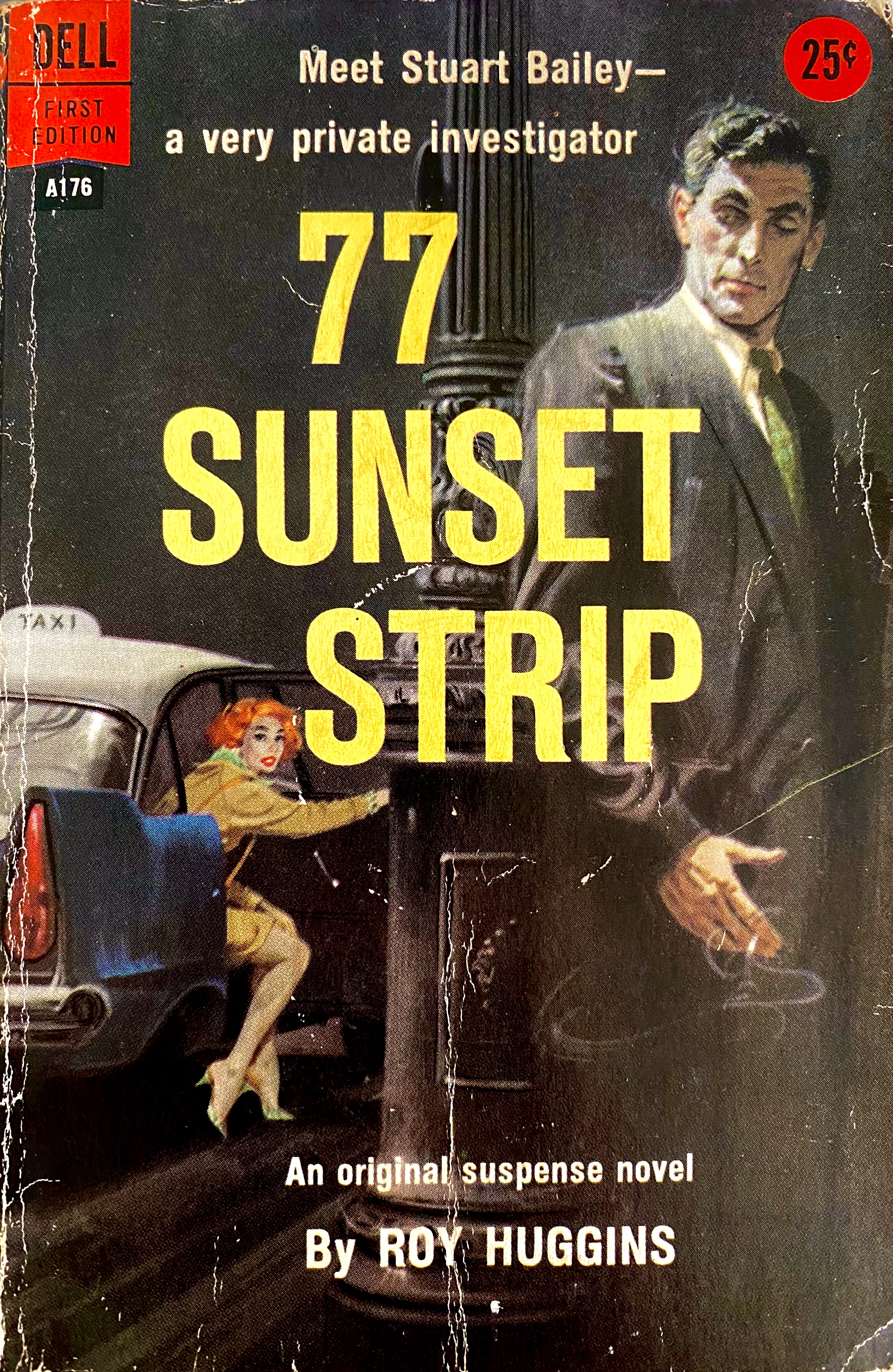
77 Sunset Strip (aka The Cases of Stuart Bailey)

Roy Huggins (1914-2002) wrote and produced a number of popular television shows like Maverick, The Fugitive, 77 Sunset Strip, and The Rockford Files. Beginning in the early 1960s, Huggins became the vice president in the television division at Universal where he worked for 18 years before becoming an independent producer and signing with Columbia Pictures Television. His television career was plagued with denied credit and compensation, leading to a more controlling contract that he created known as the “Huggins Contract”, a template used by other Hollywood producers later. 

Huggins dabbled in writing crime-fiction as well. He wrote three full-length novels – The Double Take (1946), Too Late for Tears (1947), Lovely Lady, Pity Me (1949). In The Double Take, Huggins introduced a Los Angeles private-eye named Stuart Bailey. Bailey is hired by a man who is being blackmailed due to his wife's past. Through the narrative, Bailey digs into the woman's past to free the man from extortion. The novel was serialized in The Saturday Evening Post and appeared in a condensed form in the March 1946 issue of Mammoth Mystery

Bailey appeared three more times in short stories featured in The Saturday Evening Post and Esquire. These three short stories were compiled into a compilation by Mystery House in 2019 called The Cases of Stuart Bailey. There was also a compilation of these stories released digitally in 2015 by Jerry ebooks under the title The Complete Cases of Stuart Bailey. However, the best version of these three stories is the compilation called 77 Sunset Strip. It was published as a paperback by Dell in 1959 and makes the three stories flow seamlessly into one novel. The stories are connected as Bailey weaves in and out of these three assignments while dating a woman named Betty Callister (who appears as a character in the first ten chapters). 

I've read the three stories and here are my thoughts on each:

“Now You See It” (The Saturday Evening Post, May 25 1946)

Bailey is invited to a Westwood mansion by a man named Mr. Trist. However, when he arrives at the man's front door, Trist advises him his services are no longer needed and gifts him $150 for his troubles. But, when the man's son appears, Bailey is quickly ushered inside and introduced to a dinner party as an old family friend named Mr. Tate. Just when Bailey finds that the scenario couldn't become any stranger, the lights go out, Trist is stabbed through the heart, and all fingers point to Bailey when the lights flick back on. According to the police, Bailey isn't a chief suspect, but they want Bailey's assistance in investigating the murder. Huggins builds the case around the innovative technique of disguising the murder weapon by morphing it into something entirely different. The story was a bit convoluted and I didn't entirely understand the plot, but Bailey was captivating enough and I enjoyed his interaction with the characters and police. 

“Appointment with Fear” (The Saturday Evening Post, September 28 1946)

Bailey receives a telegram from a woman named D.C. Halloran asking him to meet her at a bar in Tucson, AZ. When he arrives for the meeting, he finds that Halloran is a beautiful woman that is suffering from a paranoid personality with depressive tendencies. She feels that someone is looking to murder her and she wants Bailey to find the who, when, where, and how. Against his better judgment, Bailey spends the night with Halloran and awakens to discover her dead. Huggins uses the familiar premise to place Bailey as the chief suspect on the run from Tucson's finest to clear his name. I thought the story was fast-paced with a number of twists and turns. It also showcased Tuscon's night life and landscape of that era, which I found fascinating. Recommended.

“Death and the Skylark” (Esquire, December 1952)

This was my favorite of the three Bailey shorts. In this case, Bailey is hired by a boatman named Callister, who feels that his next voyage will lead to his own murder. Bailey takes the case and becomes a passenger on Callister's yacht. The crew is Callister's wife, first mate, and daughter – not exactly a prime suspect list. But, as the pleasure cruise commences, Bailey discovers that each character has a deadly agenda. Sure enough, Callister is fatally shot and it is up to Bailey to survive the cruise while determining who the killer is. I love boat stories and I really enjoyed this trio of characters. The story was tight and slightly confined, but developed into a real showpiece of Huggins' descriptive and fast-paced writing style. Highly recommended.

Huggins used The Double Take novel and these three short stories to develop the Stuart Bailey private-eye character. By slightly retooling the character, he successfully transitioned him from printed page to the small screen. Bailey became the private-eye character of 77 Sunset Strip for six seasons. The show featured Bailey working with another PI named Jeff Spencer out of an office located at 77 Sunset Strip. The show's last season featured episodes that starred only Bailey.

* Thanks to The Thrilling Detective blog for providing some of the author's backstory. You can also read all three shorts online for free HEREBuy a copy of this book HERE

Wednesday, June 29, 2022

Untamed Lust

Orrie Hitt (1916-1975) was a family man living in upstate New York barely making a living while he cranked out 150 sleaze paperbacks between 1953 and 1970 — many of which had significant crime-fiction elements. Untamed Lust was a 1960 Beacon Books release by Hitt that remains available today from Prologue Press and as an audiobook.

Eddie Boyd is a 23 year-old down-and-out farm worker who arrives at Wildwood Acres looking for a job hunting and trapping vermin on the estate. The master of the manor is Frank Jennings, a wheelchair bound drunk with a contempt for the wildlife he’s hiring Eddie to kill. In any case, Eddie takes the job for $300 a month, plus room and board at the upstate New York plantation.

The maid at the estate is a busty babe named Joan, with whom Eddie used to consort. Now that they’re living under the same roof in the servant’s quarters, they could resume their strictly-physical relationship. Seems simple enough until we learn that sweet Joan has marriage on her mind.

Not so fast! Eddie meets the lady of the house, Mrs. Jennings (“Call me Kitty”), and she’s a sex-on-fire, hot-pants-wearing minx. Then there’s Carole, Mr. Jennings’ conniving daughter, an irresistible sexpot with impossibly big breasts and a small waist. For his part, Eddie finds himself with a set of burning attractions that could cost him his livelihood.

Eventually, Eddie finds himself in the middle of the rivalry between Carole and Kitty for eventual control of the plantation. Eddie is pressured on multiple fronts into taking action that would provide him financial independence and a substantially upgraded sex life — fueled by his ambition and untamed lust for a trio of pulp fiction femme fatales.

Hitt’s novels often contain interesting details about the protagonist’s careers, and this one is no exception. In addition to being titillated, you’ll also walk away with a master’s degree in the art of trapping wild animals. Hitt underscores the cruelty of the practice and uses this as a means to define the characters and their motivations. This is unusually smart writing for a sleaze paperback and the reason why Hitt was so much better than his contemporaries.

Despite being derivative of James M. Cain’s work, Untamed Lust remains one of Hitt’s best novels. The ending was a little tidy for me, but the ride along the way was pure melodrama for imperfect men. Recommended. 

Buy a copy of this book HERE. Get the eBook version HERE.

Tuesday, June 28, 2022

Scratch One Mark

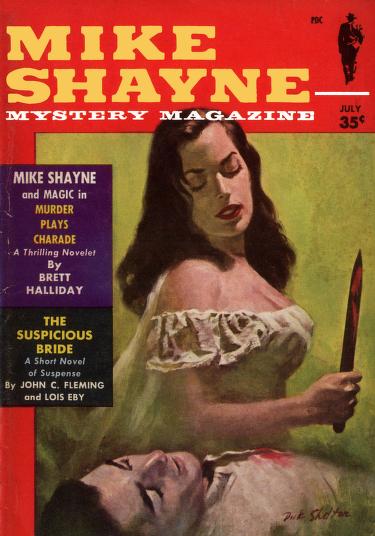
Crime-fiction author Dan J. Marlowe's best literary work was the period between 1959's Doorway to Death and 1969's One Endless Hour. I've read many of the 15 novels Marlowe produced during that 10 year span, but I haven't explored his numerous short stories for the likes of Alfred Hitchcock's Mystery Magazine, Man from U.N.C.L.E. Magazine, and Ellery Queen Mystery Magazine. According to philsp.com's excellent database, “Scratch One Mark” may have been Marlowe's first published short-story. It appeared in the July, 1959 issue of Mike Shayne Mystery Magazine. Thankfully, I had the opportunity to read it at archive.org.

The 13 page “Scratch One Mark” story features Joseph Conway as the youngest police lieutenant in the state (presumably New Hampshire, Marlowe's home at the time). Conway is a no-nonsense tough guy that is dating Judge Schofield's daughter Ann. Every Wednesday morning, Conway receives a small white-envelope containing $150 of hush-up money to ignore the backroom gambling at the local hardware store. Everyone knows about the game and even Judge Schofield and Conway both play from time to time. It's innocent enough as long as the 'ole boys keep the money at a minimum. Needless to say, Conway is flabbergasted when a player named Ted drops by and explains that some of the guys are in the hole up to $17K. 

The news creates a violent chain of events when Conway learns that Judge Schofield's nephew is a debtor to the game. The story centers around Conway's allegiances to the town and his struggles with the new high-rollers while navigating a bumpy relationship with the Schofields, which could be his future family. These conflicts collide in a savage end, but who's the victor?

What's interesting about “Scratch One Mark” is that it is written from experience. Marlowe was a professional gambler for a number of years - arguably the only thing he really did other than watching sports and writing – so there is a realism to the storytelling, a grainy know-how that blankets these seedy characters. In a few short pages, I developed a love and hate relationship for the main character. These are all of Marlowe's strengths, assets he would later develop into his anti-hero Earl Drake in the heist novel The Name of the Game is Death

“Scratch One Mark” is a short, enjoyable read and a forecast on where Marlowe was heading so early in his writing career. You can read this story for free below or HERE.

Monday, June 27, 2022

Yet Another Voice

Reading military non-fiction is somewhat challenging for me. The fact is that these are real-life, harrowing accounts of action, adventure, and heroism, far from the fantasy escapism I like to indulge in. But, at the same time, I respect it and value its purpose in revealing freedom's cost, the sacrifices made by veterans, and the historical impact of these accounts. Sometimes they can be uplifting experiences and others a dismal journey into despair and ruin. I mostly read fiction to escape my 9-5 existence, but from time to time I delve into a non-fiction book to ground me to reality. I purchased Yet Another Voice from a friend, a 112 page Leisure paperback from 1975 that is a non-fiction account of the author's six years experience as a prison-of-war in Vietnam

Col. Norman A. McDaniel, a U.S. Air Force pilot, was shot down with his crew over North Vietnam in July, 1966. In this autobiography, McDaniel explains that he guided his parachute into enemy territory, a deadly landscape that he was completely insulated from in prior war-zone experiences. On the ground, McDaniel, armed with just a .38 revolver, attempted to radio for help before being surrounded by soldiers and villagers. Other than a neck laceration, McDaniel was mostly healthy as he was taken captive and marched miles to a makeshift prison camp. Here, he was tied, beaten, and interrogated before being shipped to one of the most notorious camps, a compound called “The Zoo”.

In a small, windowless cell, McDaniel never knew light from day, and was interrogated, physically abused, degraded, and forced to endure hours of torture at the hands of prison officials. Refusing to break, he was assimilated into prison life, which McDaniel describes as monotonous existence of staring at the wall for hours on end. Eventually, his hopes of freedom evaporate when he is re-located to the more secure and notorious "Hanoi Hilton" prison. 

McDaniel spent over six years in captivity. His experiences are well-documented in this book, but told in a casual, storytelling way. There's very little technical nuances in the book, nor is it introduced as a timeline of the author's childhood upbringing, education, and training. The first three pages jump right into McDaniel's fateful day and the years following it. The author describes encounters with other cell mates, meeting his crew in the camp, various routines, and the prison Christmas shows, which were touching moments of solidarity. The book wraps up with McDaniel's arrival back home and the struggles of acclimating back into a normal civilian life.

Beyond just being a testament of courage and overcoming adversity, Yet Another Voice is a wonderful Christian message of God's overpowering strength. McDaniel frequently discusses biblical scripture in the book and how these scriptures motivated him to not only survive the ordeal, but to establish an even closer relationship with God. As a Christian myself, I really cherished these messages to reinforce my beliefs. It was just so powerful. If you enjoy military history, or underdog stories of any kind, then Yet Another Voice is certainly worth reading. 

Note – Thanks to Bob Deis at Men's Pulp Mags for providing information on the book's cover. This painting was created by Mel Crair and was originally featured as the cover for Man's Magazine, January 1958 as a “Book Bonus” version of Bridge Over the River Kwai. It was later used as the cover for Man's Magazine, November 1961. 

Buy a copy of this book HERE

Friday, June 24, 2022

Wyatt #01 - Kickback

The Wyatt series by Harry Disher was an Australian pastiche of Richard Stark’s Parker novels. The series has nine installments and began with 1991’s Kickback.

If you’re familiar with the Parker books, you know Wyatt’s background. He is a stoic, independent heist man in his 40s who prides himself on his professionalism among a community of scumbags and amateurs in his chosen profession. In Kickback, Wyatt is based in Melbourne, a city with ample opportunities for heist targets, although the underworld is largely under the control of the Syndicate in Sydney.

As the novel opens, Wyatt is pulling off what should have been an easy job. He is partnered with the 21 year-old kid brother of a business associate and the kid sees himself as a real cowboy. As a result of the kid’s malfeasance, the job goes completely sideways and an innocent woman winds up dead. Wyatt vows never to work with the young cowboy (who calls himself “Sugarfoot”) again, but the kid sees an opportunity to profit from intercepting the money on Wyatt’s next heist.

The novel is basically the story of Wyatt looking for that next score amid increasing financial pressure and sparse opportunities. He lands on a bent lawyer with a safe full of cash and a beautiful secretary willing to help from the inside. Can Wyatt pull off this heist, get the girl, and neutralize Sugarfoot before the whole thing goes sour?

I’ve heard people degrade the Wyatt series for “ripping off” the Parker series. However, I feel that there is plenty of room for these types of novels whether they are written by Richard Stark, Lionel White, Max Allan Collins, Dan Simmons or this very talented Australian author.

Inasmuch as Donald Westlake is deceased and we’re not getting any more books from his Richard Stark pseudonym, the Wyatt series seems to be a great way to fill that void in your life. For its part, Kickback is right in-line with the quality of an average Parker book, which is high praise. 

Buy a copy of this book HERE

Thursday, June 23, 2022

Cryptozoology Anthology

In my I Watched Them Eat Me Alive review, I reminisced about being a kid and watching wacky horror movies that starred nature as the dastardly villain. On any weekend, you could find me glued to TBS or USA Network watching films like Day of the Animals (1977), Grizzly (1976), Empire of the Ants (1977), and Piranha (1978). These movies were so much fun because they put me into a realm of real-world horror. There was a slim possibility that I could meet my end facing a hockey-masked killer at a campsite. But, my own backyard had ants, bees, bear, and leaping squirrels that could easily bring my demise under extreme circumstances. 

Thanks to Robert Deis and Wyatt Doyle, the concept of man versus nature is explored within the confines of the literary world. Like their prior volumes, Weasels Ripped My Flesh, the aforementioned I Watched Them Eat Me Alive, and Maneaters, these two literary scholars have been scouring the pages of vintage pulps and men's adventure magazines (MAMs for short) for strange and mysterious creature stories. Combining their efforts with David Coleman (Ancient Lake, The Bigfoot Filmography), the trio edited Cryptozoology Anthology, a 2015 publication by New Texture. It contains a total of 13 stories culled from the pages of True Weird, Men, Sir!, and Man's World among others. The book also contains two informative, introductory articles about creatures in various pop-culture trends and media.

The whole collection is highly recommended, with these stories in particular as solid standouts:

“MacDonald's Nightmare Safari”

This was originally published in Man's Conquest, August 1959 and it's one of those stories supposedly written by the main character to convey his harrowing, real-life encounter to the reader. In this case, the protagonist and author is Jim MacDonald, a former WW2 engineer that theorizes where a motherlode of diamonds is located in the Mato Grosso jungles of Brazil. To obtain it, he'll need to travel through tribes of head-hungry Indians known as the Morcegos. With the help of an enemy (you read that right) and a sexy babe, Jim finds the diamonds and the truth behind the Morcegos' worship of a strange white beast referred to as The Guardian. The story begins and ends with a furious shootout, and is laced with the traditional escapism these stories are known for. This one will be memorable for a variety of reasons.

“The Man from Another Age”

Like the above story, Mike Flint is listed as the author and the protagonist in this story that appeared in Man's Illustrated, November 1958. The creature at hand is the Abominable Snowman, also known as the Yeti, one of the most popular creatures to appear in pop-culture. Flint and other adventurers form a hunting expedition on Mt. Everest. The story, at about 20 pages in length, documents Flint's struggle with the harsh elements. But, my favorite aspect of the story is Flint's interactions with a beloved character named Billy, a young man hoping to finally overcome his fears after years of living in cowardice. Essentially, it's Billy's story, who arguably could be “The Man from Another Age” instead of the dangerous creature. Again, escapism laced with danger, high-adventure, and terror makes this story a real standout. 

“Monster Bird That Carries Off Human Beings!”

With a title like that, how could it not be a riot? I've always liked Jack Pearl's writing, and we've covered several of his books and even devoted a podcast episode to his work. He mostly authored crime-fiction, military-fiction, and biographies. But, he dipped into the Cryptozoology stories in the MAMs, including this wild “non-fiction” article in Saga, May 1963. Pearl describes “real-life” events where humans have been snatched by giant birds, often referred to as Thunderbirds in ancient civilizations. These are crazy, sometimes terrifying stories of man versus nature gone wild. Pearl points out that early American pioneers like Jim Bridger and Daniel Boone have written accounts they've experienced with giant birds. It is far-fetched, unbelievable shock-writing, but it is just so much fun to read. It's a testament to an era of imagination and curiosity. Much like many of the stories featured in this anthology.

These stories all feature wild animals and creatures wreaking havoc on mankind. There's tales of dinosaurs in jungles, sea-monsters terrorizing ships, and more Yeti, Sasquatch, and Bigfoot stories. They are all enjoyable, fast-paced, exciting action-adventure yarns surely to please fans. The artwork on the magazine covers and inner-pages is included in glorious full-color, including artists like John Pike, Jack Dumas, Gil Cohen, Mort Kunstler, and Norm Eastman just to name a few. As a bonus, there's even a hidden story buried inside the book. When searching for it, just be careful where you place your fingers. You never know what hairy, horrific creature you're liable to touch! 

Buy a copy of the book HERE.