Monday, October 10, 2022

To the Stars #01 - Homeworld

Science-fiction author Harry Harrison gained fans with his character Stainless Steel Rat in 1957. The character appeared in 12 total books. Additionally, Harrison wrote the novel Make Room! Make Room!, the basis for the 1973 film Soylent Green. My first exposure to Harrison's writing was Planet of the Damned, the first of two novels starring an Olympic-styled athlete that works for a peacekeeping interstellar agency. Anxious to read more of Harrison's novels, I selected the first in a three part trilogy titled To to the Stars. The novels were Homeworld (1980), Wheelworld (1981), and Starworld (1981). 

Homeworld is set in the 23rd century and explains to readers that tremendous gains were made in the areas of development and space travel. Earth's one-world government was able to journey out beyond the stars to other planets for cultivating, scavenging, and manufacturing. With the 20th century's economy a distant past, Earth now lives in two classes – the elites and the proles. 

The residents, like main character Jan Kulozik, exist on Earth in a privileged manner. They have the very best life has to offer with higher educations and a posh existence. Jan works as an engineer with an experienced background in computer networks, chips, and communications. He's a rich nerd from a generation of rich nerds. 

The proles are Earth's slaves, working around the clock in manufacturing, mining, serving, etc. But, people like Jan don't realize that in essence, they are slaves to their privileged existence. They aren't aware that this system is dominated by a deceitful government that firmly establishes the two levels of civilization. It's a class-based existence with no hope for anyone born as a prole. 

When Jan runs into an Israeli woman named Sara, he realizes that the government has lied. For decades the government has told its citizens that Israel doesn't exist. However, Sara is Israeli, and she educates Jan that in her country they are completely independent and free. Soon, Jan finds himself joining this resistance despite the fact that his brother-in-law is a prominent member of the government. Will Jan break the ties that bind and bring education to the people?

Homeworld is a fun book and mirrors many of the Dystopian-styled concepts that we've all read or watched. Jan's relationship with Sara is similar to Guy meeting Clarisse in Ray Bradbury's Fahrenheit 451. I imagine that this series debut is setting up a more action-oriented sequel as the story goes completely off-world. While it is science-fiction, Homeworld plays like a cat-and-mouse spy game as Jan works small assignments for Sara's government. There's a cross-country skiing adventure through the snow to free a prisoner and a space mission to disable a satellite. These things help to distract from the tight, cumbersome narrative of Jan just dodging government surveillance. 

Both Homeworld and the other two installments were packaged in one omnibus under the title To the Stars. I'm on board to read the next installment to determine how Jan's adventures continue (considering the ending of this book). An off-world prison colony seems to be the next destination, but Harrison may throw something else in the mix. While I can't speak for the whole trilogy, Homeworld is definitely recommended. 

Buy a copy of this book HERE

Friday, October 7, 2022

The Girl in 304

Harold R. Daniels (1919-1987) enjoyed a successful career as a technical writer and specialist in the metal industry. For 14 years he was the editor of the magazine Metalworking, but he also authored short stories for Ellery Queen Mystery Magazine and wrote six full-length novels. His first, In His Blood (1955), was nominated for an Edgar and hailed by the NY Times as the “best detective story of 1955”. The House on Greenapple Road (1966) was adapted into a film which spawned the short-lived Lt. Dan August television show starring Burt Reynolds. Thankfully, Stark House Press subsidiary Black Gat Books has published a new edition of his second novel, The Girl in 304. It was originally published by Dell in 1956 and now exists as an affordable paperback and ebook. 

The Girl in 304 reads like a really good John Ball novel, emphasizing small-town politics while creating an engaging, thought-provoking narrative. These ideas were nearly perfected by Ball in his novels In the Heat of the Night and Police Chief. But, many authors like Harold R. Daniels (and William Fuller for example) were using this formula at least a decade earlier. 

Edward Masters, the Sheriff of Clay County, Georgia (real place) and his deputies are called when a young boy discovers the corpse of a partially nude young woman in a heavily forested area. The woman received multiple stab wounds that led to her violent death. Rocked by this homicide, Masters immediately shifts into high-gear and notifies the state police for a lab technician and places the city's police department (his rival, county versus city) on alert. By page 25, readers are thrust into this engaging, irresistible murder investigation. 

Daniels absolutely nails the procedural investigation, pulling his reader into interviews with suspects and the victim's co-workers, family members, and acquaintances. There's a deep dive into the girl's past, leading into some really dark places. The motive and killer was easy to identify early in the novel, but I think that was the point. It was Daniels' purpose to present an imperfect hero, a noble sheriff that is determined to find answers, but continually misses the clues to break the case. It's not a criticism of law-enforcement or of Masters, who is ultimately triumphant, but a look at just how difficult the cases are when faced with a number of suspects with sketchy alibis. There is also the resistance from the city's force to assist the county, a theme touched on most recently by Lee Goldberg in his fantastic crime-fiction novel Lost Hills (2020). 

If you love crime-fiction with police procedural elements, then The Girl in 304 is definitely a must read. It has a tight story, swift pace, and doesn't lose itself completely in the details. With Daniels remarkable storytelling skills, this novel is a smooth, extremely enjoyable reading experience. Highly recommended. 

Buy a copy of the book HERE.

Wednesday, October 5, 2022

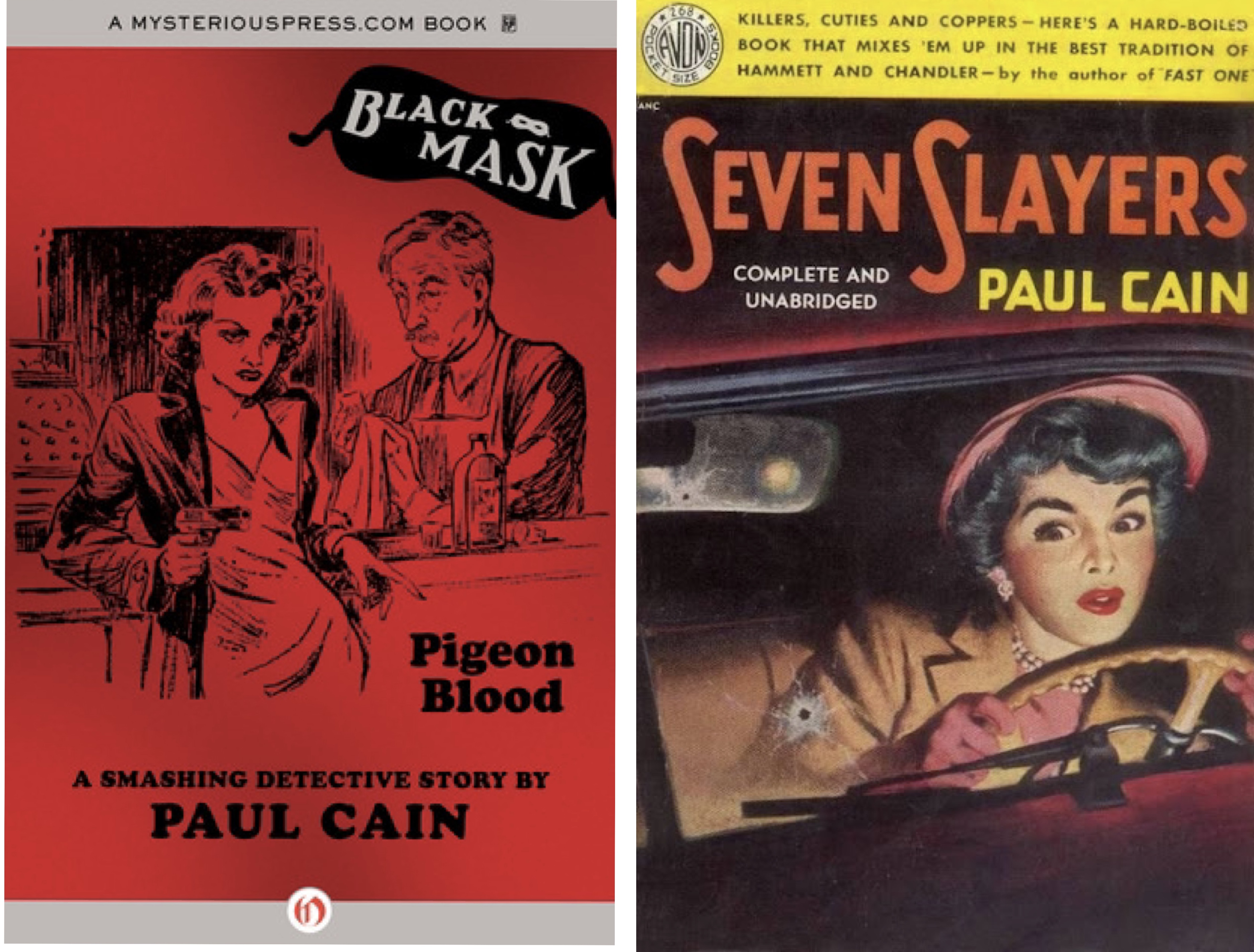
Pigeon Blood

George Sims (1902-1966) wrote screenplays as Peter Ruric and pulp fiction as Paul Cain. Seven of his 1930s works from Black Mask Magazine were compiled into the book Seven Slayers in 1946, including his most famous tale, “Pigeon Blood”, from 1933.

The novella opens with Mrs. Catherine Hannan driving from Long Island to Manhattan as thugs fire shots at her car. She’s the wife of oil millionaire Dale Hannan, and she got herself in some trouble with her own gambling debts. In order to cover her losses, Catherine partnered with a mobster to orchestrate the theft of her own rubies in an insurance fraud scheme. It now appears that the racketeer has double-crossed her and wants the socialite dead.

Her wealthy husband intervenes to save his pain-in-the-ass wife by hiring a resourceful fixer named Druse to recover the rubies and neutralize the threat on Catherine’s life. Druse is a great character who effectively takes control of the situation and determines that maybe this whole affair is not what it seems.

There are some plot twists in “Pigeon Blood” that I didn’t see coming and Cain’s writing is never boring. However, I had some issues with the convoluted conclusion that detracted from the story’s otherwise fun ride. Overall, I give “Pigeon Blood” a passing grade, but I’m not particularly inspired to dig deeper into Cain’s other stories. 

Buy a copy of this book HERE.

Monday, October 3, 2022

Paperback Warrior Episode 101 - Steve Frazee

It's a new era as Paperback Warrior storms into the next 100 episodes. #101 features a look at western and action-adventure author Steve Frazee's life and career in the pulps and paperbacks. Tom explains to listeners his cash-grab scheme using his local library and Eric discusses his recent western paperback acquisitions. Additionally, horror author Ronald Malfi, crime-fiction author Lionel White, and sci-fi writer Robert Silverberg. Watch the show's video HERE, stream audio and video below, or download the audio directly HERE.

Listen to "Episode 101 - Steve Frazee" on Spreaker.


Friday, September 30, 2022

Skin

Before his death in 2006, Mickey Spillane told his wife to give all of his unfinished manuscripts to Max Allan Collins with the assurance, “He’ll know what to do.” Since then, Collins has polished, edited, and completed several of these novels and stories for publication. “Skin” is a 36-page Mike Hammer story that Spillane began in 2005 and was finally published in 2012 after completion by Collins.

The novel opens with Mike Hammer driving back from instructing at an upstate New York Police Academy with his best friend, NYPD Officer Pat Chambers. Interestingly, the authors have aged Mike and Pat and placed the old men in a modern setting with cell phones and computers.

While driving home, Mike notices the remains of a dead body along the side of the road. He stops and sees that the body is completely pulverized with nothing but a human hand intact. It’s almost as if the body fell out of an airplane or was gnawed into pulp by wild animals.

The hand in the pile of guts begins Mike’s journey to find the killer - even finding a sexy, nightgown-clad client in the hunt. As Mike approaches the truth, the authors employ some fairly terrifying horror-fiction elements. The climax is a bloodbath of brutal violence and street justice - the most exciting conclusion I’ve read in ages.

“Skin” is an edge-of-your-seat suspense thriller starring a famous aged detective still capable of making the pages fly by for the reader. As a fan of Collins’ work, I definitely saw his fingerprints all over the prose, and I’m genuinely curious what the division of labor was between these two crime fiction legends in this unlikely collaboration.

Leaving aside the mystery of primary authorship, “Skin” is one of the most satisfying pieces of ultra-violent fiction I’ve read this year. It’s an easy entry-point for those unfamiliar with Mike Hammer, yet there are plenty of series Easter eggs for long-time fans to enjoy. “Skin” is simply a masterpiece of short crime fiction. I promise you won’t be disappointed. Highest recommendation. 

Buy a copy of this book HERE.

Wednesday, September 28, 2022

The Cop on the Corner

Before becoming a mainstay of grim, noir fiction in the paperback original era, David Goodis (1917-1967) was a prolific writer of short stories for the pulp magazines. A handful of these early works has been digitized for modern audiences, including “The Cop on the Corner” from the September 1947 issue of Popular Detective Magazine.

Elrick is a tubby beat cop who spends most of his time on foot patrol loafing and chewing the fat with his friend who runs the newsstand on the corner. One day, their eternal conversation is interrupted by a couple kids who just found a dead body riddled with bullets in a nearby alley. Elrick immediately recognizes the corpse as a local gangster whom Ekrick knows from way back when the racketeer was a lowlife juvenile delinquent running the streets with criminal abandon.

Because of Elrick’s unique knowledge of the dead mobster’s history and associates, he hatches a plausible theory regarding the identity of the murderer. This presents the corpulent copper with an idea to solve the case himself, which will likely earn him a raise and a promotion to the Detective Bureau.

Elrick’s investigation takes him to a skid row alcoholic dame who he believes provides a key to unlocking the mystery of the dead hoodlum. Of course, none of this is as easy as it seems, and Elrick’s fallibility as an investigator leads to a well-crafted scene of bloody violence and a twisty solution.

The plot twist punchline was typical of the endings seen a decade later in the pages of Manhunt, a crime digest that printed several Goodis stories and novellas. “The Cop on the Corner” remains a fantastic read that shows Goodis at the top of his short story game before moving to longer works. If you can score a reading copy, you’ll be happy with your decision.

For reasons unclear to me, “The Cop on the Corner” is not available on Amazon, but it is available at Barnes & Noble for the hundreds of people on earth with Nook devices. There are also scanned and transcribed copies floating around the internet, including HERE.

Monday, September 26, 2022

Fairy Tale

Another Stephen King 600 pager has arrived, 20 years and 27 books after he suggested his retirement to the Los Angeles Times in 2002. It's aptly titled Fairy Tale, because it is one. But, like the most wicked Game of Thrones episode, King morphs Grimm's into a psychotic, rambunctious, and sinister story involving electrified zombies, dead mermaids, homicidal giants, and brutal “to the death” sporting events. It's The Running Man meets Snow White as only the King of Horror can deliver.

Fairy Tale is mostly presented as three parts – the introduction to the main character up until he leaves this world (yep, that happens), the monomyth journey through the other world, and then prison. In typical King fashion, this probably could have been condensed into 300 pages, but it takes the author three pages just to make a cup of coffee. Apparently, it just needs elaboration.

The book is presented in the first-person by an older version of Charlie Reade (sounding like Charlie McGee of Firestarter) describing the harrowing events that transformed his life when he was 17. He swears no one will believe his story, including you, the Constant Reader. This story begins with Charlie explaining how his mother was killed on a wobbly bridge by an errant motorist. Charlie and his father sail into years of mourning, capsizing with his father's descent into the seas of alcoholism and regret. These early pages chronicle alcoholism well, complete with the AA stance and the narrow road to sobriety. It's the feel-good uplift. 

Charlie's life changes when he hears Howard Bowditch's dog barking. Bowditch is the stereotypical spooky old guy that lives in the crumbling Psycho house in the neighborhood. Charlie comes to the aid of Radar, a fun German Shepherd that leads him to rescue his owner Bowditch from the a long fall from a ladder – if rescuing means calling the rescue squad and promising to keep Radar. Soon, Charlie finds himself at the aid of Bowditch. The lonely old man has no one else and Charlie needs to mature from star athlete and childhood prankster to a civilized caring youngster. The two strike up a bond and Charlie agrees to be Bowditch's care guide, prescription deliverer, carpenter, landscaper, dog feeder, friend, and gold hauler. Gold?!?

It turns out that Bowditch has a big 'ole secret he keeps hidden in the wood shed. If you want to know the secret and not necessarily spoil the fun, continue to read the next THREE paragraphs. If you want to skip to how I felt about the book, feel free to skip these THREE paragraphs. 

Bowditch has something like $100,000 in gold nuggets he keeps in a safe. He asks Charlie to visit a local jeweler associate who will buy some gold nuggets so that Bowditch can pay off his hospital bill and also pay Charlie for his services. Where is this old recluse gaining this kind of loot? After a few chapters, Bowditch explains to Charlie that there is a secret world inside of his woodshed. Due to some rather dire circumstances, Charlie steps into the shed and descends into another world.

Charlie soon learns that the other world, seemingly hundreds of feet under Bowditch's property, is a cursed fairy tale land. Yeah, there's mermaids, kings, princesses, giants, talking horses, and lots of gold, but there is also a visible doom and gloom that has enveloped the entire kingdom. People are no longer whole, like Charlie, but instead are missing things like mouths or ears. They have seemingly lost these things due to a corrupt hierarchy that have awakened an evil thing in a Hellish well. Keep in mind that King wrote Fairy Tale during the pandemic in 2020. Considering his white-hot hatred for Republicans (he's from Maine for God's sake!), it's easy to see his inspirations for the novel – cursed land, an ill civilization, a corrupt monarchy, fighting the establishment, contending with the maaaaaaaan. You get the idea.

But, the land is important to Charlie because it possesses a sundial that can be used to reverse aging, a side-story that involves Radar's old age and debilitating physical condition. Charlie loves the dog so much that he is willing to battle through unknown terrors to turn the clock back on Radar's dog years. I'd do the same for my beloved canines Lily, Rose, and Carly. Maybe my hedgehog too. Regardless, this journey to the sundial involves a lot of adventure that eventually places Charlie in prison and forced to fight to the death in gladiator-styled sporting events. Wild and wacky stuff. 

So, does this Happily Ever After thing really work for Stephen King and his loyal fan base? Yeah, probably. It has similarities to so many of his other books and the formula he uses of parallel worlds. He used the idea for Lisey's Story, Rose Madder, The Talisman, and obviously the massive series of Dark Tower fantasy novels. Plus, there are countless short stories by the author that involve some sort of unlikely hero flirting with the idea of another world within our own. The question everyone asks is if Fairy Tale has any Dark Tower references. Yes, but nothing overly striking. I've only read the first three Dark Tower novels, but nothing detracts from Fairy Tale if you aren't familiar with Roland's epic journey. 

I appreciated King's references to plenty of Paperback Warrior material, specifically Dan Marlowe's The Name of the Game is Death, Cornell Woolrich's The Bride Wore Black and The Black Angel, as well as mentions of Ray Bradbury and H.P. Lovecraft. King loves his vintage fiction as much as we do. In fact, it's hard to ignore the comparisons to other “underground world” literary works by the likes of Edgar Rice Burroughs, Lin Carter, and Jules Verne. Fairy Tale fits right in, but cleverly shifts the heroism to a less muscular man instead of the typical barrel-chested jungle crawler. 

Overall, I enjoyed Fairy Tale but won't ever read it again. It was too long, contained a ton of characters, and the story was formulaic and predictable. King is no longer at his artistic apex, but can still write his ass off and pull off crime-fiction, horror, science-fiction, and fantasy with the best of them. Fairy Tale was probably written more for himself than his Constant Reader. During 2020's unrest, a year that will forever alter human history, writing this novel was probably a means of catharsis for the author. It's King's Fairy Tale. For us, it's just a story about a boy and his dog. 

Buy a copy of this book HERE.