Friday, February 4, 2022

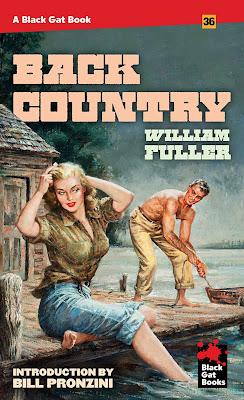
Brad Dolan #01 - Back Country

William Fuller worked on freighters and farms, served as a newspaper reporter, and was an infantryman during WWII. It was during the early 1940s through the 1950s that Fuller's short stories were purchased by the likes of Sky Aces, Adventure, and Argosy. Like Steve Fisher, Fuller found success in the slick magazines like Collier's, McCall's and even Esquire. With the onset of paperback publishing, Fuller began writing full-length novels in the 1950s, beginning with 1954's Back Country. It was an enormous success for Dell and Fuller. 

The novel, the first of six to star a vagabond hero named Brad Dolan, sold a half-million copies. Long out of print, Stark House Press has resurrected Back Country as part of their Black Gat Book imprint. The reprint features a comprehensive and insightful look at the series by esteemed scholar and author Bill Pronzini. As a fan of Fuller's Brad Dolan character and his only stand-alone novel, The Pace That Kills, I was excited to learn that Back Country was being reintroduced to modern readers.

Brad Dolan served in both WW2 and Korea, an experience that led to harsh imprisonment in a German camp as a prisoner-of-war. Banged up after the wars, Dolan is driving across inland Florida en route to the southern beaches of Miami. Along the way, his car gives out and he becomes stranded in a small, fictional Florida town called Cartersville. It is one of those map dots that features a war monument, a dusty park or two, the obligatory noisy railroad, and old men playing shuffleboard until they die. Dolan reminds readers and himself, “This is the Florida the tourists never see. This is small town anywhere.

In a sweltering bar, Dolan downs a cold brew and offers to buy a woman a drink. After a minor scuffle, Dolan is hit with a sap. He then finds himself crawling through a Japanese jungle and raking fire across huts. He then wakes up and realizes he's still in the one-horse town, only he now sees it on the wrong side of iron bars. The Cartersville police then beat him up and he spends days in a daze. Eventually, the one horse that owns the town shows up – Mr. Rand Ringo. 

Ringo reviews Dolan's past and realizes his operation could benefit from his talents. He pays Dolan a wad of cash, provides lodging, and tells him to just hang around until he needs him. The hanging around part just so happens to involve Ringo's wife in Dolan's new bed. If that isn't enough grief, Dolan befriends Ringo's sexy twenty-something daughter. But, eventually the rubber hits the road and Dolan is asked to bounce on an African-American named Sam Foster. Ringo lets Foster run some illegal gambling in the black section of town, but all the games are rigged. Sam has been tinkering with the scam and trying to earn an honest living. After Dolan talks with Sam, he realizes Ringo is a toxic influence on Cartersville. It's a criminal infestation that has to stop.

Fuller's novel is a product of the times and is filled with a lot of racist comments and attitudes. But, as Pronzini points out in the introduction, Dolan and the author aren't endorsing racism or that attitude.  Dolan's nemesis...Cartersville's nemesis...is the racist law-enforcement controlled and created by Ringo. In the book's furious finale, Dolan and Sam are forced into the street to face a mob of angry white people Hellbent on a hanging. Dolan's wits, determination, and cool factor win the day, but it's a memorable fight. 

Back Country's first half is cloudy with a lot of dialogue about God, the purpose of life and social philosophy. These conversations place Dolan on an intellectual plane that ran counter to what my beliefs and expectations were of the book. But, the price of admission is well worth it. The novel's second half is a whirlwind of emotion and violence, saturated in Fuller's scrappy storytelling. It isn't pretty, but it doesn't have to be. Back Country isn't a main street crime-noir. It lives up to its name. Back Country is a crossroads of dastardly villains, despicable authority, and a lot of lyin' and cheatin' no good son of a guns. Thankfully, Brad Dolan is back in the house.

Thursday, February 3, 2022

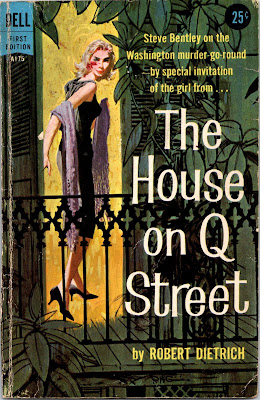
Steve Bentley #03 - The House on Q Street

Many fans point to the Steve Bentley series as the best representation of E. Howard Hunt's literary work. Hunt, a former CIA operative and convicted Watergate conspirator, authored over 70 novels using a variety of pseudonyms. The Steve Bentley series was written under the name Robert Dietrich between 1957 through 1962, with one additional novel penned in 1999. I've previously read the first two installments and thoroughly enjoyed them. The books were originally published by Dell and have recently been reprinted by Cutting Edge Books. Savoring the series, it's been 20 months since I've visited the character. Continuing in series order, I'm picking up with the third installment, 1959's The House on Q Street

Steve Bentley is a Korean War veteran that was once employed by the U.S. Treasury Department to break up black market rings internationally. Now, he is employed as a busy tax accountant surrounded by the I-495 beltway in Washington, D.C. In The House on Q Street, Bentley is referred by a friend to Major General Walter Ferrand Ballou, U.S.M.C. Retired. The desired meeting is for Bentley to possibly replace Ballou's recently deceased accountant. But, when the two meet face to face, it's a rather unusual discussion. 

Ballou's family is immensely wealthy based on old Washington money. Ballou is quite the war hero, fighting in WW2's Pacific Theater and earning his fruit salad the hard way. In a cavalier approach, Ballou never cashed his paychecks because he felt it was his duty to serve America. Ballou retired and then served as Chief of State Police before later declining a bid for governor. Bentley, respecting Ballou, asks how he can assist the retired general. Without stating the obvious, Ballou needs Bentley to hide a $100,000 payout to a blackmailer by creating a corporation and providing various write-offs and losses. The secrecy is to protect both his son and daughter from noticing the withdraw from their eventual lucrative trust. 

By creating the corporation, Bentley learns that Ballou's daughter Francie is a drop-dead knockout that's divorced and flirty. Her brother Winston is a screw-up that dabbles in horse racing and slowly whittles away his trust funds. Upon a return visit to Ballou's house, Bentley tackles an intruder and then notifies the police. The next day, Bentley learns that a former state police officer that Ballou had previously fired had been shot to death. What's interesting is that the dead man's wife shows up to bail out Ballou's intruder from jail. How are these connected? When Bentley discovers that this same woman was married to a doctor eight years earlier, he finds out that the man was murdered as well. Two husbands. Two murders. The link turns out to be way more than Bentley bargained for.

There is a lot to unpack in The House on Q Street, but it's never too convoluted for its own good. I read the novel in nearly one sitting and absolutely loved the pace and the influx of clues as each chapter scurried by. Hunt sometimes floundered in the “literary hack” echelon of crime-noir and espionage writers. But, with these Steve Bentley thrillers, he absolutely nails it every time. Bentley's probing into the murders leads to a missing gun, a mysterious nurse, the General's secrets, and a high-level criminal in Baltimore. Of course, the hero still has time for the Scotch and Ballou's hot daughter.

The House on Q Street is another D.C. thriller, complete with a twisty mystery and compelling characters. Steve Bentley remains a competent paperback hero that rubs shoulders with politicians while also digging into their darkened past to expose hidden truths. The combination of romance, intrigue, violence, and scandal makes it an absolute pleasure to read. Get a copy of the book HERE.

Wednesday, February 2, 2022

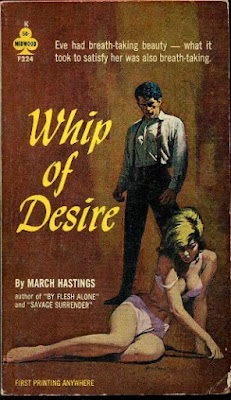
Whip of Desire

March Hastings was one of a number of pseudonyms used by author Sally Singer (b. 1930). The New York native specialized in erotic fiction and wrote over 20 novels between 1958 to 1976. These vintage paperbacks have become collector's items and often fetch prices over $100. Thankfully, Cutting Edge has been reprinting Singer's work as affordable paperbacks and ebooks. I read her 1961 lesbian novel The Outcasts and found it enjoyable enough to warrant a revisit of the author's work. I chose the Cutting Edge reprint of Whip of Desire. It was originally published by Midwood in 1962.

The book stars Fred Boyer, a 28 year old man originally from Alaska. He now lives in New York, plays the piano and has a pregnant wife named Mindy. In the opening chapter, Fred is at an employment agency hoping to find work. He's provided instructions to a theater ran by a gorgeous woman named Eve. Instantly, Fred and Eve connect and in a matter of days they establish a business that's funded by Eve's wealthy father. Fred will compose and perform music and Eve will put together a stage act. 

Later, readers learn that Eve's father crashed the family plane years ago, an accident that killed Eve's sister and injured her. Eve feels she is somehow responsible for her sister's death and harms herself frequently – pain as her penance for surviving. As Fred soon realizes, Eve craves rough sex and demands to be dominated. Eventually, Fred's heated desires for Eve erupts in a frenzy of pleasure and pain. He's liberated from the financial stress of being a husband and an expectant father by forcefully taking Eve. She pleasurably gains the abuse she feels she deserves while he is freed from life's cumbersome shackles by becoming her lover. But, Fred learns there is another man in Eve's life, a man so abusive that he leaves Eve broken, bloody, and nearly dead.

As an intriguing romance novel of the 1960s, Whip of Desire introduces some surprising elements. Both Fred and Eve were dynamic characters and the story was serviceable enough. I think Singer is a terrific writer, but she really finds her element in the sex scenes. Her descriptions are never graphic, but really convey the emotions and physical collision between these lovers. Mindy's mistrust in Fred, Eve's backstory, the business venture, and Eve's domineering “other man” made for a propulsive, fully developed story that I found entertaining. 

If you enjoy heated, erotic mid-20th century romance novels, then Whip of Desire will surely be a real pleasure to read. Recommended. Buy a copy HERE.

Tuesday, February 1, 2022

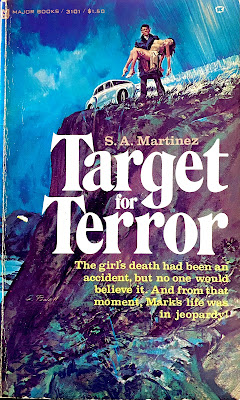
Target of Terror

Gerry Powell was a popular pulp and paperback artist that created covers for the likes of Signet, Fawcett Gold Medal, Dell, and Pyramid. It was striking cover art that led me to one of his paperback covers at a local used bookstore. The novel is Target for Terror, authored by S.A. Martinez and published by Major Books in 1976. I could find nothing online that identified the author, so that information remains a mystery. But, the contents of this old paperback are what truly matters. Intrigued by the book's premise, I dove in.

Mark and his wife Claire live in an older, three-level house on the shoreline cliffs of Malibu, California. Mark is a writer, Claire is an actress, and their marriage is falling apart. Through an employment agency, Claire has hired a new house cleaner named Leyla. While she's in New York, she notifies Mark that Leyla should be arriving in the coming days. Mark, despondent over his recent writing failures, droops around the house and spends time talking to his chatty, snooty friend Jamie.

In the opening chapters, young Leyla hitchhikes to Mark's house and arrives on a rainy, stormy night two days ahead of schedule. Readers will immediately realize that something is amiss with Leyla. She is paranoid someone is following her and she's carrying a small canvas bag and a tambourine. To his surprise, Mark finds Leyla on his doorstep in the middle of the night and ushers her inside. Anyone who has read a Gil Brewer novel knows where this is headed. 

Lonely and horny, Mark chases Leyla around the mansion hoping to get laid. Leyla just wants shelter from the night and the ability to hide from whatever deep and dark past is chasing her. After Mark becomes physical, Leyla runs up the stairs to escape. Backing away from her attacker, Leyla falls from the crumbling balcony and dies. 

The book's first 50 pages is Mark's hurried efforts to clean the crime scene – dispose of her clothes, conceal his scratch marks, eliminate her presence from the house. Thinking that her body would wash up on a northern shore, he is shocked to find her body below his house the next morning. The book's narrative then focuses on his efforts to relocate the corpse somewhere else. But, Target of Terror isn't just a tale of murder. Mark finds that he is now the target of whoever was hunting Leyla. They think he killed Leyla to obtain the valuable thing they want. When detectives, Claire, and Jamie become involved, the whole narrative twists and turns into a cat and mouse chase over Leyla's secret treasure.

You have to realize, this novel was published by Major Books. They were a lowly 1970s publisher with terrible editing and equally terrible books. Due to the publisher, Target for Terror reads like a play or a rough draft. The dialogue isn't natural, the pacing is a little off, and the characters are mostly one-dimensional. The main villain is stereotypical and there's very little backstory that suggests Mark is capable of rape and murder. But, despite the abysmal editing job, I can say I enjoyed the book. Martinez's writing is serviceable enough and I had the foresight to realize the finished product would be a hack job. In the hands of a capable editor, the book would have been a real treat. Unfortunately, what's left here is just another average paperback collecting dust bunnies in a basement zoo.

Monday, January 31, 2022

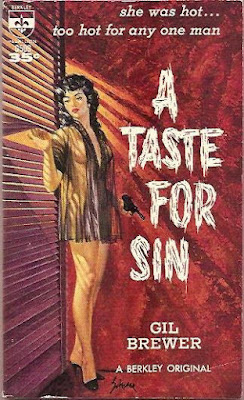
A Taste for Sin

Gil Brewer (1922-1983) was a prolific author of paperback original crime novels in the mid-20th century before his life was consumed with alcohol and personal demons. He was at the top of his game in 1961 when he wrote A Taste for Sin, a novel that’s been reprinted by Stark House Press

Our narrator is Jim Phalen, an employee at the Happytime Liquor Store.  As the novel opens, he’s been invited to the house of a horny local housewife for some afternoon delight. Her name is Felice, and her unwitting husband works at the local bank. She’s a conniving and kinky bitch — more on that later. 

Phalen is not a good and honorable person either. He rents a room in a dilapidated lodge with a toilet that barely functions, and he can barely afford those spartan accommodations on his meager salary. He recounts his brutally-violent past, and, man, it’s something else. Brace yourself for some insane violence throughout this book. Anyway, it’s clear that Phalen’s intention is to somehow leverage the rich, married lady he’s banging to change the direction of his life.

Meanwhile, Phalen is dealing with the fallout of a petty crime he committed that spun out of control. He needs to be deceptively clever to avoid getting caught. Felice learns about Phalen’s money troubles and pressures him into a scheme to rip off the bank and kill her husband. 

What we have here is a femme fatale heist novel and a rather excellent one at that. A Taste for Sin showcases some of the best actual prose writing I’ve ever read from Brewer. The sex scenes are more graphic than usual for 1961, and the action scenes are a genuine bloodbath. I’ve always cited The Vengeful Virgin and 13 French Street as Brewer’s masterworks, but A Taste For Sin is the new top-of-the-heap. Highest recommendation. 

Friday, January 28, 2022

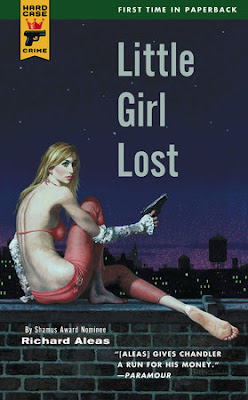
John Blake #01 - Little Girl Lost

Charles Ardai is the founder and publisher of the Hard Case Crime paperback imprint. Using the pseudonym Richard Aleas, he wrote two original, contemporary mystery novels starring a New York private eye named John Blake for Hard Case Crime. The first Blake novel, Little Girl Lost (2004), was nominated for an Edgar Award and remains available today in all formats.

The paperback opens with Blake remembering Miranda Sugarman, the sweet neighborhood girl who took his virginity years ago. She left Blake behind after high school to attend a university with a goal to become a doctor. Blake learns of her death from an exploitive newspaper headline reading, “Stripper Murdered.” Without a client, he decided to investigate her death and gain a better understanding of his former friend’s life and death.

One of my favorite elements of the set-up is Blake’s boss in the PI firm, a much older ex-cop named Leo, who plucked Blake out of college and mentored him in the investigation racket. He’s the perfect, world-weary antithesis to Blake’s youthful idealism and quest for justice. He’s also well-connected within the NYPD and a great asset to Blake’s side.

The trail to the truth takes Blake into the behind-the-scenes world of seedy NYC strip clubs. It’s a fascinating look behind the curtain as Blake encounters a conspiracy of dope, missing college girls and much more. Blake is a fallible hero who takes more than a few beatings, but is always smart, capable and upbeat. His narration moves the plot forward at a good pace and is never boring.

Ardai is a much better writer than I was expecting, and Little Girl Lost was a solid, workmanlike private eye mystery with plenty of twists leading to the satisfying solution. It’s an easy recommendation, and I look forward to reading the sequel, Songs of Innocence, from 2011.

Thursday, January 27, 2022

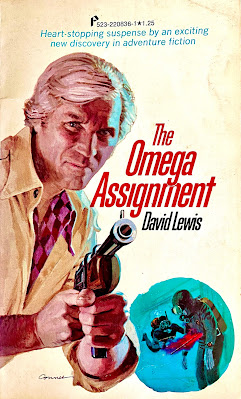
Steve Savage #02 - The Omega Assignment

David Lewis, real name Patton D. Lewis, authored a two book series of spy novels for Pinnacle in 1976. In my research, I couldn't locate anything about Lewis other than a lot of Google hits on the western writer Lewis B. Patten. The series stars part-time British Secret Intelligence Agent Steve Savage. The first novel is The Andromeda Assignment and the follow-up is The Omega Assignment. In working backwards, I'm reading and reviewing The Omega Assignment

Savage's origin tale, printed on the back of each novel, advises readers that he joined a freighter at the age of 14. He was later degraded by the Captain and beaten for six straight weeks. He managed to escape into Hong Kong and learned martial arts in exchange for cleaning a gym. He then returned to London and trained as a photographer. He has covered war and fighting throughout the world, including Vietnam, the Middle East and Belfast. His agent, Gregor de Freitas, operates as an SIS frontman after escaping the Soviet Union. Savage's capabilities to enter communist countries as a photographer allows him to work part-time as a secret agent under Freitas' guidance. Lewis warns readers that “This man is dangerous!”

In The Omega Assignment, a multi-millionaire German man named Braeder frequently entertains politicians and members of NATO on an ocean liner called Clytherea. On board, Braeder provides sadistic thrills that includes various types of sex, S&M, rape, and torture. Braeder “liberates” these sick leaders and allows them to engage in their wildest fantasies. But, he records all of this on video tape in an elaborate ruse. Here's how it works:

Braeder sinks Clytherea and uses the recorded tape as blackmail to obtain a small hydrogen bomb that fits into a suitcase. He then trades this bomb to Middle East fanatics for an extremely large supply of heroin. He then makes connections with the largest mafia families in America to become their chief supplier. With a surplus of heroin, he slowly begins to reduce the supply to the mob. To free up the supply chain, Braeder demands more money for the drug. Thus, Braeder begins raking in the dough and makes himself...king of the world?

While I don't know exactly what Braeder hopes to accomplish with all of his money, the narrative outlining all of this was a real pleasure to read. Savage becomes involved as an underwater photographer gaining footage exploring the sunken Clytherea. Lewis writes the underwater exploration portion so well. He thrusts the reader into these gloomy, dark hallways and rooms as Savage explores the ship. There are floating corpses and a plethora of art and jewels to photograph, but Savage is placed in peril when his diving partner is killed by a booby trap inside the ship.

Without ruining the fun, Savage teams up with an American female narcotics agent named Destiny, while assisting the CIA and British intelligence. The explosive narrative has Savage facing a variety of criminals on land, air and sea. Most of the plot develops in Cyprus and culminates in Destiny being captured and taken to Braeder's enormous beach-side fortress. Savage purposefully becomes captured in an effort to free her from the inside. He also teams up with an older Greek paramilitary unit known as EOKA for the finale. 

I felt that the first two acts of The Omega Assignment was a lot of fun and read like a B version of a Jack Higgins novel. The last act was really over the top with Savage forced to fight in the nude gladiator style against Braeder's “strong guy.” I thought that this final battle was more like a Richard Blade adventure complete with zany antics that made the conclusion a bit cartoonish. If you love action-packed adventure and espionage, then The Omega Assignment is an entertaining read. I liked it enough to search for the first book online. To my knowledge, these books have never been reprinted, but remain fairly affordable as used paperbacks.

Note: Thanks to Spy, Guys, and Gals for additional information about this series.