Tuesday, April 12, 2022

Race Williams #02 - Three Thousand to the Good

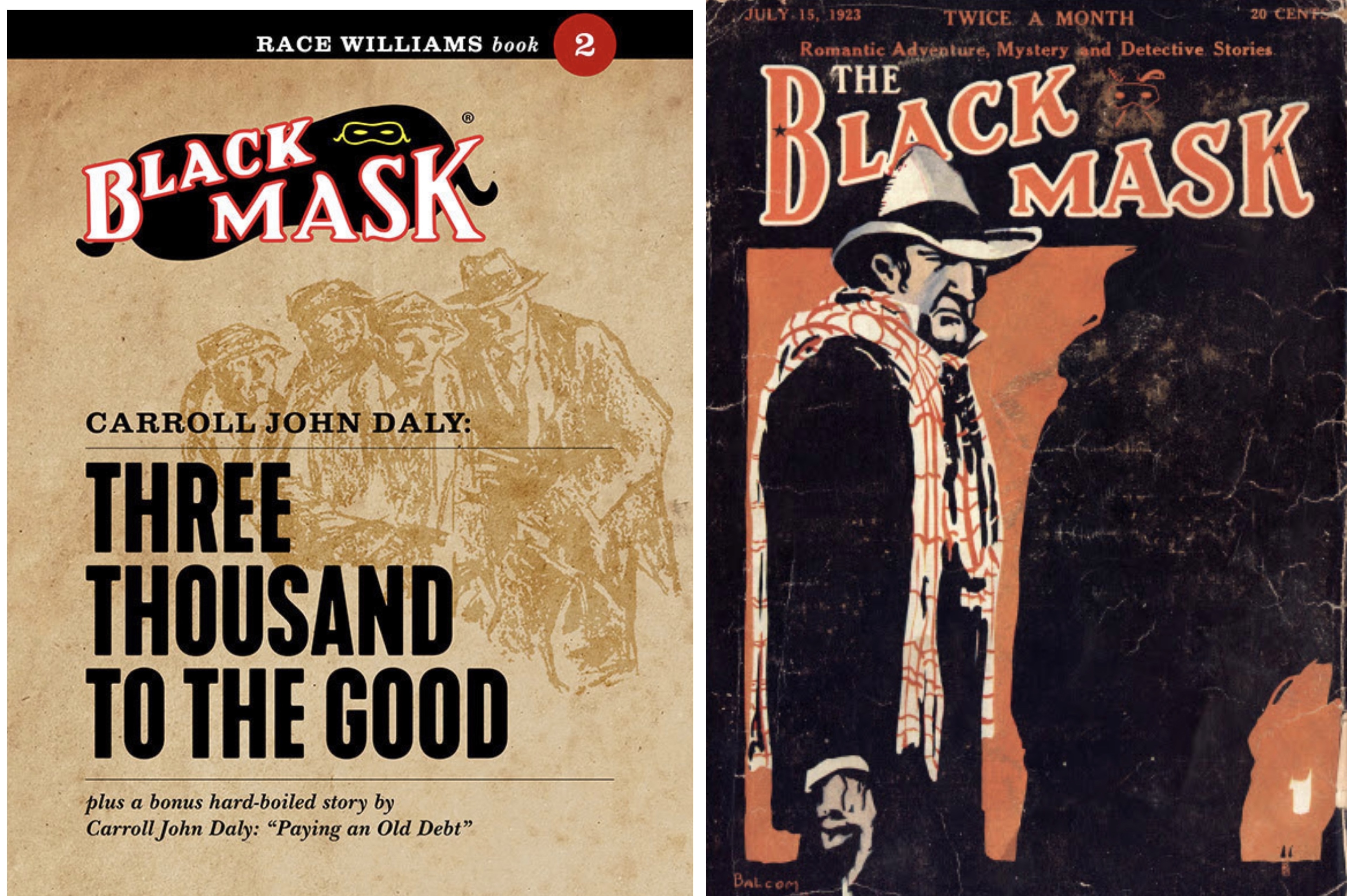
“Three Thousand to the Good” by Carroll John Daly is a 20-page short story that originally appeared in the July 15, 1923 issue of Black Mask magazine. It’s the second appearance of Private Detective Race Williams, the first hardboiled detective series character ever.

Our narrator Race Williams is ostensibly a private investigator, but he’s the first to admit that he’s really a “gentleman adventurer” who lends his services targeting criminals on behalf of paying clients. In this case, he is hired by a fellow named Abe who needs Race to be the bagman for a blackmail payment Abe owes some crooks in exchange for incriminating evidence in the possession of the blackmailers. Abe is no choirboy himself, and the activity that opened him up to blackmail in the first place underscores Race’s own operation in a morally grey area.

The blackmail payment is $10,000, and Race strikes a deal with Abe. If Race can come back with the incriminating evidence from the blackmailers and Abe’s $10,000, Race gets to keep $2,500. If Race fails, he gets nothing. Abe jumps at this opportunity for Race’s value-added services.

The story quickly shifts to Race’s attempt to double cross the blackmailers, and fans of tough-guy action find plenty to enjoy. Staging a double cross is one thing, but getting away with it is quite a different challenge. Race eventually gets to the bottom of the situation with a somewhat odd conclusion to the story.

In the world of good-and-bad Race Williams stories, this one was solidly satisfying and will please fans of Race and his imitator, Micky Spillane’s Mike Hammer. The story has been compiled elsewhere, but the cheapest option is a two-dollar ebook from Black Mask that also includes a bonus stand-alone story from Daly called “Paying an Old Debt.”

While we’re here, I’ll say that “Paying an Old Debt” was from an April 1923 issue of Black Mask - one month before Daly launched the Race Williams series. The narrator is a jailbird who cons his way into a butler job for the purpose of ripping off his host’s diamonds. It’s a great little story with an O. Henry styled ending. I thought it was a stronger story than the Race Williams one.

The Black Mask ebook containing the two stories is only two bucks and completely worth it. The stories have aged extremely well and stand as a monument to the very beginning of hardboiled crime fiction. 

Get the ebook HERE.

Monday, April 11, 2022

The Woman on the Roof

According to Wikipedia, Helen Nielsen (1918-2002) authored television scripts for classic mystery shows like Perry Mason and Alfred Hitchcock Presents. Before her writing career, she worked as a draftsman during WW2 and helped design aircraft like the B-36, XB-47, and P-80. She authored nearly 20 novels, including a series of detective novels starring District Attorney Simon Drake. Stark House Press has been reprinting some of Nielsen's stand-alone crime-fiction novels like The Woman on the Roof. It was originally published in 1956 by Dell and now remains as a reprint through Stark House Press's Black Gat Books imprint. 

Wilma Rathjen spent a considerable amount of time in a mental institution. There, she rehabilitated and learned new skills. Now, she lives in a rooftop apartment in Los Angeles and spends her spare time spying on her neighbors. The rent is completely paid by her wealthy brother Curtis, a prominent politician and lawmaker. Wilma still likes to keep busy, so she works at a nearby bakery designing birthday cakes. Thankfully, the author's final lines in Chapter One sets up the narrative.

From her rooftop view, Wilma discovered that her neighbor Ruby, a beautiful female dancer and entertainer, was lying in her bathtub dead. But, Wilma didn't want to risk being scolded by the police for snooping or reporting a dead body. She may have to return to the mental hospital where the food is bad and the staff is abusive. She can't do anything to jeopardize her comfy living arrangement. Wilma is still hiding the secret when her friend and neighbor Pop peers through Ruby's window and discovers her corpse. 

The authorities are called and the narrative then focuses on John Osgood, a 40 year veteran police sergeant and Frenchy Bartel, a homicide detective, as they attempt to find Ruby's killer. But, the tension escalates when another tenant is murdered and Wilma sees someone snooping around Ruby's empty apartment at night. The police, and readers, receive a surprise when someone walks into Ruby's apartment claiming to be her husband. Is he the killer, or is it a pesky photographer?

The Woman on the Roof didn't entertain me as much as I had hoped. I rarely strike out with Stark House Press, but I just felt the book was too long and didn't have enough to keep me occupied. It's written well and I enjoyed the characters, but Wilma left something to be desired. With her limited capabilities, I became bored with the events surrounding her. The mystery was engaging enough, and Ruby could have been sexy as Hell. But, she's a bloated corpse before the narrative even starts, so any sexy chemistry was completely voided. Osgood's role was interesting and he turned the story into a procedural investigation, although a dull one. 

Overall, this was my first sampling of Helen Nielsen's work and I'm intrigued enough to try another. Buy a copy of the book HERE.

Friday, April 8, 2022

Gold Bait

Colonel Corby spent years fighting in Korea and Vietnam before an injury ended his military career. After rehabbing at a local hospital, Corby cashed out and wanted a retirement somewhere cheap with lots of booze and sex. So, it's in Mexico that entrepreneur Max Haggard finally locates Corby, nestled between bottles of tequila and a beautiful senorita's legs. At the front door, Haggard explains that he has traveled from Korea just to find Corby. He ain't selling vacuum cleaners. What he has to offer is worth over $4 million smack-a-roos.

Haggard reminds Corby of a Korean battle at sea in which Corby, manning a small South Korean boat, managed a direct hit to sink a battleship. But, little did anyone know that the battleship held a metric ton of fun payable in small, shiny gold bricks. Those same bricks are now sitting on the seabed wherever Corby scored the hit. Haggard learned of the ship's fortune in Korea, but no one could locate any whereabouts of the sunken vessel. Only Corby can recall the coordinates After squinting at charts, Corby knows where to find it. But, he's keeping his 'ole kisser shut until they can put together a salvage job. 

Author Walter Sheldon, often writing as Walt Sheldon (once as Ellery Queen), made stacks of dimes writing pulps in the 30s and 40s. Like everyone looking for a better payday, he switched to paperback originals and dished out crime-noir, science-fiction, horror, and action-adventure novels. By the time he wrote Gold Bait, published in 1973 (Fawcett Gold Medal), he had the writing machine well-oiled. So, after consistent success, Sheldon presented Gold Bait in an experimental, different way. 

The first page of the book is a CIA memorandum from Mr. Fancy Pants to another Fancy Pants outlining Corby's possible recruitment into the organization. The memo says that the pages in the book are documents recovered from Corby, other people and agencies. The last page of the book is another CIA thingy suggesting that the documents were reviewed by enough peeps to make a final decision. The last line states that Corby is either eligible or ineligible for recruitment. I'm not telling you how it ends.

So, what are the pages inside? What do they contain? It's a conglomerate (that means buncha) of diary entries from Corby and that blonde bombshell that's on the front cover as well as letters and police reports that tell the tale of this foursome attempting to recover the sunken gold while being watched by the pesky military. Mostly, it all works out and makes this a real cool read, but I wondered how these guys had the time to write diary entries while dodging bullets, assassins, criminals, and scoundrels? 

I'm sure you just gawked at the cover and spent your $5 because it is a Robert McGinnis painting and you're a filthy savage, but if you want to open it up and read the words, I think you may get hooked on Gold Bait. I sense it could have been a series of books starring this Corby fellow blowing up people and places while pulling down panties. But, I don't think a sequel even happened and that's a real bummer. Anyhoo, Gold Bait is recommended. 

Buy a copy of this book HERE

Thursday, April 7, 2022

Cage of Ice

Duncan Kyle is the name printed on a number of 1970s and 1980s high-adventure novels. In reality, this is John Franklin Broxholme (1930-2000) using Kyle as a pseudonym. I really enjoyed my first sampling of the author's work, the action-packed 1976 novel In Deep (aka Whiteout!). I wanted to try another, so I randomly chose Cage of Ice from my bookshelf. It was the author's first published novel, originally appearing in hardcover in 1970 (Harper Collins) and later reprinted numerous times in paperback. Pictured is my 1987 Fontana edition, which has the best cover -  in my opinion - of the reprints I've seen.

In Cage of Ice, protagonist Dr. John Edwards is a British surgeon and teacher residing in New York. In a unique plot set-up, Edwards receives an envelope addressed to Professor John Edwards, which isn't him. Once he receives the envelope, he is nearly killed on the highway by a motorist and his apartment is ransacked and the doorman assaulted. Whatever was in the envelope is then stolen by these mysterious men. Edwards, desperate to learn why he has been targeted by killers, tracks down the envelope's origin and discovers it was supposed to go to Professor Ed Ward....not John Edwards. Get it? 

Edwards finds Professor Ward's residence, but when he arrives, he finds the man murdered. After surviving another round of killers, Edwards is then arrested on suspicion of murder and bailed out of jail by the CIA, who then safely ushers him to their headquarters in Washington D.C. What the heck is happening in this high-adventure-missing-high-adventure narrative? 

Here's what amounts to be the most absurd plot I've discovered yet in a men's action-adventure novel:

The Soviets need more shipping alternatives and routes to contend with the West. To do this, they need sea ports on their northern coastline. But, the area remains frozen nearly year round, so the region is mostly useless. The Soviet Union needs the sea level to rise so they can build a giant dam to allow warmer water onto their coasts while also funneling cold water to Japan, annihilating that country's climate (along with submerging most of Northern America's coastline). To force sea levels to rise, they need the Arctic Ice Caps to melt. Anyone knows that the sunlight bounces off the gleaming white snow and ice, thus it stays frozen. But, the Russians create a carbon that they can release from aircraft that turns the Ice Caps the color of dark ash. Now, the sun can become the Soviet Union's ally by melting the ice and raising the sea level. It is so ridiculous, yet somehow remarkably brilliant! 

A Russian scientist has created this whole process, but he wants out of the Soviet Union so he can spill his secrets to the U.S. and avoid a global catastrophe. But, the U.S. already knows the secrets based on correspondence this Russian scientist had with Professor Ward, who has been killed by Soviet assassins already. The Russian scientist is being held at a secret facility in a frozen wasteland off of Russia's northern coast. The CIA then recruits operatives from Japan, Scotland, England, and the U.S. to make the impossible journey, through the ice and snow, to retrieve the scientist (for some reason). But, because Edwards is a doctor, he's recruited as well because most British surgeons know how to climb icy mountains, navigate specialized snow vehicles, shoot straight, and survive under Earth's harshest elements. 

As insane as all of this sounds, Cage of Ice is a fantastic adventure if you just dismiss the destination and enjoy the ride. Duncan Kyle is writing to entertain readers and this is just pure popcorn fun. The author creates dramatic, harrowing situations for this team to endure and overcome. The survival elements are there, but they don't consume the action. Instead, it is endurance, skiing, breaking into the installation, catastrophe, and creating a backup plan on the run that keeps the pages turning. The book's finale has an awesome firefight with helicopters and a nearly apocalyptic showdown with a nuclear submarine.

If you suspend disbelief to concentrate on the overall action and adventure, then Cage of Ice is an absolute winner. It's similar to the greats like Hammond Innes and Alistair MacLean in terms of the faster pace and death-defying sequences. It's just tissue thin on plot, so your mileage may vary. I recommend it, and I rarely steer you wrong. 

Buy a copy of this book HERE

Wednesday, April 6, 2022

Paperback Warrior Primer - Jack Pearl

The first thing to know about Jack Pearl is that the name is a pseudonym of Jacques Bain Pearl. Pearl was born in Richmond Hill, New York in 1923. After obtaining his Master's at Columbia, Pearl spent nearly three years in the U.S. Army's Military Police throughout Africa, Sicily and Italy during World War 2

After the war, Pearl began a short career as an engineer, but quickly his goal of becoming a full-time writer took control of his life. In 1952, Pearl was able to get his feet wet by writing for a short-lived crime-drama television show called Gang Busters. He also began contributing short stories to the Men's Adventure Magazines. His earliest short story may have been "Submerge!", published by Saga in September 1953. He would go on to contribute short stories to Man, Climax, Impact and Boys Life. After a stint as an advertising copywriter, Pearl worked his way into a managing editor role at Saga and Climax

In 1961, Pearl began writing military non-fiction novels. The first was simply called General Douglas MacArthur, a life story of the man published by Monarch, which was followed by Blood-and-Guts, a life story of General Patton also published by Monarch. These two books instantly became hot sellers and Pearl was off to the races as a full-time novelist. A year later he wrote another one about Navy legend Admiral Bull Halsey and Famous Aerial Dogfights of World War 2.

The earliest work I've read by Pearl is his 1962 movie novelization Ambush Bay. This was a film released by United Artists and Pearl mostly sticks to the film's screenplay but has a few variations. I read the novel and it's set during World War 2 in the Philippines. Nine battle-scarred U.S. Marines and an Air Force radio man are attempting to penetrate a Japanese occupied region to rescue a U.S. Intelligence officer. I really liked it a lot and reviewed the novel HERE.

Pearl wrote a young adult, air force cadet series called The Young Falcons in 1962. The first was The Young Falcons, the second was Bruce Larkin – Air Force Cadet

In 1963, Pearl was still writing for magazines like Saga. In fact, Pearl started dabbling in Cryptozoology with some of his stories. 1964 proved to be a very productive year for the author. He wrote a non-fiction book called Battleground World War 1 as well as the movie novelization for Robin and the 7 Hoods. This was an all-star film showcasing Frank Sinatra, Dean Martin, Sammy Davis Jr., and Bing Crosby. That same year, Pearl rose to prominence with his book about historical assassinations called The Dangerous Assassins. In 1965, he also authored the movie novelizations for The Yellow Rolls-Royce and Our Man Flint, as well as a prison novel called Stockade, which was published by Pocket Books. 

One of Pearl's most popular novels was published in 1966. It was called The Crucifixion of Pete McCabe and it is about a man convicted of rape and murder that must prove his innocence. In 1967, Pearl authored a television tie in novel to the sci-fi TV series The Invaders called Dam of Death. That same year he also authored the first of a two book series of young adult science fiction called Space Eagle, which is loosely based on the Lone Ranger concept. Also in 1967, Pearl authored two books as television tie-in novels to the show Garrison's Guerillas. One was a young adult novel called Garrison's Guerillas and the Fear Formula. The other was simply titled Garrison's Guerillas, a paperback published by Dell that serves as a traditional WW2 men's action-adventure novel. I read and reviewed the book HERE.

In 1968, Pearl authored the movie novelization of Funny Girl. By the 1970s, Jack Pearl started to author books in a gritty, more violent tone that fits snugly with men's action-adventure of the time. This era of his writing begins with 1971's A Time to Kill, A Time to Die. It's about a reunion of old friends from World War 2 at an Aspen Ski Lodge. But within a half-hour, five are fatally shot by a sniper and it's up to the local police and a psychiatrist to close in on the killer and learn his/her motives. His 1973 book Victims is about a terrorist bombing attempt in New York City on Christmas Eve. 

Pearl wrote The Plot to Kill the President in 1972 and it was published by Pinnacle. This is a book that was inspired by the Kennedy Assassination. Pearl continued doing television and movie novelizations in the 1970s with a book called Nancy, a mob-themed one called Lepke. He also started tinkering with romance novels in the 1970s with books like Callie Knight.

Real life Newark Detective David Toma co-authored a handful of novels with Pearl based on his career in law enforcement. The first was co-written with Michael Brett (the same one that wrote Diecast) and two were written with Jack Pearl – The Affair of the Unhappy Hooker and also The Airport Affair

From 1977 through the late 1980s, Pearl teamed up with his cousin Donald Bain (author of the Murder, She Wrote series) to write mass-market romance novels under the name Stephanie Blake. This is what Pearl finished his career doing. He would pass away in Nassau County, New York in 1992. 

You can check out our Jack Pearl page HERE as well as listen to our podcast episode about the author HERE.

Tuesday, April 5, 2022

X-Files - Goblins

I'm an X-Files fan, one of those weird X-Phile nuts. To prove it, I have an old trunk filled with show toys, coffee mugs, calendars, books, action-figures, autographs, and various magazines like TV Guide. I even have VHS recordings of various episodes as they originally aired on Friday nights. I've read the graphic novels, fan-fiction, and some of the books. I've had Goblins for a long time and recently decided to listen to the audio version while earning my keep performing honey do chores. It was originally published in paperback by Harper in 1994 and authored by Charles Grant, a prolific writer that specialized in horror.

In a small town in Louisiana, two retired U.S. Military officers are slashed to death. However, eyewitnesses claim a hand came from out of nowhere, as if it was nearly invisible when making the killing stroke. One of the men was to marry the cousin of a sportswriter that Mulder knows. The sportswriter comes to Mulder with the murder mystery, but he's already on it. The F.B.I. has already been called to perform the investigation quietly, thus Scully and Mulder are brought up from the basement to handle what may, or may not be, a legitimate X-Files case.

The problem that the F.B.I. agents face (and readers for that matter), is that there are too many cooks in the kitchen. Grant doesn't leave well enough alone and partners two rookie agents to accompany Scully and Mulder on the case. Thus, there's multiple investigations with different pairings of the agents. Also, the sportswriter comes to town as well to conduct his own investigation, which just complicates the narrative more.

I'm not sure if Grant had actually watched an X-Files episode when he was hired to write this sort of television tie-in literature. Mulder's characterization is off, behaving in ways that doesn't really match his television persona. In this book, Mulder isn't as sarcastic with his responses or as serious as the TV character, and does the investigation in ways that has no real purpose or flow. I also didn't sense any of the guilt ridden emotion that wrecks Mulder on screen, although Grant does include a flashback scene of Samantha disappearing (Mulder's sister and major series story arc). He's also overly happy about things beyond the paranormal, which is unusual. The idea is that Mulder only becomes enthusiastic when researching X-Files-type cases. 

My main issue with Goblins is that it's just boring. Nothing really happens, the agents spin their wheels, and I figured out the whole “goblin” mystery in the book's first few chapters. The bumpy narrative was a struggle to get through and I was left thoroughly disappointed that I've hung on to this paperback for nearly 30 years only to find out it isn't very good. 

There are numerous paperbacks available, including a couple that retcon Scully and Mulder's teen years. I'll continue reading X-Files related stories and books, but there's no reason for you to read Goblins

Get the ebook HERE.

Monday, April 4, 2022

Hugh North 18 - Two Tickets for Tangier

Francis Van Wyck Mason (1901-1978) was a renowned international traveler and author with 78 books to his credit. He began his career writing stories for the pulps where he developed his signature character, U.S. Army Intelligence Colonel Hugh North (7 stories, 25 novels) in 1930. The stories began as mysteries, but shifted into spy adventures with the advent of paperback original novels. My first taste was the character’s 18th novel, Two Tickets for Tangier, from 1955. 

North, who works for a U.S. spy agency called G-2, is on vacation in London romancing a sexy babe named Lady Angela Forester. He’s known Angela for awhile, but he’s not initially aware that she’s a British MI-2 spy. Their romantic time together is cut short when North is summoned into his boss’ office in London, and Angela has to fly to Tangier for something or other. 

Don’t be embarrassed if you know nothing about Tangier. I’m here for you. It’s a port city located in Morocco on the northern coast of Africa — across from the Strait of Gibraltar from the southern tip of Spain. In 1955, Tangier was still an international city largely operating independently as a free trade zone beyond the control of much oversight from Morocco. As a result, Tangier was a multi-cultural, freewheeling city — an “anything goes” kinda place. 

As luck would have it — the paperback’s title gives it away — North’s new assignment is also to Tangier. The mission involves a gas called Thulium-X that creates intense cold temperatures similar to those of outer space. The gas was perfected by a former Nazi scientist named Dr. Vogel, who had been enslaved by the Ruskies since 1945. Somehow the scientist escaped and is hiding in Tangier. North needs to find him and buy the formula before the Soviets can make the grab. 

The plotting in Two Tickets to Tangier was good, but not remarkable. The writing, however, was a slog. The author went to such pains to portray North as a debonair man of the world that he really came off as a foppish snob. He peppers his language with French phrases and seems like the last guy I’d ever send into a critical mission. Painstaking descriptions of locations abound and offhand references to obscure characters from previous novels litter every scene. 

I was really optimistic about this series, but this first foray into the world of The Man From G-2 really left me cold. If there’s a good installment in this series, please hit me up. I assure you that Two Tickets to Tangier isn’t the one. 

Buy a copy of this book HERE