Monday, May 2, 2022

All the Way

Charles Williams (1909-1975) was the best American author of 20th century crime-noir fiction that most Americans have never encountered. Thanks to some smart reprint publishers, his work is being introduced to a new generation of readers looking for propulsive plotting and gritty, vivid characterizations. All the Way was a 1958 paperback also released under the title The Concrete Flamingo that has been reprinted by Stark House.

The narrator is a drifter named Jerry Forbes, who’s in Key West, Florida when he spots a sexy dame on the beach giving him the eye. Her name is Marian Forsyth, and she’s a secretary in a small Louisiana town. From the moment they meet, Jerry knows that Marian has a hidden agenda. Even the sex between them feels transactional. For those who read a lot of these types of books, this dame has femme fatale written all over her. 

After getting to know one another a bit, Marian proposes an idea to Jerry. She needs Jerry to impersonate her boss to move money from a stock account into their hands as a prelude to murdering the boss. Marian used to be his mistress, and he failed to marry her. Hell hath no fury and all that. 

As usual, Williams’ writing is head-and-shoulders better than his contemporaries. The monologues he wrote for Marian explaining the humiliation she suffered at the hands of her boss are staggering. The book is a bit of a slow burn, but Williams keeps the emotions running high, so the reader understands the narrator’s anxious longing for this woman bent on destroying another man. 

All the Way is basically the story of a complex and dicey long con. It’s an inventive paperback, but you need to be patient with the novel’s sluggish pace. This elaborate identity theft scheme doesn’t unfold with breakneck action. This culminates in one of the most bleak and tragic conclusions I can remember reading in ages. 

All the Way was compelling and interesting, but I don’t think it’s top-shelf Charles Williams. It would have been more impactful as a 50-page novella in Manhunt Magazine. If you’re working your way through Williams’ entire body of work, you’ll probably enjoy the novel just fine, but don’t make this your first stop. 

Buy a copy of the book HERE.

Friday, April 29, 2022

Chief Inspector Andreas Kaldis #01 - Murder in Mykonos

Jeffrey Siger is a Pittsburgh native who fell in love with Greece and has written 11 contemporary police procedural novels starring an Athens cop reassigned to the tourist island of Mykonos. The first installment is titled Murder In Mykonos, and it was originally published in 2011.  The Greeks have gone bonkers for this series despite being written by an American who is only a part-timer in the ancient nation, so I wanted to see what the fuss is all about. 

Mykonos is a Greek island in the Aegean Sea 90 miles from Athens. During the months of July and August, the population explodes from about 10,000 to over 50,000 as European tourists descend on the vacation island thick with 16th century windmills, dance clubs, and white-sand beaches matching the sun-baked white buildings. This is the island that our hero, Chief Inspector Andreas Kaldis now calls home. He was an ass-kicking hardboiled cop in Athens who was transferred to sleepy Mykanos after the wealthy residents of the island demanded better, more aggressive policing. 

Early in his new island job as Police Chief, a murdered body of a missing tourist girl is found hidden in an abandoned church. Further investigation shows that the murder may be connected to an earlier homicide, making Andreas come to the preliminary conclusion that there is a serial killer operating on this island paradise — a fact that would be devastating to the tourist-based local economy. Even worse, the murders seemed to be ritual killings of some sort. 

Mykonos makes its money from tourism and the island’s leaders doesn’t want anything to upset the visitor trade. As such, there’s a tendency to sweep bad news under the rug. If someone reports a missing foreign woman in Mykonos, the police instinct is to assume she left willingly and no missing-person report is filed. This poses a real challenge to Andreas as he’s trying to get his hands around the number of missing girls who may have been victimized by this hypothetical serial killer. 

Anyone with an interest in serial killer police procedural mysteries or life in the Greek Islands is sure to be pleased with Murder in Mykonos. The fact that it was written by an American was helpful because he took the time to explain things to readers unfamiliar with Greek culture or the unusual setting. No punches are pulled in thoughtful critiques of the island, its residents, and the underlying political climate. 

If you like crime fiction set in exotic locales, this novel is for you. Siger knows his way around the structure of a good mystery novel, and his characters are vivid and fully-realized. I look forward to the next Andreas Kaldis novel. Recommended. 

Buy a copy of this book HERE.

Thursday, April 28, 2022

James Bond #03 - Moonraker

James Bond's third series installment, Moonraker, was first published in the U.K. as a hardcover by Cape on April 5, 1955. Macmillan published the U.S. edition on September 20, 1955, followed by Pan Books publishing a paperback edition in the U.K. a month later. In December of 1955, Permabooks published a paperback version in the U.S. under the title Too Hot to Handle. In 1979, the book's title was used for the eleventh James Bond film and the fourth appearance of Roger Moore as the Secret Service hero and heartthrob. The film's production company, Eon Productions, authorized Christopher Wood to write a novelization of the film, which was published under the title James Bond and Moonraker (a bestseller that I've heard is quite terrible). 

In Moonraker, Fleming begins by providing a more intimate look at Bond's day-to-day activities. Readers gain a peek into his home, his routines, and his official desk assignments when he isn't globetrotting to extinguish international fires. It's shown that Bond is having affairs with three married women, works a desk schedule of 10 to 6, and likes to play cards in the evenings with friends. 

Fleming reveals that Bond uses a stimulant known as Benzedrine to stay awake and alert, and even combines the amphetamine with champagne. It was also,interesting to watch his habit of sprinkling black pepper on the surface of vodka. 

It is all of these things that further connected me to the character. I also found it fascinating that Bond was contemplating how many more assignments he has to complete before he can retire. He even fathoms how many will introduce the real possibility of his own death. It was written in such a poignant way that made me sympathize with him. Personally, I felt that his characteristics from Casino Royale were further enhanced by this novel. The idea that he wants to move on and have a normal existence is re-visited at the beginning and ending of Moonraker, leaving an emotional impact on readers.

Down to business, M approaches Bond about a personal favor, sort of an “off the record” assignment. He wants Bond to join him at an exclusive gentleman's club called Blades to play poker with a wealthy entrepreneur named Hugo Drax. M suspects Drax is cheating, but wants Bond to discover his method. This segment of the novel includes intense rounds of bridge as Bond verifies Drax's cheating and beats him with a stacked deck of cards, winning seven times his annual salary. All of this is important because the narrative focuses on Bond and Drax's working relationship later.

Bond's official assignment comes to fruition when a Ministry of Supply security officer is fatally shot in a facility housing England's first nuclear missile. This missile has been created by Drax's company and is to take flight as a demo version for England and foreign powers. Bond is assigned as the security officer's replacement in an effort to determine what's going on. I found his investigation hard-boiled and edgy, culminating in a high-speed chase between Bond and Drax's crew from the town of Deal to London. Of course, it wouldn't be a Bond novel without the inclusion of a beautiful co-worker named Brand. 

Moonraker is rather unique due to its settings. The entire novel takes place in and around London, with a focus on atmosphere as Bond is centralized on the sprawling White Cliffs of Dover, the countryside, and the battering of the North Sea and the English Channel. There's a sense of isolation as Bond gazes at the ocean at night, listening for the ship's foghorns and spotting a beacon. I felt that this, combined with Bond's lonely position in the book's last pages, added a sense of solitude to the story. 

Drax's backstory of his rise to criminality, war atrocities, and his fevered attempts to destroy London paired nicely with Bond's “do or die” mission. There's violence, sexiness, thrills, car chases, shootouts, and the pesky Russians to keep the pages moving at a brisk pace. The storytelling improved drastically from the rather average prior installment, Live and Let Die. While that book was action-packed, it came  across a bit campy when compared to the series debut in Casino Royale. Ian Fleming is all business in Moonraker, making it a fan favorite among James Bond fans. Recommended! 

Get the book HERE.

Wednesday, April 27, 2022

Earl Drake #06 - Operation Drumfire

After the success of The Name of the Game is Death (1962) and One Endless Hour (1969), crime-noir author Dan J. Marlowe found his heist hero in protagonist Earl Drake, the “man with nobody's face.” The Earl Drake series, for lack of a better name, includes 12 total novels, all published by Fawcett Gold Medal between 1962 and 1976. We've covered the first five novels right here at Paperback Warrior and continue our coverage with this sixth installment, Operation Drumfire, published in 1972.

In Operation Drumfire, readers become fairly familiar with Earl Drake's backstory. He was a professional bank robber who now works occasional assignments for a special agent named Erikson. It is never explained who Erikson works for beyond hinting at a sub rosa agency deep within Washington D.C. Drake's lover is a tenacious former barkeep named Hazel, who has a talent for gambling on horses and the skills to pilot the couple's airplane. She's also a sexy cowgirl that owns a sprawling ranch built from the fortunes of her former husband. Beginning in the series fifth installment, Operation Breakthrough, the duo is joined by an eccentric martial arts expert named Candy and his Chinese girlfriend Chen Yi.

In this book's opening chapters, Erikson visits Drake and Hazel to show them a video of a bank heist at a horse-racing track. Erikson's agency feels that a think-tank defense contractor called the Institute of Defense Analysis (IDA) may be behind it. The idea is that mathematicians inside the agency put together an elaborate plan to knock off the track. Now, due to Erikson's involvement in a meeting between senior leaders in Mexico and the US, he's touching shoulders with IDA. His growing suspicions of their abilities may lead to chaos with the meeting. He wants Drake and Hazel to infiltrate the agency by going undercover as mathematicians inside their headquarters. 

Honestly, I have no idea what is happening in this book. None of it makes any sense to me. Normally, I can stay fairly entrenched with whatever Marlowe is springing, but I'm not even sure he knew what was going on. It's like a chain of events including a Black Panthers type of military presence in Oakland that Candy must deal with. Then, Drake has to fake his math skills inside the agency while Hazel gains clues for something or another. There's an explosion somewhere and a firefight at the end. It was like Marlowe had individual events he wanted to schedule in the narrative, but had no logical way to connect them. 

But, it isn't all completely lost. Drake changes his old snub-nosed .38 revolver for an automatic .9mm. I felt this was a major change for the character, like a promotion into the big leagues. Also, one of the four main characters is killed off in this installment. Shamefully, I felt good about that. Other than those positives, Operation Drumfire is more like Operation Dumpsterfire. 

Buy a copy of this book HERE

Tuesday, April 26, 2022

Elin Warner #01 - The Sanatorium

According to Penguin Random House, Sarah Pearse grew up in Devon, UK and studied creative writing and English at the University of Warwick. Her debut book, The Sanatorium, was published in 2021 and became a Sunday Times and New York Times bestseller. Apparently, actress Reese Witherspoon knows a thing or two about books, and has a Book Club in which she selected The Sanatorium as a featured novel. Witherspoon is irrelevant to me, but I'm a sucker for locked room mysteries and this one looked appealing on Target's bookshelf. 

The Sanatorium introduces readers to British Detective Elin Warner, a character that Pearse is also featuring in the 2022 sequel The Retreat. Elin has been a successful, veteran detective for years, but after a particularly gruesome investigation, she's taking a sabbatical. What better place to rekindle energy than a formerly abandoned mental hospital in the Swiss Alps that has been lavishly restructured into a posh hotel? With a raging winter storm outside and the roads cut off, Elin and her husband discover that a killer is on the loose in the hotel, knocking off the trapped guests one by one as some sort of revenge tactic. 

There's so much to like about the story – great main character, multiple murder investigations, an intriguing backstory, excellent atmosphere and location – but it just fails to be overly stimulating. It's nearly 400 pages, which has become the mandatory publishing requirement for thrillers, and that's an eternity for readers to become trapped in this cavernous hotel with dull and uninspiring guests. By page 300, I no longer cared to learn the killer's identity or to even suspect who's next on the chopping block. I had lost interest completely.

If you love modern thrillers that heavily rely on lengthy dialogue to devour a high page-count, then The Sanatorium is awaiting your stay. 

Get the book HERE.

Monday, April 25, 2022

The Make-Believe Man

Elizabeth Jane Phillips (1916-1996) authored nearly 20 stand-alone novels over the course of thirty years. Often, she adopted the pseudonym E.P. Fenwick or used Elizabeth Fenwick to write her crime-fiction and suspense books, Her 1963 suspense novel The Make-Believe Man was nominated for an Edgar Award by The Mystery Writers of America. It was originally published in hardcover by Harper & Row, then published again by Avon in a paperback edition. Thankfully, Stark House Press has recently reprinted some of Fenwick's novels including The Make-Believe Man. It is in a 2022 twofer with the author's A Friend of Mary Rose (1961) and a wonderful, informative introduction by Curtis Evans.

Norma is a single mother and widow living temporarily in Detroit with her mother, Ms. Moore. In the book's opening pages, Ms. Moore, is leaving town for a few days to visit Norma's brother. She provides adequate instructions on what to do in her absence and the conversation brings up a former tenant that Ms. Moore once had at the house. His name was Cliff and he was a fine renter that was asked to leave to make room for Norma and her son Jimmy months ago.

In Ms. Moore's absence, Norma is enjoying the house and her clerical job at work. Jimmy is fond of the elderly neighbors and often goes there after school. But, one night Cliff shows up at Norma's front door asking to come inside. Cliff is really peculiar, has a black eye, and explains to Norma that he just needs a few days to rest and then he'll be moving on to another town and job. Norma says no and is genuinely creeped out by Cliff's odd behavior. Cliff finally leaves, but when Norma checks the mantle, the extra key to the home's front door is now missing. 

Norma has the locks changed, but the suspense begins to build as Cliff makes a stop at Norma's work to ask about her whereabouts. Then, he calls her on the phone and suggests that Ms. Moore is really his mother too. But, she isn't, he's just psychotic. He becomes a raging lunatic when he learns his key no longer opens the front door. From there, The Make-Believe Man transcends into some really scary happenings. 

According to my research, Fenwick really loved these “domestic menace” types of stories and it is clear she perfected it based on the quality of The Make-Believe Man. Cliff is a scary individual, made downright terrifying when readers learn about his turbulent past. I enjoyed Norma's strength, not only as a mother, but as a widow and fighter. There's a sense of intrigue when a detective begins an investigation to find Cliff. Fenwick also sprinkles in an admirable character named Benning as Norma's potential love interest and co-worker. The three characters collaborate well and I enjoyed the police procedural styling of the book's second half.

Overall, there's nothing to dislike about Fenwick's writing style or this book. Stark House Press has made a wise choice in reprinting this lost classic. It's a tightrope of suspense, scares, and action that culminates in a harrowing, unforgettable ending. In other words, you should read it right now. 

Get the book HERE.

Friday, April 22, 2022

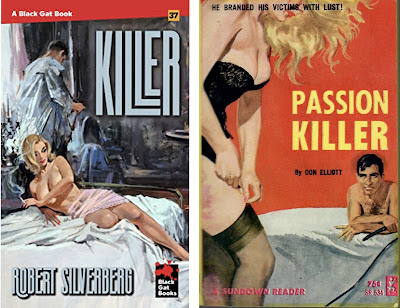
Killer

Before he was science-fiction royalty, Robert Silverberg was a cranking out cheap genre paperbacks to make ends meet. His output included sleaze novels like 1965’s Passion Killer — originally released under the pseudonym of Don Elliott when the author was 29. After discovering that the book is actually a tidy bit of crime noir fiction, Stark House Press imprint Black Gat books has re-released the paperback under the name Killer.

Lee Floyd has just arrived in Manhattan after being hired to kill Howard Gorman’s wife, Ethyl. You see, Howard has recently met a girl named Marie and has decided to upgrade. As such, he needs Hitman Lee’s help in disposing of this Ethyl situation.

For her part, Marie is happy to allow a wealthy sucker like Howard to cover her living expenses, but she finds her benefactor rather repugnant. Nevertheless, having one client paying her bills is easier than working full-time as a call girl. All things being equal, Marie enjoys lesbian sex and Silverberg pulls no 1965 punches in his erotic writing. This is definitely a sex book, and those graphic scenes comprise probably half the novel. You can decide if that’s good news or bad news.

There are some interesting crime noir manipulations and double-crosses among the sex scenes that made Killer a lot of fun to read. It’s not the top-tier hitman fiction we periodically receive from Max Allan Collins and Lawrence Block, but it’s light-years better than most 1960s sleaze fiction. Many authors aren’t proud of their output in this genre, but I’m glad Silverberg has made peace with his past because Killer is a winner. Not a masterpiece, but certainly worth your time. 

Get the book HERE