Friday, May 6, 2022

Sea Vengeance

British author Robert Leader (b. 1938) had worked as a Merchant Marine, bartender, and a factory worker before becoming a full-time novelist. He wrote over 200 short stories and sold them to magazines like Reveille, Titbits, London Evening News and London Mystery. He found success authoring a series of 10 espionage thrillers starring British agent Simon Larren. Collectively, British publisher Robert Hale published over 40 of his novels, most authored under his real name or pseudonyms like Robert Charles or Robert Brandon. Some were exported to the U.S. by Pinnacle. My first experience with the author is his 1974 novel Sea Vengeance. It was published in the U.S. by Pinnacle with a cover by Phil Marini.

The first few chapters of Sea Vengeance plays out like the exciting 1992 Steven Seagal action film Under Siege.  Chief Officer John Steele, a Korean War veteran, is working on board the Shantung as it departs embattled Saigon en route to peaceful Singapore. The large ship features eight cabins, each containing a diverse variety of passengers. Within a few hours, Steele and the crew discover that the group of Buddhist monks on board are actually Viet Cong hijackers. They kill a few of the Shantung crew and severely injure its Captain.  

With the ship under command of a Viet Cong leader named Thang, Steele works in stealth to capture weapons and free passengers. His betrayal comes from an unlikely suspect, a lover he has met on board named Lin Chi. Together, Chi, Thang, and the Viet Cong have plans to use the ship to rescue a number of their allies from a small prison camp off the coast of  battle-torn Vietnam.

At 182 pages, Sea Vengeance is brimming over with exciting danger and intrigue. Steele proves to be the capable hero – admirable, courageous, and willing to sacrifice his life for others. As a propulsive action yarn, the scenes with Steele secretly working “behind the enemy” to secure the ship was really engaging. With the author's vast experience on merchant ships, I found some of these scenes had a sense of realism. While Steele's struggles with the Viet Cong on the ship were effective, page turning events, I applaud the author's introspective commentary. 

The combatants in the Vietnam War are presented positively by the author, both condemnation and worthy appraisal provided through a philosophical look at war and its aftermath. This isn't a stretch from Leader's wheelhouse considering he has written a number of non-fiction books on religion, philosophy, and his travel experiences. He certainly has the credentials and education to provide thought-provoking dialogue between these volatile characters. I found that to be one of the biggest highlights. 

If you enjoy Vietnam military history, or love a great nautical or war story, then Sea Vengeance is highly recommended. I found it to be similar to Australian author James Edmond Macdonnell's series of World War 2 novels starring Captain Walt Kenyon. Just don't be surprised with some of the heavy dialogue sequences. While it doesn't bog the narrative down, it may slow the excitement for those of you looking for just head-on carnage. 

Buy a copy of this book HERE

Thursday, May 5, 2022

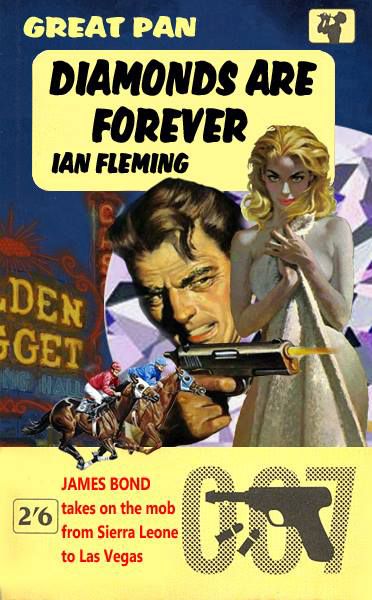
James Bond #04 - Diamonds Are Forever

Diamonds Are Forever is the fourth installment of Ian Fleming's wildly successful James Bond series of spy-thrillers. It was originally published by Jonathan Cape in the U.K. in 1956. The novel's central theme is diamond smuggling, a criminal operation that intrigued Fleming enough to not only use it as a plot, but also a non-fiction book he wrote in 1957, The Dimaond Smugglers. In 1971, the novel was adapted into the seventh James Bond film. 

In the book's opening chapters, Bond and his superior M engage in a deep discussion about the diamond industry. At the time, England was importing diamonds from Africa and then selling large amounts to various international companies and countries. It made up a large percentage of the country's income and represented what would ultimately be one of the largest diamond exporting operations. One of the largest buyers, House of Diamonds, has reduced their purchases of English diamonds, creating a financial gap in the Brits lucrative business. 

It's explained that House of Diamonds is a legitimate business owned and controlled by an American mob family named The Spangs. M, and the Special Branch, suspect that a criminal element has been introduced which is creating the rift. House of Diamonds surely must be obtaining their diamonds by smuggling them in at a cheaper price. M wants Bond to investigate the operation by infiltrating the smuggling ring into New York and Las Vegas under the disguise of a common burglar named Peter Franks. He wants Bond to engage in the job and then converse with a woman named Tiffany Case, one of the gang members involved in the smuggling.  

Bond's journey is quite epic, first beginning in New York to retrieve the smuggling money owed on the latest smuggle. His payer is a gang leader named Shady Tree. He explains that their operation doesn't just pay out the full payment for security reasons. To fulfill his payout to Bond, aka Peter Franks, he orchestrates a number of rigged gambling ventures that will produce fragmented payments. The first payout is an exciting stretch at a rigged horse race in Saratoga. Then, a rigged blackjack game in Las Vegas dealt by Tiffany. But, Bond flips the score and pays off the jockey to disrupt the payoff and then wins too much money at blackjack.

If I provide anything else pertaining to the story, it's going to provoke you to skip Ian Fleming and just read me. I'd never forgive myself. Here's the thing, read Diamonds Are Forever if you want to see Bond deeply entrenched in hardboiled danger. Fleming throws everything but the kitchen sink at readers: intrigue on a ship, danger in the desert, a train-car chase, torture, romance, and gunplay. The chemistry between Tiffany and Bond was perfect with both needing something from each other. Former American CIA agent Felix Leiter returns to this book and I found his addition to the story effective. My only real complaint is the “cowboy” appearance of one of the Spangs and the longer than necessary ending. Otherwise, Bond absolutely wins again. Recommended. 

Buy the book HERE.

Wednesday, May 4, 2022

The Freakshow

According to his Goodreads profile, Bryan Smith has authored more than thirty horror and crime novels and novellas. His crime-fiction book 68 Kill was adapted into a critically-acclaimed film in 2017. Smith also co-scripted an original Harley Quinn (Batman) story for DC Comics' House of Horrors anthology. I first discovered the author in the mid-2000s by reading his mass-market horror paperbacks like House of Blood and Deathbringer. His 2007 horror novel The Freakshow was originally published by Leisure and has now been reprinted by Grindhouse Press in multiple formats. 

The Freakshow is splatterpunk with the obligatory copious amounts of sex (mostly rape), gore, and violence prevalent over the science-fiction and dark fantasy elements. The novel's concept is that supernatural beings from a netherworld are playing a game where they control humans to do just about anything imaginable. These “things” are losing their home world, so they want ours. By conquering humans through assimilation, they can move from the netherworld into ours. 

These beings are sort of like Clive Barker's Cenobites from his novella The Hellbound Heart and the franchise of films. They have a variety of appearances and abilities and aren't necessarily good or evil, thus the “angels to some, demons to others” sentiment of Barker's stories is the theme of The Freakshow. Because of the variation, Smith's imagination runs wild. There's a two-headed succubus leader, a robotic clown, sexually depraved humans (if you can call them that), rolling heads that chomp flesh, you get the general consensus.

It's hard to find any characters to really cheer other than Heather, a young woman in an abusive relationship with her boyfriend and dealing with an ailing mother. She is the main character, but that's a loose term considering the book has a dozen or more characters. Mostly these characters are disposable and make for rape and torture targets. The story presents characters that are fighting the freakshow invaders or working for these supernatural beings. Mostly, the characters just dwell on perverse sex and creative ways to kill or maim each other. There's no respect for any higher authority beyond their own self-interest 

Overall, I found the book to be slightly better than average. With Smith's literary work, I manage my expectations, knowing that his narratives are saturated in over-the-top violence and gore. There's nothing wrong with that, but I normally like my horror to be more psychological than physical. If a unique, violent bloodbath is your thing, then The Freakshow will surely please you.

Note – Brian Keene's Urban Gothic and this book tie-in to a novel called Suburban Gothic, authored by both Keene and Smith. 

Buy a copy of the book HERE.

Tuesday, May 3, 2022

The Brat

The Brat, published in 1957 by Fawcett Gold Medal, was Gil Brewer's 12th career effort, a mid-era crime-noir that is misrepresented by the book's sultry cover. Fans of Brewer's sexier femme fatale novels, like The Vengeful Virgin (1958) or The Tease (1967) may be led to believe that The Brat possesses that same energy level. It includes all of the potent ingredients to make the narrative seemingly explode – wild women, lust, greed, criminality, and average men pushed from their suburban threshold into a world of madness. Like Orrie Hitt, Brewer loved this type of storytelling experience - the sexy seductress weaving a master-plan. But, The Brat doesn't utilize these ingredients to create anything magical. 

In this novel, Brewer mimics Day Keene's more simplistic approach. It makes sense considering the two were friends and even collaborated together. If I didn't know better, I would have pegged The Brat as a Keene novel. The narrative is saturated in genre tropes that are familiar to any seasoned crime-noir fan. The narrative's central element is identical to the “man awakens to find a corpse and flees from the law to prove his own innocence” concept. Only, Brewer exchanges the swanky apartment, soft bed, or suburban house with a bank.

Lee is a fairly wealthy guy before his trip into Florida swampland. It's in the sweltering jungle that he finds the sexy Evis, a backwoods tramp that he can't resist. Her family is redneck loonies, so Evis is rescued by Lee and soon the two ring the wedding bells. But, Evis’ domestication is ripe with greed and self-interest. She carves through Lee's savings, leaving the two almost destitute just a short time later. Evis, who conveniently works at the local bank, pitches Lee a heist plan. She can easily steal money from the bank's vault during her closing shift. Lee slightly agrees, but doesn't want to commit to steering into that lane yet.

Lee arrives from work one evening to find that Evis is working at the bank and she needs him to pick her up. When he arrives at the bank, there's a corpse, missing money, missing spouse, and enough evidence that suggests he collaborated with Evis to commit this criminal act. Terrified of being fried for murder, Lee hits the road to pursuit Evis. Along the way, he is tracked by a greedy sheriff that wants the money all to himself. There's also Lee's best friend that may have been Evis's side hustle to seduce into a joint heist. Lee must avoid the police, find Evis and the missing cash, and prove he is innocent. 

Brewer's novel  is one long road trip as Lee hops from destination to destination searching for clues. The pacing and plot structure never allows the narrative to breathe, making the characters one-dimensional and over-obsessive. This is Day Keene's wheelhouse and he excels at it far better than Brewer. The Brat is similar to Brewer's Sin for Me (1967) novel with its western feel and seemingly endless manhunt. If you must read everything Brewer has written, then you aren't skipping The Brat. Otherwise, there's no need to spend any time reading this less than satisfactory novel.

Buy a copy of this book HERE

Monday, May 2, 2022

All the Way

Charles Williams (1909-1975) was the best American author of 20th century crime-noir fiction that most Americans have never encountered. Thanks to some smart reprint publishers, his work is being introduced to a new generation of readers looking for propulsive plotting and gritty, vivid characterizations. All the Way was a 1958 paperback also released under the title The Concrete Flamingo that has been reprinted by Stark House.

The narrator is a drifter named Jerry Forbes, who’s in Key West, Florida when he spots a sexy dame on the beach giving him the eye. Her name is Marian Forsyth, and she’s a secretary in a small Louisiana town. From the moment they meet, Jerry knows that Marian has a hidden agenda. Even the sex between them feels transactional. For those who read a lot of these types of books, this dame has femme fatale written all over her. 

After getting to know one another a bit, Marian proposes an idea to Jerry. She needs Jerry to impersonate her boss to move money from a stock account into their hands as a prelude to murdering the boss. Marian used to be his mistress, and he failed to marry her. Hell hath no fury and all that. 

As usual, Williams’ writing is head-and-shoulders better than his contemporaries. The monologues he wrote for Marian explaining the humiliation she suffered at the hands of her boss are staggering. The book is a bit of a slow burn, but Williams keeps the emotions running high, so the reader understands the narrator’s anxious longing for this woman bent on destroying another man. 

All the Way is basically the story of a complex and dicey long con. It’s an inventive paperback, but you need to be patient with the novel’s sluggish pace. This elaborate identity theft scheme doesn’t unfold with breakneck action. This culminates in one of the most bleak and tragic conclusions I can remember reading in ages. 

All the Way was compelling and interesting, but I don’t think it’s top-shelf Charles Williams. It would have been more impactful as a 50-page novella in Manhunt Magazine. If you’re working your way through Williams’ entire body of work, you’ll probably enjoy the novel just fine, but don’t make this your first stop. 

Buy a copy of the book HERE.

Friday, April 29, 2022

Chief Inspector Andreas Kaldis #01 - Murder in Mykonos

Jeffrey Siger is a Pittsburgh native who fell in love with Greece and has written 11 contemporary police procedural novels starring an Athens cop reassigned to the tourist island of Mykonos. The first installment is titled Murder In Mykonos, and it was originally published in 2011.  The Greeks have gone bonkers for this series despite being written by an American who is only a part-timer in the ancient nation, so I wanted to see what the fuss is all about. 

Mykonos is a Greek island in the Aegean Sea 90 miles from Athens. During the months of July and August, the population explodes from about 10,000 to over 50,000 as European tourists descend on the vacation island thick with 16th century windmills, dance clubs, and white-sand beaches matching the sun-baked white buildings. This is the island that our hero, Chief Inspector Andreas Kaldis now calls home. He was an ass-kicking hardboiled cop in Athens who was transferred to sleepy Mykanos after the wealthy residents of the island demanded better, more aggressive policing. 

Early in his new island job as Police Chief, a murdered body of a missing tourist girl is found hidden in an abandoned church. Further investigation shows that the murder may be connected to an earlier homicide, making Andreas come to the preliminary conclusion that there is a serial killer operating on this island paradise — a fact that would be devastating to the tourist-based local economy. Even worse, the murders seemed to be ritual killings of some sort. 

Mykonos makes its money from tourism and the island’s leaders doesn’t want anything to upset the visitor trade. As such, there’s a tendency to sweep bad news under the rug. If someone reports a missing foreign woman in Mykonos, the police instinct is to assume she left willingly and no missing-person report is filed. This poses a real challenge to Andreas as he’s trying to get his hands around the number of missing girls who may have been victimized by this hypothetical serial killer. 

Anyone with an interest in serial killer police procedural mysteries or life in the Greek Islands is sure to be pleased with Murder in Mykonos. The fact that it was written by an American was helpful because he took the time to explain things to readers unfamiliar with Greek culture or the unusual setting. No punches are pulled in thoughtful critiques of the island, its residents, and the underlying political climate. 

If you like crime fiction set in exotic locales, this novel is for you. Siger knows his way around the structure of a good mystery novel, and his characters are vivid and fully-realized. I look forward to the next Andreas Kaldis novel. Recommended. 

Buy a copy of this book HERE.

Thursday, April 28, 2022

James Bond #03 - Moonraker

James Bond's third series installment, Moonraker, was first published in the U.K. as a hardcover by Cape on April 5, 1955. Macmillan published the U.S. edition on September 20, 1955, followed by Pan Books publishing a paperback edition in the U.K. a month later. In December of 1955, Permabooks published a paperback version in the U.S. under the title Too Hot to Handle. In 1979, the book's title was used for the eleventh James Bond film and the fourth appearance of Roger Moore as the Secret Service hero and heartthrob. The film's production company, Eon Productions, authorized Christopher Wood to write a novelization of the film, which was published under the title James Bond and Moonraker (a bestseller that I've heard is quite terrible). 

In Moonraker, Fleming begins by providing a more intimate look at Bond's day-to-day activities. Readers gain a peek into his home, his routines, and his official desk assignments when he isn't globetrotting to extinguish international fires. It's shown that Bond is having affairs with three married women, works a desk schedule of 10 to 6, and likes to play cards in the evenings with friends. 

Fleming reveals that Bond uses a stimulant known as Benzedrine to stay awake and alert, and even combines the amphetamine with champagne. It was also,interesting to watch his habit of sprinkling black pepper on the surface of vodka. 

It is all of these things that further connected me to the character. I also found it fascinating that Bond was contemplating how many more assignments he has to complete before he can retire. He even fathoms how many will introduce the real possibility of his own death. It was written in such a poignant way that made me sympathize with him. Personally, I felt that his characteristics from Casino Royale were further enhanced by this novel. The idea that he wants to move on and have a normal existence is re-visited at the beginning and ending of Moonraker, leaving an emotional impact on readers.

Down to business, M approaches Bond about a personal favor, sort of an “off the record” assignment. He wants Bond to join him at an exclusive gentleman's club called Blades to play poker with a wealthy entrepreneur named Hugo Drax. M suspects Drax is cheating, but wants Bond to discover his method. This segment of the novel includes intense rounds of bridge as Bond verifies Drax's cheating and beats him with a stacked deck of cards, winning seven times his annual salary. All of this is important because the narrative focuses on Bond and Drax's working relationship later.

Bond's official assignment comes to fruition when a Ministry of Supply security officer is fatally shot in a facility housing England's first nuclear missile. This missile has been created by Drax's company and is to take flight as a demo version for England and foreign powers. Bond is assigned as the security officer's replacement in an effort to determine what's going on. I found his investigation hard-boiled and edgy, culminating in a high-speed chase between Bond and Drax's crew from the town of Deal to London. Of course, it wouldn't be a Bond novel without the inclusion of a beautiful co-worker named Brand. 

Moonraker is rather unique due to its settings. The entire novel takes place in and around London, with a focus on atmosphere as Bond is centralized on the sprawling White Cliffs of Dover, the countryside, and the battering of the North Sea and the English Channel. There's a sense of isolation as Bond gazes at the ocean at night, listening for the ship's foghorns and spotting a beacon. I felt that this, combined with Bond's lonely position in the book's last pages, added a sense of solitude to the story. 

Drax's backstory of his rise to criminality, war atrocities, and his fevered attempts to destroy London paired nicely with Bond's “do or die” mission. There's violence, sexiness, thrills, car chases, shootouts, and the pesky Russians to keep the pages moving at a brisk pace. The storytelling improved drastically from the rather average prior installment, Live and Let Die. While that book was action-packed, it came  across a bit campy when compared to the series debut in Casino Royale. Ian Fleming is all business in Moonraker, making it a fan favorite among James Bond fans. Recommended! 

Get the book HERE.